
Lecture
the concept of Dunbar's number in the context of the social sciences. Robin Dunbar, an anthropologist and evolutionary psychologist, proposed the concept of "Dunbar's number" as a limit on the number of stable social relationships a person can maintain. He estimated this number at approximately 150, suggesting that this is the maximum number of individual relationships a person can maintain on a stable basis.
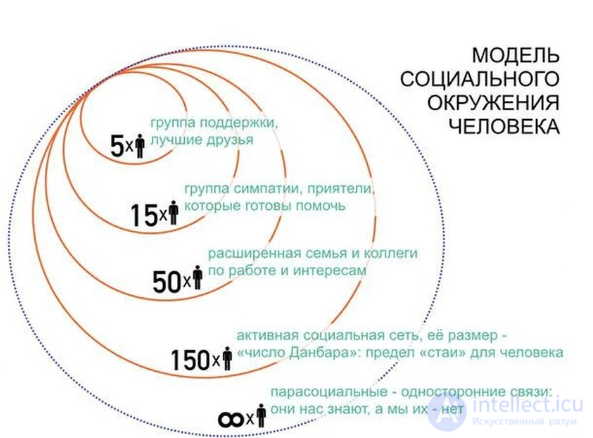
Dunbar's number is a suggested cognitive limit to the number of people with whom one can maintain stable social relationships — relationships in which a person knows who each person is and how each person relates to every other person.
This number was first proposed in the 1990s by the British anthropologist Robin Dunbar, who found a correlation between the brain size of primates and the average size of their social group. Using the average size of the human brain and extrapolating from primate results, he suggested that humans can comfortably maintain 150 stable relationships. There is some evidence that brain structure predicts the number of friends a person has, although the causal relationship has yet to be established.
Dunbar informally explained this principle as «the number of people you would not feel embarrassed about joining uninvited for a drink if you happened to run into them in a bar». Dunbar suggested that «this limit is a direct function of relative neocortex size, and that this in turn limits group size [...] the limit imposed by neocortical processing capacity is simply a function of the number of people with whom one can maintain stable interpersonal relationships». On the periphery, this number also includes former acquaintances, such as school friends whom a person would want to get to know again if they met once more. Proponents argue that larger groups generally require stricter rules, laws, and enforced norms to maintain a stable and cohesive group. A range of 100 to 250 has been proposed, with the value of 150 commonly used.
Primatologists note that, owing to their highly social nature, primates must maintain personal contact with other members of their social group, usually through social grooming. Such social groups function as protective cliques within the physical groups in which primates live. The number of members of a social group that a primate can keep track of appears to be limited by the volume of the neocortex. This suggests that there is a species-specific index of social group size, calculated from the average neocortex volume of the species.
In 1992, Dunbar used the correlation observed in primates to predict the size of human social groups. Using a regression equation for data on 38 primate genera, Dunbar predicted that the «average group size» for humans would be 148 (loosely rounded to 150), a result he considered exploratory given the large margin of error (95% confidence interval of 100 to 230).
Dunbar then compared this prediction with the observed sizes of human groups. Starting from the assumption that the current average size of the human neocortex evolved around 250,000 years ago, during the Pleistocene, Dunbar searched the anthropological and ethnographic literature for census-like information on group sizes for various hunter-gatherer societies, the closest existing approximations to how anthropology reconstructs Pleistocene societies. Dunbar noted that groups fall into three categories — small, medium, and large, equivalent to bands, clan-based groups, and tribes — with corresponding size ranges of 30–50, 100–200, and 500–2500 members each.
Dunbar's studies of village and tribal sizes also appear to have approached this predicted value, including 150 as the estimated size of a Neolithic farming village; 150 as the point at which Hutterite settlements tend to split; 200 as the upper limit on the number of scholars in a narrow academic specialty; and 150 as the base size of professional armies in Roman antiquity and in modern times since the 16th century, as well as the notion of an appropriately sized company.
Dunbar argued that 150 people would be the average group size only for communities with a very strong incentive to stay together. For a group of this size to remain cohesive, Dunbar suggested that up to 42% of the group's time would need to be devoted to social grooming. Accordingly, only groups under strong survival pressure, such as subsistence villages, nomadic tribes, and historical military groupings, averaged around the 150 mark. Moreover, Dunbar noted that such groups are almost always physically close together: «[...] we might expect the upper limit on group size to depend on the degree of social dispersal. In dispersed societies, people would meet less often and thus would be less familiar with one another, so group sizes should be smaller». Thus, a group of 150 would arise only out of absolute necessity – due to strong ecological and economic pressures.
Dunbar, in his book «Grooming, Gossip, and the Evolution of Language», suggests that language may have arisen as a «cheap» means of social grooming, allowing early humans to maintain social cohesion efficiently. Without language, Dunbar suggests, humans would have had to spend almost half their time on social grooming, which would have made productive joint efforts practically impossible. Language may have allowed societies to remain cohesive while reducing the need for physical and social proximity. This result is supported by a mathematical formulation of the social brain hypothesis, which showed that it is unlikely that increased brain size would have led to the formation of large groups without the kind of complex communication that only language makes possible.[11]
Dunbar's number has become a subject of interest in anthropology, evolutionary psychology, statistics, and business management. For example, developers of social software are interested in it, since they need to know the size of the social networks their software must accommodate; and in the modern military, operational psychologists look for such data to support or refute policies related to maintaining or improving unit cohesion and morale. A recent study found that Dunbar's number applies to social networks and communication networks (mobile phone). Participants in the career-oriented European online social network XING, who have around 157 contacts, reported the highest success rate for job offers, which also supports Dunbar's number of around 150.
Articles and books discuss the possible application of Dunbar's number to the analysis of distributed, dynamic terrorist networks, cybercrime networks, or networks that propagate criminal ideology.
Anthropologist H. Russell Bernard, Peter Killworth, and colleagues conducted numerous field studies in the United States, which yielded an approximate average number of connections of 290, roughly twice Dunbar's estimate. The Bernard–Killworth median of 231 is lower due to the upward skew of the distribution, but is still significantly greater than Dunbar's estimate. The Bernard–Killworth maximum-likelihood estimate of a person's social network size is based on a number of field studies using various methods across different populations. It is not an average of study averages, but a recurring result. Nevertheless, the Bernard–Killworth number has not become as widely popularized as Dunbar's number.
Repeating Dunbar's analysis on updated, expanded datasets using various comparative phylogenetic methods produced very different figures. Bayesian phylogenetic methods and generalized least squares methods yielded approximate mean group sizes of 69–109 and 16–42, respectively. However, the huge 95% confidence intervals (4–520 and 2–336, respectively) implied that specifying any single number is meaningless. The researchers concluded that it is impossible to determine the cognitive limit on human group size in this way. The researchers also criticized the theory underlying Dunbar's number, because the brains of other primates do not process information in exactly the same way as the human brain, because primate sociality is primarily explained by factors other than the brain, such as diet and predators, and because humans show great variation in the size of their social networks. Dunbar commented on the choice of data for this study, however now stating that his number should be calculated not from data on primates or anthropoids, as in his original study, but on apes. This would mean that his cognitive limit would be based on 16 species of gibbons living in pairs, three orangutans living solitarily, and only four great ape species living in groups (chimpanzees, bonobos, and two gorilla species), which would not be sufficient for statistical analysis.
Philip Lieberman argues that, since group societies of roughly 30–50 people are limited by the group sizes that can be fed without at least rudimentary agriculture, and a large human brain consumes more nutrients than an ape's brain, a group size of roughly 150 could not have been selected even among Paleolithic humans. It is also known that brains far smaller than the human brain, or even than mammalian brains, are capable of maintaining social relationships, including social insects with a hierarchy in which each individual «knows» its place (such as paper wasps, with societies of around 80 individuals) and computer-simulated virtual autonomous agents with simple reaction programming imitating what is called «monkey politics» in primatology.[25]
A comparison of primate species shows that the relationship between group size and brain size, as well as the species that do not fit such a correlation, can be explained by diet. Many primates that follow a specialized diet based on food scarcity have developed small brains that conserve nutrients, and they are limited to living in small groups or even alone, with a corresponding decrease in average brain size among solitary or small-group primates. The diet theory successfully predicts that small-brained primate species living in large groups are species that eat abundant but not very nutritious food. Along with the existence of sophisticated deception among small-brained primates in large groups that have the opportunity for it (both among abundant feeders in their natural habitat and among originally solitary species that have adopted a social lifestyle under conditions of artificial food abundance), this is cited as evidence against the model in which social groups select for a large brain and/or intelligence.[26]

Comments