
Lecture
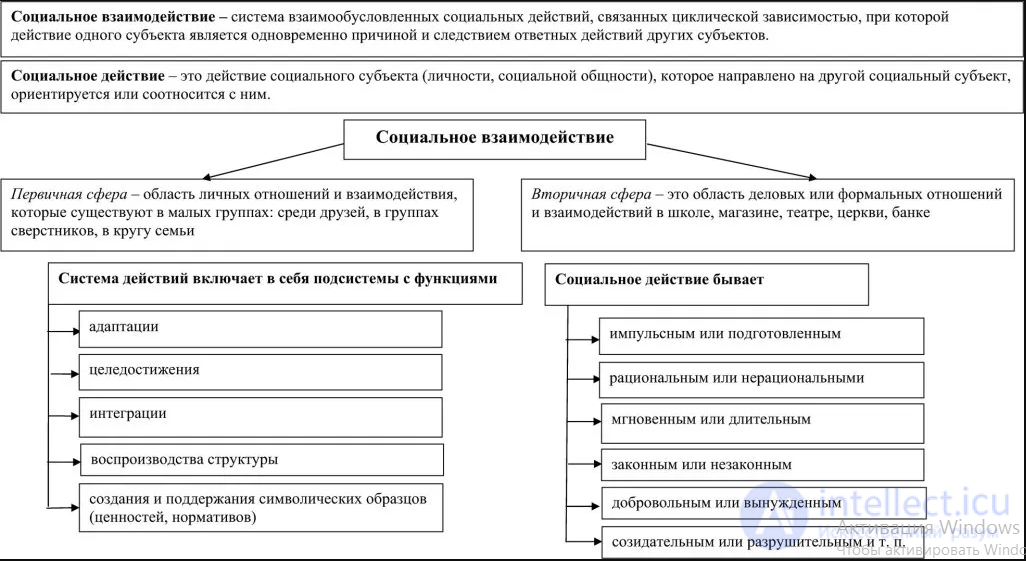
Social interaction — a system of mutually conditioned social actions linked by a cyclical dependency, in which the action of one subject is simultaneously the cause and the effect of the response actions of other subjects. It is related to the concept of "social action," which is the starting point in the formation of social ties. Social interaction, as a way of realizing social ties and relations, presupposes the presence of at least two subjects, the process of interaction itself, as well as the conditions and factors of its realization. In the course of interaction, the formation and development of personality and of the social system takes place, along with their change within the social structure of society, etc.
Social interaction includes the transmission of an action from one social factor to another, its receipt and the reaction to it in the form of a response action, as well as the renewal of the actions of social factors. It has social significance for the participants and presupposes the exchange of their actions in the future owing to the presence within it of a special causality — a social relation. Social relations are formed in the process of people's interaction and are the result of their past interactions, which have acquired a stable social form. Social interactions, unlike them, are not "frozen" social forms but "living" social practices of people, which are conditioned, directed, structured, and regulated by social relations, but are capable of influencing these social forms and changing them.
Social interaction is determined by the social statuses and roles of a person and social groups. It has an objective and a subjective side:

Comments