
Lecture
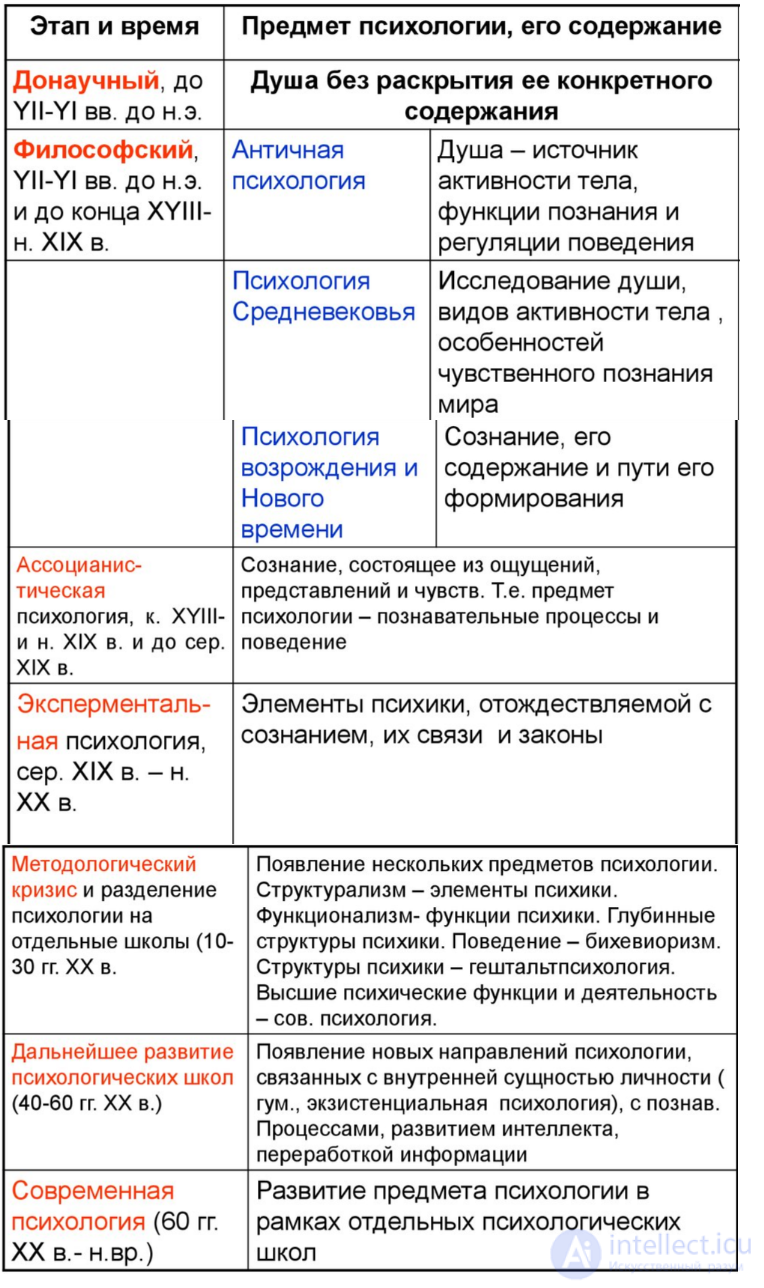
Working through the tests with answers and diagrams on the topic "History of Psychology" will help you prepare effectively and check your knowledge in this field.
Below are 90 tests, covering each subsection, with 15 questions for each of the 6 topics and 4 answer options each, one of which is correct.
To pass the tests successfully, you need to know the following:
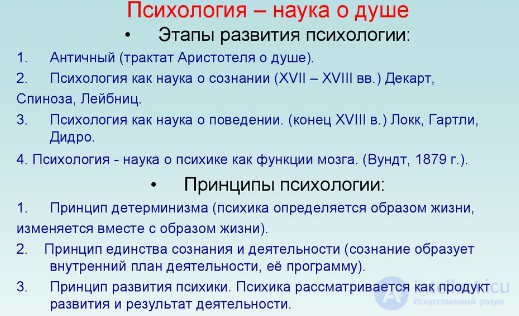
The history of psychology is a fascinating study of the evolution and development of psychological science over many centuries. Here is a brief outline of the history of psychology:
Ancient world and philosophy: The study of psychology began long before our era with ancient philosophers such as Plato and Aristotle, who presented their theories of the mind and the soul.
Middle Ages and Renaissance: In the Middle Ages interest in psychology declined, but in the Renaissance it was revived thanks to the work of scholars such as René Descartes, who regarded mind and body as separate entities.
Enlightenment and psychophysiology: In the Age of Enlightenment, attention was paid to understanding the relationship between the brain and mental processes. Researchers such as Immanuel Kant and Gustav Fechner contributed to the understanding of the interaction between the brain and behavior.
The emergence of psychology as a science: In the 19th century psychology became a scientific discipline with the development of structured methods and laboratory research. William James and Wilhelm Wundt are considered the founders of experimental psychology.
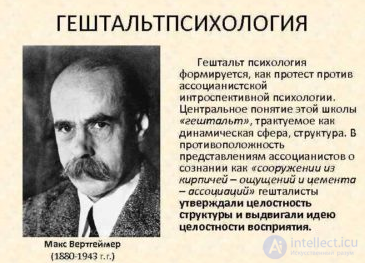
Psychoanalysis and psychological schools: At the beginning of the 20th century Sigmund Freud created psychoanalysis, and at the same time various psychological schools appeared, such as behavioral psychology and Gestalt psychology.
The cognitive revolution: In the mid-20th century cognitive psychologists such as George Miller and Noam Chomsky focused on the study of thinking, memory and cognitive processes.
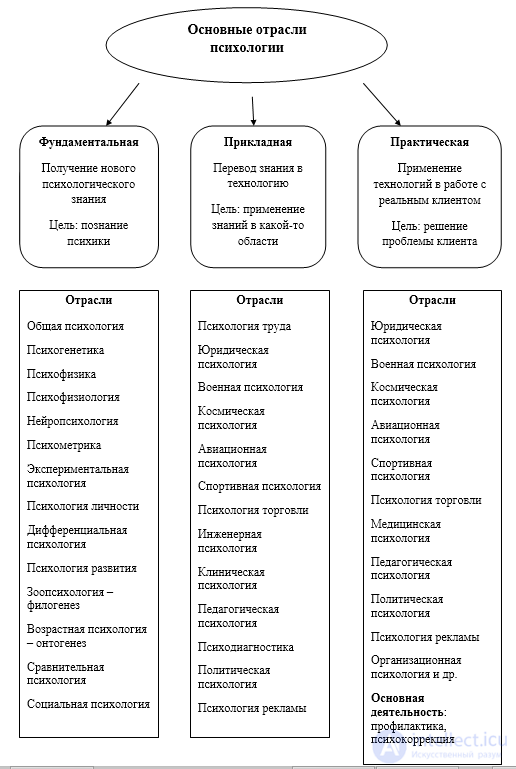
Modern psychology: Today psychology is a diverse science encompassing many subdisciplines, including clinical, social, cognitive, developmental and physiological psychology, and others. It uses a variety of methods and techniques to study the human psyche and behavior.
The history of psychology reflects many philosophical, methodological and theoretical changes that have shaped modern psychological science. This subject of study covers the entire history of human thought about the mind and the soul.
Using your knowledge, you will be able to make the most effective use of the tests with answers and diagrams on the topic "History of Psychology" to check and deepen your knowledge in this area. Good luck!
Learning elements: the subject of the history of psychology as a science, the main categories, tasks, methods and functions of the history of psychology
The subject of the history of psychology:
The history of psychology as a science studies the past and the development of psychological research and theories. Its subject includes:
The history of psychological ideas: The study of the development of concepts and conceptions in psychology over time.
Biographies and contributions of scholars: An analysis of the lives and works of prominent psychologists and their contributions to the development of psychological science.
The evolution of methods and approaches: The study of changes in the methodology and methods used in psychological research.
Main categories of the history of psychology:
Periodization: The division of the history of psychology into periods depending on the dominant ideas and methodologies.
The history of psychological schools: An analysis of various psychological schools, such as structuralism, functionalism, behavioral psychology, Gestalt psychology and others.
Biographical studies: The study of the lives and work of individual psychologists.
Tasks of the history of psychology:
Analysis of the development of psychological ideas: Identifying the roots and evolution of the main concepts and theories in psychology.
Study of methodology: Understanding changes in the methods and approaches used in psychological research.
Identifying influences and context: Determining how social, cultural and political contexts influenced the development of psychological science.
Methods of the history of psychology:
Documentary analysis: The study of original documents, including scientific articles, letters and diaries, in order to understand the motives and ideas of psychologists.
Analysis of biographies: The study of the life stories of scholars and their influence on the development of psychology.
Comparative method: The comparison of different phases of the development of psychology and their interrelations.
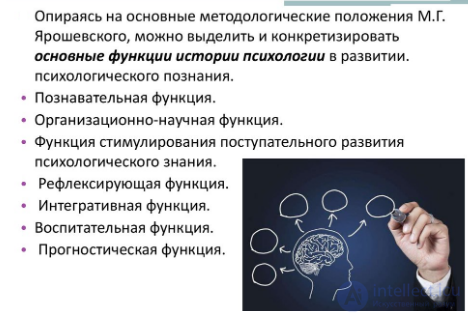
Functions of the history of psychology:
Educational function: Helps students and researchers understand the evolution of psychological science and its main concepts.
Cognitive function: Makes it possible to understand which ideas and methods were relevant in particular historical periods.
Inspiration and development: Serves as a source of inspiration for modern researchers and helps them avoid repeating the mistakes of the past.
The history of psychology plays an important role in understanding how psychology became what it is today, and what trends may shape its future development.
1. The first ideas about the psyche were of a(n) ... nature, endowing every object with a soul.
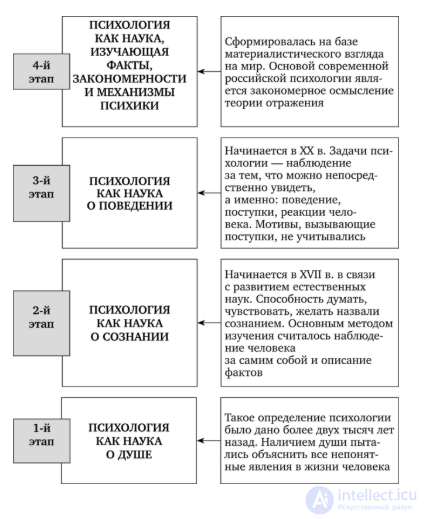
2. The branch of psychological science that studies the patterns of development of psychological knowledge is:
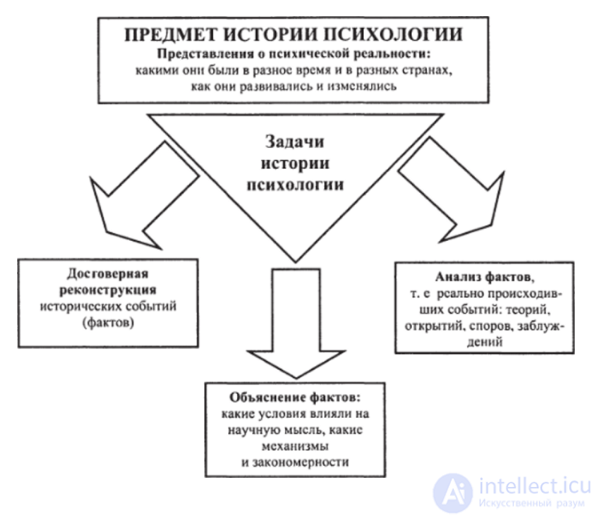
3. The subject of the history of psychology is:
4. The patterns of the emergence and formation of properly psychological knowledge constitute the ... of the history of psychology.
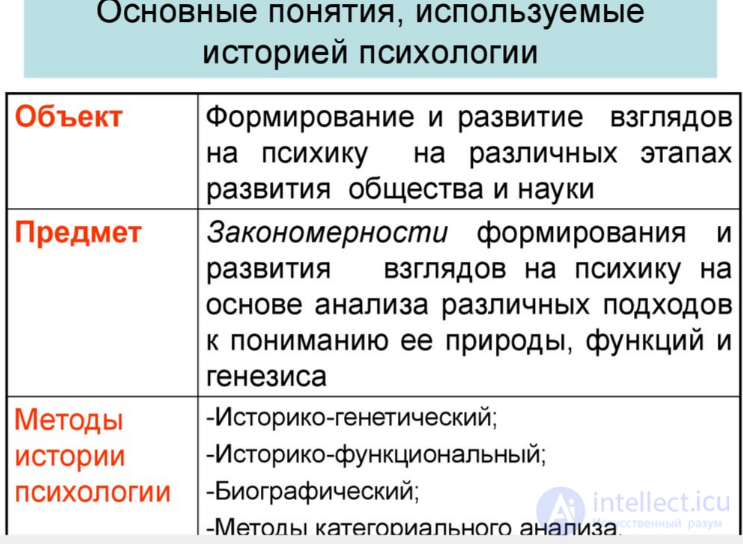
5. Moving historical-psychological research from the simple empirical description of historical facts onto a theoretical footing is a ... of the history of psychology.
6. The analysis of the emergence and further development of scientific knowledge about the psyche is a ... of the history of psychology.
7. The reconstruction of historical scientific psychological thought is a ... of the history of psychology.
8. Psychology arose as the science of:
9. According to L. S. Vygotsky, the general conditions and laws of scientific cognition and the objective requirements placed on scientific cognition are the ... of the development of psychological ideas.
10. Psychological ideas originally arose:
11. The principles of historical-psychological cognition are:
12. The following research method is used in the history of psychology:

13. The preservation, safekeeping and enrichment of psychological knowledge are functions of ... psychology.
14. Identifying the connection of times, which makes it possible to look from the past, through the present, into the future of psychology, is a ... function of the history of psychology.
15. The stage known as the "open crisis in psychology" falls in the period:
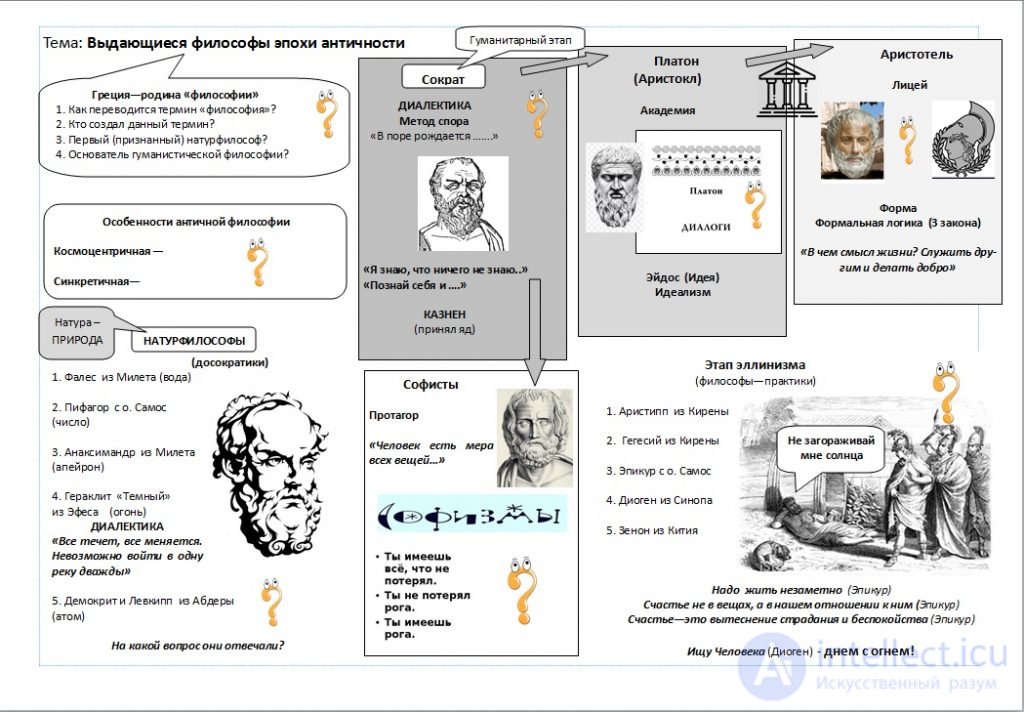
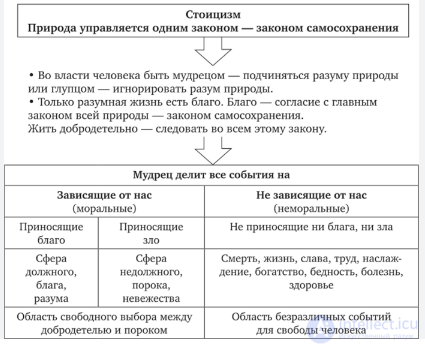
Learning elements: different ideas about the soul in primitive consciousness and in antiquity; the psychological ideas of the main thinkers of antiquity; the features of materialistic and idealistic conceptions of the soul; the essence of the problem of the relationship between soul and body and the ways it was solved in the works of ancient thinkers
The understanding of the soul and its connection with the body in primitive consciousness and in antiquity showed substantial differences and evolved over time.
Primitive consciousness:
Antiquity:
Aristotle: Aristotle held that the soul is indivisible and immortal, and that it has three aspects: rational (in humans), animal (in animals) and vegetative (in plants).
Plato: Plato divided the soul into three parts: the rational, the spirited and the appetitive. He also believed in the pre-existence of the soul before incarnation.
Socrates: Socrates attached great importance to reason and the moral values of the soul. His method of dialogue contributed to the exploration of the human soul and to self-knowledge.
Materialistic and idealistic conceptions of the soul:
Materialism: The materialistic point of view holds that the soul is the result of physical processes in the organism. For materialists such as Democritus and Epicurus, the soul was a part of the body and disappeared after death.
Idealism: The idealistic view of the soul assumes that it is independent of the physical world and has a supernatural origin. Plato and Plotinus are examples of ancient idealists who believed in the immortality of the soul.
The problem of the relationship between soul and body:
Dualism: The best-known solution to this problem is dualism, proposed by Plato and later by René Descartes. Dualists claim that soul and body are distinct and interact with each other.
Monism: Another solution, monism, assumes that the soul and body constitute a single entity. This view was held by Aristotle, who believed that soul and body are inseparable.
The history of psychology in antiquity developed around these different philosophical points of view and concepts, and their influence remains noticeable in modern psychology, especially in the areas connected with understanding the nature of the human soul and its relation to the physical world.
1. The famous saying "Man is the measure of all things" belongs to:
2. The statement "Education should teach a person to speak well, to think well and to act well" was formulated by:
3. The ancient Greek philosopher, author of the work "On Nature," one of the first materialist philosophers, to whom the doctrine of the "logos" belongs, is:
4. The human soul was interpreted as a kind of matter, as a bodily formation, consisting of various atoms, by:
5. The thesis that the soul is inseparable from the body was first put forward by:
6. In antiquity, Alcmaeon regarded as the organ of the soul:
7. Ideas about associations were first formulated by:
8. The author of the treatise "On the Soul" is:
9. The doctrine of temperament belongs to:
10. According to Democritus, a human being consists of different kinds of atoms, and the most mobile of them - the atoms of fire - form:
11. The idea that everything that exists has three aspects: being, the sensible world and non-being, belongs to:
12. The four proofs of the immortality of the soul were formulated by:
13. According to ..., the soul manifests itself in three main faculties: vegetative, sensitive and rational.
14. The doctrine of pneuma belongs to:

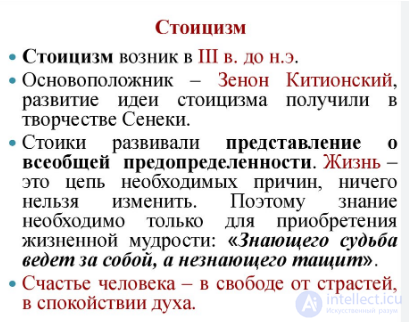
15. In his ideas about nature, Epicurus relied:
Learning elements:the time boundaries of the stage and its differentiation into substages in the history of psychology: the Middle Ages, the Renaissance, the Modern Age; representatives of philosophical science; the main tenets of the doctrine of consciousness; the general tendencies in understanding human consciousness that characterize the associative approach
Time boundaries and substages in the history of psychology:
The Middle Ages (5th-15th centuries): The Middle Ages were characterized by the predominance of religious and theological views on psychology. Consciousness and mental processes were considered from a religious point of view.
The Renaissance (14th-17th centuries): During the Renaissance there was a revival of interest in ancient philosophy and psychology. Researchers such as René Descartes and John Locke began to develop more scientific and empirical approaches to understanding the mind and consciousness.
The Modern Age (18th century and later): The Modern Age is characterized by more systematic and scientific research in psychology. The formation of psychology as an independent science began in this period.
Representatives of philosophical science:
Augustine of Hippo (Saint Augustine): In the Middle Ages he developed ideas about the soul and its relation to God. His works influenced medieval Christian psychology.
René Descartes: In the Renaissance period Descartes proposed the concept of a dualistic division between the mind (the soul) and the body. His phrase "Cogito, ergo sum" ("I think, therefore I am") became key to understanding the role of reason.
John Locke: Locke represents the transition from the Renaissance to the Modern Age. He developed the idea that the mind is a "blank slate" on which nothing is written, and that knowledge arises through experience.
The main tenets of the doctrine of consciousness:
In this context, the main tenets of the doctrine of consciousness include:
The dualism of René Descartes: The division between body and soul, and between conscious and unconscious processes.
The empiricism of John Locke: The assertion that consciousness is the result of experience and perception.
The idea of associations: In this period the development of the concept of associations began, according to which consciousness is built on the basis of associative connections between ideas and impressions.
General tendencies in understanding human consciousness that characterize the associative approach:
Associative thinking: The associative approach assumes that consciousness functions on the basis of associations, i.e., connections between ideas, memories and experience.
Subordination to experience: Consciousness is regarded as the result of experience and interaction with the external world, which emphasizes the importance of observation and experience for understanding mental processes.
Concentration on empiricism: Within the associative approach, great attention is paid to empirical research and experiential observation for studying consciousness.
1. In the psychology of the 18th century, association became a universal category explaining all mental activity, in the works of the English physician:
2. The spiritual principle is always one of the manifestations of extended substance (matter), according to:
3. The claim that the psyche is inherent only in humans belongs to the representatives of:
4. The founder of anthropopsychism is:
5. The method of in-depth investigation and cognition by a person of the moments of his own activity, called "introspection," was substantiated in the works of:
6. The soul, as passive but capable of perceiving the environment, was compared to a blank slate on which nothing is written by:
7. The author of the famous phrase "I think, therefore I am" is:
8. The basis of the teaching of the medieval philosopher Avicenna is:
9. Augustine considered the soul an instrument that governs the body and ascribed to it a special character, believing that its basis is formed by:
10. The English scholar F. Bacon is the author of the work:
11. The founders of the empirical trend in philosophy and psychology were:
12. According to F. Bacon, the main source of psychological knowledge is:
13. The new point of view put forward by B. Spinoza, according to which the bodily and the spiritual are regarded as two sides of one and the same (substance), is usually called:
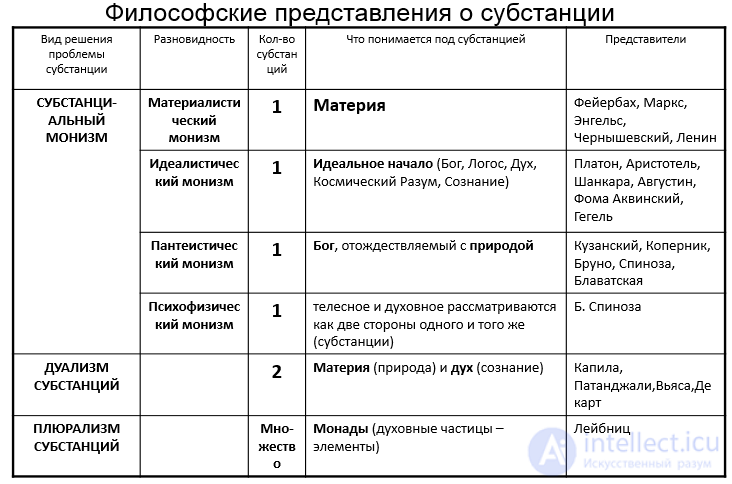
14. The English scholar J. Locke introduced the term:
15. The German scholar G. Leibniz introduced the concept of:
Learning elements: the features of empirical psychology; the contribution of German and English scholars to the development of empirical psychology; the natural-science prerequisites for the emergence of psychology as an independent science; the content of the open crisis experienced by psychological science in the late 19th and early 20th centuries
Features of empirical psychology:
Basis in observation and experiment: The main methods of empirical psychology are observation and experiment. Scientists conducted controlled experiments in order to study mental processes.
Objectivity and measurability: Empirical psychology strove for the objectivity and measurability of mental phenomena, attempting to turn them into a subject of systematic and scientific research.
Study of elementary processes: Scientists focused on the analysis of elementary mental processes such as perception, attention, memory and reactions.
The contribution of German and English scholars:
German scholars (for example, Wilhelm Wundt and Gustav Fechner) made a significant contribution to the development of laboratory psychology. Wundt founded the first psychological laboratory in Germany and became one of the founders of experimental psychology.
English scholars (for example, Francis Galton and Charles Darwin) also had an important influence on empirical psychology. Galton conducted research on intelligence and heredity, while Darwin studied emotions and their evolutionary roots.
Natural-science prerequisites for the emergence of psychology as an independent science:
Approaches from physics and biology: The contributions of the physical and biological sciences became key to the emergence of psychology as an independent science. Ideas about methods of measuring and explaining phenomena in accordance with natural laws were transferred to mental processes.
Philosophical foundation: Philosophical discussions about the nature of the mind, consciousness and the soul created the basis for the development of psychology as a science. Philosophers such as Descartes and Locke provided fundamental ideas for psychological research.
The open crisis in the late 19th and early 20th centuries:
In this period psychology faced a number of critical questions and problems:
Functionalism vs. structuralism: The contradictions between functionalism, oriented toward the study of the functions of consciousness, and structuralism, oriented toward the analysis of the structure of consciousness.
The crisis of methodology: Doubts arose about the reliability and validity of psychological methods, which called into question the status of psychology as a science.
The problem of subjectivity: Difficulties in measuring and objectively analyzing subjective mental processes.
This crisis led to a revision of the methodology and approaches in psychology and stimulated the development of new schools, such as psychoanalysis and behavioral psychology.
1. The founder of psychophysiology, a central figure in laying the foundations of psychology as a science with its own subject matter, is:
2. The "father" of experimental psychology is considered to be the German psychologist, physiologist, and philosopher:
3. The trend in psychology and pedagogy that emerged at the turn of the XIX-XX centuries, driven by the penetration of evolutionary ideas into pedagogy and psychology and by the development of applied branches of psychology, is called:
4. The first paedological laboratory was established in 1889 by:
5. The domestic (Russian) psychological school is based on the ... concept of the development of the psyche.
6. At the beginning of the XX century, the psychological school that sought to understand the place and role of consciousness in human survival is:
7. The concept of the unconscious psychic was first formulated by:
8. The founder of behaviorism is considered to be:
9. The principles of "pleasure" and "reality" are important for the formation of personality traits according to the views of:
10. The principles of "having" and "being" are important for the formation of personality traits according to the views of:
11. Psychology is an objective experimental branch of the natural sciences from the standpoint of the paradigm of:
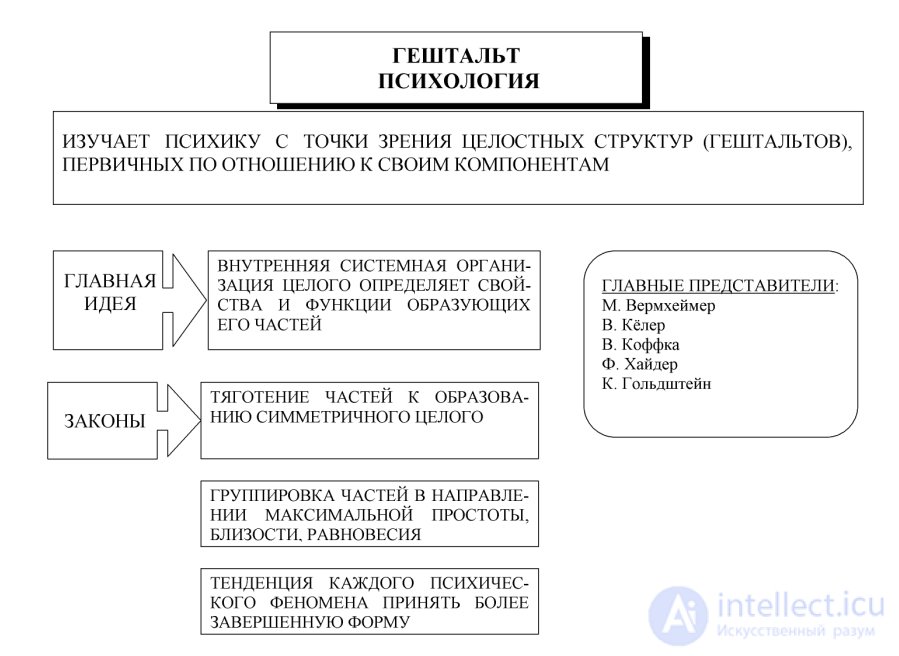
12. A program for studying the psyche in terms of holistic structures was put forward by:
13. The approach to studying the psyche in terms of holistic structures is called:
14. The trend in psychology that studies the problems of personality development, activity, self-actualization and self-improvement, freedom of choice, and the striving for higher values is:
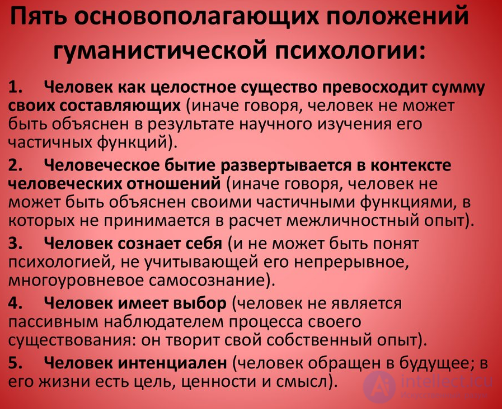
15. The first psychological laboratory was established by:
Learning elements: the main world psychological theories and schools: behaviorism, Gestalt psychology, psychoanalysis, humanistic psychology; representatives of these schools of foreign psychological science; the basic concepts of these schools, and their theoretical and applied components
The main world psychological theories and schools:
Behaviorism:
Gestalt psychology:
Psychoanalysis:
Humanistic psychology:
Each of these schools has its own unique theoretical and applied aspects, and they make a significant contribution to the understanding of human psychology and its application in various fields, including psychotherapy, education, marketing, and others.
1. The works of J. Bruner belong to the ... theories of learning.
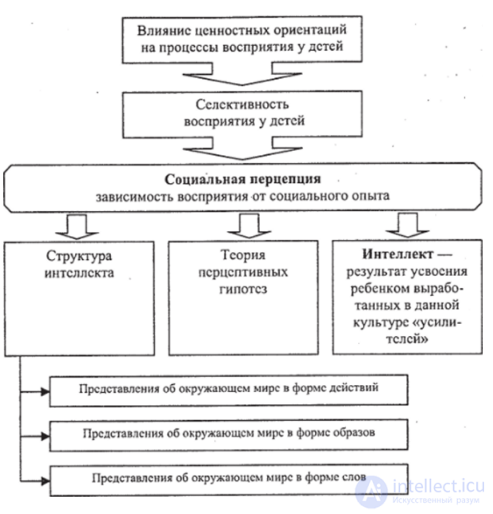
2. The author of the book "A Dynamic Theory of Personality" and the creator of "field" theory is:
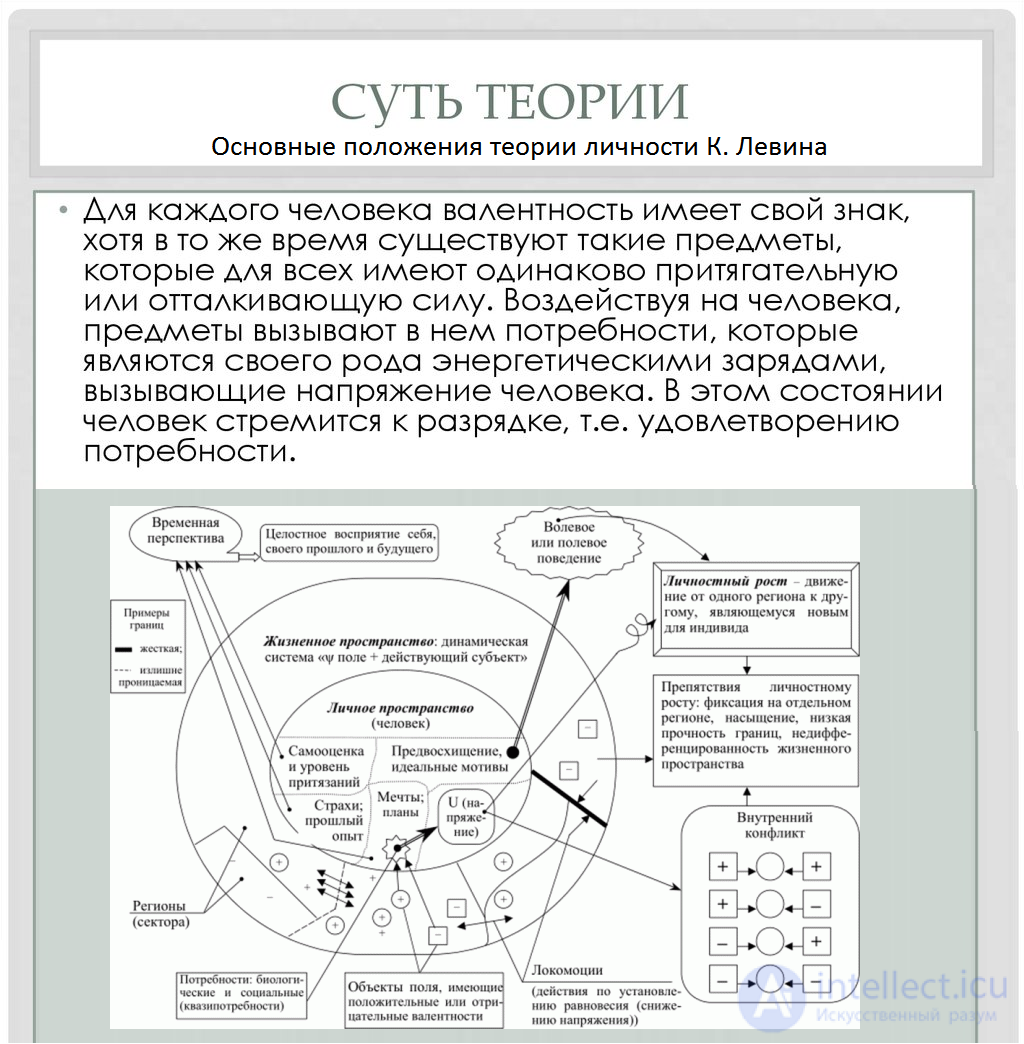
3. The author of the psychological works "The Principles of Psychology" and "Does Consciousness Exist?" is:
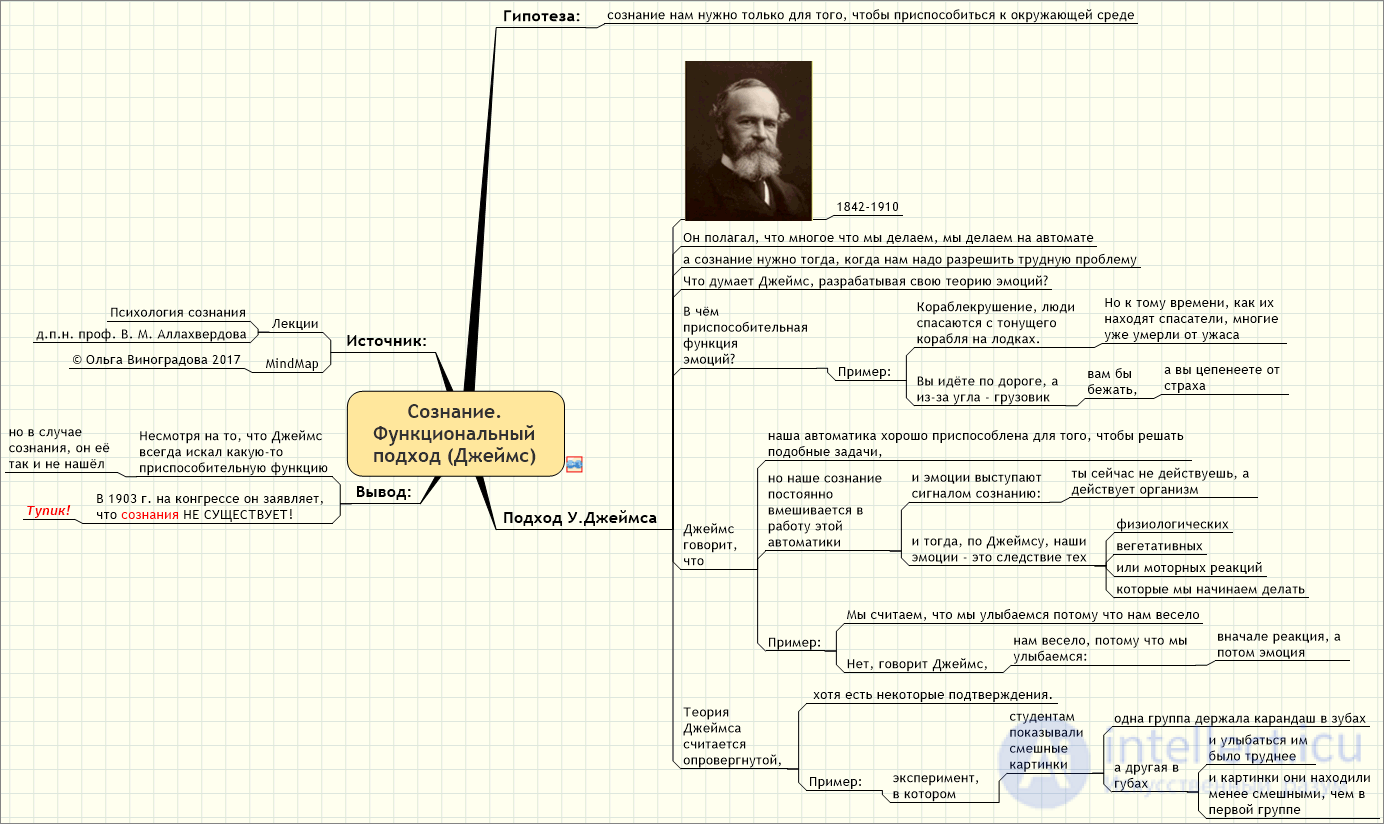
4. V. Frankl developed a school of psychology known as:
5. The representatives of Gestalt psychology are:
6. According to behaviorism, the basis of psychic development is the laws of:
7. The subject of study of psychoanalytic science is:
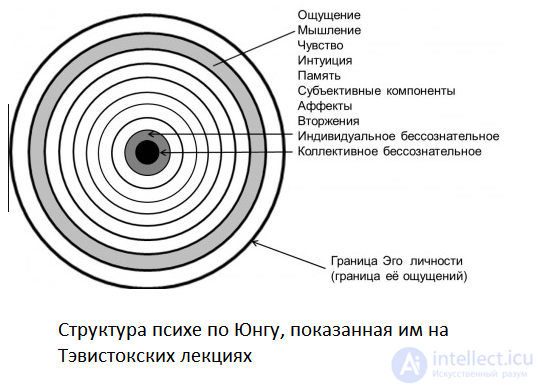
8. The author of the psychological work "The Interpretation of Dreams" is:
9. The idea of the "collective unconscious" belongs to:
10. The psychological school that appeared at the end of the XIX century in Germany and Austria, and proposed studying the psyche by means of holistic structures, is called:
11. The trend in Western psychology that explains psychic phenomena through "mystical experiences" and "cosmic consciousness" is called:

12. The representatives of neo-Freudianism are:
13. Humanistic psychology is represented in the legacy of:
14. The psychological school that rejects conformism, adaptation to the existing order of things, and determinism, understood as the conviction that behavior is causally conditioned by external biological or social factors, is called:
15. The founder of genetic psychology, the author of the book "The Language and Thought of the Child," who provided experimental and theoretical grounds for the concept of operational intelligence, is the Swiss scientist
Learning elements: psychological theories and schools, representatives, basic concepts, and theoretical and applied components in developing and underdeveloped countries; the stages in the formation of psychology in underdeveloped and developing countries
Psychological theories and schools, as well as the development of psychology, have their own particular features in developing and underdeveloped countries. These countries often have their own unique cultural and social contexts, which can influence the development of psychological science and practice. Let us consider this question in more detail.
Psychological theories and schools:
Sociocultural psychology:
Local psychological theories:
Stages in the formation of psychology in underdeveloped and developing countries:
Initial introduction: At this stage, psychology is introduced as a scientific discipline into universities and research institutes.
Adaptation to local conditions: Psychological theories and methods begin to be adapted to local cultural, social, and economic realities.
Development of national schools: In some countries, their own national schools of psychology take shape, and original theories and methods are created.
Applied psychology: Interest grows in the practical application of psychology in education, healthcare, business, and other spheres.
Cooperation and international interaction: Countries begin to cooperate actively with foreign scientists and organizations to exchange knowledge and experience.
Applied components in developing and underdeveloped countries:
Development of the education system: Psychologists can contribute to improving the educational system, including the development of more effective methods of teaching and assessment.
Healthcare and psychological assistance: Psychologists can work on developing psychological assistance and rehabilitation for people suffering from mental and emotional problems.
Cultural analysis and counseling: The study of cultural characteristics helps psychologists better understand the needs and problems of the local population and provide counseling that takes the cultural context into account.
Social research: Psychological research can help in studying social problems and developing strategies for solving them.
Psychological support in crisis situations: Psychologists can provide psychological support in cases of natural disasters, wars, and other crisis situations.
1. A representative of psychology in a developing country, Academician A.A. Ukhtomsky, introduced the concept of:
2. The author of the treatise "Letters on the Study of Nature" is:
3. The founder of neuropsychology, who experimentally investigated the problems of localization of higher mental functions, is:
4. The specific question of the subject, methods, and laws of psychological science was raised by:
5. The similarity between the mechanisms of the reflex act and the psychic act was first pointed out by the Russian physiologist:
6. What made it possible for the first time in science to explain materialistically the phenomena of voluntary human behavior was I.M. Sechenov's discovery of the mechanism of:
7. The Russian scientist V.M. Bekhterev created a doctrine that he called:
8. The Russian psychologist P.P. Blonsky defined psychology as the science of:
9. P.P. Blonsky paid particular attention to the study of:
10. One of the authors of the work "Studies in the History of Behavior" is:
11. The discrepancy between the level of tasks a child can solve independently and those solved under adult guidance was defined as the zone of proximal development by:
12. The physiologist, psychiatrist, and psychologist who founded the first experimental psychological laboratory in Russia is:
13. The fundamental principle of the activity approach in psychology, the unity of consciousness and activity, was formulated by:
14. The Soviet-era psychologist P.Ya. Galperin created the general psychological theory of:
15. The problem of the integration and differentiation of psychological knowledge with other fields of science was worked on by:
|
No. |
Name of the didactic unit |
1 |
2 |
3 |
4 |
5 |
6 |
7 |
8 |
9 |
10 |
11 |
12 |
13 |
14 |
15 |
|
2.1. |
Introduction to the History of Psychology |
a |
d |
a |
b |
d |
b |
a |
d |
a |
b |
c |
a |
d |
b |
c |
|
2.2. |
The Pre-scientific Stage in the History of Psychology |
c |
d |
b |
a |
c |
d |
a |
b |
b |
a |
c |
a |
d |
b |
a |
|
2.3. |
The Philosophical Stage in the History of Psychology |
d |
a |
b |
c |
d |
b |
a |
d |
a |
b |
d |
a |
c |
b |
a |
|
2.4. |
The Formation of Psychology as an Independent Science |
a |
d |
a |
c |
a |
d |
c |
a |
c |
b |
c |
d |
c |
b |
a |
|
2.5. |
The Current State of Psychological Science |
a |
b |
d |
a |
b |
d |
a |
d |
b |
a |
b |
d |
c |
a |
d |
|
2.6. |
The History of Psychology in Underdeveloped Countries |
a |
d |
b |
d |
a |
b |
c |
b |
d |
c |
b |
a |
d |
b |
d |

Comments