
Lecture
Since the publication of G. Allport's classic work «The Nature of Prejudice» in 1958, not much new has been discovered in this field.
Allport managed to identify and describe the most essential features of prejudice.
At the heart of prejudice lies bias – that is, an unfounded negative view of other people.
A negative view by itself is not yet prejudice. It becomes prejudice if it does not change even in the presence of convincing evidence that the judgment is unfair, mistaken, and refuted by positive facts.
Any prejudice, G. Allport argues, is a deviation from three specific norms:
the norm of rationality,
the norm of justice,
the norm of humaneness.
A tendency toward prejudice becomes a character trait, reinforcing biases and antipathies toward certain groups of people.
Bias – a prejudiced attitude, an unjustified predisposition that hinders adequate perception of a message or action, a person or a group.
Unlike prejudice, it is easily dispelled when proof of its incorrectness is presented.
G. Allport names six sources of bias (the seventh is attributed to D. Myers).
1.Personal interest. It arises when a person perceives a certain group of people as a source of potential threat. The main causes of bias in this case are contact with the unknown, the incomprehensible, the threatening, and the struggle for survival.
2.Conformity. A person follows the opinion of the majority of their group and holds a hostile attitude toward members of other groups, even though those groups pose no threat to them but are simply different, foreign, or little known.
3. Overpopulation of large cities.
4. Conflict situations and situations of rivalry.
5. Fear of the unknown.
6. Self-fulfilling prophecies.
7. Degree of religiosity and fanaticism.
Prejudice – an unjustifiably categorical and rigid attitude toward social objects.
It is the result of the uncritical assimilation of judgments accepted within a social group, reinforced by unfounded conclusions drawn from one's own experience.
Types of prejudice: racial, ethnic, gender-based, age-based, religious, class-based, everyday (for example, toward certain foods and their producers), and so on.
Causes of the formation of prejudice:
1) economic and political competition;
2) conformity to social norms;
3) the need for self-justification of hostile behavior;
4) repressed and displaced aggression;
5) personal needs arising from low social status;
6) the authoritarian personality type.
Categorization by itself is not prejudice, but it builds the foundation for it.
Negative attitudes or biases can result in discrimination.
Discrimination is unfair actions toward members of certain social groups, driven by bias (negative stereotypes).
Discrimination – is the behavioral form of prejudice and stereotypes; discrimination is most often understood as a negative attitude.
The term «discrimination» (from the Latin «discriminatio» – distinction) is associated with the name of Thomas Rice, who in 1830 introduced this term in the context of studying racial prejudice, to denote its behavioral component.
Some scholars distinguish between direct and indirect discrimination, where the direct form occurs when inequality is generated, usually intentionally; while the indirect form is shaped by stereotypes and produces behavior that is not always recognized as discriminatory.
In contemporary foreign psychology, the most commonly examined types are economic discrimination, labor-market discrimination, and other forms of discrimination based on a person's status, economic and social position; gender and racial discrimination are also examined.
At the same time, most discriminatory practices are based on the visual diagnosis of the Other.
There are five main types of prejudice and discrimination.
1. Racism – behavior based on the false theory of the existence of «superior» and «inferior» races.
2. Chauvinism – an extreme form of nationalism, the promotion of national exceptionalism, setting the interests of one nation against those of others, national arrogance, deliberate incitement of national hostility, behavior manifested in discrimination against other peoples.
3. Sexism – behavior based on the belief in the superiority of one sex over the other (men over women or vice versa).
4. Homophobia – irrational fear and negative bias toward homosexuals.
5. Ageism – the emergence of prejudice and discrimination toward age groups, usually the elderly.
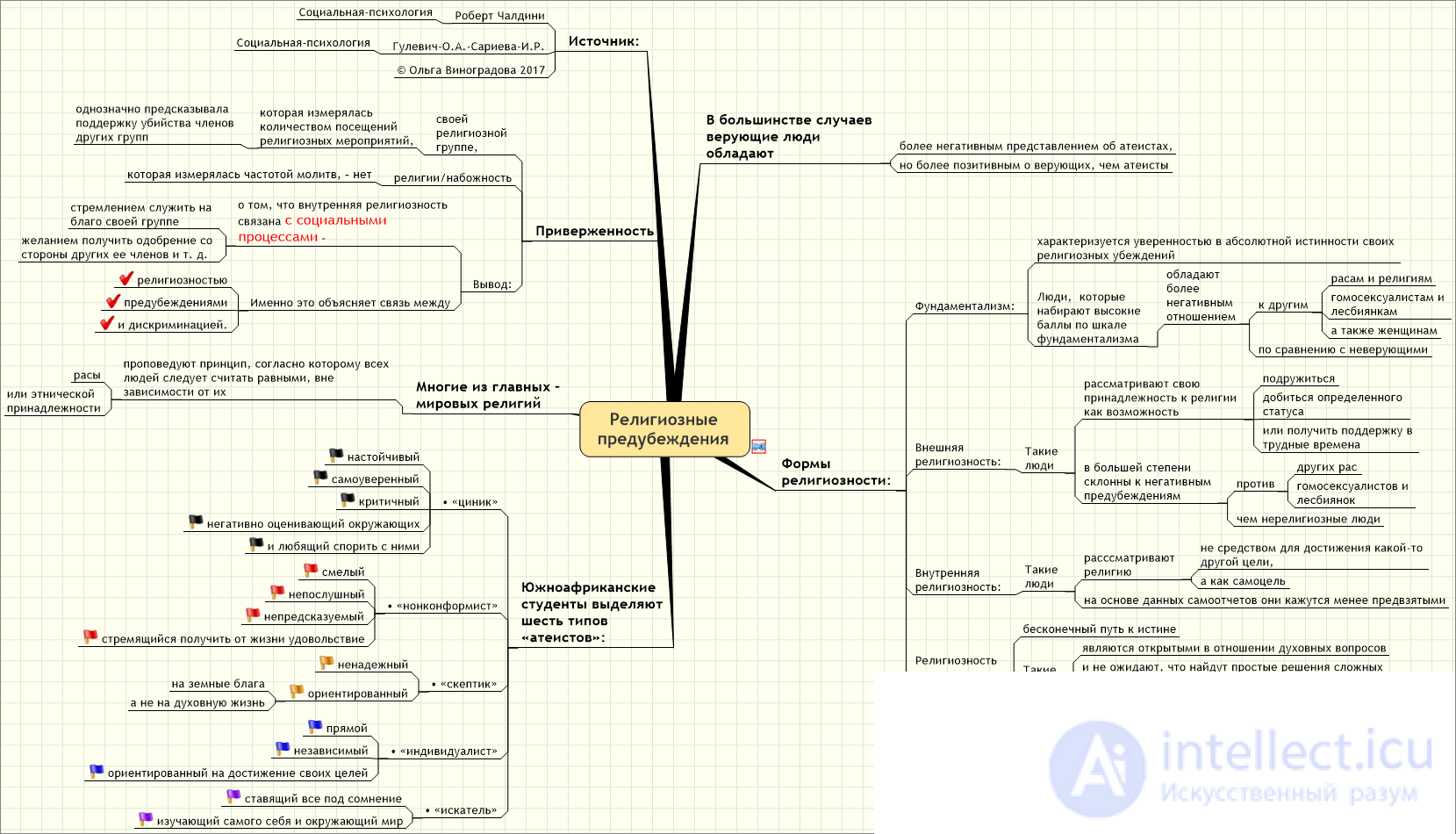 Fig. An example of religious prejudice
Self-fulfilling prophecy (the Rosenthal effect)
Self-fulfilling prophecy – a term proposed by the American sociologist Robert King Merton (1948) for those predictions that spontaneously «govern» people's behavior and lead to the outcomes they expected.
In other words, it is a prediction that influences reality in such a way that it ultimately turns out to be true. A conviction about something influences people's behavior and the situation as a whole so that it becomes reality. This happens because a person's convictions and expectations largely determine the nature of their actions and their interpretation of the actions of others. The Rosenthal effect operates in various spheres of life: in everyday life, at work, and in the learning process.
Stigma
Stigma is an ancient Greek term denoting a sign or mark, cut or burned into a person's body, characterizing them as morally «defective.» In his work «Stigma: Notes on the Management of Spoiled Identity,» E. Goffman uses this concept in relation to the mentally ill. Overall, the stigmatization of the sick turns out to be a way of coping with the fear associated with the possibility of contagion through contact with them.
For E. Goffman, social stigma is an attribute that deeply discredits its bearer in the eyes of others compared to a normal person. It follows that stigmatization implies designating a group or individual as different, even deviant. Stigma arises when an individual differs from the dominant social norm in some respect and is negatively evaluated as a result. As a consequence, the person's entire identity is evaluated through the lens of that particular attribute, and the person is dehumanized in the eyes of those evaluating them. Thus, stigma is not an individual construct but a shared social knowledge. Stigma determines how others relate to this person and what actions they take toward them. One can imagine a continuum reflecting various kinds of actions toward these people: from more neutral ones, such as silence, to more negative ones, such as ostracism and acts of violence. Among the intermediate actions on this continuum are rejection, discrimination, and isolation.
As functions of stigma, J. Crocker and colleagues, within their model of stigma as identity threat, propose the following:
boosting one's own self-esteem by stigmatizing others;
maintaining a positive social identity, which in turn results in justifying discrimination against the out-group;
legitimizing status inequality of one group or another;
managing fear, performing a protective function in connection with the emergence of strong anxiety.
Types of stigma. Goffman proposed distinguishing several types of stigma. Stigma can be related to:
1) physical defect or deformity;
2) a defect of individual character (such character defects arise, for example, as a result of mental illness, alcoholism, imprisonment, drug use, an individual's unemployed status, their low social status, in particular related to unemployment or the inability to obtain an education);
3) tribal stigma (a defect determined by an individual's belonging to a particular race, nationality, or religion, which extends to all members of each of these categories).
As we emphasized above, stigma affects the social identity of individuals, «spoiling» and devaluing it in the eyes of others; moreover, it affects not only the feelings, thoughts, and behavior of these individuals but also has a negative impact on their health.
Since the publication of E. Goffman's work, the social-psychological and sociological literature has seen the appearance of a considerable number of both conceptual and empirical works devoted to stigma. Turning to the conceptual works, it is possible to speak of an entire palette of different definitions of stigma. Thus, J. Crocker and colleagues propose speaking of stigmatization not only when an individual has some attribute that sets them apart, but also when the individual believes they have one.
Notable is the definition given by E. Jones and colleagues, in which stigma is linked to a certain mark that is associated with negative evaluations and stereotypes. These stereotypes are well known to members of the same culture and are shared by them.
The question that follows from this definition is: how are stereotype and stigma related? Broadening the context somewhat, one can also attempt to answer the question of how such concepts as «stigma» and «stereotype,» as well as «stigma» and «bias,» relate to one another. The answer to this question contributes to understanding the mechanisms that drive the process of stigmatization; determines how stigma can be studied; and also opens up prospects for developing methods of destigmatization.
Stigma and stereotypes. Thus, in the work by M. Biernat and J. Dovidio, «Stigma and Stereotype» (2000), an analysis of the social-psychological traditions of studying stigma and stereotype is presented.
The authors propose that stigma and stereotype are related but not identical concepts, since there are a significant number of situations where stigma exists without a stereotype, and vice versa. However, stereotypes are involved in the process of stigmatization, and this can be said when the party perceiving the stigma not only reacts negatively to the bearer of the stigma but also uses a set of characteristics that describe people who share the stigma. If we take into account the three types of stigma distinguished by Goffman, stereotypes are involved in the process of stigmatization predominantly in two of the three cases: in the case of tribal stigma and in the case of a defect of individual character. The need for stereotypes in these situations is explained by the fact that people need to explain and justify their negative attitude toward individuals with such stigmas, and to rationalize discrimination against them. Encountering an individual with a physical defect provokes a fairly sharp negative reaction, but this is not accompanied by the use of a stereotype. In this situation, even a fairly negative reaction is easier to explain compared to the previous two cases; accordingly, a stereotype is not necessary. Biernat and Dovidio also emphasize that stereotypes arise more quickly with respect to socially identifiable groups, which is precisely the case for the first two types of stigma mentioned above.
Stigma and bias. In a recent work, «Stigma and Prejudice: One Animal or Two?» (2008), J. Phelan, B. Link, and J. Dovidio undertake a fairly thorough analysis in order to answer this question. Thus, the focus of close analysis is 18 conceptual models applicable to the study of the processes of bias and stigma. Nine of them explain the processes of stigmatization: E. Goffman's model, E. Jones's model, B. Link's models, the identity-threat models of J. Crocker and B. Major, R. Kurzban's evolutionary model, and others. The remaining nine – among which are G. Allport's concept, M. Sherif's model of intergroup conflict, H. Tajfel and J. Turner's social identity theory, P. Devine's model of automatic and controlled components of stereotypes and bias, and others – concern the process of bias.
So, the analysis undertaken of stigma and bias (the models were compared across a range of parameters, including key concepts, the model's focus of attention (the perceiver, the perceived, their interaction), the processes of stigmatization and bias, the interchangeability of concepts, and others) allowed the authors to conclude that stigma and bias have far more in common than differences. Summarizing the various views formulated within all the models analyzed, the authors point out that stigma and bias perform three main functions:
Stigma and bias are connected to a number of processes and phenomena, including: categorization, «labeling,» stereotyping, negative emotions, discomfort in interaction, social rejection and other forms of discrimination, loss of social status, and so on.
So, these are not identical processes, but two sides of a single whole, and the existing differences are more related to the researchers' focus of attention and the emphases they place.
Dimensions of stigma. E. Jones and colleagues propose speaking of six dimensions of stigma:
concealability (the degree to which the attribute can be hidden by the individual);
course (the expected long-term outcome associated with the stigmatizing attribute);
disruptiveness (the degree to which the attribute disrupts the individual's activity in everyday life);
aesthetic qualities (the appearance of the individual who has the stigmatizing attribute);
origin (the degree of the individual's responsibility for the attribute they have);
peril (the degree of danger the attribute poses to others).
Fairly important dimensions – from the standpoint of the consequences of stigma for an individual who has the stigmatizing attribute – are concealability and the origin of the stigma.
As for the concealability of stigma, one can distinguish two cases, as E. Goffman points out: undisclosed (visible) and concealed (invisible) stigma. In the first case, individuals are forced to be constantly ready to withstand devaluation from those who do not bear such a mark. Visible stigma can inform us of the presence of some illness in an individual, of the danger they pose to others. This aspect of stigma is well illustrated by an idea expressed by Calvin, who, speaking of the plague, noted that it is a disease of the soul, and the soul is constituted such that it can infect the body, so that bodily manifestations can reveal the state of the soul. Thus, the plague turns out to be an undisclosed stigma, testifying to the «corruption,» the «defectiveness» of the individual's soul. People who bear this stigma receive a direct reaction to it in the course of interaction.
Those whose stigma is concealed can avoid devaluation from others for as long as they can keep it hidden; their status does not differ from that of everyone else. However, as soon as their stigma becomes visible, their status changes, and they are perceived by others as bearers of the stigma. It is worth noting that the «price» people pay for concealing a stigma (thereby avoiding stigmatization and its negative consequences) is quite high, for in interpersonal contacts individuals experience great tension, fearing exposure by others, fearing that their interlocutors will guess their secret from some sign or another. However, what happens to individuals who conceal their stigma should be examined not only at the interpersonal level but also at the intrapersonal level, for attempts to conceal the attribute that serves as the basis for stigmatization require a great deal of internal control, forcing people to constantly think about their stigma, which undoubtedly has a negative effect on their mental and physical health. What happens to people who conceal a stigma can be studied in accordance with D. Wegner and J. Lane's model of secrecy preoccupation, according to which the processes occurring in a person who has a secret are described as follows:
1) the secret that the person conceals – in our case, the stigma – leads to the suppression of these thoughts;
2) thought suppression leads to the emergence of intrusive thoughts about the concealed secret;
3) intrusive thoughts force the individual to make even greater efforts to suppress the thoughts. In essence, the harder an individual tries to conceal a secret – in our case, their stigma – the more accessible thoughts about it become;
4) the second and third stages repeat, since the process is cyclical, and the emergence of the second stage leads to the emergence of the third.
So, according to D. Wegner, thought suppression makes thoughts hyperaccessible to the individual's consciousness, and in a situation of cognitive load, these very thoughts appear in the individual's consciousness faster than the ones they are trying to concentrate their attention on. This effect is linked to unconscious automatic processes.
It is notable that the consequences at the cognitive level continue to exist even after the secret ceases to be one. Hence, attempts by individuals to conceal a stigma, from the standpoint of this model, result in thoughts about the stigma becoming obsessive and keeping them in a state of great internal tension, which Smart and Wegner associate with a state of deep cognitive activation. Compared to individuals with a visible stigma, individuals with an invisible stigma are burdened with different psychological consequences, since, believing they have succeeded in suppressing thoughts about the stigma, they do not realize how much these suppressed thoughts influence their behavior and judgments. In addition, deep cognitive activation leads to a decline in the ability to process information about the social world, to an obsessive tendency to perceive and evaluate the social world in terms of stigma and other constructs related to it.
There are grounds to speak of negative health consequences for an individual attempting to conceal a stigma. From Wegner's point of view, a series of works by J. Pennebaker also speaks in favor of the operation of this same mechanism, in which the negative consequences of concealing various traumatic events (including stigmatizing ones – incest, a spouse's suicide, and so on) were shown, that is, keeping such events secret did not allow one to be rid of deep cognitive activation.
As for another important dimension of stigma – its origin, or controllability – one can find different consequences for individuals by appealing to attribution theories. Thus, one can distinguish two variants of situations, depending on how the cause of the illness is attributed (controllability or uncontrollability of the symptom associated with the stigma). If the symptom is regarded as controllable, responsibility for the illness is attributed to the individual. The behavioral reaction toward such a patient is directed by anger. If, however, the symptom is perceived as uncontrollable, responsibility for the illness is not attributed to the patient. As a result, helping behavior is directed by pity.
So, almost half a century has passed since the appearance of E. Goffman's work, but interest in this problem is only increasing, as indicated by the growing number of publications devoted to it, as well as the variety of social-psychological schemes for analyzing and explaining the process of stigmatization.
Tolerance (from the Latin tolerantia – patience) – tolerance toward others' opinions, beliefs, and behavior, agreement to accept them even when they contradict the observer's own worldview.
From the standpoint of social psychology, tolerance is, first and foremost, a special attitude coming from the person themselves – an attitude (respect, acceptance, understanding-recognition are its three components), a need, a value, a norm, a view, or a belief; at the same time, it is also a certain moral-ethical category formed by society (duty, obligation).
The triggering mechanism for the emergence and manifestation of tolerance is the discovery of differences between people, groups, states, and cultures, and the way of responding to them (war or peace).
The psychological qualities that ensure tolerance are all the possible forms of people's self-expression, allowing or restricting parity in the manifestation of social differences (whether this is done freely or not).
The process of an individual's socialization influences the quality and formation of social tolerance. Social tolerance develops and manifests itself in the interaction of the individual with various social groups of society; it is directed toward equilibrium in society.
Social distance (Latin distantia – distance) – characterizes the placement of social groups and individuals in social space and establishes the degree of closeness or estrangement between them.
The concept of «social distance» was introduced by the American psychologist E. Bogardus. It denotes the degree of closeness or remoteness of social or ethnic communities, groups, or individual people.
This term began to be actively used at the beginning of the 20th century by American scholars to define social formations and the differences among masses, collectives, and groups. The term social distance in psychology came to be used for the comparative description of psychological closeness between people and the mechanisms of sympathy-antipathy.
Using the social distance scale (or the Bogardus scale), the degree of social-psychological acceptance of people by one another is assessed, which is why it is often called the scale of social acceptability.
It is used to measure distance associated with racial or national origin, age, sex, profession, religion, and to measure the distance between children and parents.
The social distance scale shows the degree of psychological closeness of people, which facilitates the ease of their interaction.

Comments