
Lecture
Agency — a property of an individual to be a subject of activity; as applied to a person, the ability to act as an agent (subject) of action, to be independent of other people. There are many interpretations of this term, either from a humanistic point of view or from a natural-science (humanities) paradigm.
The term «agency» («субъектность») was first used by A. N. Leontiev in his work «Activity. Consciousness. Personality» in 1975. By «agency,» Leontiev means a certain set of human qualities that characterize the sphere of a person's activity-related abilities, their capacity for self-determination, creative activity, and so on.
The most accurate equivalent in foreign psychology is the English word agency, which entered common usage in the 1980s. It denotes a person's ability to be an agent (subject), that is, an actively acting individual, a driving force of action.
According to one definition, agency is «the realized capacity of people to act upon their world and not simply to know it or to assign to it personal or intersubjective significance. This capacity is an inherent human power to act purposefully and reflexively, existing in more or less complex relationships with one another, correcting and remaking the world in which they live, under circumstances in which they may consider various courses of action desirable and possible, though not necessarily from the same point of view».
Among the most recognized is R. Harré's theory, who believes: «The most general requirement for any being to be considered a subject (agent) is that it possess a certain degree of autonomy. By this I mean that its behavior (actions and acts) is not fully determined by the conditions of its immediate environment». A full-fledged subject (agent), Harré believes, is able to distance itself both from the influence of the environment and from the principles on which its behavior was based up to the present moment. «A person is a complete agent with respect to a certain category of actions if both the tendency to act and the tendency to refrain from acting are within his power».
According to S. L. Rubinstein, agency is interpreted as a person's ability to bring about changes in the world and in themselves. This ability is formed in the course of historical and individual development. In this case, the subject is characterized by such qualities as activity, the capacity for development and integration, self-determination, self-regulation, self-movement, and self-improvement.
E. N. Volkova defines agency through the category of «relation»: a relation to oneself as an actor and the same kind of relation to other people. V. N. Myasishchev agrees with her, considering such relations to be the «core» of human life, because it is precisely in them that a person's goals, their feelings toward another, and the level of their abilities during interaction with other people are manifested.
I. V. Dudenkova also points to the principle of the autonomy of reason and the principle of reflection.
A. G. Asmolov views agency as a characteristic of activity that expresses its inner meaning. For Asmolov, agency is closely linked to motivation.
A. N. Ilyin writes that agency exists in a shared ontological space with freedom and responsibility.
V. I. Slobodchikov sees agency as a person's ability to manage their own actions, to actually and practically transform their activity, to plan courses of action, to implement programs, to monitor the progress of, and to evaluate the results of, their own actions.
S. S. Kashlev and S. N. Glazachev understand the subject as «the bearer of subject-practical activity and cognition to the extent that they are included, through real activity, in the process of directly transforming and cognizing the surrounding reality».
The contemporary psychologist M. N. Tsygankova views agency as a leading factor in personal and professional self-determination in adolescence. According to her recommendations, developing and cultivating agency within career-guidance activities significantly increases their effectiveness.
Defining agency as an integrative characteristic of personality that reflects the capacity for self-determination, M. N. Tsygankova notes that in professional self-determination this characteristic represents the ability to independently direct and determine one's own professional development. According to her research, a high level of agency in the sphere of professional self-determination is expressed in the following characteristics:
I. A. Seryogina proposes a structure of agency that includes conscious creative activity, the capacity for reflection, awareness of one's own uniqueness, and the understanding and acceptance of the other.
Productive agency
D. Schwartz links productivity and agency. In his view, for collaboration to occur, people do not need to communicate: even if they speak different languages, they can work together successfully. And motivation for collaboration arises precisely because they are able to express their agency through participation in productive activity.
Disjoint agency
H. R. Markus and S. Kitayama write that in the model of disjoint agency, personal autonomy, localized within the individual, comes to the forefront. This model, in their view, «is not a general model of motivation, but a model reflecting the meanings and life practices typical of the contexts of life of the European-American middle class».
Conjoint agency
With conjoint agency, the interconnection of individual subjects comes to the forefront. The formation of agency in this model is based on the assimilation of certain cultural models. Moreover, these need not necessarily be ethno-national formations. Markus and Kitayama, having studied the formation of identity in the pages of American magazines, found that publications aimed at people with higher education promote a model of disjoint agency, while media outlets aimed at those with a secondary education promote conjoint agency.
«Negative agency» is a concept denoting a state in which a person or group defines itself through negation, opposition («we are not them»), destruction, or the absence of inner activity, replacing it with an external reaction. This can manifest as a negative identity (xenophobia), a deficit of self-determination, or psychological alexithymia.
Incomplete agency is a state in which an individual's ability to act as an independent agent, to manage their own life, and to bear responsibility (agency) is revealed only partially or fragmentarily. Unlike full self-ownership, the individual does not fully control their own actions or external circumstances, often displaying only certain aspects of agency.
A. K. Osnitsky, distinguishing between the concepts of «subjective» and «agentic,» says that the subjective represents a holistic ontological characteristic of human existence, while the agentic is a characteristic of activity, and can therefore be regarded as one facet of subjectivity. V. I. Slobodchikov and E. I. Isaev define subjectivity as a basic category establishing the general principle of the existence of human reality, while agency represents «a social, activity-transforming mode of human existence». Thus, «agency is the central formation of human subjectivity».
Let us try to bring the above definitions together into a system (Fig. 1).
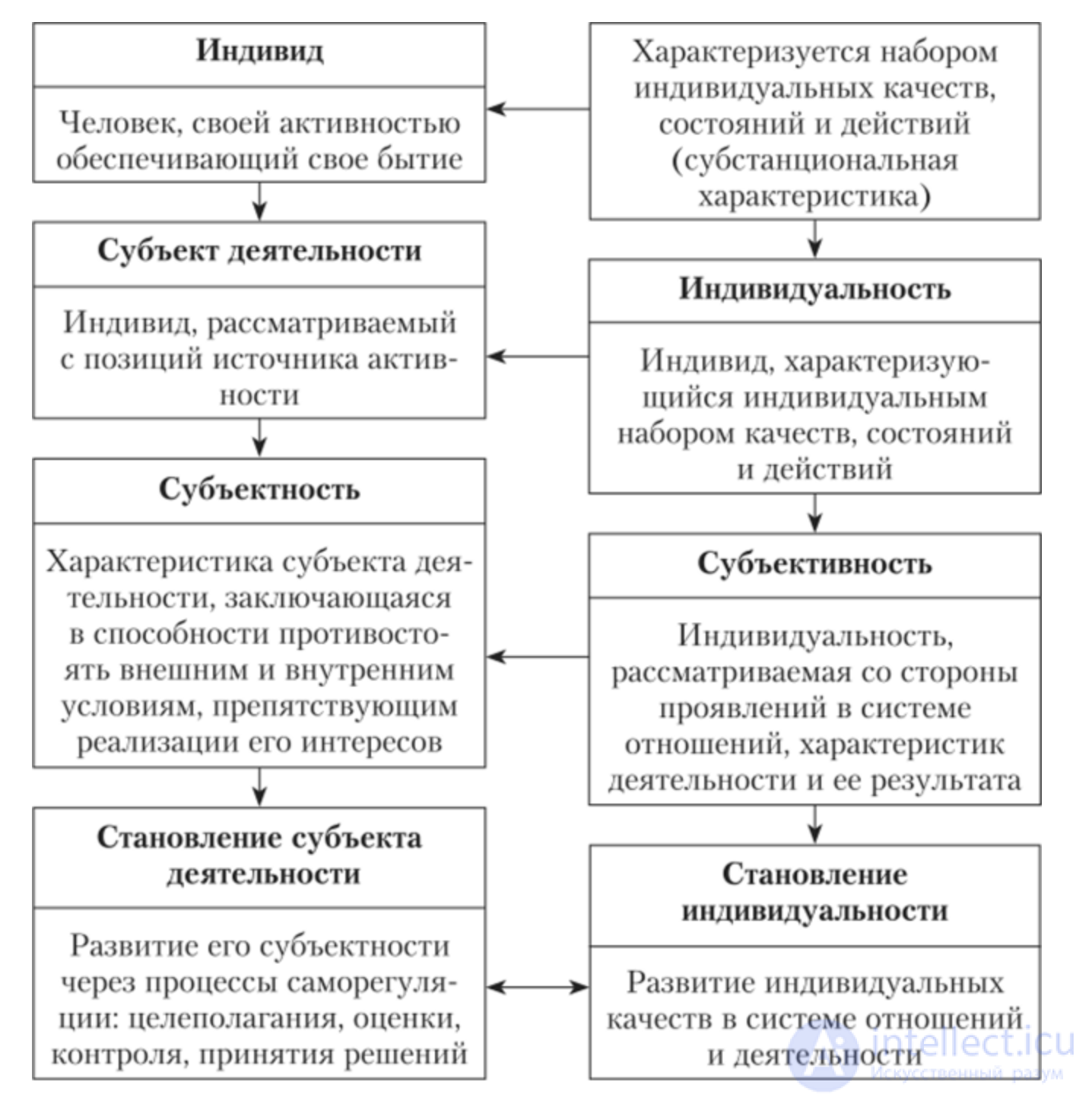
Fig. 1. The system of qualities: individual, individuality, subjectivity, agency, subject of activity

Comments