
Lecture
Social loafing — the tendency of people to exert less effort when working together toward a common goal than when working individually . This phenomenon is studied in social psychology.
A number of works have been devoted to the phenomenon of social loafing, the best known of which are the studies of Max Ringelmann, Bibb Latané, Kipling Williams, and Stephen Harkins.
Research using modern technologies has also confirmed the manifestation of social loafing. Many of the causes of this phenomenon stem from an individual's sense that their efforts will not matter to the group.
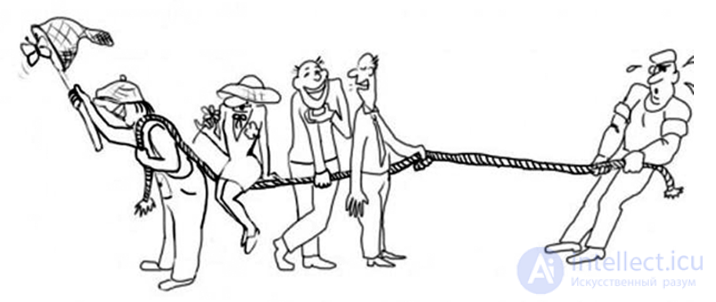
A single person pulls a rope harder than that same person does as part of a team. The larger the team, the less effort each of its members exerts
In a crowd, each participant claps and shouts more weakly than alone, and pedals better if they think they are doing it alone rather than as part of a team. At the same time, they are convinced that they are trying equally hard.
When the opportunity arises to «get lost in the crowd», everyone puts in a little less effort than when working alone: social loafing increases.
One of the first works devoted to studying the phenomenon of social loafing was the work of Max Ringelmann (1913), known as the Ringelmann effect. The scientist conducted a series of experiments on groups of individuals who were not told that their individual contribution to the overall result was being secretly measured. In the course of his research he found that, as part of a group, participants exerted less effort when pulling a rope than when working individually .
In 1974, researchers led by Alan Ingham repeated Ringelmann's experiment using two types of groups: 1) groups with real participants (as in Ringelmann's setup) and 2) pseudo-groups with one genuine participant. In the pseudo-group, the researchers' assistants pretended to pull the rope, while in reality only one person was actually controlling it. The results showed that the achievements of the group whose members genuinely exerted effort were much lower than the achievements of the pseudo-group. Since the pseudo-groups lacked genuine coordination within the team (as the researchers' assistants were not physically pulling the rope), Ingham demonstrated that communication between participants by itself does not account for the possible decline in performance — loss of motivation is the more likely cause of the decreased performance .
Bibb Latané, Kipling Williams, and Stephen Harkins continued searching for other ways to study this phenomenon. Experiments were conducted on a group of six individuals seated in a semicircle. The participants in the experiment were blindfolded and wore headphones. Deafening applause and shouting were played to the group of subjects through the headphones. Participants were unable to hear their own or others' shouting and applause. According to the experiment's script, group members were supposed to shout or applaud «with all their might» either alone or together with others. It was expected that each participant would shout louder, since they would feel less inhibited. In reality, social loafing manifested itself fully: in the group, subjects shouting or clapping produced three times less noise than each of them did individually. However, according to the participants themselves, in both cases they were «giving it their all» to the same degree .
In 1989, Christopher P. Earley conducted a study of social loafing examining the influence of cultural factors on this phenomenon. The experiment involved groups of individuals from Western (individualistic) and Asian (collectivistic) cultures. Individualistic culture is characterized by the fact that the individual goals of its members are no less (if not more) important than group goals, whereas in collectivistic culture the opposite is true — group goals prevail over individual ones. Earley hypothesized that social loafing might be less pronounced in collectivistic cultures, which are oriented toward achieving a shared result as a group rather than as individuals. In the course of the study, he demonstrated that Chinese managers, performing a series of hour-long tasks, worked harder in a group than US managers, who exerted more effort working alone .
The larger the number of participants in a group, the more each participant tends to feel deindividuated. This term denotes a decrease in an individual's sense of personal responsibility within a group, which leads to a reduction in the effort individuals put in within groups. Thus, this phenomenon can reduce the overall effectiveness of the group. An individual may feel «lost in the crowd», believing that their efforts will not be rewarded .
In a group with a large number of individuals, each of them tends to believe that their contribution to the overall result is insignificant and has no meaningful effect on the outcome. Believing that their efforts are not important within the context of the group as a whole, they put in minimal effort. A telling example of this approach is voting in the US, where the majority of citizens consider voting in elections to be an important procedure, yet the percentage of citizens who take part in voting in presidential elections is very low (51% in the 2000 election)[10]. Believing that their vote is not significant enough among millions of others, people prefer not to vote at all.
Factors influencing social loafing:
Psychologists and sociologists have been studying this phenomenon for a long time. Numerous studies have been conducted, revealing various patterns in individuals' manifestation of social loafing.
On the basis of this extensive body of research, several approaches have formed, each developing its own model of social loafing.
This model is based on D. Knoke's synthesizing model of motivation[11]. Both of these models examine the behavior of members of work groups and production groups in general, placing emphasis specifically on workers' motivation.
This model identifies several groups of factors that influence the degree to which social loafing manifests:
Group members' assessment of the group's size, the role of their contribution to the final goal, their understanding of the assigned tasks, and the prospect of receiving a bonus are combined as a set of factors included in the concept of rational choice. In this model, this phrase refers to an individual's weighing of the effort they will put into the work against the final result and the reward.
It should be noted that group size is often classified as a factor that increases social loafing; however, based on various studies, no unambiguous conclusion can be drawn on this issue, since the results strongly contradict one another.
The understanding that activity within a work group is built on fairness (which also reduces loafing) does not apply to all existing types of fairness. What matters in this case is the presence of distributive fairness[12], under which the reward for work performed is received in accordance with the effort expended.
In addition, the significance of the tasks performed also reduces social loafing. If the outcome of the work is interdependent with other tasks, loafing increases, whereas if the work is more self-contained, it decreases.[13]
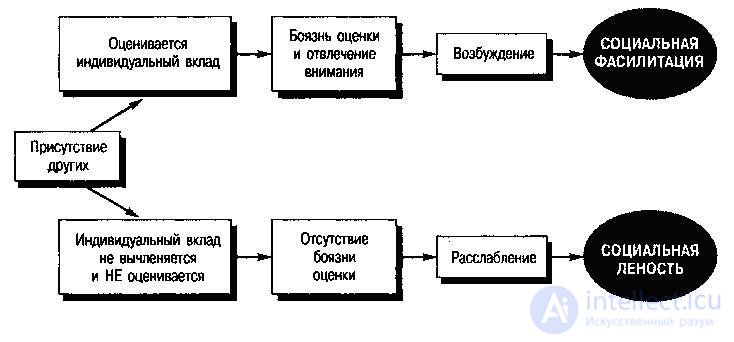
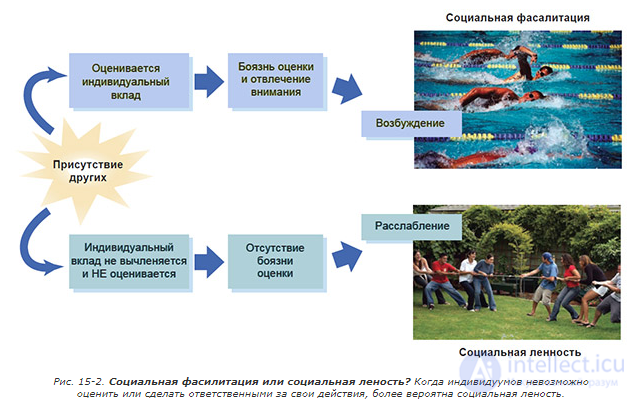
There is an opposite concept — social facilitation — a term introduced by the American psychologist Norman Triplett, who, in the course of his research, found that participants in cycling races achieved their best results when «competing not against the stopwatch», but against other athletes. To confirm his hypothesis, Triplett conducted history's first social-psychological experiment, which consisted of the following: the psychologist had children wind a fishing reel as fast as they could. In one condition, the children wound the reel alone in an empty room; in the other, in the company of peers. The result showed that children who wound the reel in the presence of other children did so faster than those who did it alone.
The difference between the phenomena of social loafing and social facilitation lies in the effect that the presence of others has on the likelihood of evaluation. In a situation of social facilitation, the presence of other individuals increases the likelihood of evaluation, since in this case the actions of one individual can be compared with the actions of others. In a situation of social loafing, the presence of colleagues reduces the likelihood of evaluation, since it is difficult to assess each individual's contribution within the group.
How widespread is social loafing? Under laboratory conditions, this phenomenon has been observed not only among those pulling a rope, pedaling an exercise bike, shouting, and clapping, but also among those pumping water or gas, evaluating poems and editorials, generating new ideas, typing, and detecting signals. Do the results obtained in real life correspond to those found in the laboratory?
Under the communist regime, peasants on Russian collective farms worked first on one field, then on another, and bore practically no personal responsibility for any specific plot of land. They were left small private plots for their own needs. According to one study, these private plots together accounted for only 1% of the land suitable for cultivation, yet produced 27% of all Soviet agricultural output (H. Smith, 1976). In Hungary, private plots occupied 13% of the land, producing one-third of the output (Spivak, 1979). In China, where after 1978 peasants were finally allowed to sell surplus production beyond the state quota, food production immediately began growing by 8% a year — two and a half times faster than over the preceding 26 years combined (Church, 1986).
In North America, workers who do not pay union dues and do not volunteer their time are nonetheless not averse to taking advantage of union benefits. The same thing happens with viewers of public television, who are in no hurry to respond to the station's fundraising campaigns. This suggests another possible explanation for social loafing. When rewards are divided equally regardless of individual contribution, each participant gets a greater reward per unit of effort if they free-ride. Thus, people may become motivated to slack off if their contribution is not assessed and rewarded individually.
For example, at a pickle-canning factory, the main concern is picking pickles of the right size off the conveyor belt and placing them in jars. Unfortunately, workers tend to grab pickles indiscriminately, since their work is not checked individually (the jars go onto a common pallet before quality control). Williams, Harkins, and Latané (Williams, Harkins & Latane, 1981) note that research on social free-riding calls for «identifying the output of individual workers» and raise the question: «How many pickles would a pickle packer pack if he were paid only for correctly packed pickles?» [The original contains a play on words based on an English tongue-twister. (Translator's note)]
But, of course, collective effort does not always lead to its weakening. Sometimes the goal is so significant, and it is so important that everyone give their maximum effort, that team spirit generates and sustains genuine zeal. Does each rower in an Olympic eight really pull the oar with less effort than in a pair or a single scull?
A body of evidence convinces us that this is not so. People in a group slack off less if the task is challengingly difficult, appealing, and engaging (Karau & Williams, 1993). When collectively solving a difficult and interesting task, people may perceive their own contribution as indispensable (Harkins & Petty, 1982; Kerr, 1983; Kerr & Bruun, 1983). When people consider other members of their group to be unreliable and incapable of productive work, they work harder themselves (Vancouver & others, 1993; Williams & Karau, 1991). Additional incentives or the need to strive for certain standards also promote collective effort within the group (Shepperd & Wright, 1989; Harkins & Szymanski, 1989).
Groups slack off much less if their members are friends rather than strangers to one another (Davis & Greenlees, 1992). Latané noted that in Israel, kibbutzim, surprisingly, are more productive than farms under other forms of ownership. Cohesion enhances effort. Does this mean that social loafing is not observed in collectivistic cultures? To find out, Latané and his colleagues (Gabrenya & others, 1985) went to Asia and repeated their noise experiment in Japan, Thailand, India, and Malaysia. What did they find? Social loafing clearly manifested itself in these countries as well.
And yet sixteen subsequent experiments in Asia showed that people in collectivistic cultures exhibit less social loafing than in individualistic cultures (Karau & Williams, 1993). As noted earlier, collectivistic cultures place strong emphasis on loyalty to family and work group. Women also exhibit less social loafing than men, who are more inclined toward individualism.
Some of these findings are similar to results obtained in studies of ordinary work groups. When a group faces a difficult task perceived as a challenge, when the group's success as a whole is rewarded, and when a spirit of «teamwork» prevails, all its members work most energetically (Hackman, 1986). So, although social loafing does indeed occur time and again when people work together without bearing individual responsibility, it cannot be said that more hands always means less work gets done.

Comments