
Lecture
Deindividuation — a social-psychological phenomenon involving the loss of one's sense of self, of self-awareness, as a result of which a person becomes more susceptible to the norms of the crowd. It arises in group situations that guarantee anonymity and do not focus attention on the individual. The term was introduced by Leon Festinger, Albert Pepitone, and Theodore Newcomb in 1952.
Deindividuation is the loss of self-awareness and of the fear of being evaluated.
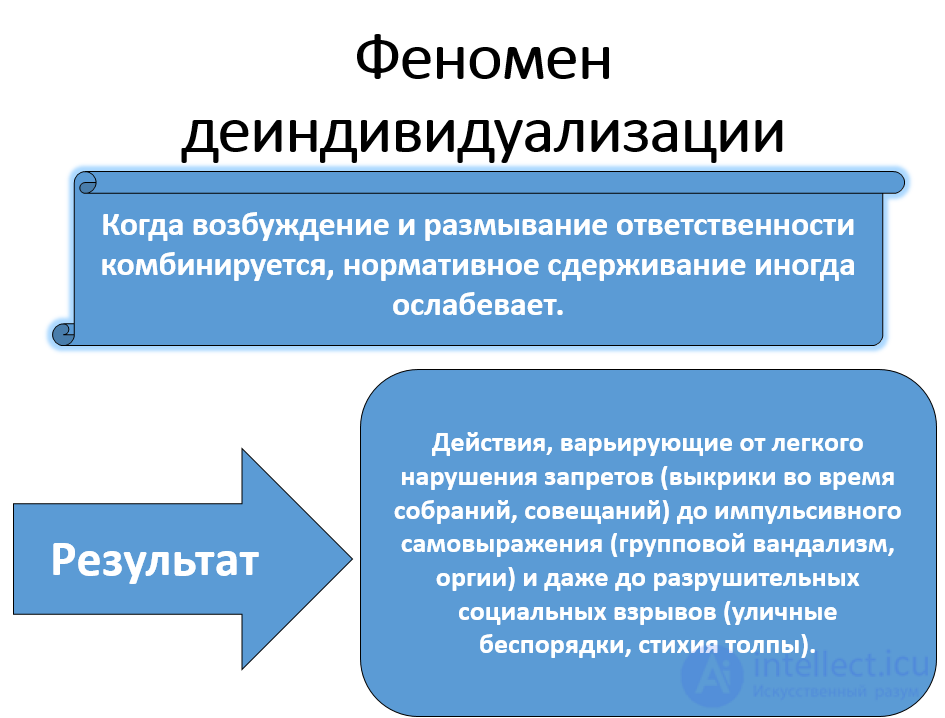
It occurs in situations that provide a person with anonymity and do not focus attention on the behavior of a specific individual. The result of deindividuation is behavior ranging from minor breaches of prohibitions to impulsive self-expression and even to destructive social acts (group vandalism, street riots, lynching). Myers names three conditions under which deindividuation arises: a large group (a crowd), darkness, and provision of the individual's physical anonymity.
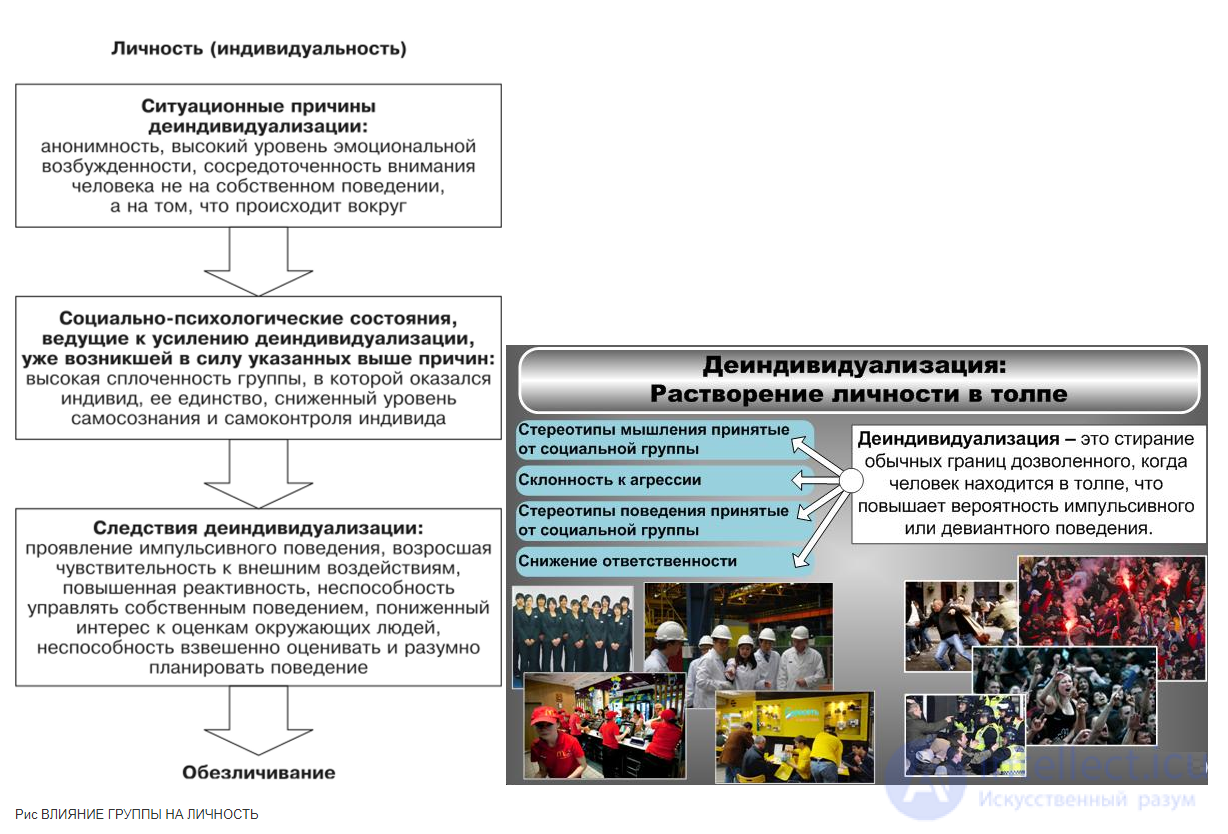
Fig. THE INFLUENCE OF THE GROUP ON THE PERSON
The French sociologist Gustave Le Bon was the first to speak of changes in human behavior under the influence of a crowd. He believed that any gathering of people constitutes a «mass», the main feature of which is the loss of the capacity for observation.
In a crowd, the following occurs:
Explaining behavior at the level of the «masses» also inspired other authors. His ideas were developed by S. Freud, H. Blumer, and G. Allport, and in 1952, L. Festinger, A. Pepitone, and T. Newcomb introduced the term «deindividuation» to describe a situation in which people within a group are not regarded as individuals. According to these authors, attention is focused on the group itself, while its individual members, including their moral qualities, remain out of focus. Deindividuation therefore facilitates a person's involvement in unlawful and antisocial acts that would normally be restrained by moral prohibitions and norms.
As an alternative, R. Ziller argued that group members become deindividuated under more specific situational conditions. For example, over time people come to associate individuation with reward situations and deindividuation with punishment situations. A person learns to expect rewards for good behavior and therefore feels responsible for their actions. However, when they perceive a high probability of punishment, they will tend to hide or share responsibility among the group's members by fading into the background.
Zimbardo, in turn, proposed that other factors besides focus on the group or the desire to avoid negative moral evaluation could also influence deindividuation. Such factors include anonymity, group size, the level of emotional arousal, the novelty and uncertainty of the situation, an altered sense of time perspective (for example, due to drug or alcohol use), the degree of involvement in group activity, and so on. As a result, the person loses cognitive control over their emotions and motivations and comes to rely on external stimuli.
Later, Diener went on to link the concept of deindividuation to self-awareness. People with a reduced level of self-awareness are unable to monitor and analyze their own behavior on an ongoing basis and, as a result, to retrieve situation-appropriate norms of behavior from long-term memory.
All instances of deindividuation are associated with an individual being part of a group. That is, groups themselves «provoke» the individual into performing atypical actions, since they generate feelings of involvement and arousal in a person. A vivid example is a person's behavior at a rock concert. But groups themselves are not the only source of depersonalization. The following can also have an effect:
Independent experiments by Mann and Mullen revealed a relationship: the larger the group, the more noticeable the decrease in the level of self-awareness and the increase in readiness to commit unlawful acts. In this case, participants tend to attribute their behavior to the situation rather than to themselves.
In one of Zimbardo's experiments, he tested whether anonymity actually promotes a sense of impunity. To do this, he dressed women in identical white hooded robes. He then asked them to administer an electric shock to another woman by pressing a button. Women in the robes held their finger on the button longer than women who wore a nametag around their neck.
Zimbardo's study is one of many studies on this topic. However, a meta-analysis of 60 studies on deindividuation shows that a person becomes less aware of themselves and more aware of the group. Moreover, the person becomes more sensitive to cues from the situation.
As a rule, aggressive behavior is preceded by a situation in which aggression could already be observed, though on a small scale. For example, this could be shouting, clapping, and so on. Diener's experiment showed that joint actions by group members become preconditions for larger-scale actions. This may be explained by the fact that people enjoy watching others around them doing the same thing they are doing. In addition, impulsive actions draw attention.
Collective experience weakens not only self-awareness but also the link between a person's behavior and their attitudes. The results of experiments by Diener, Prentice-Dunn, and Rogers show that deindividuated people are less restrained and more prone to rash actions. It has also been demonstrated experimentally that self-awareness is the opposite of deindividuation. People with a heightened level of self-awareness, when placed in front of a mirror or camera, showed enhanced self-control. For example, when tasting different cheeses, people standing in front of a mirror chose the least fatty one.
Deindividuation – the loss of self-awareness, of awareness of one's own individuality, and of the fear of evaluation – arises in group situations that provide anonymity and do not focus attention on a specific individual. When a high level of social arousal is combined with diffusion of responsibility, people may cast off their usual restraints and lose their sense of individuality. Such deindividuation is especially likely following arousing and distracting activities, when people feel anonymous because they belong to a large group or because of concealing clothing. The result can be a decrease in self-awareness and self-restraint and an increase in susceptibility to the immediate situation itself, whether it is negative or positive.
Individuality is a fairly energy-intensive process, which is why fatigue, exhaustion, and chronic stress depersonalize us. Strictly speaking, we can consider deindividuation in five forms:
1. Permanent deindividuation.
This applies to cases in which a person has lost, or never developed, the skill of self-awareness and self-identification. Naturally, this skill needs to be developed, since it does not appear by default (much like learning to write). Historically, people have been very slow to free themselves from a deindividuated existence submerged in broad kinship, tribal, and clan relations. Individuality is a skill that must be taught and learned. People who lack individuality do not pay proper attention to their own behavior and are poorly aware of themselves as separate beings. The result is an inability to monitor or analyze their own behavior on an ongoing basis and an inability to retrieve the appropriate norm of behavior from long-term memory storage. Deindividuated people also lack foresight, and their behavior suffers from a deficit of deliberation or planning.
2. Crisis deindividuation.
In conditions of crisis, awareness weakens and a person becomes vulnerable. Usually, as they emerge from the crisis, a person regains their individuality, but along the way they may be intercepted (by cult members and others) who will offer them external resources and props. Sometimes crisis deindividuation may be linked to the loss of inhibitions and to people's tendency to behave in atypical and counter-normative ways.
Each side of a conflict sees the other side as depersonalized, that is, regards it as a representative of some category or group rather than as a separate individual. Such perception promotes escalation, weakening the factors that restrain aggressive action. The depersonalization of people leads to their dehumanization. They seem less human than individuals; as a result, deindividuated people are less protected from aggression. Depersonalization is also another milestone in the cycle of conflict escalation. One side depersonalizes the other in order to find a reason for, and justify, its own initial hostile actions. After that, it becomes easier for it to apply harsher measures against the other side, and this promotes escalation of the conflict.
3. Situational deindividuation.
This manifests under provoking conditions: a large group, anonymity, weakened self-awareness, and so on. The herd feeling leads a person to practically stop distinguishing between their own "I" and some amorphous, abstract "we" of the crowd; it is as if they have dissolved within it. A crowd of people gripped by panic is especially dangerous. Feelings such as fear, greed, and hope are amplified many times over by the crowd. It is precisely these properties of the human psyche that can turn any sensible and rational person into a madman.
The main distinguishing features of an individual within a mass are as follows: the disappearance of the conscious personality; the predominance of the unconscious; the orientation of thoughts and feelings in a single direction through the mechanisms of suggestion and contagion; a tendency toward the immediate execution of suggested ideas.
4. Label-based deindividuation.
The replacement or imposition of pseudo-individual characteristics, such as «patriot», «the company hero», and so on. Or sexual depersonalization, in which the dominant characteristic of a person's identity is made to be their sex. «You're a man, aren't you», «you're a doctor», «you're a civil servant», and so on. This is especially common in state bureaucratic systems. The basic principle of bureaucratic organization — the depersonalization of the individual, the subordination of its members to a system of impersonal, abstract rules — turns out to be simultaneously its main functional and dysfunctional element. A bureaucratic organization strives, by means of its regulatory system, to eliminate the expression of personal traits in every possible way. At the same time, its effective functioning requires the maximum use of the human being. These tendencies are vividly apparent in the constant search for new ways of more personally «incorporating» the individual into the organization while preserving the overall principle of restricting the freedom of personal behavior.
Attempts to standardize people, to average them out, to force them to fit a common mold have been made in every era. In principle, any standardization inevitably results in simplification and primitivization. One example of successful standardization is the army. A good soldier should be as impersonal as an insect; not only does he not need a personality, he does not really need intelligence either — intelligence is needed only in a primitive form, as soldierly resourcefulness, as a means of survival and of better carrying out orders. Enormous importance is placed in armies on drill exercises — and yet this is a rather odd activity, since marching in formation will neither frighten nor defeat an enemy. These exercises have an extraordinary purpose: to depersonalize, to standardize, to train unthinking obedience, to turn a person into an automaton. The army is the most conspicuous mechanism for eliminating individuality. An army exists in virtually every state, and in virtually any army the depersonalization of the individual is given no less — and sometimes even greater — importance than the training of combat skills.
The classic form of standardization is mass culture and education, aimed at raising the average consumer. It shapes average thinking and average tastes. And standard education, in an entirely natural way, standardizes children and adolescents. This is how depersonalization occurs.

Comments