
Lecture
Social facilitation — an effect whereby a person performs assigned tasks more successfully in the presence of other people than alone. This mechanism itself — that is, the dependence of the speed, volume, and other performance indicators of an action on the presence of other members of one's own species nearby — is observed not only in humans but also in animals. The effect is usually observed in activities involving well-learned reactions or habitual actions. When performing complex tasks, the presence of other individuals can have the opposite effect, which in social psychology has been called social inhibition.
Social facilitation is a phenomenon in which the presence of other people (observers or co-participants) influences an individual's behavior and performance in various situations. This psychological phenomenon can manifest itself both positively and negatively, depending on various factors and the context.
Here are the key aspects of social facilitation:
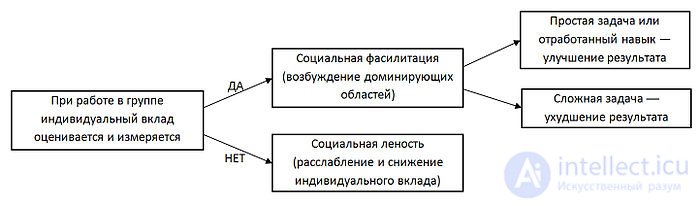
Positive social facilitation: In some cases, when an individual performs a task that they know well and have mastered, the presence of other people can help increase their performance. This shows up as an improvement in the performance of a task the individual already knows how to do.
Negative social facilitation: In other situations, when an individual performs a task that requires concentration or a new skill, the presence of other people can lead to a decline in their performance. This shows up as the individual experiencing a higher level of stress or distraction, which interferes with completing the task.
Social comparison: One of the mechanisms underlying social facilitation is social comparison. When people know they are being observed, they may evaluate their own performance or skills by comparing themselves with others. This can increase or decrease their motivation and level of anxiety.
The audience effect: The audience effect, which is determined by the size and composition of the audience, is also important. For example, nervousness in front of a small group of people can be more intense than in front of a large audience.
Competence and experience: An individual's level of competence and experience with a task can also affect how social facilitation influences their performance. More experienced people may cope more easily with pressure from others.
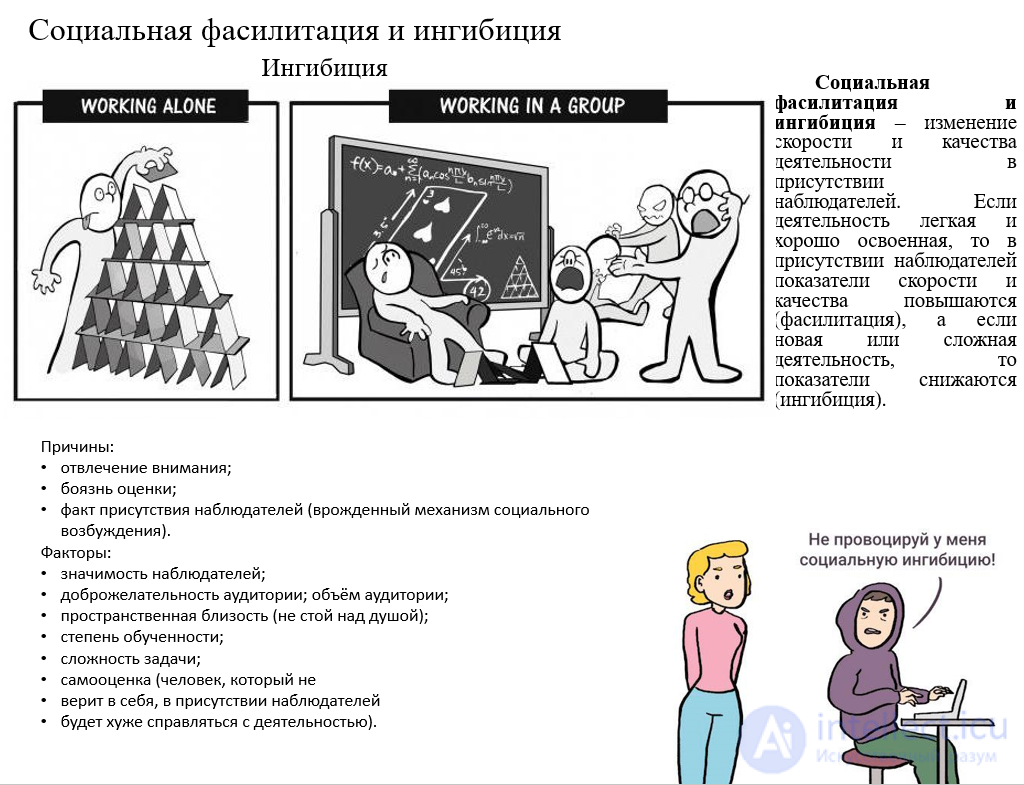
When working in a group without any evaluation of each participant's individual contribution, the opposite effect appears — social loafing.
The effect of social facilitation, though it did not yet have that name, was first identified in 1898 by the psychologist Norman Triplett. He noticed that during bicycle races, athletes showed better results not when racing against a stopwatch, but when taking part in group races. To test this observation, Triplett conducted one of the first laboratory experiments in the history of social psychology, in which children were asked to reel fishing line onto a rod's spool as quickly as possible. The results showed that in the presence of co-performers, children completed the task faster than alone. Further experiments (G. Allport, 1920; Dashiell, 1930; Travis, 1925) showed that in the presence of other people, subjects solved simple tasks faster, such as multiplication problems or crossing out certain letters in a text. However, the opposite effect was soon discovered (see below), and since the data from different experiments contradicted one another, scientists stopped working on this problem for some time.
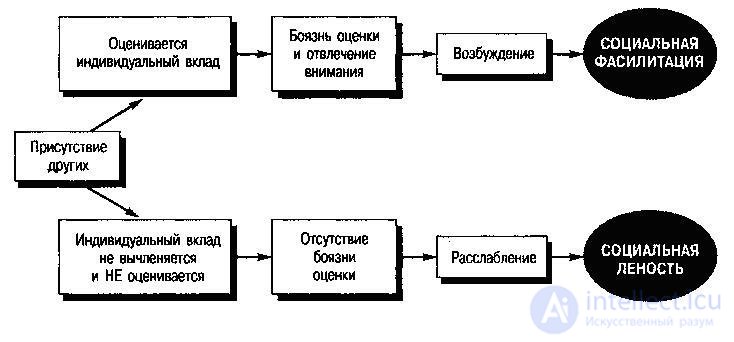
In the 1930s, experimental confirmation was obtained that in some cases the presence of other people hinders task performance. This reverse effect later came to be called social inhibition in social psychology. Thus, in actions that had not been brought to the point of automaticity (for example, memorizing nonsense syllables, running mazes, solving complex arithmetic problems), the presence of other people reduced the speed at which they were performed. In 1966 Robert Zajonc attempted to find a theoretical explanation for this contradictory data. He interpreted the results using a rule well known in experimental psychology: «arousal favors dominant responses». In other words, the social arousal caused by the presence of another person strengthens responses but reduces caution, which is why simple actions, in which an error is unlikely, are performed more successfully, whereas in complex actions requiring concentration, the number of errors increases, making them less successfully performed.
About 300 studies involving 25,000 volunteers confirmed Zajonc's hypothesis. It was later found, for example, that in the presence of observers, students navigate easy mazes faster but struggle more with difficult ones, and that good billiards players achieve even higher scores in terms of number of pocketed balls, whereas poor players start playing even worse.
The effect of social facilitation has repeatedly been observed in animals as well: in the presence of other members of their own species, ants dug through sand faster, chickens ate more grain, and mating rats displayed greater sexual activity in the presence of other pairs. So-called social inhibition has also been observed in animals: cockroaches, long-tailed parakeets, and green finches were slower to learn how to navigate mazes in the presence of members of their own species.
Social facilitation is an interesting phenomenon in the field of social psychology, studied in order to understand the influence of social factors on people's behavior and performance in various situations. It can also have practical applications in the fields of education, training, sports, and other areas where it is important to take into account the influence of social aspects on individual task performance.

Comments