
Lecture
Negative identity — a form of personal and collective identity built «by contradiction», an identification of who «I» or «my» group does not consider itself to be, who is considered an enemy, and which values are rejected. Negative identity is reflected in the image of the enemy. In negative identity, «one's own» positive characteristics, including merits and virtues, are expressed through denying them in «others», through hostility, through aggressive projections of one's own negative qualities onto others, and through attributing one's own negative motives and traits to another.
The main function of negative identity, as with positive identity, is to shape and preserve an integral image of «oneself» or «one's own» as a full-fledged social and political subject. While positive identity rests on the positive and productive differences between «oneself» or «one's own» and «others», negative identity is based on the negative aspects of the opposition; the «other» is perceived as an «enemy» to be fought, or as a «nonentity» to be destroyed. In practice, positive identity presupposes dialogue, while negative identity generates xenophobia, violence, and creates conflicts. As a rule, both forms operate together and are mutually complementary. However, the negative aspect can come to the fore. Society can be regarded as a social subjectivity that determines itself through violence via negative identity.
Xenophobia cannot be limited to aggression toward a single ethnic, religious, or social group or minority, but in specific social contexts a preferred object of negative identity can stand out.
National identity in the aspect of the «image for others» can also include a negative component.
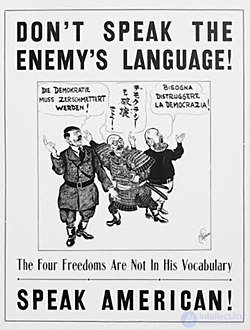
An American poster from the Second World War
The negative aspect of identity can be traced back to the ancient oppositions of «barbarians» to «Hellenes» and of «wild and bloodthirsty» peoples to the «civilized» Romans and Persians; however, it takes on special significance at the turn of the 18th–19th centuries, when modern nation-states are formed, nationalism becomes the basis of the modern system of international relations, and society itself changes under conditions of the industrial revolution, the emergence of megacities, and the increase and acceleration of social mobility. Mass propaganda during the world wars, which portrayed opponents as enemies who were dehumanized and demonized as a source of existential threat, became decisive. One of the most significant ideological expressions of this experience is the concept created by the German legal theorist Carl Schmitt, which he first set out in the article «The Concept of the Political» (Der Begriff des Politischen, 1932). In his view, the distinction between friend and enemy represents the primary phenomenon of politics and the foundation of interaction and struggle within human communities.
The negative aspect usually predominates in communities such as criminal groups, youth subcultures, religious fundamentalists, and deviant professionals such as jazz musicians, studied by H. S. Becker. In the criminal subculture, negative identity (in Russia – «frayer», «lokh», «chushka», «petukh», «musor», and others, as opposed to the positive statuses of «vor» [thief], «blatnoy», and others) serves to maintain hierarchy and to legitimize disciplinary and violent practices.
A predominant negative aspect is also characteristic of individual persons and communities under specific conditions or at particular stages, typically during the initial period of existence or during a period of crisis. Examples include adolescents, systemic outsiders, as well as political, religious, or socially reformist communities in their initial stage. Christianity in its early period built its identity through struggle against «Jews» and «pagans», Islam against «kafirs», and feminism since the 1960s against patriarchy. After a movement becomes integrated into the existing socio-political system, or reshapes it to fit itself, and in the event that its aspirations do not yield results, the negative aspect of identity gives way to the positive one, or it undergoes routinization and shifts into a «chronic» form. In its radical forms, the negative aspect of identity creates the image of an enemy who, it is claimed, is dangerous to the very existence of the community and must be destroyed. Images of the enemy are also situational, forming in connection with wars, revolutions, sudden social changes, or under totalitarian regimes. Structures of negative identity often provoke and legitimize extreme violence, including terror «from above» and «from below», war crimes, and acts of genocide. Thus, the genocide in Rwanda in 1994 followed several decades of intensifying Hutu negative identity against the Tutsi and the panicked spread of the idea of a threat from the Rwandan Patriotic Front.
Negative identity operates in a similar way within culture, including science, philosophy, and art, in the critique of old paradigms and their replacement by new ones. This identity is more characteristic of certain intellectual movements. Thus, Marxists, neo-Marxists, and the contemporary left rely on the critique of capitalism, while the Frankfurt School (M. Horkheimer and T. Adorno, E. Fromm), traditionalists (R. Guénon, J. Evola, and others), and authors such as J. Baudrillard rely on the critique of the «spiritual emptiness» of the present-day world. The Surrealists, Futurists, and Dadaists rejected all preceding forms; within the literature of the same period, the modernists rejected the classical novel, the postmodernists rejected modernism, and many of the newest movements reject postmodernism. The dynamic here unfolds in the same way: opposition provides the initial impulse, but it is subsequently leveled out or routinized, after which it is replaced by something else.
Social psychology often interprets negative identity as identification with groups of marginal, deviant, and criminal individuals, in which identity is constructed as opposition to «normal» society. On the whole, this perspective is close to sociological research on deviance, crime, «total institutions», and so on. In his work «Stigma: Notes on the Management of Spoiled Identity» (1963), Erving Goffman described the negative aspect of the identity of the disabled, the unemployed, patients of psychiatric clinics, and prison inmates as «stigma», a «spoiled identity», representing an experience of one's own inferiority. Close to this phenomenon is that of «self-hatred», the internalization by a particular group of negative external representations of itself created by the surrounding environment. The most famous example, thanks to which this term was introduced, was «Jewish self-hatred». The phenomenon gave its name to a book written by the Jewish-German publicist Theodor Lessing (Der jüdische Selbsthaß, 1930), which examined ideas current among the Jewish intelligentsia but formed within their antisemitic surroundings. Among the «black» middle class in the USA, in African countries, and in Jamaica, «auto-racism» is present. At the beginning of the 21st century, skin-«whitening» plastic surgeries and a negative body image among women became widespread.
Negative identity influences deviant behavior in adolescents. An identity crisis can express itself in the formation of a personality trait defined as negative personal identity. This identity is built on the principle of «against someone», «by contradiction», relying on hostility, rejection, aggressiveness, and opposition. The result is a simplification of one's view of the world, reduced to one-dimensionality, primitivism, and fanaticism, which can take the form of extremism and terrorism. Within extremism, universal moral values and the recognition of the value of the «other» in interpersonal communication are rejected. The basis for the formation of an extremist is a deformation of their personality resulting from a crisis in attaining personal identity. Preventing the realization and spread of extremist ideas and attitudes can primarily be achieved through education, which promotes a shift of identity toward the positive.
Jews have often become an object of negative identity, being perceived as an ethnically and socially marked group «convenient» for channeling politically or nationalistically motivated hostile and aggressive sentiments, for transferring collective guilt or responsibility for various events, or the frustration of a society, or the failures of the policies pursued by the authorities.
The collapse of the Soviet Union led to everything Soviet being perceived as negative and in need of dismantling, including former values. The rejection of the old ideology resulted in the rejection of ideology as such, and of patriotism. The rejection of the old ideology and values also occurred in other post-Soviet countries. The new identity acquired a substantial negative aspect of rejecting the Soviet legacy. In its ordinary sense, the word «patriot» carries no meaning of negative identity, indicating that a person loves their homeland and feels pride in their national belonging. Post-Soviet negative identity shifts the meaning of this concept into the sphere of negative connotations, which is also related to the equating of national and state patriotism as a legacy of the prolonged fusion, in the Soviet consciousness, of the concepts of homeland and state. Yuri M. Lotman wrote of the binary semiotic structure characteristic of Russian culture: each new transformation of the culture's value field occurs through the complete negation of the preceding state. Russian identity, in the aspect of the «image for others», includes a notable negative component: perceptions of one's own country as insufficiently «civilized» or simply «barbaric», an emphasis on technological backwardness, the underdevelopment of civil-society institutions and medicine, and the low prestige of education and science.
The concept is applied primarily in sociology, but also in psychology, mainly social psychology. Sociology examines the collective aspect of identity, its role within a community, and how this identity allows a community to pass through the stages of formation, mobilization, and overcoming crises. Psychology usually studies the individual person, their inner development and socialization, often asserting that the negative aspect of identity has a «destructive» effect on the person. The concept of negative identity can also be applied within other disciplines, including jurisprudence, where it may refer to an active rejection of society's values or indifference to them. Under this understanding, atheists, childfree people, and others may be included among the bearers of negative identity.
Within social psychology, the term was introduced by Erik Erikson in his work «Identity: Youth and Crisis» (1968), in which he distinguished three types of identity: positive, negative, and mixed. The negative type concerns a painful disharmony and disruption of a particular person's inner self-sameness, a contradiction among their own attitudes or a contradiction with the attitudes of their environment. In its «pure» form, such a self-image is destructive, so it undergoes sublimation, repression, or transfer onto other individuals or groups, which creates the image of an enemy. Beyond this aspect, the psychological interpretation corresponds with the sociological one in explaining the causal relationship between negative identity and violence. In Erikson's words, «It is not surprising that young people not inclined to literary reflection can accommodate so profound a negative identity only through aggression, or even outbursts of violence.» The researcher also explains acts of violence arising in relations among tribes, nations, and states through the transfer of one's own hidden fears onto others.

Comments