
Lecture
The concepts of social action, interaction, behavior, and social control are fundamental to modern sociological science. The classics of sociology paid attention to them; they are actively discussed from various positions in recent domestic literature. These circumstances justify my
attempt to present to the readers of our journal, which constantly draws authors and readers into the problems of the conceptual apparatus of modern sociology, an analysis of these concepts.
Action is meaningful human behavior. Social action is an action of a person or a social system whose object is other social subjects.
Social action — «the behavior of an individual (whether it is external or internal in nature) that consists of non-interference or patient acceptance, which, according to the meaning assumed by the acting person or persons, is correlated with the action of other people or is oriented toward it». The concept of social action was first introduced into scientific use by the German sociologist Max Weber.
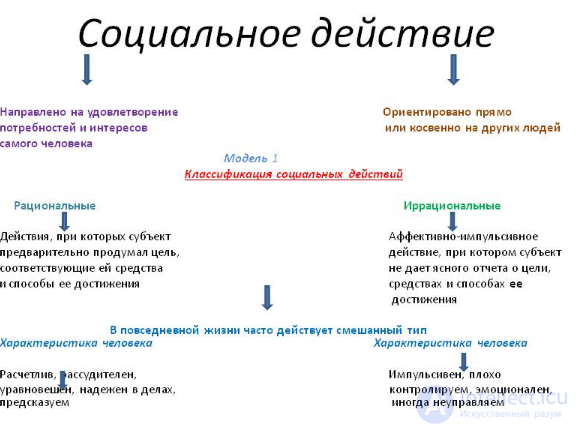
Social action is any manifestation of social activity (activity, behavior, reaction, position, etc.) oriented toward other people. It is the simplest unit (single act) of social activity, presupposing (taking into account) certain expectations and the reaction of other people.
Some researchers equate social action with social interaction. Yu.E. Volkov writes: "social action inevitably gives rise to social interaction." In my opinion, this statement is incorrect. Social action, as a rule, presupposes social interaction, but it may remain without a response. For example, a person in trouble calling for help, hoping to be heard,
and helped, i.e. he is hoping for interaction. But, if not heard, his social action will remain a one-sided act.
In classical sociology, researchers distinguish two main approaches, two points of view on the motivation of social action. The first approach is contained in the works of E. Durkheim, the second in those of M. Weber. According to E. Durkheim, human activity and behavior are rigidly determined by external, objective factors (social structure, social relations, culture, etc.). M. Weber, on the contrary, attached subjective
meaning to social action. He believed that in any social conditions a person has the opportunity to express individuality.
The concept of "social action" was introduced into sociology by M. Weber to denote the action of an individual aimed at resolving life's problems and consciously oriented toward other people.
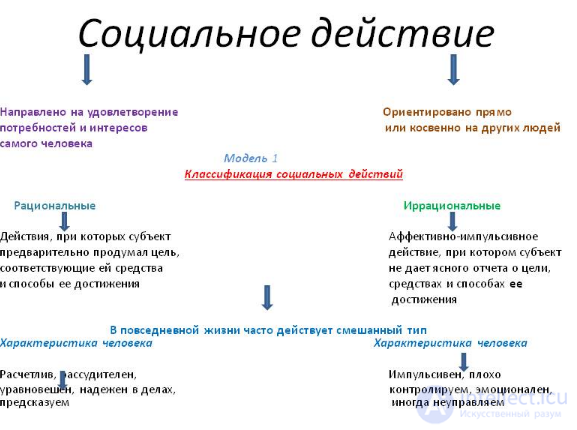
The main features of social action (according to Weber) are conscious motivation and orientation toward others. Weber distinguishes four types of social action:
1) goal-rational action — a conscious action aimed at achieving a specific goal. In this action, the goal is the main motive;
2) value-rational action — an action based on the belief that the act being performed has a certain value. Consequently, in this type of social action, the main motive is value (ethical, religious, ideological, cultural, etc.);
3) traditional action — an action performed out of habit, tradition, as if automatically, for example, we observe customs without thinking about their origin. Thinking "kicks in" only when some difficulties arise. According to Weber, traditional action is performed subconsciously, and for this reason it is a subject of study for psychology, ethnology, and other sciences, but not sociology;
4) affective action — an action determined by emotions and for this reason also not conscious, i.e. not subject to sociological analysis.
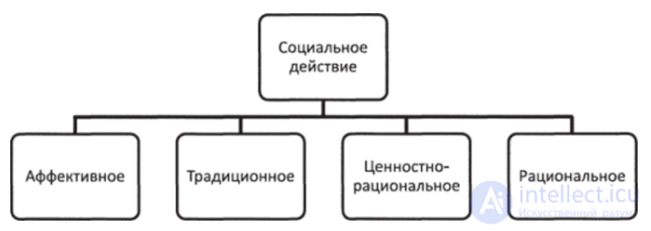
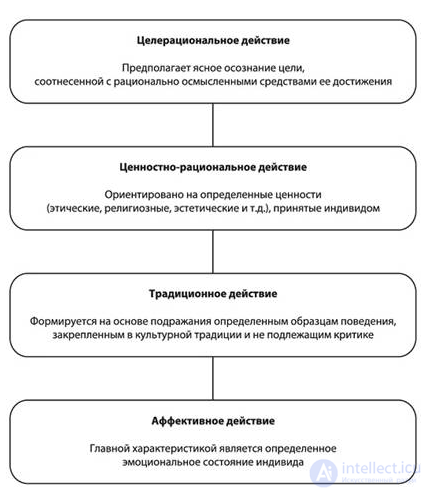
Diagram 1. Types of social action according to M. Weber
T. Parsons proposed a "general system of human action," which includes the "social system," the "personality system," and the "cultural system." Each of these listed "systems" (subsystems) has its own functional significance within the general system of social action. The social system solves problems of social interaction and the integration of society; the cultural system preserves and reproduces patterns; the personality system
performs goal-attainment functions.
The theory of social action proposed by Parsons, to a considerable extent, "limits" (predetermines) the activity of the individual through the existing institutional system, for which it (the theory) has been subjected to reasoned criticism.
The theory of social action received further development in the works of sociologists
such as J. Alexander, P.L. Berger, F. Znaniecki, A. Touraine, J. Habermas, and others. Modern
researchers strive in their concepts to simultaneously take into account objective facts and
subjective motives of social action, as well as the latest scientific and technological achievements and real changes that have occurred in recent years in civil society, in world cultures and civilizations. In doing so, priority is given to the motivational-activity
component of social action.
Thus, for example, the French sociologist A. Touraine introduces into the theory of social action
the concept of the social subject, by which, at the societal level, he means social movements. P.L. Berger believes that between Durkheim's objective determinism of social action and Weber's subjective motivation of social action, there is essentially no contradiction. Both phenomena simply exist simultaneously,
conditioning and explaining each other: "society defines us, and we, in turn, define society." According to J. Alexander, social action is determined by three main components: culture, individuality, and the social system.
Social interaction is a process of direct or indirect influence of social subjects (actors) on one another. It is a process of exchange of actions between two or more actors.
Social interaction is one of the key concepts in sociological theory, because all social phenomena (social relations, processes, changes, social structure, statuses, roles, etc.) arise as a result of social interaction.
It is composed of individual social actions directed at one another. Therefore
social interaction presupposes mutual actions of at least two actors. In this case,
the action can be initiated by the actor itself (an individual, a group) and viewed as a "challenge," or it can be a response to the actions of others — a "response to a challenge."
The essence of social interaction lies in the fact that only in interaction with other people can a person satisfy the overwhelming majority of his needs, interests, and values. Interaction itself is also a basic vital need of the person.
In the process of interaction, there is an exchange of information, knowledge, experience, material, spiritual, and other values; the individual (group) determines their position relative to others, their place (status) in the social structure, and their social roles. The role, in turn, prescribes certain patterns of behavior to the individual and makes interaction predictable. The social structure itself, social relations, and social institutions are the result of various types and forms of social interaction.
The most important component of social interaction is the predictability of mutual expectations or, in other words, mutual understanding between actors. If actors "speak different languages" and pursue mutually exclusive goals and interests, then the results of such interaction are unlikely to be positive.
The study of problems of social interaction has always been at the center of attention
of the world's leading sociologists. M. Weber believed that in the course of interaction, people strive to rationalize their behavior as much as possible in order to achieve the greatest economic efficiency. Therefore, qualities such as awareness, rationality, and orientation toward others are characteristic of social actions.
According to P. Sorokin, social interaction is a mutual exchange of collective experience, knowledge, and concepts, the highest result of which is the emergence of "culture." At the societal level, social interaction can be represented as a sociocultural process in the course of which collective experience is passed from generation to generation. At the same time, "each generation adds its own part, acquired during its lifetime, to the inherited sum of knowledge (experience), and the sum of collective experience (knowledge) thus constantly grows."
J. Homans examines social interaction within the framework of the concept of social exchange he created in the early 1960s. He believes that in the process of interaction each side strives to obtain the maximum possible rewards for its actions and
minimize costs. Among the most important rewards, Homans includes social
approval. Mutually rewarded interaction tends toward regularity and grows into relationships based on mutual expectations. If expectations are not confirmed, then the motivation for interaction and exchange will decline. But there is no direct proportional relationship between reward and cost, since besides economic and other benefits, people's actions are determined (conditioned) by many other factors.
For example, the desire to obtain the maximum possible reward without the appropriate costs;
or, conversely, the desire to do good without expecting a reward.
According to T. Parsons, social interaction at the level of social systems occurs through "zones of interpenetration" and is carried out in the process of mutual exchange.
Social systems appear as "open," being in a state of constant mutual exchange. Moreover, they are differentiated into various subsystems, which are also involved in the processes of mutual exchange [10].
Another scientific direction in the study of social interaction is symbolic interactionism (from interaction). According to J.G. Mead (1863-1931), in interaction, it is not this or that action that plays the more important role, but its interpretation. In other words — how this action is perceived, what meaning (symbol) is attached to it. For example, such a minor gesture (action) as a wink may in one situation be regarded as flirtation or courtship, and in another as support, approval, etc. People, as a rule, do not react automatically to external influences. Before responding to it, they decipher the meaning of the action, i.e. they endow it with a certain symbol. An identical interpretation of action-symbols contributes to the success of interaction.
N. Smelser believes that symbolic interactionism gives a more realistic picture of social interaction than exchange theory. "The essence of symbolic interactionism is that interaction between people is viewed as a continuous dialogue, in the course of which they observe, interpret each other's intentions, and respond to them" [11].
Social behavior is a qualitative characteristic of social action and interaction; it is how a person conducts himself in one situation or another, in one social environment or another. For example, 450 deputies simultaneously participate in the work of the State Duma, i.e. they engage in political activity. But the behavior of these political subjects is not uniform. Some doze in their deputy seats, others shout something from their place,
still others rush to the microphone at the podium, and yet others start a scuffle with colleagues.
Participants in mass events behave differently as well. For example, some participants in a demonstration march peacefully along the declared route, others seek to organize disturbances, and still others provoke bloody clashes. All these differences in the actions of the subjects of social interaction fall under the definition of "social behavior." In other words, all the actors described are engaged in political activity or participating in a mass event, but each behaves differently. Consequently, social behavior is the way in which a social actor manifests preferences, motives, attitudes, opportunities, and abilities in social action or interaction.
The social behavior of an individual (group) can depend on many factors. Let us list some of them:
Thus, for example, under the communist regime in the USSR, people were forced to participate in mass political events (subbotniks, rallies, elections, demonstrations) and, in doing so, to behave in a certain way.
The nature of behavior is significantly influenced by the motivation and degree of involvement of the actor in this or that event or process. For example, for some, participation in political events is a chance episode; for others, politics is a profession; for others still, it is a calling
and the meaning of life; for yet others, a way of earning a living [12]. Mass behavior can be conditioned by the socio-psychological properties of the crowd, when individual motivation is suppressed and dissolved in the not entirely conscious (sometimes spontaneous) actions of the crowd [13].
Four levels of a subject's social behavior can be distinguished:
Social control. The most important condition for social interaction and the effective functioning of the social system is predictability in people's actions and behavior. The absence of predictability leads society (a social community) to disorganization and disintegration. Therefore, society creates various mechanisms of social control in order to coordinate the behavior of its members.
Various social institutions serve as mechanisms of social control. For example, the institution of the family exercises primary social control and regulates people's behavior in the marital-family sphere of society; political institutions exercise
social control by political methods, etc.
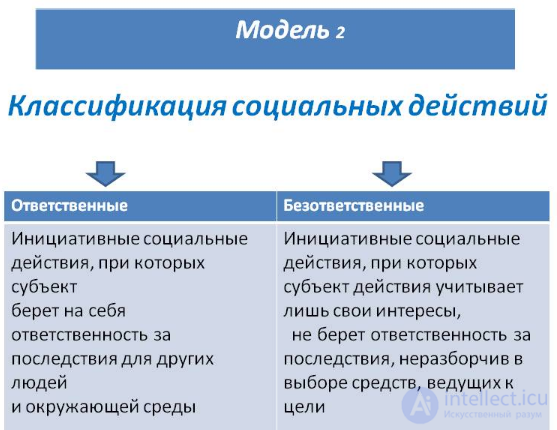
In order for people's behavior to correspond to social expectations, society creates
(forms) certain standards of behavior — social norms.
Social norms are socially approved and/or legally established rules, patterns, and standards that regulate people's behavior. They (norms) can be divided into two main types:
In order for people always to behave in accordance with the norms existing in society, it is necessary, first, to teach people appropriate behavior, and second, to exercise control over compliance with the norms. Let us examine both of these conditions (teaching and control) in more detail.
1. Certain standards of social behavior are instilled in the individual already in early
childhood. During the period of primary socialization in the family and preschool institutions, the child receives his first ideas of how to behave in one situation or another. In the course of further socialization, the individual assimilates various social roles; learns to distinguish which behavior is most preferable in which social environment; determines his attitude toward various social expectations and norms of behavior;
strives to behave in accordance with existing norms or, conversely, violates them.
2. Society, in the course of its functioning, not only forms social norms but also creates mechanisms of control over their observance; for example, such as public opinion, the mass media, internal affairs bodies, courts, etc. It (society) also predetermines a basic typology of social roles and monitors their proper observance. An individual who performs his role well, as a rule, is granted a certain reward, while the "violator" is punished.
The social structure itself, social relations, and impersonal social statuses
prescribe certain standards of social behavior to the specific individuals occupying them. For example, a popular pop performer, having won a gubernatorial election and received the status of governor, is forced to abandon his former role and play the role of a solid political leader; yesterday's cadet, having received the rank and status of an officer, is forced to play the role of a strict commander.
Methods of control are quite varied, and their application varies depending on
specific conditions and set goals. Thus, for example, a display of cowardice under ordinary
conditions may be punished by the contemptuous attitude of those around; a similar act committed by a soldier in wartime is often equated to treason and punished by public execution.
The oldest and simplest method of social control is physical violence. It can be used as one of the methods of upbringing in the family, as a way of fighting crime, as one of the means of maintaining order in public places, etc.
Political control is the prerogative of state authorities and the socio-political institutions of civil society. But society itself, if it possesses sufficient civic culture, can use mechanisms of political
control to defend its interests. Political methods of social control are the most effective, since they rely on state power and can use legitimate violence for their purposes.
No less effective than political methods are economic methods of social control. Their essence lies in the economic pressure (economic benefit or coercion) exerted on an individual or social groups. For example, an employee who is loyal to
his employers may be rewarded with additional material compensation, while an employee who does not show due loyalty may lose part of his earnings or even his job.
There are also other methods of social control, for example, ideological, religious, sociocultural, moral-ethical, and others.
A significant place in social control is occupied by the phenomenon of self-control — a mechanism of internal self-regulation of the individual formed in the process of socialization and internal mental processes. The key concept in the formation of mechanisms of self-control is "internalization." This is the process of forming internal structures of the human psyche through the assimilation of the social realities of the external world. By internalizing
the social world, the individual acquires his identity with a particular social group,
ethnicity, and culture. Social values and norms become one's own internal norms, and social control turns into self-control. The main elements of self-control are consciousness, conscience, and will.
Conscience does not allow an individual to violate the attitudes, principles, and convictions he has developed. Will helps the individual overcome his internal subconscious desires and needs and act in accordance with his convictions.
A prominent place in social control is occupied by norms created and approved by society, which are of a general nature and cannot take into account the entire diversity of real life. Moreover, many people do not have the opportunity or do not wish to comply with certain social norms. Let us examine some of the reasons contributing to the violation of social norms.
Max Weber developed the first classification of types of social action, based on the degree of rationality of individuals' behavior. Thus, he distinguished:
In T. Parsons, the problem of social action is connected with the identification of the following features:
Any social action represents a system in which the following elements can be distinguished:
The following two concepts should be distinguished: «behavior» and «action». Whereas behavior is the organism's response to internal or external stimuli (it can be reflexive, unconscious, or deliberate, conscious), action is only certain types of behavior. Social actions are always deliberate complexes of acts. They are connected with the choice of means and are directed at achieving a specific goal — changing the behavior, attitudes, or opinions of other individuals or groups in a way that would satisfy certain needs and interests of those exerting the influence. Therefore, ultimate success largely depends on the correctness of the choice of means and method of action. Social action, like any other behavior, can be (according to Weber):
In this regard:
Social actions are a certain system of acts, means, and methods, using which an individual or social group seeks to change the behavior, views, or opinion of other individuals or groups. The basis of social action is contacts; without them the desire to evoke certain reactions in an individual or group, or to change their behavior, cannot arise. So, social actions are actions whose purpose is to bring about a change in the behavior, views, and aspirations of individuals or communities. Even M. Weber emphasized that not all human actions are social actions, since achieving by no means every goal presupposes orientation toward other people. On this point, in his work "Basic Sociological Concepts," he wrote: "Social action (including non-interference or patient acceptance) can be oriented toward the past, present, or expected future behavior of others. It can be revenge for past offenses, defense against danger in the present, or measures of protection against impending danger in the future. 'Others' can be individual persons, acquaintances, or an indefinite multitude of complete strangers" [29. p.625]. Thus, according to M. Weber, social action represents a synthesis of two necessary moments:
Any social action represents a system in which the following elements can be distinguished:
Jürgen Habermas worked on developing his own theory of communicative action, which is in many ways a continuation of the works of Max Weber. Within the framework of his theory, Habermas identified 4 ideal types of social action in modern social theory :

Comments