
Lecture
Antenna noise temperature —  — is the temperature caused by radiation from the surrounding environment in the absence of the source under study , and by thermal losses in the feed system . has nothing to do with the physical temperature of the antenna. It is given by the Nyquist formula and equals the temperature of a resistor that would have the same thermal noise power in the given frequency band:
 ,
,
where  — is the noise power,
  — is the Boltzmann constant,
  — is the frequency band.
The source of noise is not the antenna itself, but noisy objects on Earth and in space. The cosmic component of the noise depends on the antenna diameter: the larger the diameter and gain, the narrower the main lobe of the radiation pattern, and consequently the less extraneous cosmic noise the antenna amplifies together with the useful signal. The terrestrial component of the antenna noise temperature depends on the elevation angle — the lower the antenna «looks», the more industrial interference and noise from sources on the Earth's surface it picks up. Therefore, the noise temperature is not a constant value but a function of the elevation angle. As a rule, it is specified in the datasheet for one or several elevation-angle values. The typical noise temperature of a 90 cm diameter parabolic antenna in the Ku band at an elevation angle of 30 degrees is 25-30 K.
In radio-frequency applications, the noise power is defined by the relation  , where k — is the Boltzmann constant, T — is the noise temperature, and B — is the noise bandwidth. Usually the noise bandwidth is determined by the bandwidth of the intermediate-frequency (IF) filter of the radio receiver. Thus, we can define the noise temperature as:
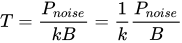
Because is a constant, we can effectively think of  as the power spectral density of the noise (in
  ,) normalized to .
Antenna noise is only one of the factors affecting the overall noise temperature of an RF receiver system, so it is usually denoted with a subscript, for example  . It is added directly to the effective noise temperature of the receiver to obtain the overall system noise temperature:

The antenna noise temperature depends on many sources, including:
Galactic noise lies at frequencies below 1000 MHz. At 150 MHz it is approximately 1000 K. At 2500 MHz it has leveled off at about 10 K.
The Earth has an accepted standard temperature of 288 K.
The level of the Sun's contribution depends on the solar flux. It is given by

where  is the solar flux,
 is the wavelength,
and  — is the antenna gain in decibels.
The antenna noise temperature depends on the coupling of the antenna to all noise sources in its environment, as well as on the noise generated inside the antenna. That is, in a directional antenna the proportional contribution comes from the part of the noise source that the main and side lobes of the antenna intersect.
For example, a satellite antenna may not receive noise from the Earth in its main lobe, but the side lobes will contribute part of the 288 K Earth noise to its overall noise temperature.
Let us consider in more detail the equivalent noise temperature, which is called the antenna temperature (TA). Its value depends on many factors, such as the size of the antenna, its elevation angle relative to the horizon, the influence of external noise sources, and the conditions of signal propagation in the atmosphere. In clear weather, the main source of noise is the background noise, since it in fact represents all the noise reaching the antenna, apart from the influence of atmospheric factors such as rain and others. Antenna manufacturers often provide this parameter in the form of a table with different values that depend on the antenna's elevation angle relative to the horizon. This parameter may also include a small contribution from galactic background noise. In total, three main components of the overall antenna noise can be distinguished.
The antenna noise temperature caused by background noise (TANT) depends on the size of the antenna and its elevation angle relative to the horizon. If the antenna has a smaller diameter, then it has a wider radiation pattern and more side lobes, which can pick up noise from the warm Earth. Consequently, such an antenna will collect more background noise. In addition, at smaller elevation angles the side lobes, especially the first side lobe, of smaller antennas will be more sensitive to background noise than those of larger antennas.
To reduce the background noise, one can decrease the antenna gain by limiting the illumination of the antenna reflector. This, however, reduces the antenna's efficiency. If we compare two antennas of the same size, a prime-focus antenna will be noisier compared to an offset antenna, because the feed head in a prime-focus antenna is located directly in the signal path and "sees" the warm Earth, which adds extra noise.
The formula for approximately calculating the antenna noise temperature in clear weather takes into account the elevation angle and the antenna diameter:
TANT (approximate) = 15 + 30 / D + 180 / EL,
where D is the antenna diameter in meters, EL is the antenna elevation angle in degrees.
Let us consider an example.
Suppose we have an antenna with a diameter of 0.65 meters that uses a mesh to reinforce the structure. We want to calculate the worst-case noise-temperature value of this antenna at a set elevation angle of 25 degrees.
To do this, we use the formula:
TANT = 15 + 30 / 0.65 + 180 / 25 = 68 Kelvin.
This means that the worst-case noise-temperature value of this antenna at an elevation angle of 25 degrees is 68 Kelvin.
The next noise component, called cosmic or galactic noise, originates from the background cosmic radiation left over after the "Big Bang". Its magnitude is usually small and amounts to about 2.7 Kelvin. This component can be ignored in practical calculations, since it is small compared to the error in calculating the background noise.
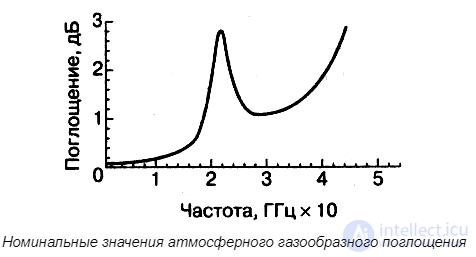
The influence of signal propagation conditions in the atmosphere should also be taken into account. In particular, atmospheric gaseous absorption of the signal by water vapor and oxygen is important, especially in clear weather. The magnitude of this absorption depends on the absolute humidity, the antenna elevation angle, and the signal frequency. At frequencies below 8 GHz it is of negligible significance.
Nominal values of atmospheric absorption for the European part of the planet's surface are shown in the figure:
To obtain specific values of the influence of signal propagation conditions on the antenna depending on the elevation angle and frequency in different regions of the Earth, one can use special software such as Satellite-Antenna-Alignment. This program helps to accurately calculate the values for different parameters.
The second component that affects signal propagation is the signal attenuation in precipitation. When the signal is transmitted upward from the ground to the satellite, the receiver on the satellite is faced with a high temperature emanating from the Earth's surface, which is approximately 290 Kelvin. Therefore, the additional emission of thermal energy from rain has only a small effect.
When the signal is directed downward from the satellite to the Earth, the receiver on the Earth looks at a relatively cool sky, which has a lower noise temperature. This means that the additional noise caused by rain plays a less significant role in the overall noise temperature of the receiving system, especially if a low-noise receiver (LNB) is used in the Ku or Ka bands. In the S and C bands, the influence of rain and atmospheric absorption is less significant.
Precipitation not only causes signal attenuation (this effect is called "rain fade"), but also leads to an increase in the noise temperature of the receiving system. This happens because the temperature of the surrounding environment approaches the temperature of the Earth's surface. Therefore, it is important to take into account not only the signal attenuation caused by rain, but also the increase in the noise temperature of the receiving system. This effect is called downlink degradation (DND).
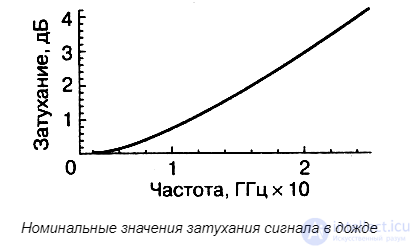
Effects associated with signal propagation conditions become noticeable at frequencies exceeding 8 GHz. Rain, snow, fog, or cloud cover can attenuate and scatter the microwave signal. The degree of attenuation depends more on the size of the water droplets (measured in cubic units relative to the signal wavelength) than on the intensity of the precipitation. Usually, in heavier rain, the droplets become larger, so these factors are often interrelated. For calculations, a physical-medium temperature of 260 Kelvin is usually used for any form of precipitation. However, in the case of cloud cover or clear weather, the temperature may be taken as equal to 280 Kelvin.
To obtain specific values depending on the particular path of the signal through the Earth's atmosphere and the signal availability, one can use the Satmaster program. The figure below shows nominal values for Europe with a signal availability of 99.7% for an average year (and 99% for the worst month).
The concept of antenna noise temperature , along with the concept of antenna temperature  , is widely used in radio astronomy. The antenna temperature characterizes the total power of the radiation received by the antenna, i.e. the noise power and the power of the objects under study, whereas the noise temperature — only the noise power (of the interfering factors). If not a single radio source falls within the radiation pattern, then the antenna temperature equals the noise temperature
  . Thus, the useful signal depends on the difference between the antenna and noise temperatures
  .
.
As a rule, the noise temperature consists of two parts: a constant part and a stochastic part. The constant component can be compensated for, but the stochastic one imposes fundamental limitations on the sensitivity of radio telescopes. Therefore, to increase the signal-to-noise ratio when designing radio telescopes, the main attention is paid to reducing the stochastic component. For this purpose, low-noise amplifiers, cooling of the receivers with liquid nitrogen or helium, and so on are used.

Comments