
Lecture
An antenna field — a compactly arranged group of receiving and/or transmitting antenna-feeder devices, deployed as part of field or stationary radio hubs, radio stations, and also — on large modern vessels and aircraft
ANTENNA FIELD — a group of antennas located within a territory (in space) limited by operational conditions. It is deployed as part of stationary or mobile RES (radio-electronic systems), radio hubs and radio centers, including on ships, spacecraft, air and railway command posts, etc.
When there are restrictions on the size of the antenna field, all of its elements, which may number several dozen, must be located relatively close to one another, yet their electromagnetic interaction must be kept to a minimum, since it can significantly distort the shape of the radiation pattern, cause interference to radio signals, alter a number of key electrical parameters, and so on.
In order to reduce the mutual influence of different radio assets, a wide variety of methods are employed, for example:
and others.
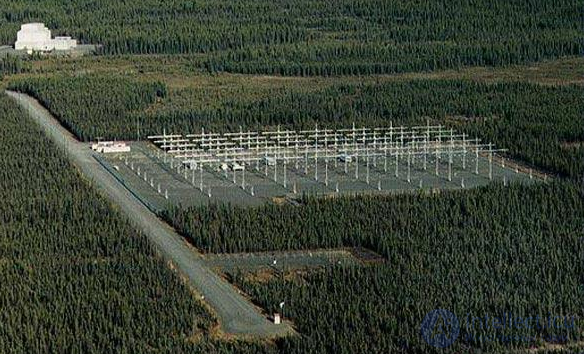
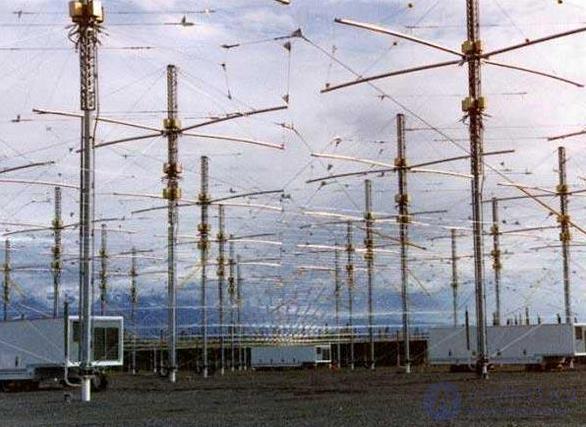
Antenna field of the HAARP facilities
HAARP (High Frequency Active Auroral Research Program) — an American research project for studying the ionosphere and auroras. The project was launched in the spring of 1997, in Gakona, Alaska.
HAARP includes antennas, an incoherent scatter radar with a 12 cm diameter antenna, laser radars, magnetometers, and computers for signal processing and for controlling an antenna field of 180 antennas.
The entire complex is powered by a large gas power plant and six diesel generators.
Unlike broadcast stations, many of which have 1 MW transmitters but weakly directional antennas, HAARP and similar systems use highly directional transmitting antennas, usually phased antenna arrays, capable of focusing almost all of the radiated energy into a narrow beam and, consequently, onto a small region of space.
Radiated power levels
HAARP (USA) — presumably up to 4.8 MW (in 2009 it was 3.6 MW) (Effective power: Pe = 3.6 GW)
Sura — about 2 MW
EISCAT (Norway, Tromsø) — 1.2 MW
SPEAR (Norway, Longyearbyen) — 288 kW
"DUGA" is the first over-the-horizon radar in the Union (not to be confused with above-the-horizon radars) intended for detecting launches of ballistic missiles. Three stations of this series are known: the experimental «DUGA-N» installation near Nikolaev, "DUGA-1" in the settlement of Chernobyl-2, and "DUGA-2" in the settlement of Bolshaya Kartel near Komsomolsk-on-Amur. At present, all three stations have been decommissioned and their electronic equipment dismantled; the antenna arrays have also been dismantled, except for the station located in Chernobyl. The antenna field of the "DUGA" station is one of the most prominent structures in the exclusion zone after the building of the Chernobyl Nuclear Power Plant itself.
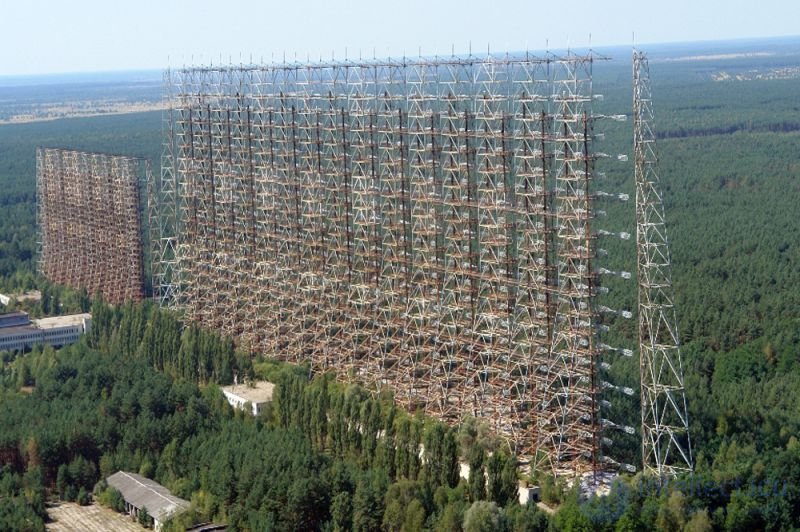
The antenna field of "DUGA" in Chernobyl, although it looks more like a wall)
As for the capabilities of "DUGA", stations of this type could only detect a massed launch of missiles, in which a large number of plumes of ionized gas from the missile engines are formed.
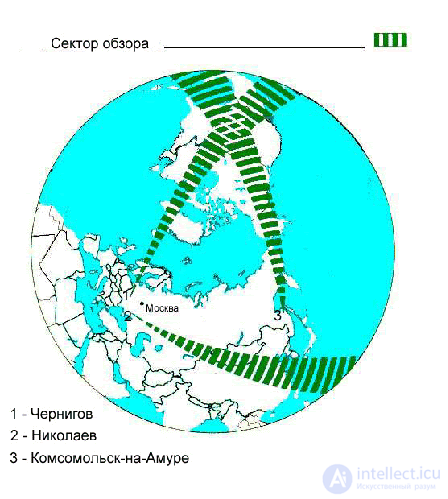
coverage sectors of the three DUGA-type stations

Comments