
Lecture
A rectenna (from English rectifying antenna — a rectifying antenna) is a device consisting of a nonlinear antenna designed to convert the field energy of an incident electromagnetic wave into direct-current energy. The simplest design variant can be a half-wave dipole between whose arms a device with one-way conductivity (for example, a diode) is installed. In such a design, the antenna is combined with a detector, at whose output, in the presence of an incident wave, an EMF appears. To increase gain, such devices can be combined into multi-element arrays. A rectenna (rectifying antenna) is a special type of receiving antenna that is used to convert electromagnetic energy into direct current (DC) electrical power. They are used in wireless power transmission systems that transmit power via radio waves. A simple rectenna element consists of a dipole antenna with an RF diode connected across the dipole elements. The diode rectifies the alternating current induced in the antenna by the microwaves in order to produce DC power, which powers a load connected across the diode. Schottky diodes are usually used because they have the lowest voltage drop and the highest speed and therefore have the lowest power losses due to conduction and switching. [1] Large rectennas consist of many such dipole elements.
Rectennas can be used as receivers in long-distance power transmission channels, which is especially important for transporting energy from solar power stations built in orbit down to Earth and vice versa, from Earth to an ascending vehicle, for example, to a space elevator.
In 1976, the American physicist William Brown succeeded in transmitting a microwave beam with a power of 30 kW over a distance of 1 mile (1.6 km). The efficiency of the rectenna in this experiment was slightly more than 80% [1], which is nevertheless lower than the efficiency of power transmission lines.
One of the greatest Soviet physicists, Nobel laureate, academician Pyotr Leonidovich Kapitsa devoted considerable time to studying the prospects of using microwave oscillations and waves to create new and highly efficient power transmission systems. [2]
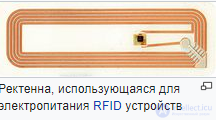
The invention of the rectenna in the 1960s made wireless power transmission over long distances possible. The rectenna was invented in 1964 and patented in 1969 [2] by the American electrical engineer William Brown, who demonstrated it on a model helicopter powered by microwaves transmitted from the ground, received by an attached rectenna. [3] Beginning in the 1970s, one of the main motivations for rectenna research was the development of a receiving antenna for proposed solar power satellites, which would collect the energy of sunlight in space together with solar cells and transmit it to Earth in the form of microwaves for enormous rectenna arrays. [4] A proposed military application was to power a reconnaissance drone with microwaves radiated from the ground, allowing it to remain in the air for a long time. In recent years, interest in using rectennas has arisen as a power source for small wireless microelectronic devices. Currently, the greatest use of rectennas is in RFID tags, contactless cards, and contactless smart cards, which contain an integrated circuit (IC) powered by a small rectenna element. When the device is brought near an electronic reader, radio waves from the reader enter the rectenna, powering up the chip, which transmits its data back to the reader.
The simplest crystal radio receiver, which uses an antenna and a demodulating diode (rectifier), is in fact a rectenna, although it discards the DC component before sending the signal to the earphones. People living near strong radio transmitters sometimes discover that with a long receiving antenna they could obtain enough electrical energy to light a bulb. [5]
However, this example uses only a single antenna, which has a limited capture area. A rectenna uses several antennas distributed over a wide area to capture more energy.
Researchers are experimenting with using rectennas to power sensors in remote areas. [6]
RF rectennas are used for several kinds of wireless power transmission. In the microwave band, experimental devices have achieved energy conversion efficiency of 85-90%. [7]
Similar devices, scaled down to the proportions used in nanotechnology, can be used to convert light directly into electricity. This type of device is called an optical rectenna or a nantenna. [8] [9] Theoretically, high efficiency can be maintained when the device is shrunk, but the efficiency has so far been limited. The University of Missouri had previously reported work on the development of low-cost, high-efficiency nantennas (optical-frequency rectennas). [10] Other prototype devices have been investigated in a collaboration between the University of Connecticut and Penn State Altoona using a grant from the National Science Foundation. [11] Using atomic layer deposition, it has been suggested that a solar-to-electricity conversion efficiency above 70% may eventually be achieved.
The challenges associated with a successful nantenna technology include fabricating an antenna small enough to couple to optical wavelengths and creating an ultrafast diode capable of rectifying high-frequency oscillations.
In 2015, researchers at the Georgia Institute of Technology fabricated an optical rectenna using arrays of 2 million multi-walled carbon nanotubes (MWCNTs) per cm 2, connected to nanoscale rectifying diodes. The MWCNTs, which act as optical antennas due to their advantageously small dimensions, are coated with aluminum oxide and covered with a metal top layer. This combination of MWCNT, oxide, metal is considered the world's fastest metal-insulator-metal (MIM) tunnel diode, capable of rectifying optical frequencies. Individual junctions were reported to have a capacitance of only 1.7 W, with switching times on the order of 1 femtosecond. [8]

Comments