
Lecture
A spark ultra-wideband noise generator is a device that generates pulsed signals with a very broad frequency spectrum. It is used in wireless communications for masking and jamming.
Here are several key characteristics of a spark ultra-wideband noise generator:
Short pulses: The generator can produce short pulses, often with a duration of several nanoseconds. These short pulses make it possible to use a wide frequency spectrum.
Wide spectrum: The bandwidth of a spark signal is quite substantial. IR-UWB can cover frequencies from a few hundred megahertz to several gigahertz, which provides high data transmission throughput.
Low energy: Spark signals typically have low energy per pulse. This contributes to more efficient use of energy during data transmission.
Wideband antenna: For efficient generation and reception of the IR-UWB signal, wideband antennas are often used.
Application in electronic warfare (EW) and radio-masking systems.
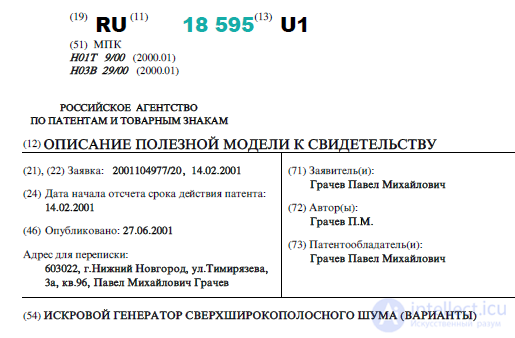
Patent authors: 18595 P.M. Grachev
1. A spark ultra-wideband noise generator comprising a source of electrical energy and a spark gap connected to it, characterized in that the spark gap is configured as a capsule placed in two cups with the required radial and axial clearances, wherein the terminals of the electrical energy source are connected to the cups, the capsule and the cups are made of valve metals or alloys based on them, and the electrically interacting surfaces of the capsule and the cups are provided with a dielectric layer of an oxide of a valve metal or an alloy based on it, and the spark gap is provided with a drive for forced movement of the capsule relative to the cups, inductively interacting with a magnetic insert placed in the capsule, and furthermore, the generator is provided with a telescopic antenna directly connected to the cups of the spark gap.
2. A spark ultra-wideband noise generator comprising a source of electrical energy and a spark gap connected to it, characterized in that the spark gap is configured as a capsule whose end zones are placed in two bushings with the required radial and axial clearances, wherein the terminals of the electrical energy source are connected to the bushings, the capsule and the bushings are made of valve metals or alloys based on them, and the electrically interacting surfaces of the capsule and the bushings are provided with a dielectric layer of an oxide of a valve metal or an alloy based on it, and the spark gap is provided with a drive for forced movement of the capsule relative to the bushings, mechanically interacting with the capsule, and furthermore, the generator is provided with a telescopic antenna directly connected to the bushings of the spark gap.
3. A spark ultra-wideband noise generator comprising a source of electrical energy and a spark gap connected to it, characterized in that the spark gap is configured as a dielectric tube placed in two cups, wherein the terminals of the electrical energy source are connected to the cups, a plurality of balls is placed in the cavity of the dielectric tube, and the balls and the cups are made of valve metals or alloys based on them, and the electrically interacting surfaces of the balls and the cups are provided with a dielectric layer of an oxide of a valve metal or an alloy based on it, and the spark gap is provided with a drive for forced movement of the balls relative to the cups and to one another, inductively interacting with a magnetic insert placed in one or several balls.
4. The spark generator according to claim 3, characterized in that the generator is provided with a telescopic antenna directly connected to the cups of the spark gap.
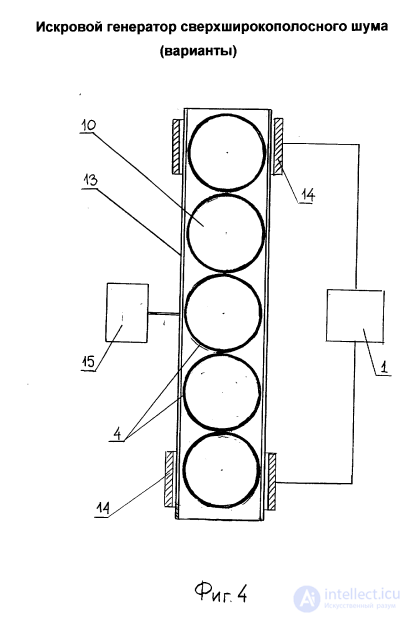
5. A spark ultra-wideband noise generator comprising a source of electrical energy and a spark gap connected to it, characterized in that the spark gap is configured as a dielectric tube inside which a plurality of balls of a valve metal or an alloy based on it is placed, wherein the tube is secured in bushings connected to the terminals of a high-frequency high-voltage source of electrical energy, wherein the electrically interacting surfaces of the balls are provided with a dielectric layer of an oxide of a valve metal or an alloy based on it, and the spark gap is provided with a drive, for example a vibrational one, for forced movement of the balls inside the dielectric tube.
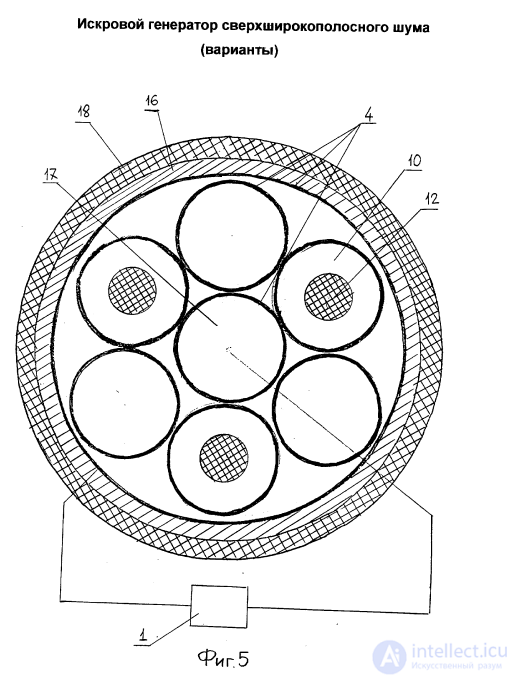
6. A spark ultra-wideband noise generator comprising a source of electrical energy and a spark gap connected to it, characterized in that the spark gap is configured as an annular cage provided with a centering roller, wherein a plurality of balls is placed between the inner surface of the annular cage and the centering roller, and the annular cage, the centering roller, and the balls are made of valve metals or alloys based on them, and the electrically interacting surfaces of the annular cage, the centering roller, and the balls are provided with a dielectric layer of an oxide of a valve metal or an alloy based on it, wherein the terminals of the electrical energy source are connected to the annular cage and the centering roller, and furthermore, the spark gap is provided with an induction drive configured as a solenoid surrounding the annular cage, and some of the balls are provided with magnetic inserts.
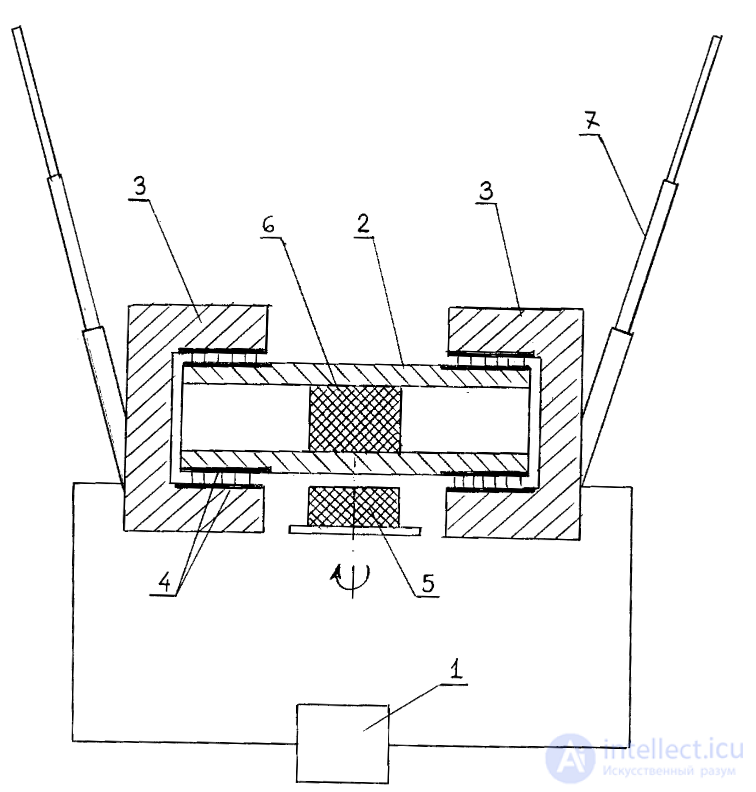
Fig. 1.
The utility model relates to means for generating
broadband electromagnetic radiation over a wide range of
frequencies and can be used to protect information from leakage
via a radio channel (protection of computers, blocking of eavesdropping
devices, radiotelephones, countering radio-controlled
explosive devices, etc.).
To assess the novelty and technical level of the claimed
solution, let us consider a number of known technical means of similar
purpose.
A controlled spark gap is known, comprising two
opposing main electrodes and a triggering electrode,
separated from the grounded main electrode by an insulating
bushing protruding into the gap between the main electrodes and
arranged coaxially with the triggering electrode, and a coil
of an electromagnet installed outside said insulating
bushing, wherein the triggering electrode is configured as a ring
installed outside said insulating bushing, the grounded
electrode is configured as a hollow cylinder coaxially
installed inside said insulating bushing, and the coil
of the electromagnet is arranged coaxially with the triggering electrode; see
USSR author's certificate No. 1769669, H01T 2/02.
An ultra-wideband signal generator is known,
comprising a noise element connected to a voltage source and
configured as a tube filled with metal balls,
which are made of aluminum, wherein the tube is made of
a dielectric and is placed on the longitudinal axis of an introduced conical
horn; see RF patent No. 2031538, H03B 29/00.
A spark generator of electromagnetic radiation
with a non-constant frequency spectrum is known, comprising a set of electrodes
connected to sources of electrical discharges, and a system
for random short-circuiting of the electrodes, which is configured as
a dielectric plate with rigid walls connected to a vibrational mechanism,
made with spherical recesses and
provided with a set of oxide-free metal balls placed
on the plate with the ability to move freely and having
a radius commensurate with the radius of the recesses, the electrodes connected to
opposite poles of the sources of electrical charges,
being mechanically combined by means of additionally introduced
bases into spring-loaded pairs, the number of which is chosen equal to
the number of recesses, in each of which a corresponding pair
of electrodes is installed, wherein the depth H and radius B of the recesses are chosen in the ratio
0.4 < H/B < 0.66; see RF patent No. 2037245, H01T 9/00.
By the largest number of similar features and the result achieved
in use, this technical solution is chosen
as the prototype of the claimed utility model.
The disadvantages of the prototype, which do not allow achieving
the goal we have set, are the insufficient stochasticity of the
frequency characteristics of the electromagnetic radiation of the spark
discharges, the insufficient bandwidth of the obtained frequencies, and the low
output power relative to the dimensions and cost of the generator.
The utility model is based on the solution of the problem of creating
a simple and reliable device for generating
ultra-wideband noise with a high entropy factor
of radiation, a high efficiency, and a high
average output power relative to the mass-and-dimension
characteristics and cost of the generator.
The essence of the claimed utility model is expressed in
the following sets of essential features of several
independent variants of the claimed technical solution,
united by a single inventive concept.
According to the first independent variant of the utility model, a
spark ultra-wideband noise generator comprising a source of
electrical energy and a spark gap connected to it,
is characterized in that the spark gap is configured as a capsule
placed in two cups with the required radial and axial
clearances, wherein the terminals of the electrical energy source
are connected to the cups, the capsule and the cups are made of valve
metals or alloys based on them, and the electrically interacting
surfaces of the capsule and the cups are provided with a
dielectric layer of an oxide of a valve metal or an alloy based on it,
and the spark gap is provided with a drive for forced
movement of the capsule relative to the cups, inductively
interacting with a magnetic insert placed in the capsule,
and furthermore, the generator is provided with a telescopic antenna,
directly connected to the cups of the spark gap.
This constitutes the set of essential features
of the first independent variant of the claimed solution, ensuring
the achievement of the technical result in all cases to which
the requested scope of legal protection extends.
According to the second independent variant of the utility model, a
spark ultra-wideband noise generator comprising a source of
electrical energy and a spark gap connected to it,
is characterized in that the spark gap is configured as a capsule
whose end zones are placed in two bushings with the required
radial and axial clearances, wherein the terminals of the
electrical energy source are connected to the bushings, the capsule and the bushings
are made of valve metals or alloys based on them, and
the electrically interacting surfaces of the capsule and
the bushings are provided with a dielectric layer of an oxide of a valve metal
or an alloy based on it, and the spark gap is provided with a drive for
forced movement of the capsule relative to the bushings,
mechanically interacting with the capsule, and furthermore, the generator
is provided with a telescopic antenna directly connected to
the bushings of the spark gap.
This constitutes the set of essential features
of the second independent variant of the claimed solution, ensuring
the achievement of the technical result in all cases to which
the requested scope of legal protection extends.
According to the third independent variant of the utility model, a
spark ultra-wideband noise generator comprising a source of
electrical energy and a spark gap connected to it,
is characterized in that the spark gap is configured as a
dielectric tube placed in two cups, wherein the terminals
of the electrical energy source are connected to the cups, in the cavity
of the dielectric tube a plurality of balls is placed, and the balls and
the cups are made of valve metals or alloys based on them,
and the electrically interacting surfaces of the balls and
the cups are provided with a dielectric layer of an oxide of a valve metal
or an alloy based on it, and the spark gap is provided with a drive for
forced movement of the balls relative to the cups and to one
another, inductively interacting with a magnetic insert,
placed in one or several balls.
This constitutes the set of essential features
of the third independent variant of the claimed solution,
ensuring the achievement of the technical result in all cases
to which the requested scope of legal protection extends.
In addition, the generator in this embodiment may be
provided with a telescopic antenna directly connected to
the cups of the spark gap.
According to the fourth independent variant of the utility model, a
spark ultra-wideband noise generator comprising a source of
electrical energy and a spark gap connected to it,
is characterized in that the spark gap is configured as a
dielectric tube inside which a plurality of balls
of a valve metal or an alloy based on it is placed, wherein the tube
is secured in bushings connected to the terminals of a high-frequency
high-voltage source of electrical energy, wherein
the electrically interacting surfaces of the balls
are provided with a dielectric layer of an oxide of a valve metal or
an alloy based on it, and the spark gap is provided with a drive, for example
a vibrational one, for forced movement of the balls inside
the dielectric tube.
This constitutes the set of essential features
of the fourth independent variant of the claimed solution,
ensuring the achievement of the technical result in all cases,
to which the requested scope of legal protection extends.
According to the fifth independent variant of the utility model, a
spark ultra-wideband noise generator comprising a source of
electrical energy and a spark gap connected to it,
is characterized in that the spark gap is configured as an
annular cage provided with a centering roller, wherein
between the inner surface of the annular cage and the centering
roller a plurality of balls is placed, and the annular cage,
the centering roller, and the balls are made of valve metals or
alloys based on them, and the electrically interacting
surfaces of the annular cage, the centering roller, and the balls
are provided with a dielectric layer of an oxide of a valve metal or
an alloy based on it, wherein the terminals of the electrical
energy source are connected to the annular cage and the centering roller,
and furthermore, the spark gap is provided with an induction drive configured
as a solenoid surrounding the annular cage, and some of the balls
are provided with magnetic inserts.
This constitutes the set of essential features
of the fifth independent variant of the claimed solution, ensuring
the achievement of the technical result in all cases to which
the requested scope of legal protection extends.
The claimed technical solution is new, since all
the variants claimed in the independent claims of the formula are characterized
by the presence of new sets of structural features,
absent in all objects of technology of similar
purpose known to us.
The direct technical result that can be
obtained upon implementation of the claimed set of features of each
independent variant of the claimed generator consists in that
in each of them optimal conditions are achieved for the occurrence of
spark discharges, the possibility of micro-welding between
the electrically interacting surfaces
of the spark gap is eliminated, an ultra-wide band of generated frequencies
and a high efficiency are ensured. All the claimed variants
of the generator can be implemented on an industrial scale with
the use of known technical means (sources of
electrical energy, drives, antennas).
The foregoing makes it possible to recognize the claimed technical
solution as meeting all the conditions established by law for
the patentability of a utility model.
The essence of the utility model is illustrated by drawings, where in
Figs. 1-5 the independent variants of the claimed generator
corresponding to the figure number are presented.
All variants of the ultra-wideband noise generator
comprise a source of electrical energy 1 and a spark gap
connected to it.
In the first variant of the generator, the spark gap is configured as
a capsule 2 placed in two cups 3 with the required
radial and axial clearances. The terminals of the electrical
energy source 1 are connected to the cups 3. The capsule 2 and the cups 3
are made of valve metals or alloys based on them.
The electrically interacting surfaces of the capsule 2
and the cups 3 are provided with a dielectric layer 4 of an oxide of a valve
metal or an alloy based on it. The spark gap is provided with an induction
drive 5 for forced movement of the capsule 2 relative to
the cups 3, which interacts with a magnetic insert 6,
placed in the capsule 2. The generator is provided with a telescopic
antenna 7 directly connected to the cups 3 of the spark
gap.
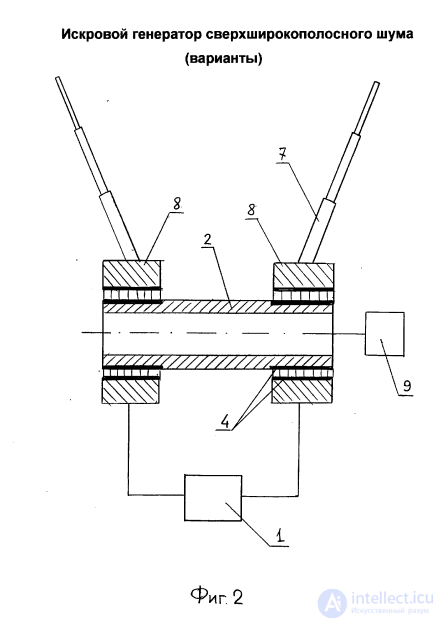
In the second variant of the generator, the spark gap is configured
as a capsule 2 whose end zones are placed in two bushings 8 with
the required radial and axial clearances. The terminals of the
electrical energy source are connected to the bushings 8. The capsule 2 and the bushings 8
are made of valve metals or alloys based on them.
The electrically interacting surfaces of the capsule 2
and the bushings 8 are provided with a dielectric layer 4 of an oxide of a valve
metal or an alloy based on it. The spark gap is provided with a drive 9 for
forced rotation of the capsule 2 relative to the bushings 8. The generator
is provided with a telescopic antenna 7 directly connected
to the bushings 8 of the spark gap.
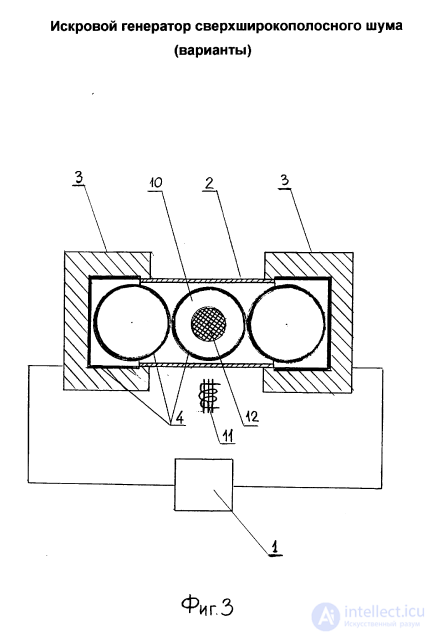
In the third variant of the generator, the spark gap is configured
as a dielectric tube 2 placed in two cups 3.
The terminals of the electrical energy source 1 are connected to the cups 3.
In the cavity of the dielectric tube 2 a plurality of balls 10 is placed.
The balls 10 and the cups 3 are made of valve metals or alloys
based on them. The electrically interacting
surfaces of the balls 10 and the cups 3 are provided with a dielectric layer
4 of an oxide of a valve metal or an alloy based on it. The spark gap
is provided with an induction drive 11 for forced movement
of the balls 10 relative to the cups 3 and to one another, which
interacts with a magnetic insert 12 placed in at least
one of the balls 10.
The generator in this variant may be provided with
a telescopic antenna directly connected to
the cups of the spark gap (not shown in the drawing).
In the fourth variant of the generator, the spark gap is configured
as a dielectric tube 13 inside which
a plurality of balls 10 of a valve metal or an alloy based on it
is placed. The tube 13 is secured in bushings 14 connected to the terminals of a
high-frequency source of electrical energy 1. The electrically
interacting surfaces of the balls 10 are provided with
a dielectric layer 4 of an oxide of a valve metal or an alloy based on
it. The spark gap is provided with a vibrational drive 15,
interacting with the tube.
In the fifth variant of the generator, the spark gap is configured as
an annular cage 16 provided with a centering roller 17.
Between the inner surface of the annular cage 16 and the centering
roller 17 a plurality of balls 10 is placed. The annular cage 16,
the centering roller 17, and the balls 10 are made of valve metals
or alloys based on them. The electrically interacting
surfaces of the annular cage 16, the centering roller 17, and
the balls 10 are provided with a dielectric layer 4 of an oxide of a valve
metal or an alloy based on it. The terminals of the electrical
energy source 1 are connected to the annular cage 16 and the centering roller
17. The spark gap is provided with an induction drive configured as
a solenoid 18 surrounding the annular cage 16, and some of the balls 10
are provided with magnetic inserts 12.
The device in all variants operates as follows.
All the claimed variants of the generator, by the method of forming
the ultra-wideband signal, belong to short-pulse
generators. The principle of their operation is based on the electrical breakdown of
multilayer dielectric structures (an air gap,
dielectric layers 4 of an oxide of a valve metal, and boundary
layers on the surface of the valve metals from which
the corresponding elements of the spark gap are made: capsules 2, cups 3, bushings
8, balls 10, annular cage 16, centering roller 17).
As a result of the high-voltage breakdown of the multilayer
dielectric structure at a voltage drop of up to 1000 V,
a powerful (up to 100 A) ultra-short (10-100 ps) current pulse
is formed with a repetition rate of 1-10 MHz, which excites in the elements of the
spark gap or in the antenna 7 connected to them electromagnetic
oscillations, which constitute the ultra-wideband noise.
The spark gaps of the claimed designs form high-power pulses
with a short leading edge, which leads to the broadening of the band
of generated radiation frequencies. The high average output power
of the generators is ensured by the high pulse power and
the high pulse repetition rate. This is explained by the fact that
the oxides of valve metals possess high dielectric
strength and a short recovery time of their dielectric
characteristics after each breakdown. The forced
relative movement of the electrically interacting
surfaces of the elements of the spark gap or their parts relative to
one another (the capsule 2 relative to the cups 3 or the bushings 8,
the balls 10 relative to the cups 3 or relative to one another) by
means of the drive 9 or 15 acting directly on them,
or by means of the induction drives 5 or 11 or 18, ensures
the guaranteed occurrence of the maximum possible number of
sufficiently powerful electrical discharges between them, and furthermore
eliminates the possibility of micro-welding between these surfaces and
ensures the cooling of these surfaces.
The claimed generator ensures the occurrence of physical
processes of noise formation with weak correlation
of the sequence of formed pulses (or its absence) in
amplitude, duration, and phase.
The use of one or another embodiment of the generator,
the change of the dimensions of its elements, the presence and length of the telescopic
antennas make it possible to vary the spectral characteristics
of the generator, shifting the radiation maximum into the part of the spectrum needed
to solve a specific task.
The generator in any embodiment may be configured as
a single unit with an antenna connected to it (if necessary).
With the aim of increasing the integral output power,
the uniformity of the spectral characteristic and the radiation
pattern, and of ensuring high reliability during operational
work, several generators may be used, with the provision of
autonomy of power supply from built-in batteries, concealment of
switching-on, and indication of operation. During the parallel operation of several
generators, an additive summation of powers occurs and the
entropy factor of the total radiation is increased.
The use of the claimed solution, compared with all
known means of similar purpose, provides
the following advantages:
generation of ultra-wideband noise,
high efficiency,
the possibility of increasing the spectral power density of the noise
by means of additive summation of powers during the parallel operation of
several generators,
ensuring the required distribution over space
of a sufficiently uniform spectral characteristic,
high entropy factor of radiation,
environmental cleanliness of the generated radiation, due to the fact
that the characteristics of the generated high-entropy signal
are as close as possible to the characteristics of thermal radiation.

Comments