
Lecture
Noise radar is a radar technology in which a noise-like (random, chaotic) continuous or pulsed signal is used as the probing signal. Detection of the echo signal is based on optimal reception and correlation between the emitted probing signal and the received reflected signal. Usually, a high-frequency noise source is used directly as the generator of the probing signal. However, there is also a technical implementation in which the noise signal is formed by modulating a sinusoidal oscillation in phase or frequency with random noise. This technology provides lower range sidelobes and higher average radiated power (when using transmitters with peak-excursion limiting). In addition, in this case the requirements on the receiver's dynamic range and on the bandwidth of the modulating signal can be relaxed.
The idea of noise radar has been known for a long time and consists in using continuous or pulsed random (noise) signals (NS) as probing signals together with coherent reception of their reflections. Analysis of the first experiments in the radio detection of metallic objects shows that they were carried out precisely by means of NS signals, but with non-coherent reception of them. C. Huelsmeyer (Christian Huelsmeyer) in Germany created and patented in 1904 the first predecessor of radar – the «telemetallodetector» («telemobiloscope») in a monostatic configuration. However, as early as 1897, A. S. Popov in Russia tested an installation with a similar function, but in a bistatic version . In both cases the authors used spark gaps as transmitters of noise pulses and a coherer as the detector, which performed the reception of the reflected noise pulses. Apparently, the first works on the development of range meters based on coherent reception of NS were published by R. Bourret in 1957 and B. M. Horton in 1959 . When coherent reception of radar reflections is ensured, NS can be classified among the most effective probing signals, one that makes it possible to achieve important operational characteristics of a radar: high resolution in range and velocity, the best noise immunity, electromagnetic compatibility, covertness of operation, jamming resistance, and others. Developers of radar systems have repeatedly attempted to create effective noise radars with coherent processing of the reflected signals at many research centers around the world, including at IRE NAS of Ukraine. However, these studies were not successful, mainly for the following reasons: the absence of effective NS sources and of controllable wideband delay lines required for the coherent processing of reflected random signals, i.e. wideband correlation receivers. Thus, the key tasks whose solution is necessary for the successful development of modern noise radar include: the creation of effective sources of noise radio signals and of wideband correlation receivers for the coherent processing of such signals. The methods we have developed for chaotization of electronic systems and for digital-analog processing of random signals have made it possible to create a number of chaotic-oscillation generators and wideband correlators, on the basis of which research prototypes of modern noise radars in the mm and microwave ranges have been developed and tested, and thereby to lay the foundations of modern noise radar technology [5-11]. Noise radar technology comprises three main components:
– the development and study of NS generators based on methods of chaotizing oscillations in electronic systems of the microwave and mm ranges;
– the development of methods for digital processing of random signals and the creation of wideband digital-analog correlators; –
the development of noise radars and probing systems for various purposes.
In addition to research in the aforementioned directions, we are studying the autodyne effect in chaotic-oscillation generators and the possibility of its application in radar, as well as investigating the phenomenon of interference of decorrelated signals, in particular spectral interferometry, and building precision measurement systems on its basis
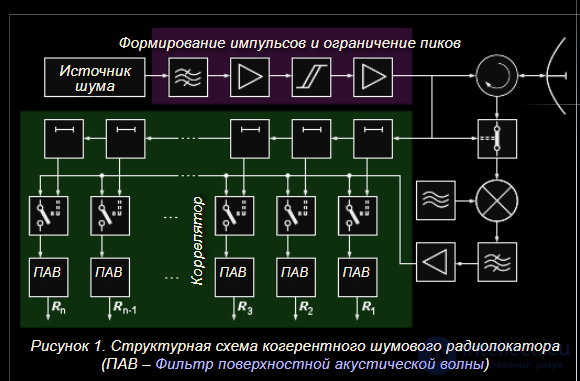
Figure 1. Block diagram of a coherent noise radar
(SAW – surface acoustic wave filter)
Using noise radar technology, radar systems for military purposes can be significantly improved, in particular by increasing the covertness of their operation (Stealth radar). This concerns improving the characteristics of military radars, namely achieving the best values of low probability of intercept and of electromagnetic compatibility, which is required for covert operation under conditions of enemy countermeasures.
The use of noise radar requires that the radar include components with specific properties, namely:
Ranging systems in which random noise is used as the modulating signal are built on the basis of measuring the correlation between the modulation of the emitted signal and the modulation of the received signal. The spectrum of the modulating signal determines how this correlation, and hence the output signal, is related to the distance to the reflecting object. In practice, each possible discrete value of the distance to the target must correspond to its own tap of the delay line. The realizability of such filters limits the range of the noise radar. Theoretically, either amplitude or frequency modulation can be used; however, frequency modulation has certain advantages in noise immunity (suppression of random spurious signals arising in the system). The resulting system is similar to existing airborne radio altimeters, but is free of the measurement ambiguity inherent both in pulsed radars and in continuous-wave radars with frequency modulation. It also avoids systematic measurement errors. The system is capable of measuring distances down to a few feet, which makes it suitable for use as an altimeter in «blind» landing systems.

Comments