Grief — an intense emotional state accompanying the loss of someone (or something) with whom (or with which) a person had a deep emotional and psychological connection. This term is not used as a synonym for depression. In other words, it is one of the basic emotions, associated with the sense of an objective or subjective loss of a significant object, part of one's identity, or an expected future. Grief is also understood as a profound, deep sorrow, mourning.
Symptoms of grief
The symptoms of normal grieving are of two kinds :
- Physical symptoms (difficulty breathing, spasms in the throat, rapid breathing, heart palpitations, etc.)
- Emotional, psychological suffering, which may include :
- Negatively coloured emotional processes
- Preoccupation with the image of the loss of the former state (before the grief)
- Feelings of guilt
- Hostile and aggressive reactions
- Loss of natural behaviour patterns, withdrawal from others
- and others
TYPES OF GRIEF (by subject of experience)
- Childhood grief
- Spousal grief
- Parental grief
SPOUSAL GRIEF is a reaction to the loss of the closest person, often laden with many complex feelings
PARENTAL GRIEF is a reaction to the death of a child, experienced especially intensely and for a long time, with strong feelings of indignation, protest, guilt, and depression
CHILDHOOD GRIEF
CHILDHOOD GRIEF is characterized by difficulty making sense of the loss, severe stress due to the immaturity of adequate psychological defences
PSYCHOLOGY OF CHILDHOOD GRIEF; PSYCHOLOGICAL FEATURES OF CHILDHOOD GRIEF
Children always experience the loss of a loved one, only this does not always happen in a form that is obvious and understandable to those around them
. FEATURES OF HOW CHILDHOOD GRIEF MANIFESTS ITSELF
- Uneven expression of sorrow over a long period of time
- Open expression of feelings — can be unexpected
- Delayed reaction in time
- Concealment of feelings, a wave-like character
WARNING SIGNS:
- Persistent anxieties and phobias, frequent panic attacks, prolonged fear of being alone
- Aggression, unexplained outbursts of anger, destructive ways of expressing anger
- Avoidance of conversations about the deceased
- Excessive imitation of the deceased, appearance of persistent symptoms of their illness
- Repeated statements about wanting to be reunited with the deceased, manifestations of suicidality
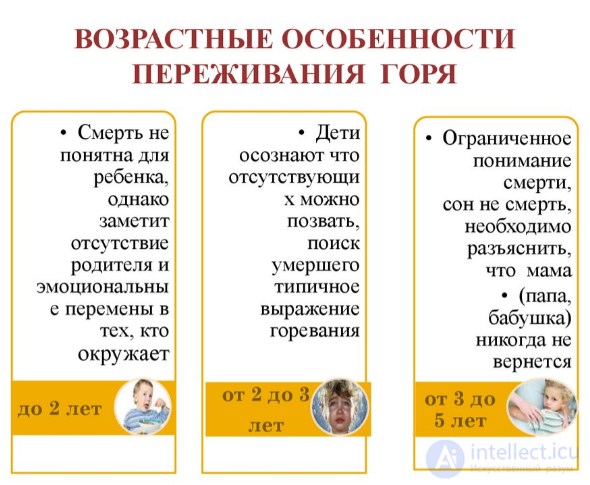
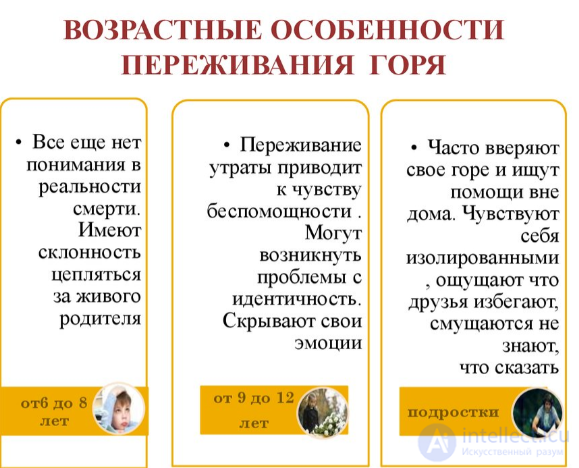
AGE-RELATED FEATURES OF HOW A CHILD EXPERIENCES GRIEF
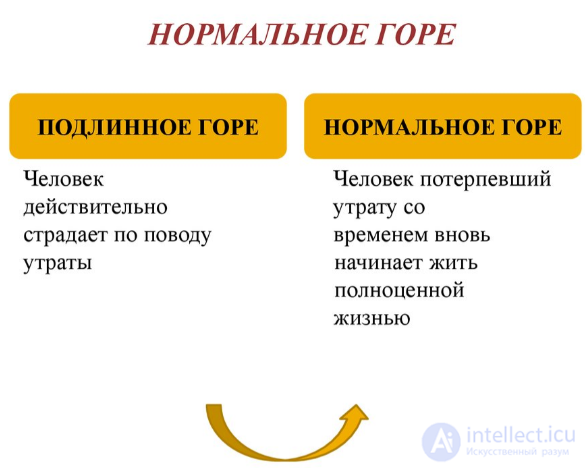
NORMAL GRIEF and GENUINE GRIEF
Normative grief: This is grief that arises in response to natural life events, such as the death of a loved one, divorce, children leaving home, or the loss of a job. Features:
- Strong emotional reactions, such as sadness, anger, fear, and even relief.
- Temporary change in behaviour and mood.
- Specific symptoms of grief, such as insomnia, loss of appetite, tearfulness.
THE PSYCHOLOGICAL PICTURE OF NORMAL GRIEF
Acute grief — this is a specific syndrome with psychological and somatic symptomatology — Erich Lindemann
SIGNS OF EXPERIENCING ACUTE GRIEF:
- physical
- change
- suffering
- of consciousness
- stretching out
- feeling
- of guilt
- of the process of mourning
SIGNS OF EXPERIENCING ACUTE GRIEF:
- feeling
- of guilt
- hostile
- loss
- reactions
- of behaviour patterns
- appearance
in the grieving person of the traits of the deceased, especially
symptoms of their final illness or
manner of behaviour — this symptom already lies
on the border of pathological responding
THE IMPACT OF GRIEF
spheres of life
cognitive
affective
motivational
behavioural
DEMONSTRATIVE GRIEF — A person outwardly displays sadness and mourning; the reason for such behaviour is usually a feeling of guilt or a desire to meet the expectations of those around them.
Complex grief: This is grief associated with several losses or traumas occurring simultaneously or close together in time. Features:
- Increased intensity of emotional reactions.
- Elevated level of stress and difficulties adapting.
- May require a longer period of time and professional support to cope.
Traumatic grief: This is grief caused by extreme events, such as an accident, violence, natural disasters, or military actions. Features:
- Excessive stress and prolonged emotional trauma.
- Symptoms of post-traumatic stress disorder (PTSD), such as flashbacks, nightmares, anxiety.
- Requires specialized psychological help.
Abstract grief: This is grief that is not connected with a specific loss, but may be caused by a general feeling of anxiety, dissatisfaction with life, or a sense of loss of meaning. Features:
- Absence of a clear cause for the grief.
- Feelings of emotional exhaustion and depression.
- May require psychotherapeutic support to identify and resolve the underlying problems.
Pathological grief
Pathological grief — when a person fails to cope with this phase and becomes stuck in it. Pathological grief: This is grief that lasts too long or is too intense and interferes with normal functioning. Features:
- Prolonged depression with no improvement.
- Alienation from others and social isolation.
- May require medication and/or psychotherapy.
PATHOLOGICAL GRIEF — the experiencing of grief remains unresolved, incomplete, and leads to psychological problems
PATHOLOGICAL GRIEF CAUSES:
- a sudden or unexpected loss;
- conflicts or quarrels with the loved one before their death;
- unfulfilled promises made to the deceased;
- excessive dependence on the deceased;
- multiple losses within a short period of time;
- absence of systems of personal support or life support.
Types of pathological grief:
- • Blocking of emotions.
- • Transformation of mourning into identification with the deceased (renouncing everything that distracts from thoughts of the deceased).
- • Stretching out the process of mourning.
- • Acute feeling of guilt.
- • Fixation on the event of the loss itself (denial of the loss, forbidding oneself to experience grief, preoccupation with the image of the deceased, a sense of the presence of the deceased long afterward, refusal to part with the belongings of the deceased).
- • Fixation on a feeling of revenge (in divorce “I will never forgive him for this!”).
. STAGES of pathological MOURNING
STAGES OF PATHOLOGICAL MOURNING S. Freud
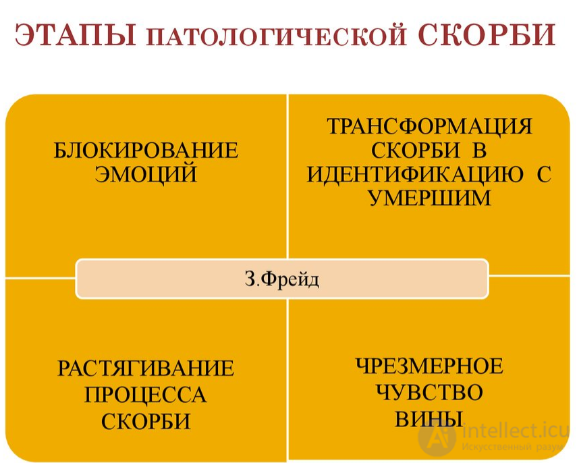
- BLOCKING OF EMOTIONS
- TRANSFORMATION OF MOURNING INTO IDENTIFICATION WITH THE DECEASED
- STRETCHING OUT THE PROCESS OF MOURNING
- EXCESSIVE FEELING OF GUILT
PRINCIPLES OF COMMUNICATING WITH AND HELPING A GRIEVING CHILD
IMPORTANT QUESTIONS:
- Should you tell a child about the death of a loved one? YES!
- Should you include them in the family process connected with the funeral? YES!
- Should you take them with you to the funeral? YES!
- Should you talk about the deceased? YES!

CONSEQUENCES OF NOT TELLING A CHILD ABOUT THE DEATH OF A LOVED ONE
Fertile ground is created for fears and distrust of adults
EXCLUDED FROM THE PROCESS OF PREPARING FOR THE FUNERAL
The emergence of a feeling of abandonment
DID NOT ATTEND THE FUNERAL
Relationships remain unfinished, fears arise

HELPING A GRIEVING CHILD
Information for the teacher:
- Tell the child that you know about what happened
- Talk to their classmates and tell them how they can offer support
- Allow the child not to attend lessons if necessary
- It is necessary to create a gentle environment; it makes sense to temporarily lower academic expectations
- If possible, appoint a “guardian” from among the older students
- Allow feelings to be expressed and be ready to offer support
Reminder for parents
- Tell the child about the death of the loved one
- Allow yourself to feel the pain of the loss, tell the child about it and cry together
- Tell them that preparations for the funeral need to be made. If possible, involve them in helping
- If the child is small, it is necessary to set aside time to play and play with them
- Answer the questions the child asks honestly and calmly
- Take them to the funeral if they want to go. Explain what will happen and how. Make sure a close person is with the child. It is possible that
- the child will want to leave partway through
- Remember the deceased. Tell the child stories from their life
Differences between normal and pathological grief
Pathological grieving — a term used in psychiatry as a syndrome for a group of disorders. Normal grief differs from pathological grief in a number of parameters:
- The presence of dynamics in the state. Grief is not a state but a process.
- Periodic distraction of attention from the painful reality of the death.
- The appearance of positive feelings within the first 6 months after the death of a loved one.
- The transition from acute grief to integrated grief.
- The ability of the person who has experienced the loss not only to acknowledge and accept the death of the loved one, to let go and part with them, but also to seek new and constructive ways of continuing the relationship with the deceased, such as preserving their memory
Approaches to helping with grieving
Three main approaches :
- Accompaniment and psychological support (provided by loved ones)
- Psychological counselling (conducted by a qualified psychologist).
- Psychotherapy and medication treatment. Conducted by psychiatrists and psychotherapists.
The phenomenon of grief in psychoanalysis
The Austrian psychologist Sigmund Freud believed that the main function of sorrow is to “withdraw” psychic energy from the lost object. During this time “the object continues to exist psychically”, and once it is complete the “ego” becomes free of the attachment and can direct the released energy toward other objects . Thus, the theory of Freud explains how people forget about what has been lost.
STAGES OF EXPERIENCING LOSS the model of E. Kübler-Ross
1. Stage of shock and denial
2. Stage of anger and resentment
3. Stage of guilt and obsessive thoughts
4. Stage of suffering and depression
5. Stage of acceptance and reorganization
1. STAGE OF SHOCK AND DENIAL
News of the death of a loved one stuns a person and causes shock. In a state of shock a person loses touch with reality. Feelings disappear and “indifference” sets in – this is an adaptive function against unbearable emotional pain. Speech slows down, facial expressions freeze
Unreality of what is happening, anticipation of a reunion with the deceased
2. STAGE OF ANGER AND RESENTMENT
The fact of the loss comes to be acknowledged. A host of “why” questions arise, directed at those who did not do “everything” to prevent
it from happening. Resentment and anger, accusations and rage appear
3. STAGE OF GUILT AND OBSESSIVE THOUGHTS
The grieving person torments themselves with numerous “what ifs”. The work of grief begins its activity of accepting the loss, a struggle against denial
of what happened. Inadequate understanding of the situation, tormenting pangs of conscience. Feelings of guilt. Idealization of the deceased
. 4. STAGE OF SUFFERING AND DEPRESSION
Strong emotional pain of a wave-like character. Suffering is accompanied by weeping. The process of experiencing almost always carries elements
of depression. Suffering as evidence of love and devotion to the deceased
5. STAGE OF ACCEPTANCE AND REORGANIZATION
Emotional acceptance of the loss. Restoration of interest in life, reorganization
of life plans. Sorrow – is replaced by a bright sadness, and gratitude remains in the soul
that You were with me
Phases of experiencing grief
In Russia, the psychologist F. E. Vasilyuk studied the topic of experiencing grief. In his book “Surviving Grief” he described 5 phases of experiencing grief.
- Shock and numbness — this is the initial phase of grief, when a person has only just learned the sad news. The mourner is rigid, tense. Breathing is difficult, arrhythmic. A loss of appetite and sexual desire is usually observed. In the person’s consciousness a sense of the unreality of what is happening appears, along with emotional numbness, insensitivity, and a stunned feeling. Perception of external reality is dulled, which leads to gaps in memory. However, outbursts of anger are sometimes observed. But even so, the person is psychologically absent in the present; it passes by them, as it were. This is a denial of the fact that “I (the grieving person) am here”. The traumatic event tears life apart into “before” and “after”, leaving the person in this “before”, where everything was as it used to be.
- The phase of searching — this phase is distinguished by an unrealistic striving to bring back what has been lost and a denial of the permanence of the loss. Usually it is difficult for the person to keep their attention on the outside world; reality seems covered by a thin veil. Despite a realistic attitude, the author speaks of hope, which constantly gives rise to belief in a miracle. The person is weakly sensitive to contradictions, which allows them to live according to two laws that do not interfere with one another — toward external reality according to the reality principle, and toward the loss — according to the “pleasure” principle.
- The phase of acute grief — this is a period of despair, suffering, disorganization, and a period of reactive depression. At first, various bodily reactions persist and may intensify — difficulty breathing, asthenia, a feeling of emptiness in the stomach, tightness in the chest, a lump in the throat, increased sensitivity to smells, and so on. This is the period of the greatest suffering, acute emotional pain. Strange and frightening feelings and thoughts may appear. A sense of emptiness and meaninglessness, despair, a feeling of abandonment and loneliness, anger, guilt, fear, anxiety, and helplessness. The relationship with those around them changes. A loss of warmth, irritability, and a desire for solitude may be observed. Everyday activity changes: it can be difficult to concentrate, difficult to see a task through to completion, and complexly organized activity may temporarily become inaccessible. It is precisely in this phase that the main mystery of the work of sorrow takes place, and only by knowing this is it possible to find the key to explaining the remarkably varied picture of the different manifestations of both normal and pathological grief.
- The “residual pangs and reorganisation” phase. In this phase life falls back into its groove: sleep, appetite, and professional activity are restored. The loss ceases to be the main focus of life. The experiencing of grief now proceeds as frequent, and over time increasingly rare, isolated pangs. These residual attacks can be just as acute as in the previous phase. During this period the loss gradually settles into life, since the person has to solve a great many practical tasks that are somehow interwoven with the experiencing itself.
- The “completion” phase — the final phase, in which the mourner overcomes certain cultural barriers that hinder the act of completion. The meaning and task of grief is for the image of the loss to take up its permanent place.
PSYCHOLOGICAL HELP AT DIFFERENT STAGES OF EXPERIENCING LOSS
. STAGE 1: SHOCK AND DENIAL
- Bring the person out of the state of shock
- Help them acknowledge the fact of the loss
- Try to awaken feelings, since this sets off the work of grief
. STAGE 2. ANGER AND RESENTMENT
- Help the person understand that the negative feelings they are experiencing (anger or resentment) are normal
- Help them express their feelings in an acceptable form
. STAGE 3. GUILT AND OBSESSIONS
- Talk about the feeling of guilt toward the deceased
- What can be done about the feeling of guilt
- Identify the nature of the guilt (neurotic or existential)
- With neurotic guilt, reframe the situation.
- With existential guilt, draw a life lesson from it
- Ask forgiveness from the deceased
4. STAGE OF SUFFERING AND DEPRESSION
- Suffering from the loss, from the loved one no longer being nearby
- Acceptance of the loss
- The person’s attitude toward their own death
5. STAGE OF ACCEPTANCE AND REORGANISATION
- Find ways of adapting to the new reality
- Rebuild the system of relationships with those around them
- Reconsider life priorities
- Define plans and goals for the future
- Rituals and ceremonies play a supportive role in the process of experiencing grief
PSYCHOLOGICAL FOUNDATIONS OF SUCCESSFULLY EXPERIENCING LOSS AND HELPING WITH GRIEF PRINCIPLES, STRATEGIES AND METHODS OF HELPING WITH GRIEF
. THESE STATEMENTS HURT:
- “Well, you’re still young, you’ll marry again”
- “Don’t cry – he/she wouldn’t have liked that”
- “I understand your feelings so well”
- “You need to get on with your life, you need to put an end to the mourning”
- “Time heals wounds”
. THIS WILL NOT HELP:
- Withdrawing from the person, depriving them of support
- Instilling positive conclusions from the loss
- Mentioning that the death could have been prevented
- Being frightened by intense emotions
- Trying to talk without touching on feelings
- Using force
THE WORK OF THE SOUL
- Accept the reality of the loss
- Live through the pain of the loss
- Adjust relationships with the surroundings, in
- which the deceased is no longer present
- Live through the loss and move forward
THIS WILL HELP THE MOURNER
- Know that you are able to go on living
- Know that all your feelings are normal
- You may grieve, take a pause in grieving
- Readiness to laugh is a sign of healing
- Find a good listener
- Accept help and support
- Do something for other people
WHAT SHOULD THOSE AROUND THEM DO?
- Be with the mourner, this brings comfort
- Be with them to listen, but do not force them to talk
- Do not initiate sexual contact with the mourner during a period of intense emotional stress
- If the mourner begins to abuse alcohol or drugs, neglects their health, or talks about suicide, recommend that they seek professional help
It is important to remember that grief is an individual process, and every person may experience it in their own way. Some people can cope with grief without professional help, while others may need the support of a psychologist or psychotherapist. Support and understanding from those around them play an important role in coping with grief.
See also
- [[b2676]]
- [[b12176]]
- [[b12177]]
See also


Comments