
Lecture
Psychological support groups for children who have experienced grief play an important role in helping them cope with loss and emotional difficulties. These groups are created so that children can share their feelings and experiences with others who have gone through similar tragic events, and receive support from experienced specialists. Here are the main characteristics of psychological support groups for grieving children:
Age adaptation: Psychological support groups are divided by age group so that children can communicate with peers. This allows them to feel more comfortable and understood.
A safe and supportive environment: Groups create a safe and trusting environment where children can freely express their emotions and feelings. This is especially important after a tragic event.
Facilitation by professionals: Psychological support groups are usually run by experienced psychologists, psychotherapists, or trauma specialists, who can help children process their emotions and talk about the loss.
Sharing experience: In the groups, children can discuss their experience of loss, sharing their feelings and memories. This helps them realize that they are not alone in their pain and that there are others who understand them.
Creative methods: For younger children, creative methods may be used, such as drawing, games, stories, and songs, to help them express their emotions and understand them.
Skill development: Groups can also teach children skills for managing stress, relieving tension, and adapting to a new situation.
Support for parents: It is also important to provide support to parents so that they can better understand and support their children in the mourning process.
Long-term nature: Groups may continue for a long period of time, since the mourning process in children can be lengthy and changeable.
Individual approach: It is important to remember that every child is unique, and the approach to support must be adapted to his or her specific needs and level of development.
When children meet each other in the group, they get an opportunity to
see, as if in a mirror, their own experiences reflected in others and to recognize
the connection between their own feelings and the death of a loved one. They cannot
be called "deprived of reason by their suffering"; they have a perfectly normal reaction
to an extremely difficult situation.
The purpose of the group's work is to encourage children in their desire to share their
experience, thoughts, and feelings; in this way they gain a deeper awareness of the various
circumstances and of themselves within them. The children reproduce their own actions
at the verbal level and, by getting to know one another better, gain the opportunity
to analyze their own case, their own reactions to the loss, and the way
this affects their personal characteristics, their self-concept. The group
of helpers, made up of adults, offers to constructively expand
the ability to reproduce the recent past, which most likely makes the process
of experiencing grief more beneficial.
In the group, various topics are analyzed that bring together
the problems of grief and the concepts of integrity, clarity, self-analysis, and
self-awareness.
Rules for selecting the group. As a rule, children of school
age — from 7 to 18 years old — are invited to the groups. Children are given as
wide a range of experience of being in grief as possible, so two
different models can be used for working in the group. The first model is a group
that meets 8 times weekly (for younger children) and once every two
weeks (for teenagers). Sessions last 2 hours with a proper break. The other
model is work over the course of two or three days from 9:00 to 16:00, with
several short breaks and one break for a meal. But
both in procedure and in content, these models are similar to each other.
The first thing that needs to be done is to send a letter of invitation in the
form of a request to those families who have already contacted us themselves, or to the
schools and hospitals suggested to us.
Over the course of an entire day in a group made up of 10 to 15 boys and
girls, 3 adult helpers work. It is important to have representatives of both
sexes in the group (both among the children and among the psychologists).
Girls and boys often express their grief differently and can learn
from one another. The group leaders make use of their distinctive
qualities in order to support the children.
The first session — in a certain sense — is the most important. It
involves getting acquainted in a specially organized way.
We establish several rules, for example the rule of psychological
safety (confidentiality). This is fundamental, so that the children
feel free to speak openly without being at risk
of having someone reveal their secret. Parents often want to know what their children talk about and how they behave in the group, and in that case one should let them in on the group
rules, and then the parents will accept it without objection.
Another rule is that each person decides for himself or herself how much and exactly what
he or she wants to tell. It should be agreed to sit quietly and listen to
others. As a rule, some children find it hard to start talking, but it becomes
easier for them once they have first listened to others. Someone is always more talkative
than the rest. During the first meeting with the group, one should identify children with
strong resistance, for whom analyzing the grief situation may also
be dangerous at this difficult time for them.
At the beginning of the first session, the children are told the purpose of the group's work.
One must be able to tell them frankly why they are here:
because someone in their families has died; because we are going to talk about
the changes in their lives and the experiences connected with the death. That is why
a clear, plain way of beginning the conversation is so important, so that later on it
will be possible to speak with the children openly.
It is necessary to use warm-up exercises, or rather games,
that can be used to get to know one another better. One game is
connected with names, to become acquainted with those present; the second
exercise is an interview; for a few minutes (from 2 to 5)
the children interview each other, asking questions about age, favorite food, what
school he or she attends, and so on. Then each child introduces the
child he or she interviewed.
The first exercise on the topic "Grief" consists of a small
group (3-5 people) drawing a family. This gives an opportunity to talk about
the person who died, about the cause of death, and about the situation at the time
immediately surrounding the death. What does the child know? Are there
questions that need to be, and should be, asked of him or her? Here one may
encounter the first problem concerning death and the problem of the clarity of
the information the child reports. Work is also done with the past.
What was the family like on the eve of the death? What does it look like now? Often, after
the death of a loved one, certain changes take place (the appearance of a stepfather, a stepmother,
new sisters or brothers; a new family, a move to a new house, even to a new
city).
The family drawings are hung on the wall, and each child briefly
presents the family to the whole group, telling the others who,
of the people depicted, has died, and also the cause of his or her death. There is
a break in every session, at which tea can be offered. It is a good idea to end each session
by establishing some kind of ritual, for example playing some sort of farewell
game, marking the end of the session in a special way.
Second session. What happened?
Every session can begin with the name game. This helps a great deal in
starting the group's work the same way each time.
In the second session there is an exercise like this: the child talks about
the loss and reactions to it. A little psychological
information can be given about what happens to a person when someone close
to him or her dies. "First there is shock, to which you may
have reacted quite differently from how you feel you should have reacted — for example,
with laughter or a feeling of numbness, an inability to cry. Later, such
reactions often bring on a feeling of guilt. It is useful for children to hear that
such manifestations are quite normal. One should not give lectures; the work
should be more like a discussion, with the children taking part in it,
sharing their own experience. The next exercise is brainstorming:
what has changed? On a large sheet of paper hanging on the wall, we draw four
big circles, in which we write: name, school and friends, body, feeling, and thoughts.
All the children then voice their opinions about what has become
characteristic of their lives after the death of a loved one. What new
thoughts have come to them: fear that someone else in the family might also
die, nightmares, and so on. One should not forget to emphasize that all this is
a normal reaction to grief. Somatic symptoms — such as
insomnia, a feeling of constant fatigue, headaches, stomach aches, and
so on. Listening to the stories of other children, the possibility of seeing everything
that was written on the paper — all this can influence how the children come to understand
their own reactions and themselves.
Sessions three and four. Talking about feelings.
Some children are very well aware of their moods and are able to
easily distinguish one impression from another. But many, especially the younger ones,
have no clear idea of what is happening to them. With younger
children, one can use the silhouette of a person, a "mannequin person," to
find out exactly where in the human body the emotions are located. Another
exercise concerns how feelings change over time. The children
are asked to distribute their own emotions — sadness, anger,
fear, happiness — among 4 circles: a) at the time of the death of the loved one; b) at the group
session; c) today; and d) in the future. The circle exercise can also
be used to establish how significant, within the "Family" circle,
the child's own grief is compared with, for example, the grief of the mother, grandfather, or siblings
and sisters. Some children feel that there simply is not enough room for their
own grief, because, for example, the mother's grief is much greater than
theirs. Or the situation may be perceived quite differently; a child
may, it turns out, have felt completely alone in his or her grief, with
no one in the family understanding how heavy his or her suffering was.
Another exercise is called "feelings and masks". Sometimes, in grief, we
prefer to hide certain agonizing states and to hide behind a
mask. The children draw 3 feelings that they consider difficult
to express openly; then they draw a mask, the facial expression behind which they hid
their real feelings. The "mask" has both advantages
and disadvantages. For exercises on feelings, one session is often
not enough, since this topic can be developed at greater length.
Conducting this topic requires a great deal of strength.
Fifth session. Memories.
Memories are an important part of our personality, our
inner images. It is known that children cherish memories and need
them, because they are connected with the person who will never again be there,
especially if it is one of the parents. The person who is gone is necessary for the child's
psychological development; the child, as it were, links his or her present with
the deceased. In this session one can use a large sheet of paper,
hung on the wall (just as in the "What has changed?" exercise).
Inside one or another circle we write down various details of memory: "Personal
belongings", "What we did together", "What he/she taught me", "Him/her in
my personality and our physical resemblance". There are also such
circles as: "Confused memories" and "Memories from the time of his/her illness
and death".
Some children are afraid that they will forget the one who died, or they feel
guilty because they now think about him/her less than before, because
enough time has already passed. Some spend a great deal of effort on preserving
memories within themselves, but this too creates difficulties for the child: after all, one needs
to replenish one's store of energy and concentrate on the present, for example, on
schoolwork. Children try to carry out these three tasks. A second exercise,
concerning memories, could serve as a supplement to the means
the children deal with in the third task. The next exercise is
writing a book about the person who died. In these books, each of
which could be remarkable, — a few blank pages are left so
that the children can fill them with drawings, stories, photographs, and other
kinds of memories. But the book can also be quite simple, more
like a binder into which pages can be added as they are
filled in.
Session 6. The "letter" exercise.
Unfinished business, events that were never talked about — this
could be described in a letter to “the one who is gone”. In this exercise the child
can express feelings which, once fixed on paper,
clarify thoughts and make them easier to understand. Younger children
may express a wish for the adult group staff to help them
write the letter, or they may perhaps turn to drawing instead. In other words, this
exercise is individual; it reveals the connection with the person who is gone.
The children's plans for what they would like to do with the letter
afterward should be discussed. Some will prefer to bury it in the grave, others — to burn it and scatter
the ashes to the wind or throw them into the water.
Session seven. What helps?
This is a small group exercise that uses a light-touch
test. Children sometimes have the absurd idea that they are helped by a situation in which
they are overwhelmed by painful feelings. It is important to maintain a balance between
suffering and finding a way out of it. When working with children who have
a great deal of emotional experience, then crying, embracing something beloved,
something dear — a toy or a household object — turning to mother for
support, thoughts of the deceased before falling asleep — these are examples of what
does relieve tension in children. Playing football, other kinds of physical
activity help discharge emotions; watching TV, sleep, the urge to behave
as if nothing had happened — all these are paths toward a liberating opening
in the situation of grief.
Session eight. The children's own support system, general social work.
In this exercise the children represent themselves as a circle in the center
of the sheet, then circles are drawn around the "I" circle, in which would be depicted
the people who matter to this child. One should ask: "Who can
talk to you when you need support?", "Who
do you need?". Children often do not even realize that there are people close to them
who can truly help and comfort them. The exercise clarifies for the child
this kind of situation. He sees that he is not alone at all, but if the support system
looks extremely weak, if it is practically impossible to find those people
whom one could bring into this situation (and one should work carefully
on this together with the child), then it is important to ask whether the child
will allow us to be part of this system that the child himself is building.
This concludes the program of our group. However, one or two more sessions should be held
a few months later.
There is one more session, but it is exclusively for parents (or guardians). In it, they are given general information about what took place in the group. A discussion is held about the characteristics of children's grief.
One must realize that the psychologist becomes involved in the situation of children's experiencing of grief for only a very brief period, but it is necessary to bring something to it that makes this process a little less painful. We cannot fully cover every detail of this phenomenon, because grief
is prolonged, it is experienced for a long time, perhaps several years, and therefore children must overcome the bitterness on their own, with the help of their
family. Regardless of this, children and parents should know that they can
always get help from us.
Appendix 2. Children's Grief. A Few Pieces of Advice for Relatives and Loved Ones
Foreword
The authors of this booklet are Atle Dyregrov and Elin Hordvik. They are psychologists, both
working at the Center for Crisis Psychology in Bergen (Norway). Both have
extensive experience working with children in crisis. Translated by Maria Tornell.
The publication was produced with the support of the organization “Save the Children”, first
published in Swedish, in 1995.
The death of loved ones usually causes strong
reactions in children and adolescents. This may involve despair, fear, bitterness, sleep problems,
a feeling of helplessness and danger, sometimes even depression and a strong
sense of helplessness and danger, sometimes even depression and a strong
sense of emptiness and abandonment.
But the grief of children and adolescents is still not sufficiently recognized.
Too often it happens that their grief is not perceived by adults, and they
are left alone with their thoughts and confusing feelings. In this case
it is very hard for them to cope with their grief.
It can be repeated many times that children's grief is intense, deep, and
long-lasting, but it is more important that we, the adults, help and support them
in the best way from the very beginning. We hope that this booklet
will help you in this work
Children's understanding of death
Children's understanding of death follows their mental development and forms gradually. Insufficient understanding is typical of children under 5 years of age.
“Jun wants us to get Agnes's room ready in the new house, and he keeps talking about when she will come back.”
“Will Anders arrive soon? Where is he?”
“Who feeds daddy there, in the grave?”
It is easy to misunderstand these reactions in young children and
to interpret them as a denial of what happened. Rather, these reactions
are an expression of insufficient experience. Children do not understand that
death is final, and therefore think that the one who died may come back
or that one can go visit him or her.
Children, just like adults, come to accept reality gradually
and waver between denying and accepting what has happened.
Preschool-age children need to be told again and again that the one
who died has gone and will not come back. Children must know that the deceased
person no longer breathes, that his or her heart no longer beats, that the nails and hair no longer grow, that
the deceased cannot think and does not feel any pain.
When you talk with very young children, it is important to remember that
they find it hard to understand abstract explanations. A four-year-old who knows
that Anna is buried in the ground, but who is told that “Anna is together with
Christ”, may find it hard to understand the connection.
In children between the ages of 5 and 10, an understanding gradually develops
that death is final and that all life functions cease when
a person dies. Then they begin to understand that death is inevitable, that everyone – including
themselves – will die someday. Just like very young children, they need
concrete things that can provide support in grief — a photo album, a video,
a grave, and so on.
The idea of death becomes more abstract only by around age 10,
when children better understand what consequences death carries with it and think more
about what happens after death. They begin to ponder the meaning of
what has happened, and are preoccupied with thoughts about the injustice of death.
For children aged 10 and older, especially boys, it is often difficult to show
their own feelings caused by the death.
Children may experience grief differently at different ages,
because the understanding of death comes gradually. Suddenly they may
feel a wish to talk about death, even if for a long time they
seemed completely indifferent. This should not be seen as a step backward, but
as an opportunity for new and more mature experiencing and understanding of the
death.
Children’s reactions to grief
When children learn of a death, they, like adults, may
feel a sense of unreality and doubt. And then they show
no strong feelings at all. Sometimes their reaction is expressed
through protest, tears, and anger.
In the first period after the death, the following reactions can be observed in children:
Thus, children do not experience grief in any one particular way, but react to it differently. Here are a few of the most common
reactions.
Anxiety in children

Four-year-old Andreas has not let his parents out of his sight since his sister died. He strongly protests when others
look after him, even people he knows very well.
He goes into his parents’ bedroom several times a night to check that
they are there. When Dad is resting after lunch, Andreas becomes anxious
that he too will die..
Death easily gives rise to a fear that another catastrophe will happen. This feeling can arise in both children and
parents. Children of different ages may voice their fear that something will happen to their parents or to the parent who remains
alive. They may also fear that they themselves will die.
If a child is very anxious, constant vigilance and tension may result in pain in the stomach, shoulders, neck,
and head.
Small children may cling constantly to their parents, thereby revealing their fear of being separated from them. They will not let go of them
for a single minute.
Children often want to sleep with a light on and the door open, so they can see that the adults are there.
If the death occurred in the child’s presence, or if he found the deceased, he
may become frightened every time something reminds him of what happened. In such cases joint “training exercises” may be needed, for example, if
the death occurred as the result of a car accident, and every time the car is approached the child feels strong anxiety.
Withdrawal, isolation, and problems with concentration.
In the first period after the death, watch to see whether your child is withdrawing into himself. This may be a sign of his struggle with
thoughts and feelings, with which he needs help. If, in addition, his results at school worsen, there are reasons to seek
help from a specialist.
Sadness, longing in children
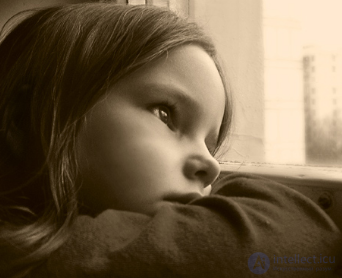
Grief is not measured by tears, and children do not grieve for as long as adults. But they may go on thinking about the deceased for a long time and feel sadness and longing. Children miss a great deal, and a child may feel a wish to return to the places where he was together with the deceased, just as when they smell his clothes, look at photographs and videos. When the longing becomes unbearable the subconscious may recreate the person who is gone. The child may get the feeling that the deceased is in the room and talking, which can both frighten and comfort the child. Prepare him for this so that he knows that such things are normal.
Guilt in children

Most children think a great deal about why death came, what caused it. Nine-year-old Elena was watching her little brother, who died in his crib. The cause was sudden infant death. Elena blamed herself for this death, and when her parents tried to explain the real cause, she said: “You’re only saying that to comfort me”. Sometimes children think that their own thoughts or actions caused the death. They may also place the blame on their parents. Children often find it hard to put these thoughts into words, so try to talk with them gently, and pay attention to whether your child’s games and drawings reveal a sense of guilt.
Anger in children

A child may feel very strong anger when a loved one dies. Sometimes the anger may be directed at something specific or at a particular person. In other cases the child is so lost that he becomes anxious, helpless, and irritable. In this case the anger may be directed at you. The child may also behave destructively. “It’s your fault. If you hadn’t gone to the hospital, the baby wouldn’t have died”, said a four-year-old boy, hitting his mother hard. Such outbursts of anger are quite common. It is important for adults to allow them and to explain that feeling angry when someone dies is natural. You can also tell the child how he can express his feelings, for example, by hitting a pillow, screaming in the forest, or using his energy for a long run.
Reactions of parents
Children’s reactions to death reflect not only their own grief and longing, but also the reactions of their parents. It is painful for a child to see his parents crying and not caring for him as usual. Parents who are experiencing grief have less energy left for their children. They easily become impatient and irritable when children demand their attention, and try to hide their reactions in order to protect the child. Our experience shows, however, that a child feels better when parents try to describe their feelings. Then it is easier for the child to understand his parents’ reactions and easier for him to show his own feelings and thoughts.
Give concrete information
Regardless of whether death came suddenly or not, the
information the child receives, and the conversations held with him,
are of decisive importance for how the child will cope with the misfortune.
Therefore it is important to avoid metaphors such as “the deceased is asleep”, or that “he or she
has gone away or left on a journey”. Do not wait until the funeral to break
the news of what happened.
So that the child’s trust in the parents is not undermined, the child should as soon as possible
receive accurate information. Let the child ask questions,
and answer them if there is an answer, and dare to say “I don’t know” if you
have no answer. This will help the child understand better what happened.
Children, like adults, need to understand the reality of death, and
this process is gradual. Therefore it may be necessary to talk about
what happened, many times.
Avoid unnecessary separations
After a death, parents often allow other people
to look after the children, sometimes temporarily, sometimes for a longer period.
But this may increase children’s worry that their parents will disappear too.
Understand that children have a strong need for your closeness in the first
period after a death.
If someone wants to help the parents and look after the children, it is better
if that person comes to the children in their home, so that they remain in
their familiar surroundings.
Let children be present at the farewell ceremony
and the funeral
Our experience shows that children are not traumatized if they see
the deceased or attend the funeral. Children’s fantasies about
death and the deceased are often more frightening than reality. Nevertheless, we want
to emphasize that parents should listen to their own
feelings. If you do not have the strength to take the children with you, do not do so.
Before the child goes to the farewell ceremony, he should be told
what he will see there: what the dead person looks like, that his or her body
is cold to the touch, how the adults will react, and so on.
It is better if an adult goes into the room first and then describes
to the child in detail what everything looks like there.
At the farewell ceremony the child needs an adult nearby.
The child can say goodbye to the deceased in a specific way —
by placing in the coffin a drawing, a toy, a letter, or something else that has
meaning. You can suggest that the child say something to himself
or whisper something into the deceased’s ear.
After the farewell ceremony, time should be set aside to
talk with the child about it, or to give him the opportunity to express his feelings
in another way, for example by drawing or playing.
Even if the deceased’s body has been seriously damaged, we
still recommend taking the child to the farewell ceremony, since
meeting the deceased makes the unreal real. In addition, it reduces
the risk of distressing fantasies arising. But it is very important to
prepare the child well.
HOW CHILDREN PROCESS A DEATH
Children have a strong need to remember the deceased,
while at the same time making sense of what happened.
Children may express this in different ways.
Looking at photographs of the deceased.
At certain moments every day. Children, even very young ones,
may take something belonging to the deceased, carry it with them, sleep with it.
Visiting the grave
If the grave is not far from home, children can go there by themselves.
Visiting the scene of the accident may also help the child
better understand how the death occurred. Sometimes only then do they begin to understand
what happened.
Children may also feel a wish to visit places where he
was together with the deceased. If possible, do this together with
the children, even if for you, as someone close, it is painful — it will help everyone
all of you.
Specific questions
Children often ask questions that can be hard to answer.
By asking detailed questions, the child gradually begins to understand better
what happened. It is understandable that it is sometimes hard to answer children’s direct
questions, but giving an honest answer is very important
If a child is developed enough to be able to ask a question, then he
developed enough to receive a direct answer to it.
Children aged 10 and older usually do not want to talk about what
happened, because it is too painful. Sometimes they need quite a long
time before they can talk about the death. If the child
is doing well at school and interacting with his friends, there is
no particular reason for concern.
We have noticed that withdrawal is a common reaction, reflecting the way
children cope with strong feelings. Gradually they open up
more and more, setting their own pace.
Playing in order to understand better
Children often imitate a funeral procession. They bury
animals and insects, which helps them understand what happened to the deceased.
They may also draw graves with a cross or draw other things
related to the deceased.
For a child this is a normal way of expressing his feelings.
At the same time they begin to understand better what happened.
It is therefore important not to stop children when they are playing or drawing.
If a child witnessed a dramatic death, he
may repeat the same game many times.
If the child’s behaviour changes significantly, or if strong emotions do not
lose their intensity over such a long period of time that this
begins to worry you, you should seek professional help.
A FEW TIPS FOR THOSE CLOSE TO THE CHILD
Below you will find a few tips that may help you when
dealing with a child’s grief. Of course, the tips should always be matched to
the individual situation.
Speak openly and honestly
Avoid vagueness
Help the child understand
Make the loss feel real
There is no minimum age for taking part in
the farewell ceremony and funeral. Later in life, knowing that you were there, even if you were only six months old and were in your mother’s or father’s arms,
can have great symbolic significance.
It is very important that children are well prepared and that someone close
is nearby. He or she can help and support the child, answer questions, explain what is happening — during the funeral and afterward.
Do not depart from the established routine.
Try not to separate the child from his parents. Even a brief absence from home may be a cause of anxiety.
Try to keep to your household’s established routine.
Accept that the child needs your closeness and protection. Do not delay the child’s return to school or kindergarten.
Ease the child’s worry that he or his parents will soon
die
Talk with the child about his fears.
Reassure the child that such deaths are very rare.
Ease feelings of guilt in the child
Talk seriously with the child if he shows feelings of guilt.
Reassure the child that nothing he thought or did
led to the death.
If, after the death, the child’s behaviour changes significantly,
for example if he withdraws from his friends or becomes completely
unmanageable.
If the child was present at the death or found the
deceased, and constantly keeps recalling these situations.
If the child remains sad for a long time after the death,
has lost interest in school, or expresses thoughts about not wanting to live.
Psychological support groups for grieving children can help them cope with painful emotions and learn to go on living after a loss. It is important to turn to qualified specialists or organizations that specialize in supporting children and adolescents in grief.

Comments