
Lecture
The doctrine of free will is a philosophical and psychological concept that examines the nature and scope of human volition. The question of how far a person possesses free will and can make independent decisions is one of the key questions in philosophy, religion, and science. There are several main positions on the doctrine of free will:
Determinism: An approach according to which every event and every action has a cause, and a person does not possess absolute free will. Determinism holds that human actions are determined by external factors such as genetics, upbringing, education, and environment. On this view, free will is limited.
Indeterminism: This approach holds that some events and actions may be random or unpredictable, and that a person possesses a certain degree of free will. Indeterminism opens up the possibility of spontaneous or unpredictable decisions.
Compatibilism: This is a middle path between determinism and indeterminism. Compatibilism holds that free will can coexist with predetermination or the laws of nature. It maintains that free will does not necessarily mean the absence of influence from external factors; a person can make decisions in accordance with his or her own beliefs and desires even while being subject to external constraints.
Philosophical and spiritual perspective: In religious and philosophical traditions such as Christianity and Islam, the existence of free will is generally assumed, while it is also held that a person bears responsibility for his or her actions before God or a higher power. In this perspective, free will may be linked to moral responsibility.
Scientific and psychological perspective: Some scientific research in neurobiology and psychology suggests that human will may be constrained by physical and neurological factors. However, this remains a subject of active debate within the scientific community.
Logotherapy rests on two fundamental anthropological characteristics of human existence: the capacity for self-transcendence and the capacity for self-detachment. Existence, then, is not only intentional but also transcendent. Self-transcendence is the essence of existence. To be human means to be directed not at oneself but at something else. The category of “being-in-the-world” (L. Binswanger) implies that we regard the person as deeply engaged, drawn into a situation of being set over against the world, whose objectivity and reality are in no way diminished by the subjectivity of that “being” which finds itself in the world.
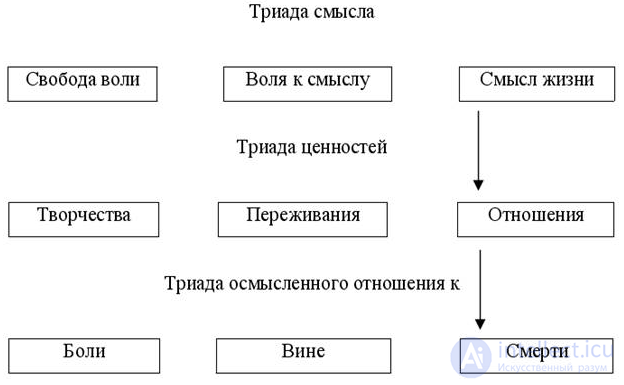
Preserving “otherness,” the objectivity of the object, means preserving the tension established between object and subject. To preserve this tension, meaning must be kept from coinciding with being. The meaning of meaning lies in the fact that it directs the course of being. A person is free in seeking and realizing the meaning of his life, even when his freedom is markedly limited by objective circumstances. A person is free because his behavior is determined above all by values and meanings located in the noetic dimension, which are not subject to the determining influence of drives, needs, and external circumstances. In this respect the person is defined by two fundamental ontological characteristics: the capacity for self-transcendence and the capacity for self-detachment. If I do not do this — who will? And if I do not do it right now — then when am I to do it?
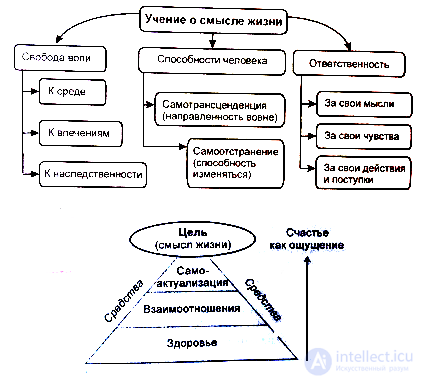
But if I do it only for my own sake — then who am I? Hillel. Self-transcendence is expressed in a person's constant movement beyond himself, directed toward something that exists outside him. The capacity for self-detachment is expressed in a person's ability to rise above himself and his situation, to look at himself from the outside. These two fundamental capacities of the human being make it possible to find meaning while passing through suffering, without being broken by it. Through the values of attitude, they allow a person to find meaning in his existence in situations that appear hopeless and meaningless.
In a certain sense, the concept of values of attitude is broader than the meaning that can be found in suffering. Suffering is only one aspect of the tragic triad of human existence.
The doctrine of free will is a complex and philosophical topic that continues to occupy the minds of philosophers, scientists, and artists. It has profound moral and practical implications, since it bears on questions of choice, responsibility, and human nature.

Comments