
Lecture
Logotherapy (from Ancient Greek λόγος — meaning, reason) — a type of existential psychotherapy based on the search for the meaning of existence. It was developed by Viktor Frankl in the mid-twentieth century, and his work is continued by the Austrian psychotherapist Elisabeth Lukas. Logotherapy is a psychotherapeutic approach developed by the Austrian neuropsychiatrist and philosopher Viktor Frankl, whose foundational work is the book "Man's Search for Meaning". Logotherapy focuses on the search for meaning and values in life as a way of overcoming suffering and resolving psychological problems. Here are the foundations of logotherapy:
Meaning of life as a key element: Logotherapy holds that a person strives for meaning and goals in life. The absence of meaning, or wandering in search of meaning, can be the root of many psychological problems.
Freedom of choice: The central idea of logotherapy is the understanding that a person possesses freedom of choice with respect to his actions and reactions to life circumstances, regardless of external conditions. This freedom of choice allows a person to find meaning and values in any circumstances.
Three main sources of meaning: Frankl identified three main sources of meaning in life:
Overcoming the "vacuum of meaning": Logotherapy proposes that many psychological problems, such as depression and angst, may be linked to a "vacuum of meaning" — a sense of the absence of meaning in life. Logotherapy helps people search for meaning in their lives and find ways of attaining it.
Supporting the search for meaning: The logotherapist works together with the patient, helping him to identify his values, goals, and sources of meaning. This may include reflection, dialogue, and contemplation of life experiences and values.
Justice and the meaning of suffering: Logotherapy also addresses the question of how meaning can be found even in suffering and hardship. Frankl believed that the capacity to bear suffering with dignity can give it meaning and value.
Man — is more than psyche: man — is spirit. V. Frankl
The foundations of logotherapy were laid by V. Frankl — the founder of the third Viennese school, a man of extraordinary fate. His writings were forged not at the tip of a pen, but on the front line, where the boundary between life and death runs. The experience of those terrible years, and the meaning drawn from that experience, Frankl carried with him throughout his life. He had the right to say that man is more than psyche: man is spirit. To be human is not only to stand in a field of meaning awaiting fulfillment, but also to turn toward values awaiting realization. This means living in the field of tension that arises between the poles of reality and of ideals demanding to be made material. Man lives by ideals and values. Human existence is not authentic unless it is lived as self-transcendence. Man strives to find meaning and experiences frustration or a vacuum if this striving remains unfulfilled.
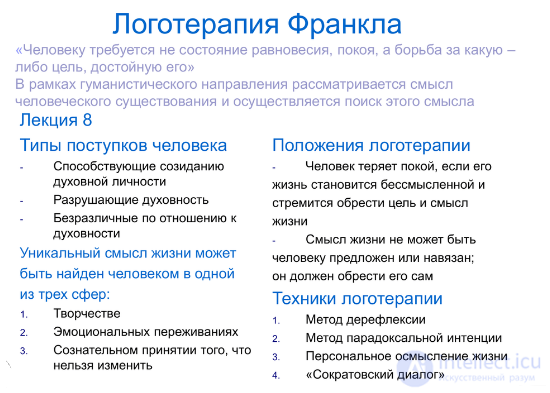
Within logotherapy a method of logoanalysis has been developed for studying the life and values of the patient. It was developed by the American James Crumbaugh (Eng. James C. Crumbaugh), one of Viktor Frankl's students. The method allows for a detailed, as Crumbaugh puts it, inventory of the patient's life. Logoanalysis employs two main techniques: expanding the field of consciousness and stimulating creative imagination.
For the treatment of phobias and obsessive-compulsive disorder, Frankl proposed the method of paradoxical intention . Within this technique, a patient who has, for example, a particular phobia is invited to make the paradoxical attempt to wish for the very thing he fears most. This may be an object, an action, or a situation in which the patient is very afraid of finding himself.
The purpose of the method of dereflection is to overcome an obsessive tendency toward self-observation that has become excessive. The person is advised to shift attention away from himself and toward the meanings and values he can realize in the surrounding world. Frankl himself characterized dereflection as follows:
Through dereflection the patient is given the opportunity to ignore his neurosis by focusing his attention on something external. He directs his attention toward a life full of potential meanings and values that bear a direct relation to his personal abilities .
Logotherapy places emphasis on the search for meaning and values in life as a way of overcoming psychological problems and achieving psychological well-being. This approach can be especially useful for those who confront questions about the meaning of life, values, and personal identity.

Comments