
Lecture
Psychoeducation is the process of educating and informing people about the psychological aspects of life and personal development. It is an important part of education that helps people understand themselves and others, better manage their emotions and relationships, and develop their cognitive and emotional skills. The main directions and principles of psychoeducation include:
Understanding oneself: The goal of psychoeducation is to help people better understand themselves, their motives, emotions, and behavior. This includes developing self-awareness and self-understanding.
Understanding others: Psychoeducation helps people develop skills of empathy and understanding of others. This contributes to improving interpersonal relationships and communication.
Developing communication skills: The principles of effective communication, including listening and the adequate expression of one's thoughts and feelings, are an important part of psychoeducation.
Developing emotional literacy: Psychoeducation teaches people to recognize, understand, and manage their emotions. This helps in coping with stress and developing emotional intelligence.
Developing psychological skills: This includes skills in managing time, stress, problem solving, as well as improving concentration and memory.
Developing self-efficacy: Psychoeducation contributes to developing confidence in one's own abilities and the capacity to achieve set goals.
Supporting mental health: Psychoeducation includes information about mental health, helping people recognize the signs of mental disorders and seek help when necessary.
Prevention of and dealing with social problems: Psychoeducation may include information about and discussion of important social problems, such as violence, addiction, and discrimination.
Individual and group approach: Psychoeducation can be conducted both individually and in groups, depending on the needs and goals of the participants.
Ethical principles and confidentiality: Important principles of psychoeducation are adherence to ethical standards and protection of participants' confidentiality.
Many social factors have a positive
effect on a person and contribute to their personal development. But
among them there are also those that affect the individual negatively and lead
to disharmony of behavior, often causing "anomalies" of personality
(substance abuse, drug addiction, etc.). Such a situation of the social
condition of the ordinary person requires conscious and purposeful
activity, directly aimed at helping the individual to
develop resistance to the negative influences of the elemental
social forces. Informing people and raising their awareness helps
a person to find their bearings amid the confusing multiplicity of life's phenomena.
In the Soviet Encyclopedic Dictionary, the concept of "enlightenment/education"
is defined as:
1) the spreading of knowledge, education;
2) a system of educational and cultural-enlightenment institutions in the country.
Education/enlightenment should occupy a special place in the system of contemporary civilization. The primary function of enlightenment is the expansion of the horizons of
human consciousness. Only an enlightened person, free of prejudice, defining themselves within universal human culture, is capable
of truly free, independent, and responsible actions. Social, economic, and everyday difficulties raise a person's
level of neuroticism and anxiety, and heighten their interest in mysticism. Hence people naturally turn for help to psychics,
sorcerers. The well-known German psychiatrist K. Jaspers wrote that in a society deprived of hope, a need for illusion always arises. About 80%
of adolescents who fall into the nets of destructive cult organizations, mostly religious ones, which in their activities rely on the ignorance, lack of information, and inexperience of young
people.
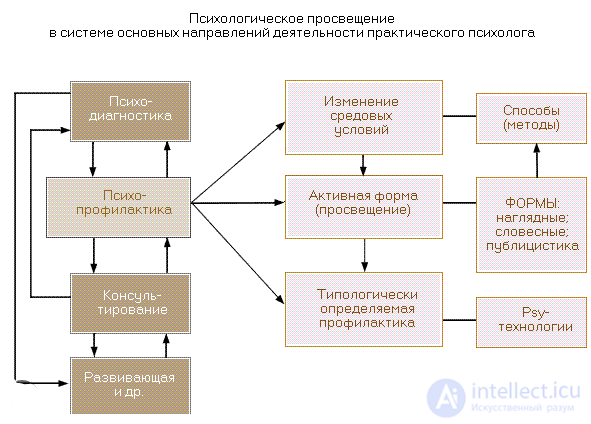
Speaking of the state and prospects for the development of psychological help
to the population, it should be noted that it is time to stop viewing psychology
as a science of separate mental processes; it should become
the psychology of the developing personality in a holistic world. Psychological
literacy should be mandatory for every person.
Psychoeducation is a special form both of enlightenment,
and of psychological help. In form, psychoeducation
has an indirect character, and its significance increases in cases of such
large-scale catastrophes as, for example, the Chernobyl disaster. A direct
psychological assistance, whatever its effectiveness, will not be
decisive, because of the large number of victims and the shortage of
trained specialists, as well as the population's insufficient
readiness to accept psychological assistance that has no material dimension.
Organizing psychological assistance in crisis situations requires
meeting a number of preliminary conditions.
1. It is necessary to know the socio-demographic characteristics of the population group at which the specialists' efforts are directed.
2. It is important to have an understanding of the personal development of this population group, which largely determines how far the demand
for psychological assistance has taken shape.
3. It is important to know what material and human resources are available.
All these variables determine the direction and nature of psychological assistance.
Psychoeducation is oriented toward creating the conditions for
the active appropriation and use of socio-psychological knowledge by the individual in the course of everyday life. The result
of psychoeducation is people's appropriation of
psychological knowledge and skills that would help them
succeed in developing in various spheres of social life and overcome the difficulties
of the life course. For example, for schoolchildren, what is very important for achieving
a state of mental health is the ability to cope with
psychological stress and to establish effective interpersonal
relationships with peers.
A theoretical review of the literature on this issue, together with the experience
of our own work, has made it possible to identify the main directions
of psychoeducation:
– familiarization with the basic rules and norms accepted in a given community;
–psychoeducation proper, as a specific type of activity aimed at conveying scientifically grounded rules of human behaviour in extraordinary, crisis situations.
Psychoeducation addresses the following tasks:
– psychotherapeutic self-instruction;
forming a demand for psychological assistance.
Indirect psychological assistance to the population is carried out
through publications in the media, the issuing of booklets, and through psychological
workshops for non-professionals.
Booklets and psychological workshops address two tasks:
1) the direct provision of psychological assistance through
the implementation of self-help programs;
2) indirect psychological
assistance through the formation of a demand for psychological assistance – the development
of reflexive processes of self-awareness and self-understanding (Appendix 2 presents the booklet "Helping the Victims of the Tragedy of 30 May 1999").
Indirect psychological assistance proceeds through three stages:
– first, psychotherapeutic instruction in the basics of self-diagnosing stress-inducing life events takes place (the didactic stage);
– second, an analysis and evaluation of one's own emotional experiences takes place: fear, irritation, anxiety, etc. (the reflexive stage);
– third, an attempt is made to change one's anxious states, drawing on the reflexive and evaluative stages (the therapeutic stage).
The task of forming a demand for psychological assistance is carried out at all three stages, but self-analysis of one's states already begins
at the reflexive stage.
Psychoeducation can be conducted in various forms, including educational programs, seminars, trainings, consultations, and self-instruction. Its goal is to provide people with the knowledge and skills that will help them cope better with life's difficulties and develop their potential

Comments