
Lecture
In every age, human beings have asked themselves: “Is my life predetermined, or am I myself its creator?” This is not merely a philosophical puzzle — it is a profound inner experience that can accompany us at critical moments of life. Fate, in this context, functions not so much as a religious or mystical category as an existential challenge that lays bare our fear, our hope, and our striving for meaning.
Death — a universal yet deeply personal phenomenon. It brings biological life to an end, but in human consciousness it is present as a constant existential backdrop. The experiencing of death is not only a reaction to loss, but also an awareness of one's own finitude, which accompanies a person throughout the whole of life.
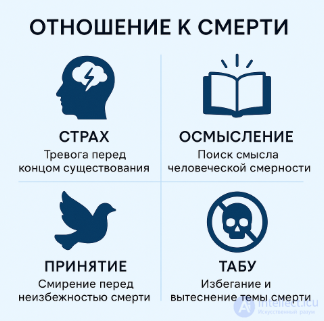
Anxiety in the face of fate and death are two of the key existential anxieties that can have a profound effect on a person's psychological state. Let us examine them in more detail:
Anxiety in the face of fate (fatefulness): This anxiety is linked to the awareness that a person's life may be largely determined by external circumstances or factors over which he has no control. A person may feel uneasy about how his fate will unfold, and anxious that he cannot fully control his own life. This can give rise to a feeling of powerlessness and anxiety in the face of the unknown.
Anxiety in the face of death: The awareness of death as an inescapable part of human existence can give rise to intense states of anxiety. A person begins to ask questions about the meaninglessness of life, along with a fear of the unknown after death. This anxiety can also lead to reflection on the meaning of life and a search for spiritual or philosophical answers.
How to cope with anxiety in the face of fate and death:
Philosophical reflection: Reflecting on the philosophical and ethical aspects of life, death, and fate can help one find meaning and understanding in these matters.
Spiritual practice: For some people, spiritual beliefs and practices can provide comfort and answers to questions about fate and death.
Psychotherapy: A professional psychotherapist can help a person explore and understand his anxious feelings and develop strategies for coping with them.
Communication: Discussing one's anxieties and worries with close friends or family can ease the feeling of isolation and provide an opportunity to receive support and understanding.
Active planning: Planning for the future and taking active steps to achieve one's goals can help reduce feelings of anxiety about fate.
This pair of existential anxieties is the most foundational, the most universal, and the most inescapable. Any attempt to prove its groundlessness is futile. Even notions of the immortality of the soul do not hold up, since everyone understands that as the biological body fades, an awareness of the loss of one's very self occurs.
Death anxiety is an absolute constant of life, a persistent, ongoing threat to human self-affirmation. Death anxiety increases as individuation develops, which is why members of collectivist cultures are less subject to this type of anxiety. This does not mean, however, that collectivist cultures lack basic death anxiety. In collectivist cultures there exists a special kind of courage, one that
is characteristic of stable collectivism.
Diverse groups of people, from street gangs to entire nations, can make use of group belonging to express their fear of annihilation in a particular way: by attacking other groups and destroying them. Perhaps war is simply a manifestation of the need to meet death face-to-face, to conquer it, to emerge from that duel alive — that is, a peculiar form of denying one's own
death?
E. Kübler-Ross.
This courage is created, is formed through a multitude of inner and outer (psychological and ritual) actions and symbols, which shows that even collectivism is compelled to overcome this basic anxiety. Death anxiety (the fear of death) is the foundation on which collectivist communities are formed. Indeed, it is frightening to face death alone. The Russian proverb “Even death is bearable when shared with others” captures this very precisely, confirming the preceding thesis. Death, as the inescapable reality of non-being, is hard to live through and to await alone. Considerable courage is required to meet the end of one's own “I.” Thus the hero of V. Bykov's novella “Sotnikov” frantically searches, before death, for human eyes in the crowd that might help him meet death and pass on, leave behind, a part of his being in this life.
Ontic self-affirmation is also threatened by the anxiety of fate. This type of anxiety is characterized by:
All this characterizes our being, which is by its very nature contingent. Our presence in a particular place is contingent, and the character of that place is contingent. The contingency of everything that surrounds us cannot but arouse anxiety about our spatial existence. Fate exists according to contingent laws — it is itself the law of contingency. “Contingent” – does not mean causally undetermined, but means that the determining forces of our existence do not possess ultimate necessity. They are given, but they cannot be logically derived. The anxiety of death and the anxiety of fate are engendered not by objects with which we coexist, which we overcome, with which we struggle, but by the human situation as such. Hence Hamlet’s question is possible in a somewhat different reading: “Do we have the courage to be, and no less courage not
to be?”
Existential anxieties in the face of fate and death can be complex and profound, and their resolution may require time and self-reflection. It is important to remember that many people encounter similar anxious states, and there are many ways of dealing with them and of seeking answers to one's questions about the meaning of life and finitude.
The person becomes aware of the finitude of being, yet at the same time feels a need to control his or her life.
Anxiety arises: “If everything is predetermined, why do I struggle?”
On the other hand, if everything depends on me — why can I not change what causes me pain?
Ancient tragedy (Sophocles, for example) showed how fate manifests itself as an external force, while the hero's inner choice remains decisive.
In existentialist philosophy (Sartre, Camus), fate is a challenge: the person is free, but bears responsibility for every choice.
In literature and art, fate is often depicted as something blind, yet beautiful and terrible at once (the Moirai, the Parcae, the wheel of fortune).
These images help express the non-rational aspects of experiencing — the sense that our life is subject to a higher order that we do not understand.
Contemporary psychology speaks of the phenomenon of “existential anxiety” — a state in which the individual confronts questions of meaning, fate, and death.
At such moments, the search for a personal path and one's own meaning is often activated, as a counterweight to the sense of an “imposed script.”
Below is an overview of various types of death, presented from philosophical, biological, and cultural points of view — as if one were peeling the concept of "death" apart into layers of meaning:
Clinical death — cessation of cardiac activity and breathing, but resuscitation is still possible.
Biological death — irreversible destruction of vital systems (brain, heart, lungs).
Brain death — complete and irreversible loss of brain activity while the body's vital functions are maintained by mechanical means.
Existential death — the loss of the meaning of existence, a sense of inner "emptiness."
Social death — alienation or isolation from society; it may occur with senile dementia, imprisonment, or being forgotten.
Symbolic death — the loss of one's former "self," as in the case of radical life changes (for example, renouncing a career or religious conversion).
Heroic death — an act of self-sacrifice in the name of ideas or other people (for example, in tragedy, in war).
Absurd death — Camus regards it as a consequence of the world's indifference to man.
Death as initiation — in many cultures death is treated as a transition — not an end, but the beginning of a new cycle (for example, in shamanic traditions).
Natural death — as a result of aging or illness, without external intervention.
Violent death — due to external causes: murder, accident, war.
Unexpected (sudden) death — rapid and unpredictable: stroke, heart attack, catastrophe.
In literature, death often takes on images (the reaper, the shadow, the passage, silence).
In religion — death as judgment or liberation.
In psychoanalysis (Freud, Jung) — death as an archetype connected with transformation and the unconscious.
Death anxiety — a term used in psychology to describe the fear that arises upon becoming aware of mortality.
In adolescence and adulthood, the question of death becomes especially acute, provoking crises of identity or of meaning.
Experiencing death can be a trigger for growth: an understanding of finitude can strengthen the drive to live more consciously.
Martin Heidegger: the human being is a being-toward-death. Awareness of death makes us authentic, prompting us toward authentic existence.
Epicurus: “Death does not concern us, for as long as we exist, death is not present, and when death is present, we no longer exist.”
Camus: the absurd arises from the collision between the striving for meaning and the silence of the world. Death is the supreme manifestation of absurdity.
The loss of someone close gives us the experience of “another's death,” through which we begin to make sense of our own mortality as well.
The psychology of grief (according to Kübler-Ross): denial → anger → bargaining → depression → acceptance.
Art, religion, and rituals help to “culturalize” death — to turn it into an event that one can live with.
Awareness of death can become a source of meaning: we strive to create something that will outlive us — creative work, relationships, ideas.
Viktor Frankl: “Life has meaning to the very end, even in dying.”
Accepting death is not capitulation — it is a way of affirming life in all its depth.
The experiencing of fate is not an error of thinking, nor is it an illusion. It is an inner dimension of human nature, a point of contact with the questions that shape our personal myth. And perhaps what matters is not so much whether fate is determined, but how we experience our involvement in it.
The experiencing of death is not only the fear of the end, but also a form of profound awareness of the very act of existing. It shapes our choices, our values, our way of life. The ability to keep death within one's field of vision without falling into panic is a mark of maturity and inner freedom.

Comments