
Lecture
Psychological debriefing is a form of crisis intervention, a specially organized discussion in groups of people who have jointly experienced a stressful, critical event.
Psychological debriefing is an important form of crisis intervention aimed at helping people who have experienced traumatic events or crisis situations. This process provides an opportunity to express emotions, discuss experiences, and analyze events with the goal of mitigating the psychological consequences of the crisis.
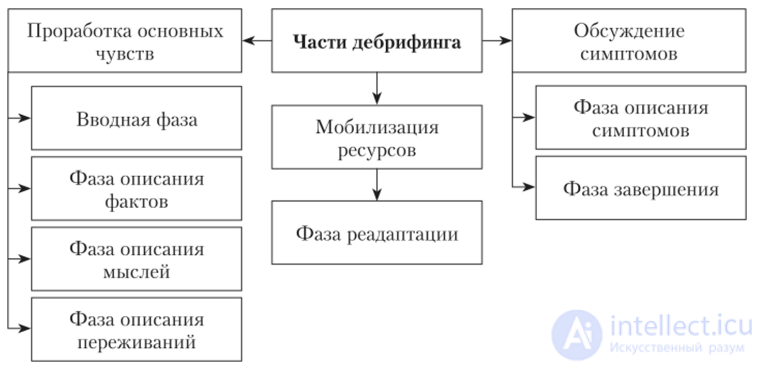
Fig. Structure of debriefing
Here are some key aspects of psychological debriefing:
Purpose of support: The main goal of psychological debriefing is to provide emotional support and facilitate the restoration of psychological balance after a crisis. This helps reduce the risk of developing psychological disorders such as post-traumatic stress disorder (PTSD). The goal of the group discussion is to minimize psychological suffering.
Timing and place: Debriefing is usually conducted relatively soon after the crisis, while emotions and experiences are still fresh. This may be within several days or weeks after the event. The venue may be physical or virtual, and it is important to create a safe and supportive environment.
Structure of debriefing: Debriefing usually has a structured format that includes the following elements:
Conducted by specialists: Psychological debriefing is usually conducted by trained specialists who have experience working with crisis situations and trauma. This helps ensure proper support and assessment of the participants' needs.
Client-centeredness: The approach to debriefing is oriented toward the needs and emotional state of each participant. There is no universal template for all cases.
Objectives of debriefing
1. "Working through" negative impressions, reactions, and feelings.
2. Cognitive organization of the experienced event: awareness of the traumatic event, and of the reactions and symptoms accompanying and caused by it.
3. Reduction of individual and group tension.
4. Reducing the sense of uniqueness and pathological nature of one's own feelings and reactions.
5. Normalization of states (well-being): the emergence of an opportunity to discuss the crisis situation and share one's experiences with others.
6. Mobilization of internal and external resources and strengthening of group support, solidarity, and understanding.
7. Preparation for experiencing those symptoms or reactions that may arise several days or weeks later.
8. Identification of means for further help if needed, and informing the participants of the group discussion where and to whom they can
turn if necessary.
The condition for applying classical psychological debriefing is considered to be the presence of a crisis situation with the presence in it of a threat recognized
by the participants and the participation of all members of the group in it. The optimal time for conducting debriefing is no later than 48 hours after the event.
The discussion can, of course, be organized at a later time after the event, but the more time that passes, the hazier the
memories will be. To recreate the picture of the events that occurred at a great time distance, video recordings
of the events, if available, may be used.
The setting for conducting psychological debriefing should be comfortable, preferably with an isolated room in which the group would
be protected from external interference, such as, for example, phone calls, accidental visitors. Members of the group can seat themselves around
a table. This is preferable to using the traditional group therapy model: chairs arranged in a circle. The empty space in
the center of the circle is unusual for a group of people, especially for those who have survived a traumatic event, and may therefore be perceived by them as carrying
an anxiety factor.
Intervention means interference. In an intervention, the psychologist is the most important part of this process. The qualification requirements
for the facilitator reflect knowledge and experience in conducting group training, the ability to work with people who have experienced grief, fear, anxiety, psychological
trauma, i.e., knowledge of the symptomatology of post-traumatic stress disorders, readiness for intense emotional expression among the members
of the group, and mastery of empathic listening techniques. The conduct of psychological debriefing is led by one person who has assistants - one
or two co-therapists. The presence of assistants is a mandatory condition for conducting psychological debriefing.
The core of debriefing is facilitating the group discussion, which includes speaking, listening, decision-making, teaching,
following the agenda, and bringing the meeting to a conclusion satisfactory to the group members. Based on this, the list of skills required of the facilitator
includes their actions at all stages of the group discussion, knowledge of the laws of group dynamics and their use for therapeutic
purposes, facilitation, control over the movement of group members inside and outside the room where the debriefing is taking place, control over time, individual
contacts with someone who is experiencing distress. The debriefing process should be recorded; however, the use of technical means (audio and video recording)
is limited, since the consent of all members of the group discussion is required. The size of the group for psychological debriefing varies
around the figure of 15. A noticeable increase in the number of participants is associated with the need to have an additional number of co-facilitators and conditions
for conducting the debriefing: a spacious room, so that people can hold the discussion simultaneously in several groups of 15 people.
The structure of psychological debriefing includes three parts and seven distinctly expressed phases.
Part one: working through the main feelings and measuring the intensity of stress includes:
Part two: detailed discussion of symptoms and ensuring a sense of calm and support consists of
Part three: mobilization of resources, provision of information, and forming plans for the future 7) the re-entry phase.
It should be emphasized once again that the procedure of psychological debriefing described here is presented in its classical form. All
the phases listed are possible and necessary, since the participants in the group discussion were witnesses to or victims of one event that was extraordinary
for them.
1. The introductory phase of psychological debriefing involves a skillful start to the group work: conducting introductions, and the seating arrangement
of the participants at the table. About 15 minutes is spent on the introduction.
At the beginning of the introductory phase, the debriefing facilitator introduces themselves and their assistants, and states the goals and objectives of the meeting.
The rules of debriefing are outlined in order to minimize the anxiety that may arise among the participants in the group discussion.
Rule one. Participants in the group discussion speak only when they wish to do so. No one can compel them to
disclose. The only requirement is that they state their name and express their attitude toward the event being discussed.
Group members are required to be able to listen without interrupting and to allow everyone who wishes to speak to do so.
Rule two. Group members must be assured that the confidentiality of the content of the discussion will be maintained. At each meeting
its own level of confidentiality is established. The facilitator gives a guarantee that everything said will not go beyond the bounds of this circle
of communication. Group members are also asked not to gossip about what happens here. This creates a state of psychological safety among the participants in the group discussion
It should be specifically noted how note-taking during group discussions is handled. It is necessary to relieve fear by reassuring participants that
nothing will be recorded against their will.
However, on the other hand, they can be told that it would be useful for themselves to make a record of the facts and thoughts presented, so that later
they could refer back to this material. This is especially useful for dispelling the illusions that arise regarding the uniqueness
of the events that occurred.
Rule three. Participants in the group discussion are told that the psychological debriefing procedure does not involve evaluations, criticism, or
verdicts. This is not a tribunal, not a court; there are no guilty parties or judges here - it is merely a procedural discussion. This kind of framing prevents disputes,
mutual accusations, which may arise due to differences in expectations, thoughts, and feelings.
Rule four. Participants are warned that they may feel somewhat worse during the group discussion (during
the session), but this is a normal phenomenon that usually occurs due to touching on painful issues. The facilitator should explain that
this is part of the price for the subsequent ability to withstand stress, for future recovery.
Rule five. The group is not recommended to work without a break.
Therefore, they may be offered: to have a snack or visit the restroom before the debriefing begins. It is useful to have a coffee maker or kettle, so that everyone can
serve themselves right there, without interrupting the session.
Rule six. Participants in the group discussion are warned that they have the option to quietly step out and return. However, the facilitator should be informed of one's condition; if the person leaving is in distress, they need to be accompanied.
Rule seven. Participants in the group discussion are told that they may discuss issues that go beyond the given topic,
and ask any questions. It is important to constantly remember that participants generally have little experience presenting their “self” within a group. The facilitator and their team
bear responsibility for encouraging and reassuring group members. And the start of this activity is already set in motion during the introductory phase. Gentle
jokes and light self-deprecating humor are appropriate here. All this helps reduce tension in the group.
2. Fact phase.
This phase consists of a brief description by the person of what happened to them during the incident. Participants may describe how they
saw the event under discussion, and what the temporal sequence of the stages of its perception was. The facilitator should encourage questions that help
clarify and correct the objective picture of the facts and events available to the group members. This is important because, due to
the scale of the incident and errors of perception, each person reconstructs the picture in their own way. This may involve simply inadequate experiencing
of the events, or the presence of erroneous key perceptions about them. Sometimes the sense of time is disrupted: the sequence and duration
of the events.
The duration of the fact phase may vary. But the longer the traumatic event lasted, the longer the fact phase may be. Knowledge
of all the episodes of the event and their sequence creates a sense of cognitive organization of the past event. This is one of the main tasks
of psychological debriefing - to give people a chance to see the situation more objectively and adequately, having a complete picture of all the facts
of the event under discussion; such a clear discussion blocks the various speculations that fuel anxiety.
3. Thought phase. This phase involves focusing on judgments about the event. The judgments expressed are analyzed and
discussed. The questions that open this phase may be of the following type:
People who are in no hurry to share their first thoughts, because these thoughts seem inappropriate or bizarre to them, are experiencing an intense feeling of fear. The first thought may reflect what subsequently forms the basis of anxiety. It is necessary to encourage participants in the group discussion to speak about the event that occurred.
Memories can be revived and thoughts activated with the help of questions: "What were you doing during the incident? Why did you decide to do
exactly what you did?"
At the end of this phase, the impressions participants had at the scene of the event may be voiced. The questions that may be
asked are as follows: "What were your impressions of what was happening around you when the events were just beginning to unfold? What did you hear,
see, smell?"
Comparing memories and verbally reporting them makes their destructive effect less powerful, since they are also verbalized
within cognitive frameworks, in the process of the group discussion.
4. Reaction phase. During this phase, feelings are explored. This is often the longest part of psychological debriefing.
For it to proceed successfully, the facilitator needs to help people talk about their experiences, often even painful ones. This
will reduce the destructive nature of the feelings expressed.
When people describe the reasons for the decisions they made, they very often speak of fear, helplessness, loneliness, self-blame, and
frustration. Typical comments include: "I was so afraid of making mistakes..."; "I knew that if I could..."; "I had never in my life been so frightened. My
hands were shaking and shaking..."; "I didn't know whether I was saving a life or taking a life..."; "I was so alone that I had to make all the decisions
on my own...". It is important to pay attention to those who seem more affected, who are silent, or who have particularly pronounced symptoms
of post-traumatic stress disorder. These may be people who have suffered the most from violence and cruelty. Such participants need
an individual approach, and after the psychological debriefing ends, they may be offered an individual program of support,
of psychological help. Sometimes, during the debriefing, even older crisis events or more personal problems may surface. It is
necessary to consider a more detailed examination of certain individual reactions. Group members are asked to describe the symptoms and shocks
(emotional, cognitive, and physical) that they experienced at the scene of the event, when the incident ended, in the following days, and at the
present time. Special attention should be paid to unusual experiences, and to certain difficulties in returning to normal work and to
their usual way of life.
Familiar features of post-traumatic stress can be expected - the experience of the phenomena of avoidance and numbing. Fear may cause
changes in behavior. Phobic reactions may manifest in the fact that people cannot return to the place where the event occurred.
This becomes especially problematic if that place is their main place of work. After such incidents, people sometimes
are forced to change their place of work and residence, are afraid to use public transportation, and may be afraid to sleep without a light on.
In the course of recounting their experienced feelings, group members develop a sense of similarity, commonality, and the naturalness of their reactions. The group
discussion, which removes the uniqueness of what was experienced, is key. Questions that help create a sense of commonality might be
such as: "How did you react to the event?"; "What was the most terrible thing about what happened, for you?"; "Have you experienced anything like this
before, earlier in your life?"; "What caused you to feel this same sadness, distress, frustration, fear?"; "How did you feel when
this event occurred?"
It is important to get an answer to the question about the most difficult experiences connected with the event that occurred. The correct behavior of the facilitator
of psychological debriefing is especially important at this phase of the discussion. He must create conditions such that everyone participates in
the communication, intervening if the rules of debriefing are violated or if destructive criticism occurs. Why is this so important in
the debriefing procedure? The fact is that one of the main therapeutic outcomes of debriefing is the modeling of strategies that determine how
to cope with the emotional problems that arise in relationships after a traumatic event. Participants in the group
discussion must learn to express their feelings, know that this is safe, and understand that they have the right to discuss their problems with
others.
It is not uncommon for participants to become upset when they experience strong emotional reactions. For the facilitator, this is
a signal to organize group support. Forms of support can be quite varied: one can place a hand on the shoulder of a person
who is in a state of distress, or simply verbalize support, saying that tears are acceptable and appropriate here.
The debriefing facilitator should bear in mind that even such a seemingly simple form of group support as touching
a neighbor's shoulder may provoke a negative reaction and therefore requires special permission.
If someone leaves, the debriefing facilitator's assistant should make sure that the person leaving is feeling well and help them
return to the group.
Special attention should be paid to the problem of relationships within the family. Often a person who has experienced stress finds that the family cannot understand
what they went through, and a feeling of mutual estrangement arises within the family.
6. Teaching phase. At this stage of psychological debriefing, the facilitator or one of their assistants, who kept notes on the discussion,
should try to synthesize the participants' reactions. Therefore, special requirements are placed on the note-taker and on carrying out diagnostics
of the group's overall reactions and attempts to normalize the state of the group.
At this phase, materials from other incidents or even research findings may be used. The emphasis is on demonstrating reactions
that are "normal reactions to abnormal events".
It is important here to emphasize each person's individuality. Participants in the group discussion should not get the impression that they are obligated
to react just because they are normal in these events. They should only know that they can always do so, if they wish.
It is useful to use notes that help restore reactions in memory, clarify them, and make them more precise and consistent
memories. This should not be done during the psychological debriefing itself, but only at the end, so as not to disrupt the discussion process.
It is good to have a chart of symptoms, where each of them is described in detail; it is advisable to hang the chart in the room so that everyone can come up and
add something to the symptoms if they had not noticed them in themselves before. It is important that even at this phase participants can agree on
the next meeting. Information about the upcoming meeting allows participants to think about forming their own strategy
for overcoming their expectations. Reactions such as increasing anxiety, feelings of vulnerability, problems with sleep and concentration are important not
only to describe, but also to anticipate their occurrence. In the course of the discussion they should be summarized, and participants in the group discussion should
form attitudes and expectations that, with a normal course of events, the symptoms will disappear over time.
In the course of work during the re-entry phase, the future of the participants in the group discussion is discussed and planned, and strategies for overcoming negative symptoms are outlined.
One of the main goals of psychological debriefing, among other things, is to create a safe intragroup psychological
context. Experiencing a lack of understanding on the part of colleagues or family members can be one of the most traumatic aspects of post-traumatic stress.
A typical statement among those affected by some traumatic incident might be expressed in the following words: "We need the opportunity to talk to one another, to share all our experiences and
thoughts without fear that others will laugh at us". It is useful to discuss in which cases a participant needs additional
help. The determining factors may be the following indications:
Directions for further help. The group should discuss and decide on its further course of action: on the need to organize a follow-up debriefing, or at least note its likelihood if the incident was particularly traumatic or some problems remained.
In extraordinary circumstances, for example, the death of one of the staff members, or to deepen group solidarity, it is possible
to hold a follow-up debriefing.
Provision should be made for further communication with one another later, when the team is disbanded. For example, exchanging phone numbers and
addresses.
Resuming the work of psychological debriefing may take place after two weeks or even two months. This process is already less
structured than the first one, and its main task is to track progress in the restoration of the normal functioning of the participants in the group
discussion.
Psychological debriefing can be an effective tool for helping people who have experienced crisis events, and can promote healthier psychological recovery. However, it is important to note that it is not a panacea and is not suitable for everyone. In some cases, additional psychological help or therapy may be needed for a deeper and more lasting recovery.

Comments