
Lecture
Experiencing grief is a complex process that depends on many factors, including a person's age. Age-related characteristics can influence how a person perceives and copes with grief. Here are some of them:
Children (preschool age): Children can experience grief, but their ability to understand and express their emotions is limited. They may show grief through whining, anxiety or changes in behaviour. It is important to provide them with support and to explain death or loss in a form accessible to them.
Children (school age): At this age, children begin to better grasp the meaning of death and grief. They may have many questions and need honest and clear answers. They may also express their emotions through social behaviour and communication.
Adolescents: Adolescents may experience grief more intensely than children, since they perceive the world more consciously. It is important to teach them how to cope effectively with their emotions and to seek support if necessary. They may also experiment with different ways of expressing grief.
Adults: Adults may have more stable ways of coping with grief, but they too may encounter different reactions, depending on the nature of the loss and their individual characteristics. They may turn to friends, family or professionals for support.
Elderly people: With age, the loss of loved ones often becomes more frequent. Elderly people may experience grief more often, and this may be associated with a sense of loss and loneliness. Support and care from family and society are of great importance.
Regardless of age, experiencing grief is a normal reaction to loss. It is important to be sensitive to other people's emotions and to provide them with support and understanding in accordance with their age-related and individual characteristics. Grief is a process that can take a different amount of time for each person, and everyone may go through it in their own way.

1. Reactions to death vary depending on the child's age or stage of development. Psychologist Maria Nadi describes the following differences in children's reactions to death depending on the period of development. At the age of 3 to 6, children perceive death as being akin to sleep or a journey from which one can wake up or return. The permanence of death is not yet grasped. Children of this age perceive and explain the world by taking into account the opinions and actions of the adults around them. The child is not able to understand the meaning of the words "death", "always" or "will never come back". The child will search for the deceased person, but will eventually give up their attempts and come to terms with it; they will react to the loss by becoming clingy and irritable, or — in more severe cases — by withdrawing into themselves. The best help for a traumatised child is when another adult becomes involved in their situation and gradually builds a reliable emotional bond with the child, thereby continuing the dialogue that was suddenly interrupted. This new contact can later become the solid foundation thanks to which the child will be able to cope on their own with the misfortune that has befallen them. At an earlier age, when the presence of the mother and father is so important for the child's development that, having lost one of the parents, they experience what is, as it were, a double loss: the surviving parent (mother or father), because of their own personal grief, is more or less emotionally withdrawn from the child. Instead of comfort and support, the mother or father may scold the child and reject them, while the child's normal reactions to the death of a loved one are expressed, perhaps, in clinginess, tearfulness and whining. If the parents have lost one child, the situation for the second child may become similar. The parents are absorbed in their own grief, and it is very difficult for them to understand the problems of their other children. We have encountered parents who, having lost one child, for quite a long time failed to recognise the existence of their other children, or the fact that they too might have psychological problems connected with the loss of a brother or sister.
A child aged 3-6 thinks that their thoughts can influence the world around them. They live under the illusion of their own omnipotence, and find it difficult to separate fantasy from reality. To a child who thinks about or wishes for something to happen, it seems that it has already happened.
This age is characterised by a sense of connection between the ability to commit an act and punishment. When a child feels within themselves a strong inclination towards some misdeed, they naturally feel guilty: "If I had behaved more politely, if I had been better, mum would still be alive!"; "If I had never been angry at my little brother and had never wished he didn't exist, he would not have died". Children of this age have a strong imagination, and they find it difficult to put their own dreams into words; children are not always sure whether their fantasies really exist, in the outside world, or whether they live only in their own minds. This circumstance makes the mechanism of grief more complex. The child might try to do something in order to return to ordinary life again, for example, by starting to behave very well, becoming obedient — after all, such behaviour is valued by adults; the latter rarely perceive the child's state in all its complexity, as a "sign of trouble", even though in reality that is exactly what it is.
Or, perhaps, the child will become more restless and difficult to deal with in order to be punished, since, in their opinion, they deserve it, because they are the one to blame for the terrible thing that happened. Adults, however, do not perceive this at all: it is hard for them to grasp that defiant behaviour is a sign of guilt or grief. As a result, the child is met with scolding and punishment for their bad behaviour — at a time when they could instead have experienced reassurance and relief. When working with a preschooler experiencing grief, it is important to remember that they do not understand such abstract words as "never" or "always". The child is only aware of concrete actions. "If you say grandpa is in heaven, then where is heaven and how did he get there?", "If he was able to go there, then he can also come back". You must be sure to give concrete answers and explanations. Explain the difference between being alone and being dead.
2. Younger schoolchildren (7-9 years) often think about death, because they already understand that death is inevitable and final. They know that basic life circumstances cannot be changed. Children observe and reflect on this, though they are still far from being able to manage the situations that may give rise to feelings of anxiety and helplessness. At this age, children understand the reality of death, but find it hard to imagine that they or their loved ones could die
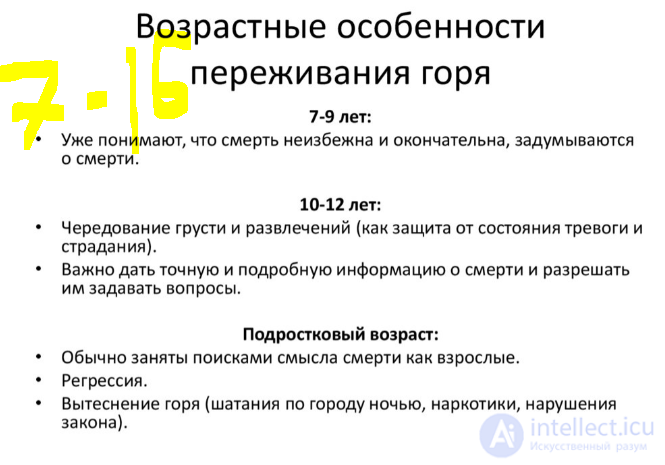
3. In the behaviour of 10-12-year-old children, fragmentation can be observed. This behaviour can be viewed as the child's psychological defence against a state of anxiety and suffering, meaning that the childhood experience is characterised by a periodic alternation of states of sadness and of amusement, games, in order to minimise frightening fantasies and intense experiences in children, it is important to give them accurate and detailed information about death and to allow them to ask questions. Knowledge of concrete facts will help restore the child's faith in life. Children become aware for the first time of the inescapable nature of death. At the same time, they are more interested in the biological aspects of death. At the same time, they also become aware of the social significance of death and loss.
4. The thinking of teenagers, the next age group, is already similar to the way adults think. But often the period of adolescence is a difficult time for experiencing grief. Psychological defence mechanisms are weakened, the adolescent examines themselves "Who am I?" They need adult role models of behaviour in order to find themselves or to reject something in themselves. Adolescents may regress to earlier notions of death, but they are usually preoccupied, like adults, with the search for the meaning of death. Grief reactions in adolescents resemble the reactions of both adults and children. Since adolescents usually undergo regression under such intense stress as loss, their reactions may resemble those of children more closely. However, there are specific features of adolescent grief that affect their reactions. Grieving adolescents may engage in rewriting the reality of death in daydreams, denying or postponing grief for later. Another complicating factor may be the adolescent's struggle between independence and dependence.
Death may be, in a sense, a threat to an adolescent, who may develop a fear of separation and independence. Since adolescents often strive to appear more mature or hide their feelings better than children do, their feelings connected with loss may be buried alive. Finally, adolescents are unique in their self-awareness. They may be more preoccupied with their behaviour or clothing than with the loss itself, a most thoroughgoing means of denial that causes embarrassment or irritation in those around them. Losing a mother or father at this time may perhaps be unbearable. Some of the adolescents we have met encapsulated their grief inside themselves while outwardly leading turbulent lives. Wandering the city at night, experimenting with drugs, breaking the law — all these are also ways of suppressing grief. Often a person who has experienced the loss of a loved one accumulates anger, which may prove harmful both to the person themselves and to others. Suicidal thoughts are probably an example of self-destruction, but they may also, perhaps, express the subject's desire to be reunited with the deceased. Almost everyone who has experienced the tangible loss of a loved one has thoughts of suicide come to mind. It took only asking the children in our group about this once for us to find confirmation of this assumption. Adults rarely ask children questions about suicide; such questions are taboo for many of us. When we did ask what had helped most in overcoming grief, some children and adolescents replied that what truly gave them the strength to go on living and struggling with their problems was the thought of, and the possibility of, ending their own life.

Comments