
Lecture
It is easier to change individuals gathered into a group than each of them individually (K. Lewin).
Support groups – a form of group work in which joint activity is organized. The group is united by the similarity of problems that people cannot solve alone. Participants' need to unite on the basis of similar problems is used to exchange information about how to organize their lives more effectively in the presence of illness, isolation, emotional trauma, or life crises.
The "support group" method is a form of psychosocial support that is provided in a group format. This method is often used to help people suffering from various mental or emotional problems, and can be particularly useful for those who have experienced trauma, loss, stress, or relationship problems. Here is a general characterization of the "support group" method:
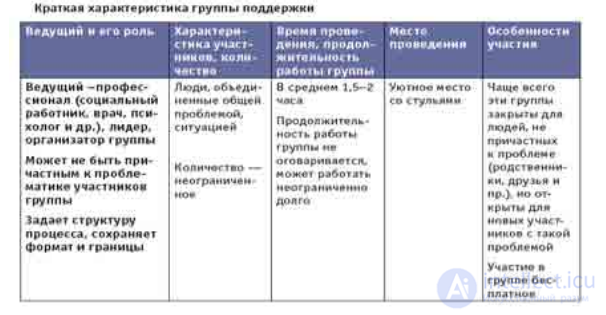
Group dynamics: Support groups usually consist of a small number of participants (usually from 6 to 12 people). Participants meet regularly, usually once a week, under the guidance of a professional therapist or facilitator. Group dynamics allow participants to support one another and share their experience and feelings.
Support and mutual understanding: Support groups provide a non-judgmental and understanding environment where participants can express their feelings, worries, and fears. This helps participants feel that they are not alone in their problems.
Exchange of experience: In support groups, participants can share their own experience of how they cope with specific problems. This can be an important source of information and inspiration for others.
Learning experience: Some support groups may hold educational sessions where participants learn about their problems and methods of solving them. This can help participants better understand and manage their problems.
Confidentiality: An important aspect of support groups is the observance of confidentiality. Participants are obliged to respect other people's private information and not disclose it outside the group.
Duration: Support groups can be temporary or long-term, depending on the needs of the participants and the nature of the problems. Some groups may continue for months or even years.
Diversity of topics: Support groups can be organized around various topics, including the loss of loved ones, trauma, depression, addictions, family problems, and much more.
Professional guidance: Support groups are usually conducted under the guidance of a professional therapist or facilitator, who ensures a safe and effective environment.
The purpose of holding a support group. A support group is intended to organize support, facilitate the exchange of information, help the process of adaptation to a new situation of development, and create favourable conditions for help and mutual help.
Support groups — these are regularly meeting groups of people united by a common problem or situation. They serve to exchange experience and information, and to provide help. The peculiarity of this type of group work is that responsibility for organizing and conducting the meetings rests with the specialist, not the group's participants. Given that the group's work is built on a “top-down” principle, it is clear that it is organized and entirely supported by some organization. Its leader (usually the same person) is a paid employee of the organization: a psychologist or a social worker, who may either “be within the problem” or have no such experience. It is precisely this person (alone or together with other staff members) who is engaged in creating and developing the group. And, although participants may be involved in decision-making (when assessing needs or adopting certain rules), they are not leaders. Support groups usually have no membership or limits on numbers. The rules are either entirely determined by specialists, or the decision about them is made jointly with the group's participants. Support groups are especially effective for people in a crisis situation. In the group, they can learn to talk about the problem, discuss their feelings and experiences, and, ultimately, accept the fact that they have an illness/difficult life situation, and find resources for support and problem-solving. Support groups are effective in a situation where there are not yet resources for creating self-help/mutual-help groups. They can be successfully transformed into mutual-help groups, provided that people have appeared who have adapted to the new situation and constructively changed their behaviour. The key to the success of such a change is the activity and motivation of the group's participants toward constructive change, as well as support from specialists who understand that activists have appeared who are already ready to organize and lead a self-help and mutual-help group. During this period, it is appropriate for the specialist to provide the group's participants with full information about this form of work, consultat
Objectives of the support group. The main task of the support group is to organize the exchange of emotional experience, which makes it possible to solve a number of
specific tasks that are difficult or impossible to resolve in solitude. Such as removing the sense of uniqueness, effective search for personal resources, acceptance of the fact of loss, and the ability to find and accept support.
Form, type of support group. The form in which a support group is conducted depends on many factors. We will focus on the socio-cultural ones. For example, in a rural area the most acceptable form of work will be a club. In a work environment, groups
organized around various types of activity will be most effective. Among people of predominantly creative professions, discussion groups are most likely to succeed.
Social orientation of the support group. The essence of the social orientation of the support group is the organization of help to a person in
grief. Helping a person in grief means both facilitating their inclusion (return) into social life and changing their way of life. Ultimately,
the support group sets itself the task of helping to achieve personal growth after a loss.
Mechanisms usually involved in conducting a support group. First, this is social evaluation and awareness of the problem; second, this is socio-psychological activation; third, this is the exchange of social and psychological information at the cognitive,
emotional, and behavioural levels.
The leader of the support group. Here there is quite a wide range of possibilities. The participants themselves may serve as leader(s). The most acceptable
choice for leader of a support group is a professional (a social worker or a practical psychologist). It is
not contraindicated for a support group to be led by paraprofessionals — clergy, representatives of law-enforcement
agencies, and others.
The role of the group leader. The significance and role of the leader are diverse and have a fairly wide range: an unfamiliar/familiar uncle or aunt,
a person who leads the discussion, discusses topical problems, an emotional leader capable of acutely sensing others' experiencing and
drawing the affected persons into the group discussion. The most acceptable definition of the leader's role is contained in the term — facilitator. In
the context of a support group, this term can be translated as a person creating conditions for easing suffering, a person easing
suffering
Duration of the group. There is no strict regulation here. The duration of the group's existence is determined by the needs of its
participants. As a rule, groups discussing losses meet over the course of a year with varying frequency of meetings. How to form a support group. The group leader is the sole person responsible for creating and assembling the group. A considerable share of the work of maintaining the group's existence falls even on the period before the first meeting, and the fate of the group depends to a great extent on the leader's ability to correctly select patients and prepare them for therapy.
The process of creating and organizing a support group includes the following stages and questions that must be resolved before the work itself begins:
Preparing the leader themselves for organizing the support group.
Selection of participants.
3. Principle of composition: demographic composition and potential compatibility of the participants, i.e. the degree of homogeneity and heterogeneity of the group.
4. Place and conditions of work.
5. Open or closed group.
6. Size of the group
7. Frequency and duration of support group meetings
The principles of work of a support group differ somewhat from
the rules of work adopted in psychotherapeutic groups:
1. The principle of personal safety (in psychotherapeutic groups it is called the "level of confidentiality"). It is periodically necessary to conduct a test of personal safety. The level of safety
is established at the first meeting. Each person proposes their own level, but the highest of the proposed levels is adopted. It is possible that over time the level of candour will increase. If among the participants of the group discussion there are those who work together, then, as a rule,
the highest level of safety is established, since, even without naming
names, it is very easy to identify the participants.
2. Establishing the boundaries of what is permissible. Group participants must accept the boundaries of pleasant – unpleasant, that is, how far the discussion can be
turned into a celebration, how far one can accept others' pain and troubles. In the group, the principle must prevail that we not
only receive but also give, and that to get something, one must give something. Someone must be given support, no matter how bad and hard things
are for oneself.
3. Active listening. The principle of the facilitator's work is to help people identify and name their problems. Perhaps, for many, the main
the need is for someone to listen to them, without giving too much advice. What happens in everyday life when a person is faced with
difficulties? He tries to keep all his troubles to himself, convincing those around him that everything in his life is "fine!". And this is logical, since such
an approach is more adaptive, since we do not create extra difficulties for others, but at the same time it has a negative effect on well-being and on
one's state of health.
In the group one need not hold back one's emotions; one can cry oneself or sympathize with those who are crying for similar reasons. The law of psychological
contagion often has a positive effect on the participants of the group process. It is important that the group treat all
problems, statements, and emotional displays with understanding. For some it is enough to be listened to, others are ready to receive advice, and still others
need help and support. The facilitator needs to sense, and if necessary to ask directly, what kind of help this or that
group member needs.
4. Problems of social contact. One of the conditions for the effective functioning of a support group is creating a comfortable
sense of well-being for participants in various group-discussion situations: for example, creating conditions in which people are not afraid to share any
information.
5. Time limit in the group. The duration of a group meeting is, as a rule, limited (no more than two hours), so time must be economized and
used effectively. The requirement to be attentive to one's own and others' time in itself creates certain boundaries,
a certain meaningfulness of life precisely in that period of the life path when the “connection of times” has been destroyed, has fallen apart, when some rupture of
continuity has occurred. Thus, the requirement to use time effectively also has a psychotherapeutic character.
6. Homework assignments. Group members must work not only during group meetings but also at other times - completing homework assignments,
keeping a diary, and so on. This requirement-rule is especially necessary at the stages of acute grief, when continued support is needed outside
the group context as well.
7. The facilitator's need for support. The optimal option is when the facilitator works with a co-facilitator. When the leader
of a group discussion arrives not alone but with an assistant, the participants see that he too needs support, and this has a calming effect on
the participants of the group discussion.
Requirements for the group leader
There are general requirements for the personality of the group leader: sincerity, personal integration, patience, courage, flexibility,
warmth, the ability to orient oneself in time, and self-knowledge. Let us give a more detailed characterization of an effective group
leader.
Courage. Courage is manifested: first, in the ability to allow oneself to make mistakes; second, in the ability to stand up to the group's
participants; third, in the ability to make decisions; fourth, in the ability to be direct and honest with the group's participants; and fifth, in the ability to speak openly
about what is happening in the group.
Being an example for the group's participants. To meet this requirement, the leader must strive for constant
self-improvement. The group will work effectively if it sees that the leader himself does in the group what he requires of its
participants.
Emotional involvement in the group. This means the group leader's involvement in the doubts, fears, pain, suffering, and joy of the participants.
Openness. This is a multifaceted trait of an effectively functioning group leader, encompassing openness to oneself, to other
group members, to new experience, and to different lifestyles and values. The ability to accept aggression. In the life of a group there are many situations
when the leader may be blamed, have dissatisfaction expressed toward him, or meet with an aggressive reaction — he may be accused of not caring
enough about the participants, of caring only about some of them, of regulating the group's work too much or, conversely, of not doing
enough of it, and so on. The main thing for the leader in this situation is an attitude of constant readiness to discuss the unpleasant, hostile reactions
of the group's participants.
Personal strength. This is the leader's ability to guide the behavior of participants in the right direction. Strength of personality means that he knows who he
is and what he wants. Such self-confidence is connected with sincerity and openness — a strong person is one who is not afraid
to analyze himself, who finds in himself not always positive personal characteristics, and who can show himself to others just as he
is.
Striving for new experience. The group leader is, of course, not obliged to go through and experience every possible hardship, but it is important to have the experience of living through as wide a palette of feelings as possible.
Sense of humor. The ability to see the funny side even in very difficult and complicated situations, in general the ability to laugh when things are hard, is
psychotherapeutically invaluable. In crisis situations in the group, humor can reduce tension and help solve problems in paradoxical
ways.
Support groups can be a very effective method of helping people cope with psychological and emotional difficulties, since they give participants the opportunity not only to receive support but also to give it to others, which can contribute to the process of healing and growth.

Comments