
Lecture
The previous topic explored the concept of existential anxiety and provided a systematics of the basic anxieties.
The psychotherapeutic theory of anxiety today finds itself in a difficult
position. One reason for this state of affairs is the absence of a clear
distinction between existential and pathological anxiety, as well as
between the main forms of existential anxiety. Human life, -
existentialist philosophy asserts, - can be regarded as
movement from being toward non-being. Such a path, knowingly leading nowhere, demands
courage of a person. “Courage has usually been called the soul's capacity
to overcome fear”, fear of the events of one's life course.
Human life cannot be separated from anxiety about this life. “Anxiety, -
writes P. Tillich, - is the state in which being becomes aware of the possibility
of its own non-being”. The role of a catalyst of non-being is played by traumatic
events of one's life course. The first postulate: “events” of the life course
that do not fit into the experience of lived experiencing remind a person of non-being. Thus the experiencing of the death of a loved one acts upon the latent
awareness of the inevitability of one's own death. Death, as a signal of non-being,
reinforces basic anxiety.
Anxiety is the subjective perception of extraordinary circumstances
(K. Goldstein). According to K. Goldstein, in extraordinary
circumstances the individual cannot cope with the demands of the environment and
therefore feels a threat to his existence (or to his values,
which matter for his existence). A person perceives anxiety as
the destruction of himself, the cessation of the existence of his own personality.
Therefore, to be fully consistent, one should say “it is not that a
person has anxiety, but that the person is anxiety”. Anxiety
is personified, primary, while fear develops later.
The psychoanalyst Kubie holds that the startle reaction is a
stage in the ontogenesis of anxiety. He asserts that the startle reaction, first
and foremost, indicates the existence of a rupture between the individual and
the surrounding world. A fetus in the mother's womb, Kubie holds, cannot
be frightened. But the infant and the startle reaction are born simultaneously. From
that moment on there exists a “distance” between the individual and the environment.
The child experiences such states as anticipation, delayed
response, and frustration. Both anxiety and thinking arise
as a consequence of this situation of rupture between the individual and the surrounding
world, and the emergence of anxiety precedes the development of thinking.
“In the life of the individual, anxiety links the startle reaction with the rudiments of all
the varieties of the thought process”
The existential philosopher and theologian P. Tillich systematized these
types of anxiety according to the areas of threat to human
self-affirmation. The scholar holds that in various periods, associated with the decline of different civilizations, a particular area of human
self-affirmation was subjected to a threat characteristic of that time.
Thus, the decline of antiquity corresponds to the threat to ontic
self-affirmation, [ontic (from the Greek “on” - being), in this case
denotes the foundational self-affirmation of being in its simple
existence], the decline of the Middle Ages - the threat to moral
self-affirmation, the decline of our modern age - the threat to spiritual
self-affirmation.
Existential anxieties are specific types of anxiety states associated with questions of the meaning of life, death, freedom, loneliness, and choice. These anxieties are inherent to human existence and usually arise in response to an awareness of the fundamental aspects of being. Here are some characteristics of existential anxieties:
Anxiety in the face of death: Existential anxiety in the face of death is linked to an awareness of the inevitability of death. A person begins to ask questions about the meaninglessness and finitude of life, which can give rise to states of anxiety.
Anxiety in the face of loneliness: Existential anxiety in the face of loneliness arises when a person becomes aware of his own particular individuality and solitude within his own existence. This can lead to a feeling of isolation and alienation.
Anxiety in the face of freedom: Existential anxiety in the face of freedom is linked to the awareness that a person has freedom of choice and responsibility for his decisions. This can give rise to anxious feelings, since freedom requires accepting responsibility for one's actions.
Anxiety in the face of meaninglessness: Existential anxiety in the face of meaninglessness arises when a person confronts questions about the meaning of life and may feel that his existence is devoid of purpose.
Anxiety in the face of choice: Existential anxiety in the face of choice is linked to the difficulty of making decisions, especially when the question arises of which path in life to choose. This can give rise to a fear of making the wrong choice and the trials that come with it.
Philosophical reflection: Existential anxieties are often accompanied by philosophical reflection, in which a person tries to understand the deep questions about the meaning of life and his place in the world.
Effect on psychological state: Existential anxieties can give rise to depression, insomnia, a feeling of unease, and other psychological problems, especially when a person fails to find satisfactory answers to his questions.
The study and understanding of existential anxieties is important for psychology and philosophy, since they can have a profound effect on a person's psychological and emotional well-being. It is important to remember that these anxieties can be part of normal human experience, and many people turn to philosophy, religion, or psychotherapy to seek answers and cope with them.
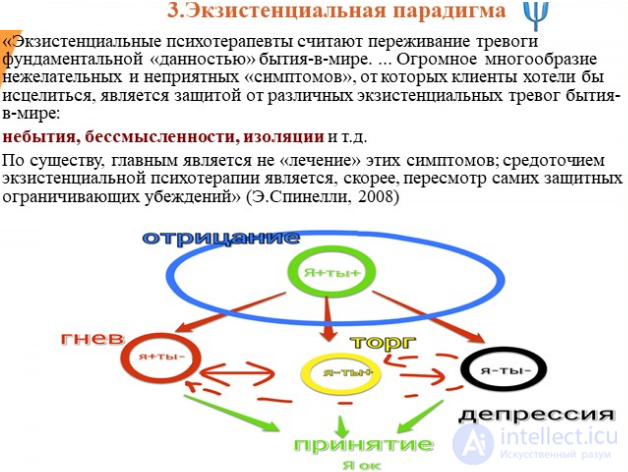
Thus, before us are the types of existential anxieties that threaten
human self-affirmation in three areas: simple existence,
moral becoming, and spiritual becoming.
Let us consider, in turn, these three pairs of existential anxieties.

Comments