
Lecture
This program is based on the actualization, the “evoking”, of past psychological traumas, among which traumas of
childhood occupy a special place.
Goal of the program: Reducing the influence of childhood impressions, events, and experiences of a traumatic nature on personality development, on behavior,
and on the character of interaction with the immediate microsocial environment.
A program for overcoming childhood psychological traumas can only be developed and conducted by qualified specialists, such as psychologists, psychotherapists, or psychiatrists. This program will be individually tailored to the needs and requirements of each particular child or adult suffering from the consequences of childhood trauma. However, there are general steps and methods that can be used in such a program:
Assessment and diagnosis: The first step is conducting a diagnostic evaluation to determine the nature and degree of the trauma. This may include interviews with the patient, questionnaires, and tests.
Establishing trust: Building a trusting relationship between the patient and the therapist is a fundamental step. This may require time and patience.
Teaching stress-management strategies: The patient may need to learn to manage stress and anxiety using methods such as deep breathing, meditation, relaxation, and others.
Memory therapy: This part of the program may involve working with the patient on becoming aware of and processing traumatic memories. This can be done through various methods, such as psychoanalysis, cognitive-behavioral therapy, or emotional regulation.
Working with self-esteem and self-image: Many childhood psychological traumas can affect self-esteem and self-image. Therapy may include work with these aspects of personality.
Social support: Support from family, friends, and support groups can be an important aspect of the program.
Medication: In some cases, medication may be required, especially if the psychological symptoms are severe.
Working with the family: If the family environment was part of the problem, family therapy or family counseling is sometimes conducted.
Completion and follow-up support: The program ends once the set goals have been achieved, but support may continue over a longer period.
Preventive measures: The ultimate goal is not only to overcome the consequences of the trauma, but also to teach the patient methods for preventing the recurrence of trauma and for maintaining psychological health.
The program performs the following tasks:
1. To release material blocked in childhood, which is often not consciously recognized but has a destructive effect on psychological and physical
health.
2. To lift the veils of amnesia enveloping the early years of childhood, and to give expression to the infantile life that is hidden behind
the veils of memory.
3. To work through the traumatic events of childhood that interfere with living life to the full (traumatic events may be reflected in dreams, or in
slips of the tongue).
4. To find resources in childhood, to discover happy episodes, successes, and strokes of luck in one's childhood life, and to reinforce them.
5. To make it possible to relive childhood episodes in a different, more constructive (happy) version, to forgive someone from childhood or to say something left unsaid, to respond to the offender.
6. To feel oneself a child again, to recover one's true feelings, sensations, instincts, and impressions, to become aware of one's true self, in order to
understand and accept oneself and then the other. (Return to a safe “self”)
7. To recover the reality of experiencing, disrupted as a result of psychological trauma.
8. To learn to recognize one's own experiences and reactions connected with stress-inducing events, and to treat them as normal reactions
to abnormal situations along one's life path.
Functions of the program.
The first function of the program is diagnostic.
In the course of group work, the trainer identifies childhood problems that may have a negative influence on present-day life. The program makes it possible to identify the event (or events) that proved traumatic. It makes it possible to clarify the circumstances or the specific people who may have inflicted psychological trauma or who were the object of aggression in childhood. This event is not always
consciously recognized by the person, and special techniques are required so that the memories
become the impetus for revealing the psychological tension of childhood and
adult life.
The second function of the program is psychotherapeutic.
The procedure of the program does not make it possible to determine in advance which part of the training will be diagnostic in nature and which will be psychotherapeutic
in nature. Experience in conducting training for overcoming childhood psychological traumas shows that any task can become a mechanism triggering
awareness, working through, and processing of the traumatic event, and consequently, further recovery. It is important to remember and be able to
distinguish the nature and severity of psychological trauma, since in some cases group work may not be sufficient for full
recovery, and individual sessions are required.
The third function of the programme is preventive.
One of the objectives of the psychotherapeutic programme is to increase the traumatized individual's stress resistance. A major role in developing
preventive measures is played by the idea that knowledge of the mechanisms of stress and post-stress reactions considerably helps
one recognize them in oneself and regard this as a normal, natural process in abnormal situations of the life course.
Content and procedure of the training.
The basic idea of the training consists in evoking memories associated with childhood. Childhood memories may have various emotional colouring and need
not necessarily be traumatic in character; therefore the subject matter of the memories is neutral in nature, allowing the defences that hinder a return to childhood to be lowered. If a person's psyche senses a threat,
a psychological defence mechanism may be triggered and the psychologist will not
achieve the desired result.
The part of the training that performs the preventive function is based on a somewhat different procedure. Its scenario essentially resembles debriefing with its successive phases: facts, thoughts, feelings, symptoms. The essential difference between this procedure and classical debriefing is the absence of a single traumatic event — the event is individual.
The psychotherapeutic and diagnostic function of this training is realized in two forms of presenting childhood memories.
First variant. A microgroup of 4-5 people is selected from the group. The remaining part of the group forms an "aquarium" and does not take part in
the discussion. The microgroup receives from the trainer, in sequence, 5-6 questions that allow the participants of the group work to “return” to
their childhood. All the events that need to be recalled and presented to the group must be "taken" from a childhood as early as
memory allows.
The second variant differs from the first primarily in its form of work. Whereas in the first variant a group of 4-5 people works and there is an
audience (an aquarium) that plays the role of an emotional backdrop, in this case we propose using dialogue. The group, divided into
pairs, proceeds to discuss the proposed topics. (This variant is also effective for the professional training of psychologists at the stage of
working through personal psychological traumas).
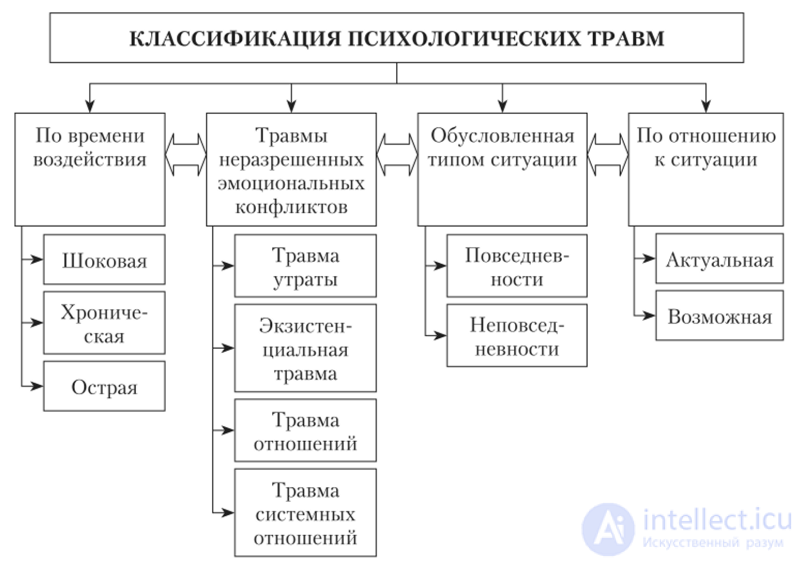
Fig. Classification of psychological traumas
Rules for working in dialogue mode (second variant). Instructions for the speaker. Sit so that you do not look at
the recorder. You are given ten minutes to answer 4-5 questions and to find your earliest memories. Tell
your memories to your recording partner. Try to reproduce your memories as accurately and clearly as possible, since only in this case do you
gain new experience from your past for the present. If you recall something else that goes beyond the scope of the question, allow yourself to mention it.
Instructions for the recorder. Your task is to take notes as your partner tells about past events. Note references and instances in later life; pay special attention to what importance your partner attaches to particular aspects of the memory. Be aware of possible defence mechanisms,
which weaken or blunt the memories.
Working procedure
1. Divided into pairs, decide who will speak and who will take notes. Later you will switch roles, so there is no need to worry about
who goes first.
2. After ten minutes, stop, and without discussing what was said, switch roles. Again, one tells the story and the other takes notes.
3. After ten minutes, stop and think about what you
told and what you heard.
4. Discuss your notes with each other. Point out implications and connections with one another; if it seems useful to you, then
try to link aspects of the memory with how you live now, or how you react to an unexpected, traumatic situation similar to
the ones you recalled.
Note. If one of you begins to feel embarrassed or irritated
during the discussion, simply take the notes about your memories,
thank your partner, and work on your own.
Below is a list of questions that can be used both in the microgroup and in dialogue mode.
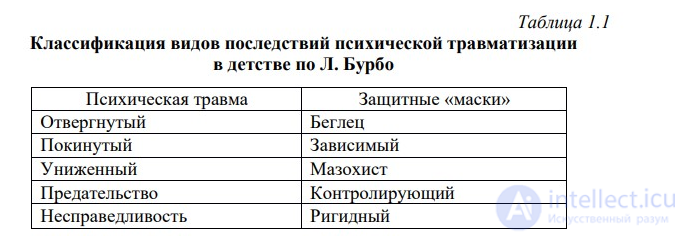
Procedure. The list of questions given is sufficient for conducting 4-5 sessions. These questions make up the main content
of the psychocorrectional programme, but each session should be framed with exercises for group dynamics, psychogymnastics, for entering the
group, for creating rituals of greeting and farewell, etc.
Preventive stage.
Objectives of the preventive stage.
The procedure is based on evoking a traumatic event or incident from memory. The exercise is performed in the form of an inner dialogue with subsequent discussion in the group. The procedure is based on the principles of visualization and levitation. The term visualization is known in practical
psychology and means evoking, through special techniques, visual, auditory, and olfactory representations of events that have occurred. We
introduce a new term: “levitation”. The term levitation denotes the ability to mentally travel to the place of the event, constructing the background
accompanying that event.
Scheme of the inner dialogue (introspection)
The last point of the inner-dialogue scheme, depending on the individual characteristics of the client's personality, splits into two lines of subsequent self-analysis. The first line is figurative, which may have the following sequence: image – metaphor – drawing – change of the
drawing. The second line is object-based. It consists of finding an object – its colour, shape, smell; touching the object – moving
the object – changing the object.
The problem of the effectiveness of this training. The question of the effectiveness of group psychological help can be formulated as follows. What kind of change in patients is associated with the application of various forms and methods of psychotherapy
Sources of information about the onset of these changes are heterogeneous: patient reports, psychophysiological and psychometric studies.
As a result of conducting the training for overcoming childhood psychological traumas, the following changes can be recorded on the basis of self-reports and/or psychometric studies:
It is also possible to use the following psychological instruments as tools for verifying the effectiveness of the psychotherapeutic procedure:
the Rosenberg self-esteem scale, the Spielberger-Hanin personal anxiety scale, the Dembo-Rubinstein self-assessment scale.
It is important to understand that this programme must be developed individually and tailored to the specific needs of each person. It is also necessary to turn to professionals in order to obtain the necessary help and support.

Comments