
Lecture
The primary instrument of differential diagnosis for the entire
complex of disorders under DSM-III-R criteria, including PTS, is the
method of the structured clinical interview – SCID (SCID-Structured
Clinical Interview for DSM-III-R). SCID was published in 1987 and has since
been widely used by physicians and psychologists both in clinical
practice and for research purposes.
Diagnosing posttraumatic stress disorder (PTSD) is an important step in identifying and treating this condition. There are several methods of diagnosing PTSD that professionals in psychology and psychiatry may use. Here is an analysis of some of them:
Clinical interview: A clinical interview with the patient is one of the primary methods of diagnosing PTSD. An experienced therapist or psychiatrist can conduct a structured interview using standardized questions to assess PTSD symptoms. It is important to ask about recurrent memories of the traumatic event, avoidance and numbing, hyperarousal, and other symptoms.
Diagnostic and Statistical Manual of Mental Disorders (DSM): The DSM is a standardized classification manual used for diagnosing mental disorders. The most recent versions of the DSM (for example, DSM-5) contain criteria for diagnosing PTSD that can help professionals make a diagnosis based on symptoms.
Questionnaires and inventories: There are various standardized questionnaires and inventories developed to assess PTSD symptoms. For example, this may be the PCL-5 (Posttraumatic Stress Disorder Checklist), which patients can complete on their own, or the CAPS (Clinician-Administered PTSD Scale), which is administered by an experienced clinician.
Physiological markers: Physiological markers, such as measuring stress-hormone levels in the blood or changes in brain activity detected through neuroimaging (for example, functional MRI), are sometimes used to diagnose PTSD.
Differential diagnosis: Because PTSD symptoms can resemble the symptoms of other mental disorders, differential diagnosis is important. This means that professionals must rule out other possible causes of the symptoms, such as depression, anxiety disorders, or behavioural disturbances.
Observation and behavioural analysis: Professionals may also analyze the patient’s behaviour in order to identify signs of PTSD. This may include observing reactions to triggers, changes in social functioning, and responses to therapeutic methods.
SCID includes a number of diagnostic modules (blocks of questions)
that ensure a diagnosis is made according to the criteria contained in DSM-III-R. The structure of the interview makes it possible to work separately with any
of the modules needed for a given case, which
is selected on the basis of the data from a general (screening) interview of the patient at the
first stage of the assessment. The final diagnosis is determined from the data
of the summary composite scale, into which the results obtained
from applying each module are entered.
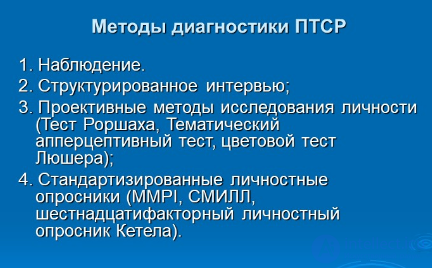
In addition to the primary instrument (SCID) for diagnosing PTS,
the following methods are also used:
(1) The Mississippi Scale (Mississippi Scale). Allows the presence
of a PTSD syndrome to be determined in 93% of cases and its absence in 89% of cases
of the syndrome.
(2) The PTSD subscale developed on the basis of the MMPI.
Use of the MMPI subscale detects up to 82% of PTSD cases.
(3) The Beck Depression Inventory.
(4) The Spielberger test for determining trait and state
anxiety.
(5) The scale for assessing the severity of the impact of a traumatic event
(Impact of Event Scale – IES) by Horowitz, which makes it possible to determine the presence in the
patient of a PTSD syndrome by the prominence of one of two tendencies:
a tendency toward intrusive re-experiencing of the trauma or toward avoidance
of everything associated with it.
The Scottish psychologist W. Yule presented his experience of using
the Horowitz scale with 8-year-old children (1993).
(6) Locus of control. J. Rotter’s scale.
(7) To determine the level of development of the capacity for imagery
the QMI questionnaire (Questionnaire Upon Mental Imagery) is usually used.
In addition to the capacity for imagery, it registers the prominence of the tendency
to seek out “sharp” impressions (“sensation seeking”).
Combining various methods of diagnosing PTSD can be the most effective approach, especially in complex cases. Diagnosing PTSD is important for determining the correct plan of treatment and support for patients suffering from this disorder.

Comments