
Lecture
The development of thinking in students is an important aspect of education that promotes the development of their analytical, critical, and creative abilities.
Thinking is a mental process peculiar to humans alone; no other creatures on earth are capable of thought
processes. Thinking is the highest form of reproduction by the human nervous system of everything that surrounds it in the environment.
Thinking is a socially conditioned mental process, inseparably linked with speech, of searching for and discovering something essentially new — a process of mediated and generalized reflection of reality in the course of its analysis and synthesis.
Thinking is a movement of ideas that reveals the essence of things. Its outcome is not an image but a certain thought, an idea.
There are several classifications of types of thinking. In psychology, the following simplest and somewhat conventional classification of types of thinking is the most widely accepted and common:
Visual-active thinking is a type of thinking based on the direct perception of objects in the process of acting upon them. This is the most elementary type of thinking, arising in practical activity and serving as the basis for the formation of more
complex types of thinking. The main characteristic of visual-active thinking is determined by the possibility of observing real objects and learning the relationships between them through the real transformation of a situation.
Practical, cognitive, object-related actions form the basis of any later forms of thinking.
Visual-imaginative thinking is a type of thinking characterized by reliance on representations and images. In visual-imaginative thinking, the situation
is transformed at the level of an image or representation. The subject operates with visual depictions of objects through their figurative representations. In doing so, the image of an object makes it possible to combine a set of heterogeneous practical operations into a coherent picture. Mastery of visual-imaginative representations expands the scope of practical thinking.
In its simplest form, visual-imaginative thinking arises predominantly in preschoolers, i.e., at the age of four to seven years. The connection between thinking and
practical actions is retained in them, though it is no longer as close, direct, and immediate as before. In the course of analyzing and synthesizing the object being cognized, the child does not necessarily and not always need to touch the object that has caught their interest. In many cases, systematic practical manipulation (action) with the object is not required, but in all cases it is necessary to clearly perceive and visually
represent that object. In other words, preschoolers think only in visual images and do not yet possess concepts (in the strict sense).
Verbal-logical thinking is a type of thinking carried out with the help of logical operations on concepts. In verbal-logical thinking, by operating with logical concepts, the subject can learn essential regularities and unobservable interconnections of the reality being studied. The development of verbal-logical thinking restructures and orders the world of figurative representations and practical actions.
Abstract-logical (abstract) thinking is a type of thinking
based on identifying the essential properties and connections of an object and
disregarding others that are non-essential.
Visual-active, visual-imaginative, verbal-logical, and abstract-logical thinking are successive stages in the development
of thinking in phylogenesis and in ontogenesis. Psychology has now convincingly shown that these four types of thinking coexist in the adult and function in solving various tasks. All types
of thinking are closely interrelated. In solving problems, verbal reasoning relies on vivid images. At the same time, solving even the simplest, most concrete problem requires verbal generalizations. Therefore, the described types
of thinking cannot be evaluated as more or less valuable. Abstract-logical or verbal-logical thinking cannot be the "ideal"
of thinking in general, the final point of intellectual development. Thus, the further improvement of thinking in psychology is associated with expanding and specifying the areas of application of acquired mental norms and techniques.
In addition, types of thinking can be distinguished on various grounds. Thus, drawing on various sources concerning the study of
thinking, the following types of thinking can be identified (see fig. 1).
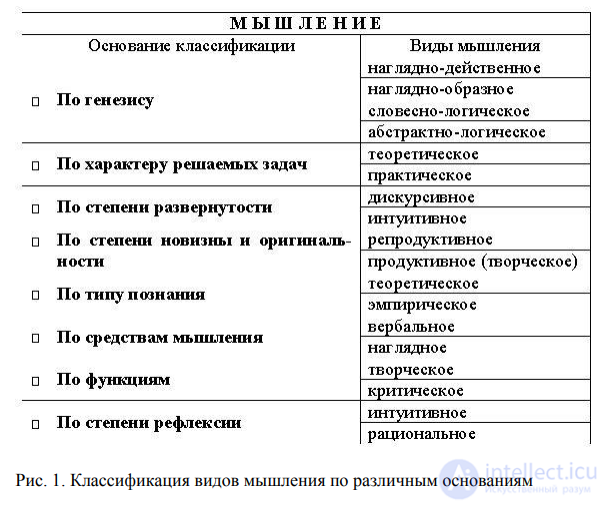
Fig. 1. Classification of types of thinking on various grounds
By the nature of the tasks being solved, theoretical and practical thinking are distinguished.
Theoretical thinking is
the cognition of laws and rules. The main task of practical thinking is the development of means for the practical transformation of reality: setting
a goal, creating a plan, a project, a scheme. Practical thinking was studied by B.M. Teplov. He established that an important feature of practical
thinking is that it unfolds under conditions of severe time constraints and actual risk. In practical situations, the
possibilities for testing hypotheses are very limited. All this makes practical thinking, in a certain respect, more complex than theoretical thinking.
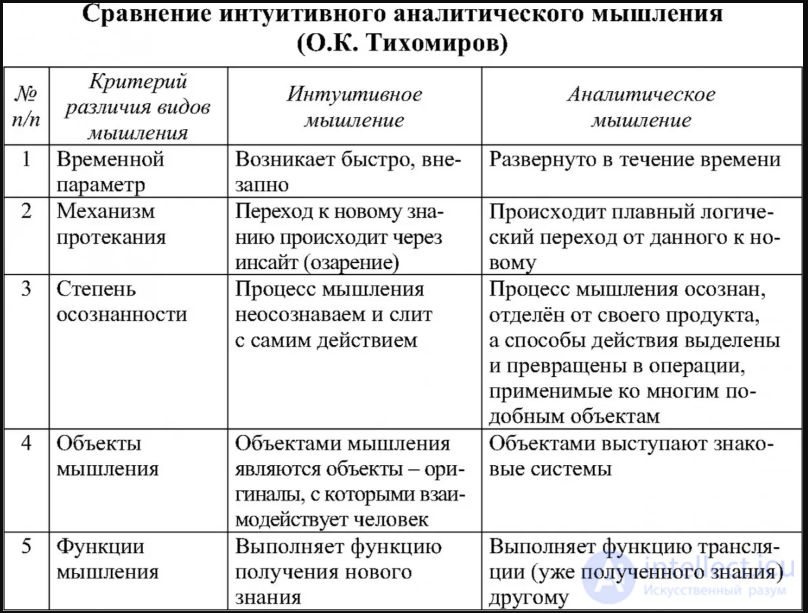
By the degree to which thinking unfolds over time, intuitive and discursive, or analytical, thinking are distinguished.
Discursive (analytical) thinking is thinking mediated by the logic of reasoning rather than by perception.
Analytical thinking is extended in time, has clearly defined stages, and is represented in the consciousness of the thinking person themselves.
Intuitive thinking is thinking based on direct sensory perceptions and the direct reflection of the effects
of objects and phenomena of the objective world. Intuitive thinking is characterized by the speed with which it proceeds, the absence of clearly defined stages, and
minimal awareness. Three criteria are usually used to distinguish discursive from intuitive thinking:
By the degree of novelty and originality, reproductive and productive thinking are distinguished according to their functional purpose.
Reproductive thinking is thinking based on images and representations drawn from certain definite sources.
Productive thinking is thinking based on creative imagination.
In their activity, people encounter objects that have a holistic-systemic character. To orient themselves in such objects, a person
must be able to distinguish within them their external and internal content, their inner essence and its external manifestations. In this connection, according to the type of cognition,
theoretical and empirical thinking are distinguished.
Theoretical thinking is thinking directed at cognizing the internal content and essence of complex systemic objects. The main
mental action associated with such cognition is analysis. Analysis of a holistic systemic object reveals within it a certain simple connection (or relation) that acts as the genetically initial basis for all its particular manifestations. This initial connection serves as the universal or essential source of the formation of the holistic systemic object. The task of theoretical thinking consists in discovering this initial essential connection, then isolating it, i.e., abstracting it, and subsequently
reducing all possible particular manifestations of the systemic object to this initial connection, i.e., performing the act of generalization.
Empirical thinking is thinking directed at cognizing the external manifestations of the objects and phenomena under consideration. The main operations
of empirical thinking are comparison and classification, which are linked to the actions of abstracting and generalizing identical properties
of objects and phenomena. The cognitive product of carrying out these actions is general representations (or empirical concepts) of these objects and phenomena. Empirical thinking performs very important and necessary
functions in the everyday life of people, as well as in sciences that are at the
initial stages of their development.
By functional purpose, critical and creative thinking are distinguished.
Critical thinking is directed at identifying shortcomings in the judgments of other people.
Creative thinking is associated with the discovery of fundamentally new knowledge, with the generation of one's own original ideas, rather than with evaluating the thoughts of others.
The conditions for their realization are opposite: the generation of new creative ideas must be completely free of any criticism, external and internal prohibitions; the critical selection and evaluation of these ideas, on the contrary, requires strictness toward oneself and others, and does not allow for overestimating one's own ideas. In practice there are attempts to combine the advantages of each of these types. For example, in well-known methods of managing the thought process and
increasing its effectiveness ("brainstorming"), creative and critical
thinking, as different modes of conscious work, are used at different stages of solving the same applied problems.
One of the traditional distinctions between types of thinking is based on an analysis of the content of the means of thinking used — visual or verbal. In
this connection, visual and verbal thinking are distinguished.
Visual thinking is thinking based on images and representations of objects.
Verbal thinking is thinking that operates with abstract sign
structures. It has been established that for full-fledged mental work, some
people need to see or imagine objects, while others prefer
to operate with abstract sign structures. In psychology, it is believed
that visual and verbal types of thinking are "antagonists":
those with a predominance of the first type often find even simple tasks presented in sign form hard to access; those with a predominance of the second type do not easily cope with tasks
requiring the operation of visual images.
There are many different types and modes of thinking (more than a hundred), each of which represents a unique process of considering and solving problems.
Note that all modes of thinking have their own advantages and disadvantages, and excessive use of any one of them can significantly distort your perception of the world.
Here is a brief description of some of them:
Associative thinking: Creating new ideas based on associations and related ideas.
Logical thinking: Solving problems based on strict logic and sequence. This is a type of human thinking in which a person uses logical concepts and constructs, characterized by evidentiality. It is a mental process by which one can link facts and events into a chain in order to obtain options for resolving a situation or a notion of a specific action.
Intuitive thinking: Making quick decisions based on experience and intuition.
Creative thinking: Forming original ideas by combining various elements.
Imitative thinking: Establishing similarity between objects based on analogies.
Practical thinking: Solving problems based on knowledge and experience.
Systems thinking: Analyzing complex problems taking into account the interconnection of elements of a system. Systems thinking is the ability to identify and analyze systems based on a systems approach — a view of a situation in which all the factors currently affecting it are taken into account when making a decision: past and future, environment, near and far goals. Thinking is called systemic when, in cognizing the world, a person is able to establish connections between phenomena and objects, identify existing regularities, forecast their development, and solve emerging problems.
Analytical thinking: Breaking complex objects down into their components for analysis; it implies searching for new information, studying and systematizing it, and drawing conclusions based on the data obtained.
Holistic thinking: Considering an object or problem as a unified whole, as well as the organic unity of intuitive, emotional-imaginative, and verbal-logical thinking.
Empathic thinking: Understanding the feelings and states of other people in order to solve social problems.
Reflective thinking: Analyzing one's own strengths and weaknesses for personal development.
Fantasy thinking: Creating images and events based on imagination.
Decision thinking: Choosing the best solution from among alternative options.
Creative thinking: Creating new and original ideas.
Abstract thinking: Reasoning about objects and ideas without their actual presence.
Informational thinking: Gathering, analyzing, and using information to make decisions.
Poetic thinking: Interpreting language and using words to create new ideas.
Philosophical thinking: Considering the fundamental questions of life and moral values.
Expert thinking: Making decisions based on experience in a specific field.
Social thinking: Using knowledge of social dynamics to solve problems.
Scientific thinking: Creating new knowledge through the formulation of hypotheses and experiments.
Artistic thinking: Using emotions and intuition in art.
Technical thinking: Applying technical knowledge to develop technologies.
Heuristic thinking: Solving problems based on simple rules.
Symbolic thinking: Using symbols to convey information.
Ecological thinking: Analyzing environmental problems and interconnections.
Lateral thinking: Searching for unconventional solutions. 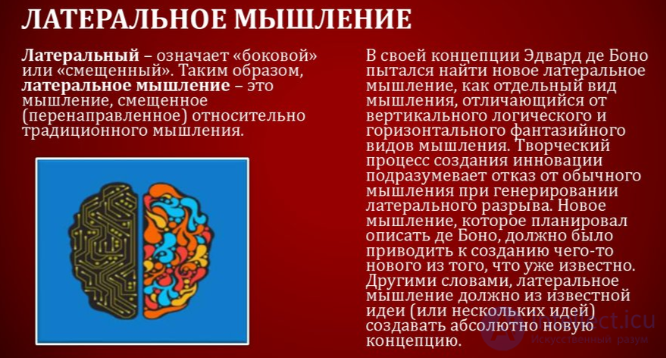
Global thinking: Considering problems in a global context.
Engineering thinking: Solving engineering problems.
Quantum thinking: Applying quantum mechanics to solving problems.
Strategic thinking: Planning long-term strategies while taking into account a multitude of factors and courses of action.
Metaphorical thinking: Using metaphors and analogies to create new ideas and concepts.
Deductive thinking: Applying general laws and rules to specific problems.
Interactive thinking: Joint analysis and problem-solving in a group or team.
Mechanical thinking: Solving problems based on predetermined algorithms and rules.
Ethical thinking: Making decisions oriented toward ethical principles and values.
Linguistic thinking: Using language to solve problems, communicate, and express thoughts and ideas.
Aesthetic thinking: Considering beauty and the artistic perception of the world.
Collective thinking: Joint discussion and decision-making in a group or collective.
Network thinking: Using computer networks and technologies to solve problems and exchange information.
Digital thinking: Using digital technologies to solve problems and exchange information.
Positive thinking: Focusing on the positive aspects of life and seeking optimistic solutions.
Neuro-thinking: Studying thinking at the molecular level and applying neurotechnologies to study the processes of thinking.
ARCHAIC THINKING - the holistic thinking of ancient people, in which the concrete is not separated from the abstract, the image from the idea, the symbol from reality, the earthly from the otherworldly. In it, the world appears not so much as the familiar multitude of things we are used to, but as the presence and action of many "Thous" of a personal or quasi-personal nature, with whom one can enter into communion (see animism).
Complex thinking, a term used by L.S. Vygotsky to designate a stage in the development of a child's concepts, situated between syncretes and true concepts — the second stage in the development of concepts, characteristic of the thinking of children from 4–6 to 11–14 years of age. The generalizations created by means of this mode of thinking represent complexes of individual objects, united on the basis of objective connections that actually exist between these objects. But these connections differ from those revealed by thinking in scientific concepts. At the basis of a complex lie factual connections discovered in immediate experience. Therefore, such a complex represents, above all, a concrete unification of a group of objects on the basis of their actual proximity to one another.
Investigative thinking: Analyzing new information to draw conclusions and make informed decisions.
Emotional thinking: Making decisions based on emotions and feelings.
Irrational thinking: Making decisions based on intuition, emotions, or biased views.
Paired thinking: Solving problems in a pair or group, where each participant reasons independently and then exchanges ideas.
Managerial thinking: Making decisions based on knowledge of the global economy, finance, and organizational management.
Problem thinking: Solving complex problems with a systematic and analytical approach.
Implementation thinking: Carrying out goals and objectives.
Psychological thinking: Analyzing the psychological aspects of people's interaction in order to solve problems and improve interpersonal relationships.
Journalistic thinking: Investigating and interpreting events, as well as writing articles and texts.
Mass thinking: Making collective decisions based on cultural and social factors.
Educational thinking: Creating knowledge and developing modes of thinking through education.
Deep thinking: Investigating philosophical and cultural problems.
Economic thinking: Analyzing economic data to solve problems in finance, investment, and business.
Resource-based thinking: Using natural resources to solve problems in biology and ecology.
Academic thinking: Critical thinking about various scientific and humanities topics in study and research.
Critical thinking is a system of judgments that allows one to analyze information in such a way as to make rational decisions on its basis. Critical thinking is the analysis of information in which you question its truth. The concept appeared at the beginning of the 20th century, in a work on pedagogy by John Dewey. The author expressed the view that the primary goal of education should not be the memorization of material but teaching critical thinking. At its origins stands the ancient Greek philosopher Socrates, who examined his opponent's arguments in search of truth. Already in the 20th century, a proposal was put forward to use critical analysis to substantiate the scientific method of proof. K. Popper proposed refuting any theory: if no truthful counterarguments can be found against it, then it is scientific. Roughly speaking, those very "proof by contradiction" theorems from the school mathematics course are a clear example of the use of critical thinking.
Emotional thinking: Making decisions based on emotional experience and feelings.
Magical thinking: Forming beliefs and ideas based on faith in the magical properties of objects and symbols.
Clip thinking is a type of consciousness in which a person perceives information through short formats and vivid images and is able to switch quickly from one piece of information to another due to a superficial engagement with its substance.
Positive thinking is a concept applied in seminars on the motivational development of personality, as well as in the corresponding literature. Synonyms are "new thinking," "correct thinking," "the power of thought," or "mental positivism." It is an optimistic view of everything around one and a belief that any event happens for the best. Psychologists and psychiatrists warn that this method can harm labile and depressive patients, and in people not inclined toward critical thinking it can lead to a loss of contact with reality. Loss of touch with reality can arise as a result of avoiding critical questions and, consequently, partially concealing one's existing weaknesses. As a result, various qualities of the person, the structure of their personality, and the interaction between the individual's psyche and their social environment come to be neglected. An experiment by Joan Wood and colleagues at the University of Waterloo showed that participants with weakly expressed self-awareness, merely by uttering positively connoted sentences, significantly worsened their mood, optimism, and willingness to take part in any activity. People with good self-awareness, by contrast, benefited from self-suggestion, though the effect was barely noticeable.
Negative thinking is a mode of thinking that operates with negations, is prone to objections, and sees the negative sides of things — in which a person sees insurmountable difficulties everywhere and is always oriented toward the most disastrous outcome of events. It is accompanied by various fears, phobias, and self-doubt.
Independent thinking is a person's ability to analyze information on their own, form their own judgments, and make decisions without blindly succumbing to the influence of others, authorities, or public opinion. Independent thinking does not mean rejecting all authorities or ignoring others' experience. It presupposes a balance between critical analysis and the ability to extract useful knowledge from various sources.
These different types of thinking can be applied in various areas of life and work to solve problems effectively and generate new ideas.
A child can compare, analyze, draw conclusions, and discover connections between objects and phenomena thanks to thinking. A younger schoolchild's thinking relies on action and imagery. It is not for nothing that people say: «A younger schoolchild learns not with their ears and eyes, but with their hands». What does this mean?
A child grasps any task more easily if it has «passed» through their hands, becoming fixed in a specific practical action. A younger schoolchild still does a great deal by trial and error. They cannot yet fully picture the path to solving a learning task in advance, analyze the appropriateness of the chosen methods for solving it, or compare the result with a standard.
So — a younger — schoolchild — is characterized — by visual-active thinking, that is, to carry out a new, difficult task they perform a series of real actions with objects. Example: Two children are assembling a cut-up picture. One takes a fragment of the picture in hand and studies it for a long time, fitting it by eye to the right spot. The other tries to squeeze the fragment they have taken into one place, then another, until they find the right one. The first child tries to foresee the course of solving the task, while the second acts by trial and error.
Visual-figurative thinking is characterized by the fact that the learning task is solved as a result of internal operations with images (representations), without recourse to practical actions.
Psychologists have proven that these two types of thinking are prerequisites for the formation of logical thinking. The higher the level of the first two types, the faster a schoolchild moves on to thinking using an internal plan of action. That is why it is so important to give children learning tasks that call for different types of mental activity. This makes it possible to study not only those properties and qualities of objects in the surrounding world that are easily noticeable, but also those that are revealed only to a person capable of observing, establishing connections, and discovering causes.
The prerequisites for the successful development of logical thinking are figurative and active thinking. Without images, there is no logic.
The ability to process material logically often develops in adolescents spontaneously. Developing such abilities should become a special task for the teacher. Not only the depth and firmness of knowledge depend on this, but also the possibility of the adolescent's further intellectual development and the development of their individual traits. So how should one develop adolescents' thinking? To properly develop thinking, the teacher uses every opportunity — teaching adolescents to give correct definitions, to analyze, compare and distinguish objects and phenomena, to express their thoughts clearly, correctly and precisely, and cultivating the ability to reason, draw inferences, and make conclusions and generalizations.
To this end, adolescents should more often be placed in situations requiring them to independently compare various objects, find similarities and differences between them, and be asked more often, «What do these have in common?», «How do they differ?». Simple comparison should be followed by its more complex forms, identifying essential and non-essential features. Such tasks are, firstly, good mental exercises, and secondly, they promote better mastery of the learning material. At the same time, one must ensure that students do not merely «understand» a difference or similarity, but also learn to formulate their thoughts clearly and precisely. It is important to accustom the adolescent to independent work with the textbook, wall charts, dictionaries, learning texts, and various reference materials. The so-called heuristic approach to mastering new material, which guides schoolchildren toward independent generalizations and
conclusions, is exceptionally useful for activating adolescents' independent thinking.
It is known that active, independent work of thought begins when a person is faced with a question, a problem. To stimulate adolescents' independent creative thinking, it is useful to organize their schooling so that problems constantly arise before them, and to encourage them toward creative searches for ways to solve these problems. Based on a problem the students have become aware of, a cognitive task arises,
which then becomes the motive for mental activity. Given that an adolescent's thinking (especially that of a younger adolescent) is still largely concrete, instruction must be structured so that, as far as possible, thinking is grounded in visual representations. The teacher should consider what paths students' thought might take in the process of forming concepts, and take measures against the possible substitution of abstract features with visual ones. Maximum variety in visual experience can serve this purpose, along with the demonstration of varied types of cases (not simply a large quantity), in which non-essential features would vary. In forming, say, the concept of «island» in younger adolescents, one should show on a map that islands can be large and small, flat and mountainous, of various shapes, oceanic and continental. When teaching geometry, one must be sure to vary the diagrams when proving theorems, avoiding a standard arrangement of figures.
Of course, combining demonstration and explanation gives the best results. For example, when introducing the concept of «vertical angles», the teacher says: «Vertical angles need not be drawn the way they are in the textbook. They can occupy this position, and this one, and this one (draws on the board), and the size of the angles can also vary (demonstrates)». In these cases students become aware of the essential features through a clear contrast with non-essential, incidental ones, and uneven substitution of features does not occur.
The development of thinking and the correct mastery of concepts are aided by exercises in the practical application of the concepts being learned. Finally, to develop an adolescent's thinking it is necessary, day in and day out and
systematically, to teach them the techniques of correct, logical thinking, and to let no logical error pass unnoticed. Of course, this is not the responsibility of the language teacher alone.
All teachers develop logical thinking. In this respect, the everyday, coordinated work of the entire teaching staff is important. Numerous observations show that even
the simplest logical operations (not to mention complex ones) often cause difficulties for adolescents (especially younger adolescents). For example, many of them give logically incorrect definitions, failing to indicate the genus («A noun is that which denotes the name of an object»), or failing to indicate all the features making up the specific difference («A circle is a closed curved line»). Cases are often encountered where adolescents make a logically illiterate division of a concept. («All the students in our class set about doing the assignment: boys, girls, pioneers, and underachievers»).
The teacher must draw adolescents' attention to logical inconsistencies in their answers and teach them to express their thoughts in a logically literate way. It is very useful to accustom adolescents to correcting their own logical errors independently. To develop independence and critical thinking, adolescents should be required to review their classmates' answers in lessons according to a
set plan:
The recommendations compiled here contain the main points on developing thinking in adolescence. However, the further introduction of innovative ways and methods of developing this most fundamental of cognitive processes in the life and activity of every person is needed.
Conduct creative games. The distinctive feature of any creative game is that it helps develop creative thinking and imagination in an atmosphere of competition and excitement. It is precisely the game format that often helps one concentrate and effectively learn the necessary material, not only for children but for adults as well. Today the internet has numerous classifications of creative games: computer games, online games, group games, intellectual-creative games, role-playing games, and many others. This will allow you to choose a game depending on whether you want to play alone at a computer or plan to play with a group.
Here are some recommendations for developing thinking in students:
Encourage critical thinking: Ask students questions that require analyzing and evaluating information. Encourage them to consider different points of view and justify their opinions.
Stimulate creative thinking: Give students the opportunity to express their ideas and solve problems using various methods and approaches.
Develop logical thinking: Give puzzles and problems that require logical thinking and reasoning. Teaching mathematics and programming also fosters the development of logical thinking.
Teach creative problem-solving: Encourage students to look for unconventional ways to solve problems and encourage them to experiment.
Create an environment for independent learning: Provide resources and materials that students can explore and study on their own.
Teach critical reading: Help students develop skills in analyzing and critically perceiving texts, articles, and books.
Practice problem-solving instruction: Give students the opportunity to solve real problems as they encounter them in everyday life or in the classroom.
Create a multicultural environment: Introduce students to different cultures and points of view, which fosters the development of their tolerance and cultural diversity.
Support the development of research skills: Teach students to conduct research, formulate hypotheses, and analyze results.
Develop communication skills: Teach students to express their thoughts and ideas clearly and convincingly, as well as to listen to and respect other people's points of view.
Use technology: Use educational apps and online resources to stimulate thinking and the learning of new skills.
Organize group work: Working in groups promotes the exchange of ideas and joint problem-solving.
Support interest in the sciences and the arts: Science and art can inspire students to develop their thinking skills and creativity.
Evaluate and give feedback: Give students feedback on their thinking skills and help them improve.
Encourage reading: Reading a wide variety of literature promotes the development of vocabulary and thinking abilities.
Teach planning: Teach students to plan their tasks and actions, which promotes the organization of thinking.
Hold discussions: Organize discussions on current topics where students can argue their opinions and listen to others.
Support reflection: Encourage students to analyze their own thinking process and identify areas for improvement.
Use games and puzzles: Games and puzzles promote the development of logical and spatial thinking.
Strive for variety: Provide a variety of learning tasks and experiences to develop different aspects of thinking.
Developing thinking requires constant practice and support. It is important to create a stimulating and supportive learning environment in which students can develop their thinking skills throughout their entire academic life.
The study of magical thinking was significant for sociology and anthropology at the early stage of their development in the 19th century. It was assumed that this type of thinking was part of most religious beliefs and was characteristic of traditional cultures, which were contrasted with Western scientific rationality and regarded as «primitive». This approach influenced 20th-century psychology, above all such researchers as Sigmund Freud and Jean Piaget.
The study of magical thinking was significant for sociology and anthropology at the early stage of their development in the 19th century. It was assumed that this type of thinking was part of most religious beliefs and was characteristic of traditional cultures, which were contrasted with the scientific rationality of Western societies and regarded as «primitive» .
Sigmund Freud put forward the idea of two basic forms of thinking and linked them to individual development. This model explained the stages of development of human cultures, which, according to the research of early anthropologists, evolved from magic and religion toward rationality and science. According to Freud, there are two basic forms of thinking: the primary and secondary processes, which reflect the stages of personality development from childhood to the adult state. Magical thinking is a form of the primary process, which is governed by instinctive desires (the pleasure principle) that disregard external constraints. The secondary process, in contrast to the primary one, is linked to the emergence of the Ego, when rational assessments (the reality principle) begin to ensure adaptation to the external environment .

N. S. Matveev, «Fire», 1891.
In the chapter «Animism, Magic and the Omnipotence of Thought» of the treatise «Totem and Taboo» (1913), Sigmund Freud puts forward the hypothesis that it is precisely magical thinking that underlies animism, religion and folk superstitions, and possibly art as well. Performing a particular ritual (a sacrifice, a prayer) or observing a taboo can, according to the logic of magical thinking, bring about one or another desired result. For example, some rain incantations are built on imitating rain through urination or mimicking a thunderstorm, while fertility incantations are built on demonstrating the sexual act. Primitive people, as it were, «played at rain» . At the same time, «distance plays no role, and telepathy is accepted as something self-evident». According to Freud,
…primitive man has an enormous trust in the power of his wishes. In essence, everything he creates by magical means must occur simply because he wants it to.
In his book «Argonauts of the Western Pacific» (1922), the anthropologist Bronisław Malinowski wrote about the natives of the Trobriand Islands, that their belief in the reality of supernatural phenomena is rooted in tradition and a magical heritage which has left «signs and traces» of mythical events and which links the mythical past to the present. Malinowski noted the magical power left behind by ancestors; in his view, for the natives this past is not something distant, but is perceived as something close, «living and true». Malinowski considered magic and myth to be mutually conditioning and linked to social institutions. From myth followed «magical formulas», while magic pointed to the truth of the myth; the function of myth often consisted in grounding the magical system. According to Malinowski, both myth and magic underlay social institutions, which myth influenced through magic. Malinowski wrote:
…If we recall that here, as in all other beliefs in the miraculous and the supernatural, there is a loophole for opposing forces, and that black magic, if performed incorrectly or ineffectively, is undone by the violation of a taboo, incorrectly uttered spells, or for some other reason, and that, on the other hand, suggestion strongly affects the victim and weakens their natural resistance, and that, moreover, all illnesses are invariably attributed to one sorcerer or another, who, whether or not it is true, often openly admits responsibility in order to bolster his reputation — taking all this into account, we can easily understand why belief in black magic flourishes, why no empirical evidence can undermine it, and why the sorcerer believes in his own powers no less than his victim does. This is at least as hard to understand as many modern instances of the results of, for example, faith healing miracles (through Scientology[К 1] or at Lourdes), or any cure achieved through prayer and piety.
Jean Piaget, like Freud, examined magical thinking in children. Based on surveys of children, he concluded that a child under the age of seven or eight considers their own actions to be the cause of events in the material world. Thus, children think they can influence the movement of celestial bodies or cause the wind by waving their arms. Piaget considered magical thinking to be a consequence of "deep egocentrism": the child sees themselves as the center of the universe, not distinguishing "intrapsychic" experience from causality in the material world. Later, according to Piaget, this stage is overcome thanks to the differentiation of the two domains: magical thinking gives way to rational and scientific thinking. Piaget, like Freud, though less explicitly, correlated these stages with the gradual development of human cultures from magic and religion toward rationality and science.
According to modern research, children do have magical thinking, though it is not as widespread as previously assumed; children can perceive causal relationships at a much earlier age than Piaget believed. Adult thinking may include elements of magical thinking within religious beliefs, which, however, touch on more complex questions about life, mortality, being, and so on, and therefore differ from children's magical thinking.
In psychiatry, magical thinking is considered normal in children up to 3–5 years of age. Magical thinking is often found in disorders of the schizophrenic spectrum. In particular, in the International Classification of Diseases, 10th revision (ICD-10), and in the American Diagnostic and Statistical Manual of Mental Disorders, 5th edition (DSM-5), magical thinking is listed as one of the symptoms of schizotypal disorder.
Modern psychiatry attributes manifestations of magical thinking to adjustment disorders, and when a person begins visiting sorcerers, psychics, or astrologers, building their life according to their recommendations, or becomes a member of a sect, or immerses themselves in the world of esoteric teachings, it is classified as "magiphrenic syndrome."
Freud wrote about the significance of magical thinking for literature and art in his 1919 essay "The Uncanny." The French psychoanalyst Octave Mannoni, in 1969, used magical thinking to explain a number of paradoxes of aesthetics. For example, the popularity of horror films and a number of other genres is explained by the fact that, despite the viewer knowing their main moves and devices in advance, and despite being fully aware of the unreality of what is happening on screen, they subconsciously wish to return to the level of "childlike," magical thinking. Mannoni expressed this paradox of preferring the "childlike" animistic mode of perceiving the world over the "adult," scientific one, with the formula: "Yes, I know, but all the same…" (French: Je sais bien, mais quand même…).
"Quasi-magical thinking" describes "instances in which people act as though they mistakenly believe that their actions influence an outcome, even though they do not actually hold this belief." People may be aware that a superstitious intuition is logically false, but act as though it were true, because they make no effort to correct the intuition.

Comments