
Lecture
The conceptual three-dimensional model of the teacher's work, proposed by Larisa Mitina, serves as the theoretical foundation for understanding and studying teachers' professional activity. This model comprises three main dimensions that characterize the teacher's work.
In pedagogical psychology, the problem of studying the teacher's work as an integral system is one of the most important scientific and practical problems. The success of measures aimed at improving the effectiveness of a teacher's work depends to a large extent on progress in the fundamental research on this issue. The ideas of integrity, unity, and systemic organization of the teacher's work have made it possible to represent it as a multidimensional space consisting of three interconnected parts: the teacher's personality, pedagogical activity, and pedagogical communication, with the predominant role belonging to the teacher's personality. These three areas are united by the overarching task of developing students' personalities. At the same time, they do not repeat or duplicate one another, but enter into complex dialectical relations in which each of them, in the course of the teacher's work, acts now as a precondition, now as a means, now as a result of development. Being situated within a common multidimensional space, each part has its own coordinate system, its own central system-forming basis (Fig. 1).
The multidimensional space of the teacher's work includes, besides the teacher himself, the other subjects of the educational process (students, school administration, colleagues, students' parents, and so on) in their interaction with one another, which should be viewed above all as the coexistence of personal interests embodied in the emotional, volitional, cognitive, and communicative aspects of behavior.
Thus, the teacher's work is an extremely complex, multi-subject, multi-motivated, integral psychic reality.
Within the framework of the psychological concept of the teacher's work, we have developed the structures of pedagogical activity, pedagogical communication, and a structural-hierarchical model of the teacher's personality (Mitina L. M., 1991, 1994, 1998).
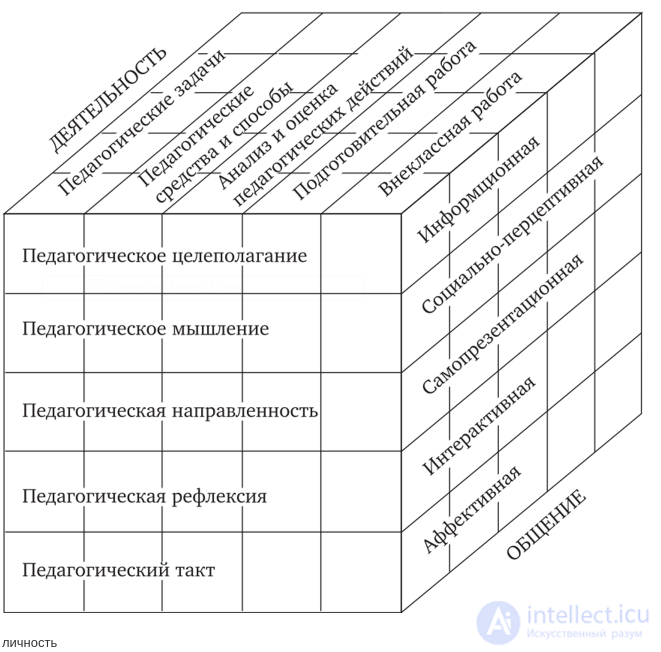
Fig. 1. Three-dimensional model of the teacher's work
Pedagogical activity comprises the teacher's professional activity aimed at solving the tasks of developing and educating the younger generation. The learning process, both in its content and in the forms of its organization and delivery, should today be built as a process of development, with the teaching of knowledge, abilities, and skills regarded as a component part of development, as its principal means. Accordingly, the structure of the teacher's pedagogical activity acquires new content.
The structure of pedagogical activity represents the organization and sequence of stages that a teacher passes through in the process of interacting with students and carrying out the educational process. Although the specific structure may vary depending on the methodological approach and context, it usually includes the following main components. According to current theoretical views, it comprises the following three main components.
1. Pedagogical goals and tasks.
At every moment of pedagogical activity the teacher deals with a hierarchy of goals and tasks, the range of which encompasses both general goals (the goals of the school, of the public education system, of society) and operational tasks.
2. Pedagogical means and methods for solving the tasks set.
When choosing the means and methods of pedagogical influence, the teacher should be oriented first and foremost:
a) toward the student as the central figure of the pedagogical process, toward stimulating the moral, emotional, and intellectual development of each child, toward projecting new levels of the child's psychic development.
The realization of these influences is based on a single general idea — the development of pupils' activity and independence; placing the student in the position of an active subject of their own activity and developing their capacity for self-management and self-realization. The teacher not only sets pedagogical tasks but also strives to ensure that these tasks are internally accepted by the students. The teacher should structure the management of students' activity not as direct influence, but as the transmission of those «grounds» from which the student could independently derive their own decisions. At the same time, the teacher's choice of pedagogical means should above all depend on the individuality of the child, their age-related capabilities, and the characteristics of the class;
b) toward the selection and application of pedagogical techniques and methods of self-realization, self-actualization, and the expression of the teacher's personal capacities and abilities in working with children.
The main norms and principles of a teacher's self-realization in pedagogical activity are: emotional and personal openness; a psychological «attunement» to optimal work with a given class with the aim of achieving maximum persuasiveness and expressiveness; trustfulness and sincerity in expressing feelings and attitudes; satisfaction with oneself in the process of joint creative activity with students;
c) toward the selection and processing of the content of the educational material, aimed at students' mastery of a system of knowledge that grounds the deep connection between the subject and life, and the selection of its components (auxiliary, illustrative, informational).
It is important that the content of the educational material be combined with the child's existing knowledge and experience, that it awaken their interest, imagination, inventiveness, intuition, and feelings. This makes it possible to develop in the student a need for knowledge, openness to everything new, and thus to form a striving toward self-education, self-upbringing, and self-development;
d) toward the selection and application of methods and organizational forms of interaction with students and among students themselves; the creation of conditions that facilitate the learning process, an atmosphere of live communication, and a positive emotional-psychological climate.
This requires the teacher's respectful attitude toward the child's personality, open dialogic communication, warmth and friendliness, identifying areas of misunderstanding and striving to eliminate them by relying on the student's strengths and individual experience, personalized encouragement and support, and the search for active and varied methods of student work in the lesson.
3. Analysis and evaluation of the teacher's pedagogical actions (a comparative analysis of what was planned and what was implemented in the teacher's activity).
Let us examine the third component of the structure of pedagogical activity in more detail. The teacher strives to grasp the essence of pedagogical phenomena and processes, to understand the regularities governing the course of pedagogical activity, and to correctly evaluate and promptly correct their own work. Therefore the third component of the structure of the teacher's activity is directed toward the teacher's awareness and correction of their own work. The teacher studies the course and results of their activity, evaluates themselves as a participant in dialogue in terms of how successfully they manage to organize this dialogue and how active the students are within it, and also carries out an analysis of errors, mistakes, and pedagogical discoveries, generalizes their experience, and builds and implements a plan for professional development. A distinctive feature of these actions is their orientation toward the self, the study of one's level of pedagogical mastery through an analysis of the procedural and effective sides of one's work.
In real pedagogical activity, contradictory relations often arise between the goals and tasks set by the teacher and the results achieved. These can become a source of professional development if the teacher correctly analyzes their own actions and recognizes the cause of the contradiction. The result may also be more multifaceted than the task set, revealing an unexpected perspective and stimulating the continuation and development of the activity.
The study of teachers' experience (reports, conversations, classroom observations, etc.) shows that the most widespread and characteristic difficulties for a teacher are diagnosing the level of development of their own activity and pedagogical communication. Their cause lies in the underdevelopment of skills for analyzing pedagogical activity, as a result of which teachers do not always understand the regularities of its course, or the interconnection of its individual aspects (components). This leads to cases of mismatch among the components of the teacher's activity, such as, for example, the following.
1. The content, nature, and volume of the educational material selected by the teacher for the lesson do not fully correspond to the pedagogical tasks set (the material is insufficient or unconvincing — too meager or too entertaining, not consistent with real life or the students' experience, and so on).
2. In solving pedagogical tasks, the teacher fails to take into account the following conditions for their implementation:
3. The teacher distributes lesson time inexpediently, for example not paying attention to a stimulating introduction and to establishing the necessary logical connection with previously covered material, devoting most of the lesson time to pedagogical means and methods and too little to the students' comprehension of the lesson's tasks and to monitoring their activity.
The inability to analyze pedagogical activity means that the teacher monitors and evaluates their own work irregularly and situationally; methods of analysis are developed empirically, typically singling out not general grounds for analysis but random striking moments of their own activity and that of their colleagues. Because of this, it is not possible for the teacher to identify the causes of their own subjective dissatisfaction. Teachers therefore need to be specifically taught methods of analysis and self-analysis. And it is advisable to begin with an understanding of the content and principles of pedagogical analysis, which is characterized above all by an ordered, logically grounded approach to solving the tasks of a teacher's professional activity by means of specific tools and methods of pedagogical influence. Pedagogical analysis can be defined as a way of disclosing the essence of specific pedagogical phenomena in order to obtain the information needed to optimize the educational process. Its basis, in our view, is the teacher's awareness of the interconnection among the components of pedagogical activity, of the relations between the tasks the teacher sets, the means and methods chosen for solving them, and the anticipated result. Mastering the generalized principles of such analysis enables the teacher to see pedagogical activity as a whole and to understand the logic and regularities governing its course.
Two variants of analyzing pedagogical activity are possible, differing in the position of the subject of the analysis. In the first, the subject is separated from the object of analysis and examines it from the outside. For example, a teacher analyzes the pedagogical activity of a colleague during an open lesson. In the other case, the subject of the analysis is itself its object, i.e. the teacher evaluates their own activity (self-analysis). In their professional activity a teacher makes use of both variants of analysis; at the same time, it is important to particularly emphasize the necessity for the teacher to master methods of studying their own pedagogical activity.
To this end we developed special techniques:
Thus, the structure of a teacher's pedagogical activity can be represented as follows.
Taking into account these three components, correlated with the orientational, executive, and control phases of pedagogical activity, the content-related and dynamic characteristics of the teacher's individual style, as well as the effectiveness of their pedagogical activity, were identified (Nikonova A. Ya., 1986).
Out of the whole variety of styles, four of the most characteristic were selected, two of which are polar and two intermediate:
Let us describe the content-related characteristics of the emotional styles.
Teachers of the emotional-improvisational style (EIS) are distinguished by an orientation predominantly toward the learning process. Such a teacher structures the explanation of new material logically and interestingly; however, in the course of the explanation they often lack «feedback» from the students. During questioning, the EIS teacher addresses a small number of students, mainly the strong ones who interest them, questions them at a rapid pace, poses informal questions, but gives them little time to speak and does not wait for them to formulate the answer independently. The EIS teacher is characterized by insufficiently adequate planning of the educational process. For working through in the lesson, they select the most interesting educational material; less engaging material, though very important, is left for the students' independent work. The EIS teacher's activity is distinguished by high operational efficiency and the use of a large arsenal of varied teaching methods. They often practice collective discussions and encourage spontaneous statements from students. The EIS teacher is characterized by intuitiveness, often manifested in an inability to analyze the features and effectiveness of their own activity in the lesson.
The teacher of the emotional-methodical style (EMS) is characterized by an orientation toward both the process and the results of learning, adequate planning of the educational process, high operational efficiency, and a predominance of intuitiveness over reflectiveness. They plan the educational process adequately, work through all educational material stage by stage, carefully monitor the level of knowledge of all students (both strong and weak), and their activity constantly features the consolidation and repetition of educational material and the monitoring of students' knowledge. The EMS teacher is distinguished by high operational efficiency, frequently changes the types of work in the lesson, and practices collective discussions. Using an arsenal of methodical techniques for working through educational material just as rich as that of the EIS teacher, they, unlike the latter, strive to engage children not through external entertainment but by firmly interesting them in the specifics of the subject itself.
The content-related characteristics of the reasoning styles are as follows.
The teacher of the reasoning-improvisational style (RIS) is characterized by an orientation toward both the process and the results of learning, adequate planning of the educational process, operational efficiency, and a combination of intuitiveness and reflectiveness. Compared with teachers of the emotional styles, they display less inventiveness in selecting and varying teaching methods, are not always able to ensure a high pace of work, practice collective discussions less often, and the relative time of their students' spontaneous speech during the lesson is less than that of emotional teachers. At the same time, unlike teachers of the emotional styles, the RIS teacher speaks less in the lesson themselves, especially during questioning, preferring to influence students indirectly
(through prompts, clarifications, etc.), giving respondents the opportunity to formulate a detailed answer.
Focusing predominantly on learning outcomes and adequately planning the educational process, a teacher of the reasoning-methodical style (RMS) shows conservatism in the use of means and methods of pedagogical activity. High methodicalness (systematic reinforcement, repetition of learning material, monitoring of students' knowledge) is combined, in such a teacher, with a small standard set of teaching methods used, a preference for reproductive activity on the part of students, and infrequent conducting of group discussions. During questioning, the RMS teacher addresses a small number of students, giving each enough time to answer, with particular attention paid to weaker students. In general, the RMS teacher is characterized by reflectiveness.
At the level of dynamic characteristics, teachers of emotional styles are distinguished by heightened sensitivity, which is, on the one hand, the cause of their pronounced dependence on the situation in the classroom and their frequent personal anxiety, and on the other hand, a manifestation of sensitivity and perceptiveness. They are characterized by flexibility and impulsiveness. Teachers of reasoning styles differ from emotional teachers in reduced sensitivity, which accounts for their lesser dependence on the classroom situation and the absence of demonstrativeness and self-admiration. They are characterized by caution and traditionalism.
From the standpoint of the effectiveness of pedagogical activity, the most effective are individual styles that combine methodicalness with emotionality, and improvisation with reasonableness, i.e., intermediate styles. In this sense, neither methodicalness nor improvisation is preferable in itself.
The activity of teachers of the emotional-improvisational style is characterized by the fact that students' persistent interest in the subject being studied is combined with insufficiently solid knowledge and insufficiently developed learning skills. Students taught by a teacher of the reasoning-methodical style usually possess good knowledge and learning skills, but they often lack interest in the subject being studied.
Teachers of the emotional-methodical and reasoning-improvisational styles achieve high learning effectiveness, developing stable learning skills in children while arousing interest in the subject being taught.
When a teacher is found (through long-term observation, questionnaires, interviews, conversations with the teacher, evaluation of the teacher's activity by students and colleagues, etc.) to have a predominantly emotional-improvisational style, corrective work should be aimed at increasing the effectiveness of his or her activity: improving «feedback» with students during the explanation of learning material, exercising control over students' knowledge, increasing methodicalness and the systematic nature of reinforcement when working through learning material, and increasing the independence and length of students' answers.
If a teacher shows a predominantly reasoning-methodical style, it is necessary to draw his or her attention to improving the learning process: increasing all types of encouragement of students, increasing the duration of students' spontaneous speech in class, wider use of group discussions, and varying diverse forms of lessons (including active learning methods).
In the process of improvement, the emotional-improvisational style tends to converge with the emotional-methodical style, and the reasoning-methodical style — with the reasoning-improvisational style.
Thus, the central, fundamental formation of a teacher's pedagogical activity, of its process and result, is his or her system of actions. We distinguish two fundamentally different systems:
If the content of a teacher's pedagogical activity is to facilitate the student's mental development, then the main «instrument» is his or her psychological interaction with the child, pedagogical communication.
The conceptual three-dimensional model of a teacher's work helps make teaching activity more conscious and makes it possible to more fully assess the diversity of its aspects. It also underscores the importance of developing professional, personal, and organizational skills for a teacher's successful work.

Comments