
Lecture
The essence of the regulatory and legal support of a pedagogical psychologist's professional activity lies in creating a legal framework that regulates his or her work, protects the rights of all participants in the educational process, and establishes standards for the provision of quality psychological assistance. The main aspects of the essence of regulatory and legal support can be reduced to the following:
Regulation of activity: Regulatory documents determine which duties a pedagogical psychologist performs, under what conditions he or she works, and with which categories of students he or she interacts. This makes it possible to systematize the work and make it effective and predictable.
Protection of rights: The regulatory framework protects the rights of the pedagogical psychologist him- or herself (for example, labor rights), as well as the rights of children, parents, and other participants in the educational process. Legislation guarantees that psychological assistance is provided within the framework of ethics and citizens' rights.
Standardization of quality: Professional standards define the competencies that a pedagogical psychologist must possess in order to meet the requirements of the profession. This is aimed at improving the quality of the services provided and ensuring their compliance with modern requirements.
Ethical norms: Regulatory documents establish rules of conduct for the pedagogical psychologist in the professional environment and regulate his or her relations with students, colleagues, and parents. This contributes to creating an atmosphere of trust and observing confidentiality.
Regulation of psychological assistance: Laws determine how psychological assistance should be provided, who has the right to receive it, and in which cases a specialist's intervention is required. This guarantees that assistance is provided within a legal framework, in compliance with all necessary procedures and rules.
Thus, the essence of regulatory and legal support lies in creating conditions for the lawful, ethical, and effective work of the pedagogical psychologist, aimed at supporting and developing the personality of students.
Human rights and freedom are the measure of a person's possible behavior in society, the ability to do everything that is not prohibited by law.
The first generation of human rights – personal (civil) and political.
The second generation of human rights – the deepening of personal (civil) rights and the development of socio-economic and cultural rights (for example, the right to education).
The third generation of human rights – solidarity (collective) rights, i.e., the rights of all humanity (to peace, security, independence, to a healthy environment, to the social and economic development of both the individual and humanity as a whole
The fourth generation of human rights – Freedom (in law) is a possibility of certain human behavior enshrined in the constitution or another legal act (for example, freedom of education, speech, religion, etc.).
The legal personality of the child
0 – 6 years
6 -14 years capacity to enter into transactions MC, GLC
14 – 18 years capacity to enter into transactions, capacity for tortious liability
16 AC, MC
Art. 2 of the Constitution of the Russian Federation. A person, his or her rights and freedoms, is the supreme value. The recognition, observance, and protection of the rights and freedoms of man and citizen are the duty of the state.
the striving for freedom and justice stems from the dignity inherent in the human person.
Art. 17 of the Constitution of the Russian Federation.
2. The fundamental rights and freedoms of a person are inalienable and belong to everyone from birth.
The measure of possible behavior is determined by:
1) knowledge of one's rights;
2) the ability to exercise them;
3) the ability to realize one's rights and freedoms.
3. The exercise of the rights and freedoms of man and citizen must not violate the rights and freedoms of other persons.
In educational institutions, when defining duties, restrictions, and prohibitions, it is necessary to:
International treaties related to the protection of children's rights
The Universal Declaration of Human Rights of 1948 established
(Art. 26) that everyone has the right to education
a) education shall be free, at least in the elementary and fundamental stages;
b) elementary education shall be compulsory;
c) technical and professional education shall be made generally available;
d) higher education shall be equally accessible to all on the basis of merit.
International law directs education toward the full development of the human personality and respect for human rights and fundamental freedoms.
Declaration of the Rights of the Child (UN, November 20, 1959)
Convention on the Rights of the Child
(approved by resolution of the UN General Assembly
of November 20, 1989)
Art. 28 reproduces the fundamental obligations of states to ensure the accessibility of education, to promote regular school attendance, and to reduce the number of students who have left school.
School discipline shall be maintained by methods that ensure respect for the child's human dignity.
Education shall be directed to (Art. 29):
The right to education must be ensured for:
Convention on the Rights of the Child (November 20, 1989, UN General Assembly)
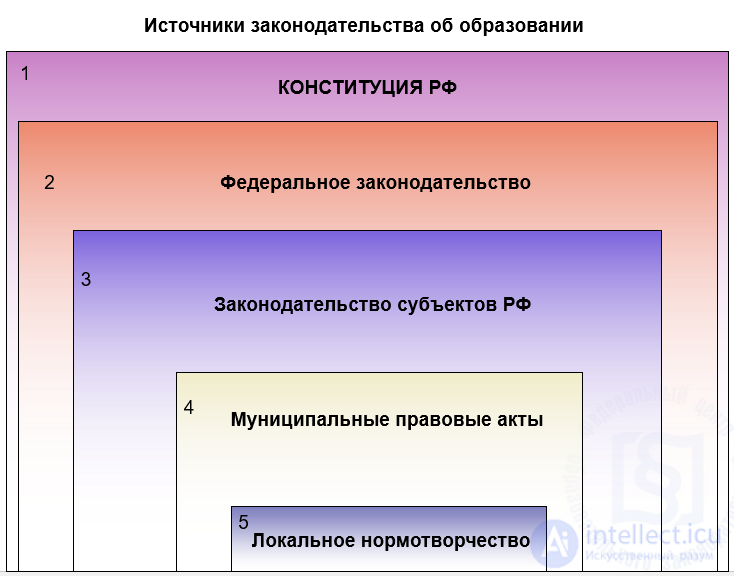
The regulatory and legal support of a pedagogical psychologist's professional activity in Russia includes the following key documents and acts:
The Constitution of the Russian Federation – the basic law of the country, which guarantees human rights and freedoms, including the right to education and psychological assistance.
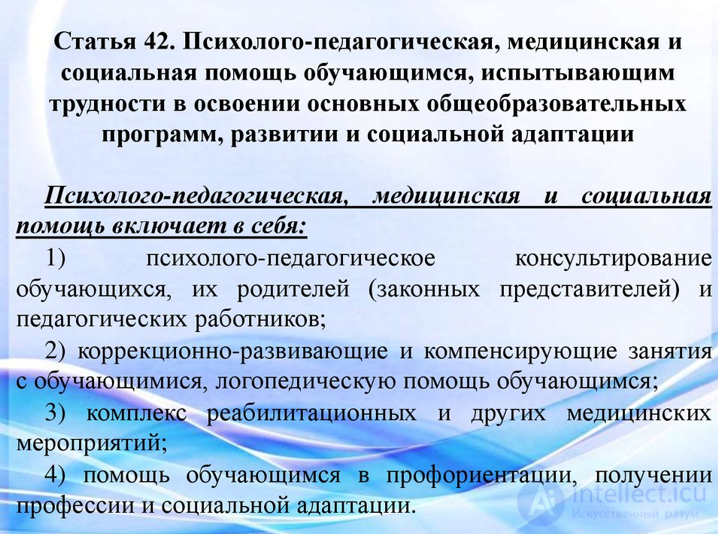
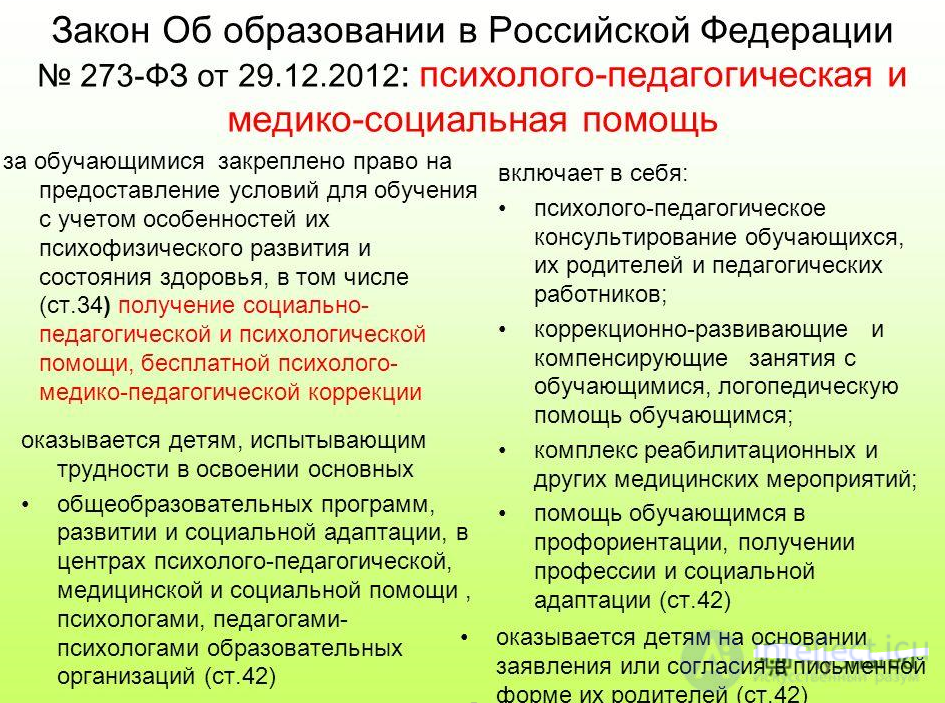
Federal Law "On Education in the Russian Federation" No. 273-FZ (2012) – regulates relations in the field of education, including the activity of the pedagogical psychologist. The law establishes the rights and duties of participants in the educational process, including the right to receive psychological assistance.
Federal Law "On Psychiatric Care and Guarantees of Citizens' Rights in its Provision" No. 3185-1 (1992) – regulates the provision of psychological assistance and upholds the rights of citizens related to medical and psychological care.
The professional standard "Pedagogical psychologist (psychologist in the field of education)" – defines the qualification requirements for a pedagogical psychologist, his or her duties, the necessary competencies, and the conditions for performing professional tasks. The professional standard was approved by Order No. 682n of the Ministry of Labor and Social Protection of the Russian Federation dated July 24, 2015.
The Code of Ethics for the pedagogical psychologist – contains norms of professional ethics and the principles of the pedagogical psychologist's interaction with students, colleagues, and parents.
Orders and methodological recommendations of the Ministry of Education of the Russian Federation – regulate the procedure for providing psychological assistance in educational institutions, the organization of psychological and pedagogical support for students, preventive work, and work with special groups of children.
The Labor Code of the Russian Federation – regulates the labor relations of the pedagogical psychologist, his or her rights and duties, working conditions, working hours, leave, and other aspects related to labor activity.
These documents and laws create the legal basis for the activity of the pedagogical psychologist and regulate matters of providing psychological assistance in the educational sphere.
Psychological and pedagogical activity – a type of pedagogical activity aimed at the personal, intellectual, emotional, and social development of the participants in the educational process, which at the same time acts as a basis for self-development and self-improvement
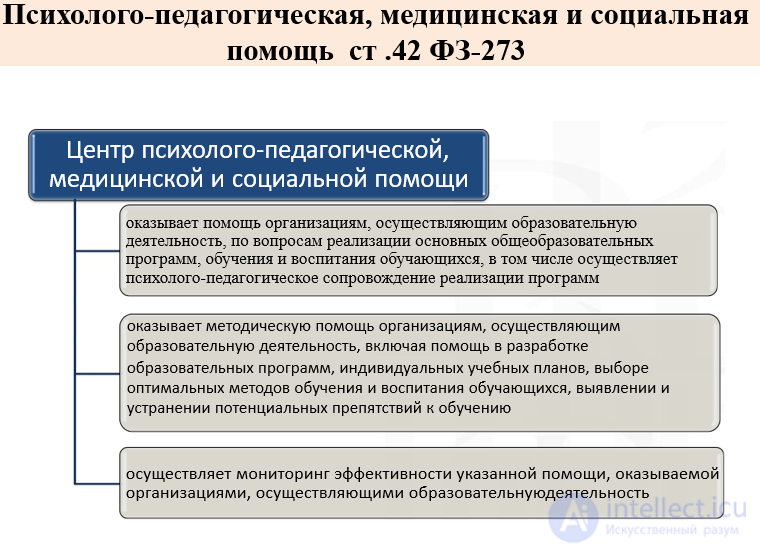
Requirements for the system of psychological and pedagogical support of an educational institution's activity
The system of principles of psychological and pedagogical support
Tasks of psychological and pedagogical support
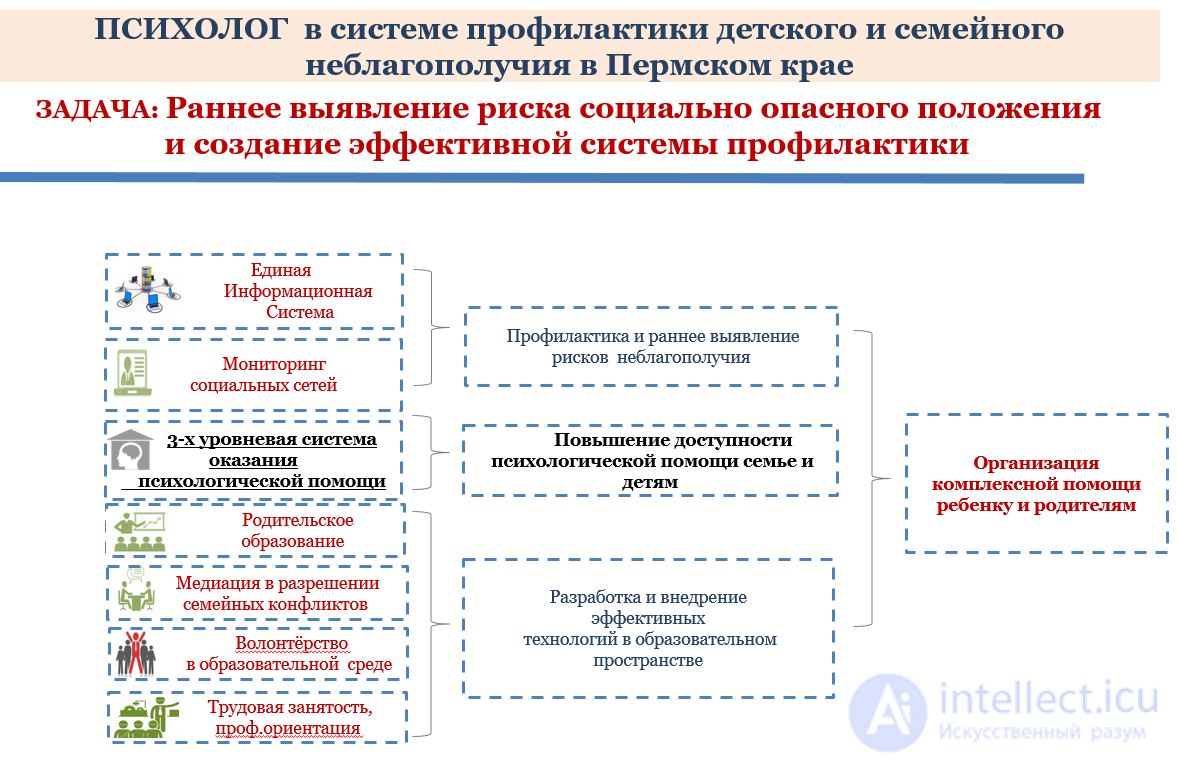
REGULATORY LEGAL ACTS AND DOCUMENTATION SUPPORTING THE ACTIVITY OF THE PEDAGOGICAL PSYCHOLOGIST
The regulatory and legal basis for organizing psychological and pedagogical support under the Federal State Educational Standards for General Education
8. Order of the Ministry of Education and Science of Russia No. 373 of October 6, 2009 (as amended on May 18, 2015) «On the approval and implementation of the Federal State Educational Standard of primary general education».
9. Order of the Ministry of Education and Science of Russia No. 1897 of December 17, 2010 (as amended on December 29, 2014) «On the approval of the Federal State Educational Standard of basic general education».
10. Order of the Ministry of Education and Science of Russia No. 413 of May 17, 2012 (as amended on December 29, 2014) «On the approval of the Federal State Educational Standard of secondary general education».
11. Order of the Ministry of Labor of Russia No. 514n of July 24, 2015 «On the approval of the professional standard «Pedagogical psychologist (psychologist in the field of education)»».
12. Letter of the Ministry of Education of the Russian Federation No. 28-51-513/16 of June 27, 2003 «Methodological recommendations on psychological and pedagogical support of students in the educational process under conditions of modernization of education».
13. Letter of the Ministry of Education of the Russian Federation No. 20-58-07IN20-4 of 22.01.98 «On speech therapist teachers and pedagogical psychologists of educational institutions».
14. Letter of the Ministry of Education and Science of the Russian Federation No. 06-1216 of September 24, 2009 «On improving comprehensive multidisciplinary psychological-pedagogical and medical-social-legal assistance to students and pupils».
REGULATORY AND LEGAL SUPPORT FOR THE EDUCATION SYSTEM OF CHILDREN WITH DISABILITIES
Convention on the Rights of Persons with Disabilities, UN General Assembly, December 13, 2006.
The Convention, for the first time, addresses the realization of the rights of children with disabilities not from the standpoint of their adaptation to the life of society, but from the standpoint of arranging the life of society in such a way that it takes into account the needs and characteristics of persons with disabilities and persons with limited health capabilities. The Convention establishes that States Parties recognize the right of persons with disabilities to education and take comprehensive measures to realize this right.
«On the social protection of disabled persons in the Russian Federation», No. 181-FZ of November 24, 1995;
«On basic guarantees of the rights of the child in the Russian Federation», No. 124-FZ of July 24, 1998;
«On general principles of the organization of legislative (representative) and executive bodies of state power of the constituent entities of the Russian Federation», No. 184-FZ of October 6, 1999;
«On general principles of the organization of local self-government in the Russian Federation», No. 131-FZ of October 6, 2003.
Letter of the Ministry of Education of the Russian Federation No. 29/152 4-6 of April 26, 2001 «On the concept of integrated education of persons with disabilities (with special educational needs)», Letter of the Ministry of Education of the Russian Federation No. 03–51–5 in/23 – 03 of January 16, 2002 «On the integrated upbringing and education of children with developmental disorders in preschool educational institutions».
Resolution of the Chief State Sanitary Doctor of the Russian Federation No. 189 of December 29, 2010 (as amended on November 24, 2015) "On the approval of SanPiN 2.4.2.2821-10 "Sanitary-epidemiological requirements for the conditions and organization of education in general educational institutions" (together with "SanPiN 2.4.2.2821-10. Sanitary-epidemiological requirements for the conditions and organization of education in general educational organizations. Sanitary-epidemiological rules and standards")
Order of the Ministry of Education of the Russian Federation No. 29/2065-p of April 10, 2002 «On the approval of the curricula of special (correctional) educational institutions for students and pupils with developmental disorders»
The Constitution of the Russian Federation.
The Convention on the Rights of the Child, 1989.
The Convention on the Rights of Persons with Disabilities, 2006.
«On the social protection of disabled persons in the Russian Federation» - Law of the Russian Federation of November 24, 1995 No. 181-FZ, with supplements and amendments.
«On the procedure and conditions for recognizing a person as disabled» - Decree of the Government of the Russian Federation of February 20, 2006 No. 95 (as amended by Decree of the Government of the Russian Federation of 07.04.2008 No. 247)
«Individual rehabilitation program for a disabled child, issued by federal state institutions of medical and social expertise». Appendices No. 2 and No. 3 to the Order of the Ministry of Health and Social Development of the Russian Federation of 4.08.2008 No. 379n
«On the approval of classifications and criteria used in conducting medical and social expertise of citizens by federal state institutions of medical and social expertise» - Order of the Ministry of Health and Social Development of the Russian Federation of August 22, 2005 No. 535)
«On the approval of the regulation on the psychological, medical, and pedagogical commission» - Order of the Ministry of Education and Science of the Russian Federation of September 20, 2013 No. 1082.
«On the psychological-medical-pedagogical council (PMPc) of the educational institution) - Letter of the Ministry of Education of the Russian Federation of 27.03.2000 No. 27/901-6).
Order of the Ministry of Education and Science of the Russian Federation No. IR-535/07 of 07.06.2013
«On correctional and inclusive education of children».
Order of the Ministry of Education and Science of the Russian Federation No. 1015 of 30.08.2013 «Procedure for the organization and implementation of educational activity under the main general education programs – educational programs of primary general, basic general, and secondary general education».
Letter of Rosobrnadzor of 08.04.2014 No. 02-206 «Methodological recommendations on the organization and conduct of the state final certification under educational programs of basic general and secondary general education in the form of the basic state exam and the unified state exam for persons with disabilities».
Letter of the Ministry of Education and Science of Russia of April 9, 2014 No. NT-392/07 «On the final certification of students with disabilities».
Order of December 26, 2013 No. 1400 «On the approval of the procedure for conducting the state final certification under educational programs of secondary general education».
Order of the Ministry of Education and Science of the Russian Federation of 19.12.2014 No. 1598 «On the approval of the Federal State Educational Standard of primary general education for students with disabilities».
Order of the Ministry of Education and Science of the Russian Federation of 19.12.2014 No. 1599 «On the approval of the Federal State Educational Standard of education for students with intellectual disabilities».
Ministry of Health and Social Development of the Russian Federation No. 1086 ; Ministry of the Russian Federation for Civil Defense and Emergencies No. 550 ; Ministry of Education and Science of the Russian Federation No. 2415, Order of September 29, 2011 «On the approval of the concept for creating an Internet psychological assistance service for the population and a comprehensive plan of measures for its implementation»
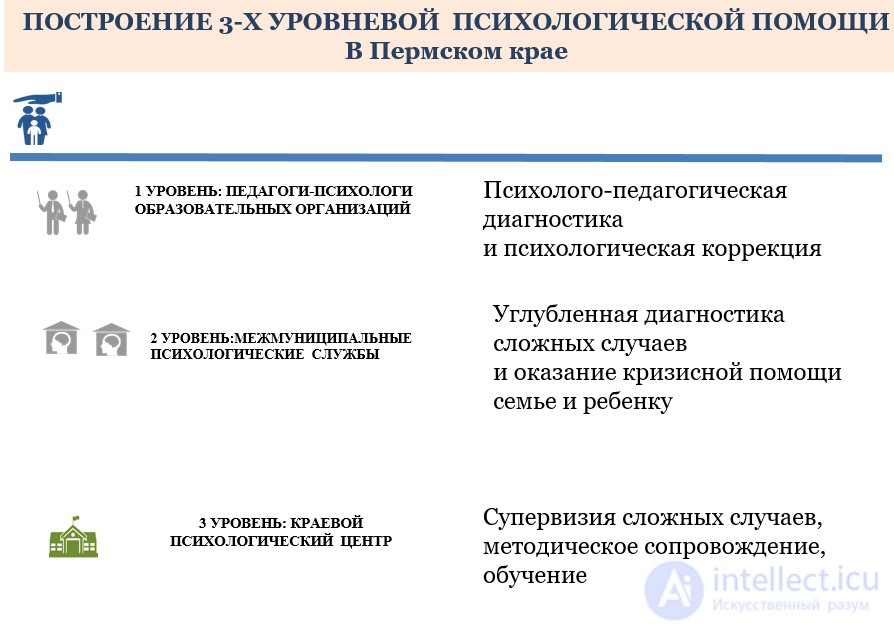
Letter of the Ministry of Education and Science of Russia of 10.02.2015 No. VK-268/07 "On improving the activity of centers for psychological, pedagogical, medical, and social assistance" (together with "Recommendations of the Ministry of Education and Science of the Russian Federation to state authorities of the constituent entities of the Russian Federation in the field of education on improving the activity of centers for psychological, pedagogical, medical, and social assistance")
2. The program "Psychological and pedagogical support of students with disabilities and disabled children«
Order of the Ministry of Education and Science of Russia of 19.12.2014 No. 1599 "On the approval of the Federal State Educational Standard of education for students with intellectual disabilities»
3.6.4. The organization provides separate specially equipped rooms for conducting classes with a special education teacher, a pedagogical psychologist, a speech therapist, and other specialists, meeting the objectives of the correctional work program of psychological and pedagogical support of the student.
Letter of the Ministry of Education and Science of Russia of 22.04.2015 No. 06-443 "On the forwarding of Methodological Recommendations" (together with "Methodological Recommendations for the development and implementation of adapted educational programs of secondary vocational education", approved by the Ministry of Education and Science of Russia on 20.04.2015 No. 06-830vn)
- psychological and pedagogical support is provided for disabled students and students with disabilities who have problems in learning, communication, and social adaptation, and is aimed at studying, developing, and correcting the student's personality and the adequacy of the formation of his or her competencies;
Order of the Ministry of Education and Science of Russia of 17.12.2010 No. 1897 (as amended on 31.12.2015) "On the approval of the Federal State Educational Standard of basic general education»
variability of the directions of psychological and pedagogical support for participants of educational relations (preserving and strengthening the psychological health of students; forming the value of health and a safe lifestyle; developing one's ecological culture through differentiation and individualization of education; monitoring the capabilities and abilities of students, identification
Order of the Ministry of Education and Science of Russia of 11.05.2016 No. 536 "On the approval of the Specifics of the working hours and rest time regime for teaching and other staff of organizations engaged in educational activity»
Legal basis for the activity: Regulatory legal acts governing the activity of the pedagogical psychologist create a legal basis for the fulfillment of professional duties. This ensures the legitimacy of his or her work and legal protection for all participants in the educational process.
Guarantee of rights and duties: Laws and standards establish the rights and duties of the pedagogical psychologist, enabling him or her to perform professional functions within the framework of the law, while also protecting the rights of children, parents, and other participants in the educational process.
Standardization of professional requirements: The professional standard for the pedagogical psychologist defines qualification requirements, competencies, and basic duties, which contributes to a unified approach to training specialists and providing psychological assistance.
Ethics and professionalism: Ethical norms, enshrined in regulatory acts and professional standards, govern the conduct of the pedagogical psychologist, guaranteeing observance of the principles of confidentiality, respect, and professionalism in work with children, parents, and colleagues.
Quality of the services provided: The regulatory and legal framework contributes to ensuring a high level of psychological assistance in educational institutions, which makes it possible to take into account the individual characteristics of students and provide the necessary support in a timely manner.
Social responsibility: The pedagogical psychologist performs an important role in the education system, and regulatory oversight helps him or her effectively address tasks of supporting, adapting, and developing students, which is a significant contribution to creating a favorable educational environment.
Thus, the regulatory and legal support of the pedagogical psychologist's professional activity ensures high standards of his or her work, protection of the rights of the participants in the process, and the creation of conditions for providing quality psychological assistance in the educational environment.

Comments