
Lecture
Aggression (Lat. aggredi — (literally) a step): In its original sense, «to be aggressive» meant «to move toward a goal without delay, without fear or doubt,» and therefore aggression can be constructive, lending strength to move toward a goal.
Benign aggressive behavior is an adaptive process that helps sustain life and represents a reaction of the psyche to a threat to one's interests or to danger, both in the human world and in the animal world.
There are various approaches to defining this phenomenon. Let us outline just a few of them:
Despite the large number of approaches, none of them provides a complete and exhaustive definition of aggression, each reflecting only one or another facet of this phenomenon.
"The role of anger in psychic development, especially in the dynamics of those terrible experiences capable of disrupting the entire forward movement of life, has long been known. The Latin scholars and poets Seneca and Plutarch wrote a great deal about anger. In a recent work[when?] Averill[who?] reports that about 90 years ago[when?] the well-known American psychologist G. S. Hall counted around 2200 states of anger described in his studies. Today, various schools of psychology actively study anger and discuss how to cope with it, how to rid oneself of it, and how to make use of it.
A. Buss and A. Durkee distinguish the following five types of aggression:
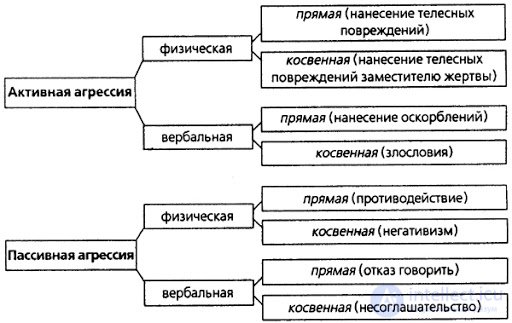
Fig. Classification of types of aggression
Classification of types of aggression
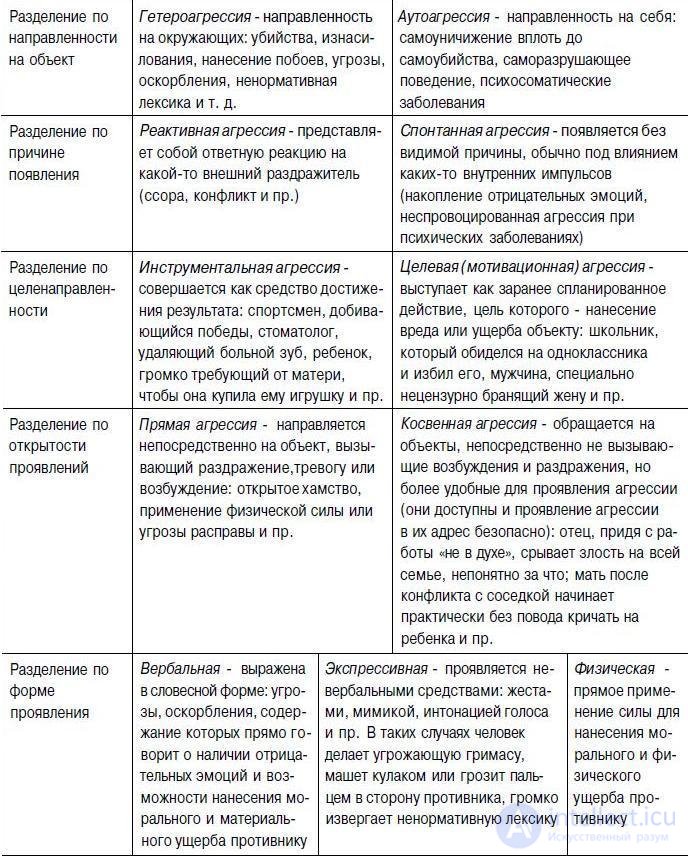
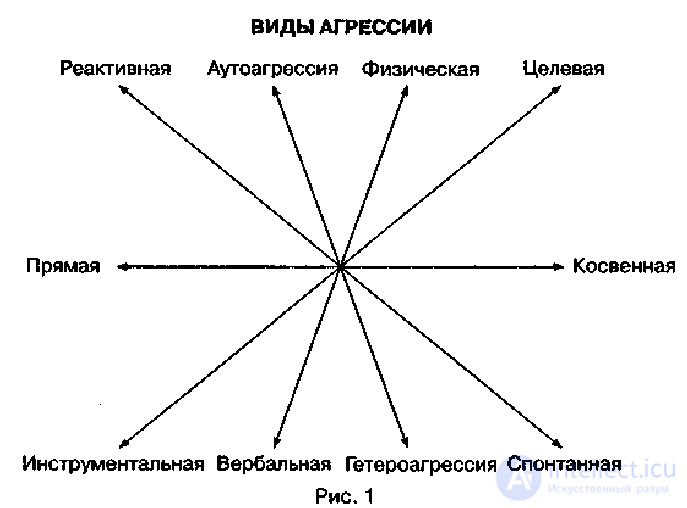
Erich Fromm distinguished the following forms of aggression:
According to George Simon (Eng. George K. Simon), aggression can be divided into overt and covert. The latter most often serves as a mechanism of interpersonal manipulation. People characterized by covertly aggressive behavior always strive to get their own way, to subjugate other people, and to control the situation, while using techniques that mask their aggressive intentions. They may appear polite, charming, and attractive while remaining unscrupulous, cunning, and vindictive fighters .
A person's aggressiveness is not linked to their sex, but depends on the cultural (social) environment. Thus, in one archaic society men and women are equally aggressive, whereas in a neighboring society of the same type men display aggression more often than women[10].
The level of physical aggression depends on genetic factors, in particular on the sensitivity of androgen hormone receptors, which is determined by the length of the CAG (Cytosine—Adenine—Guanine) triplet repeat sequence in the androgen receptor gene. Researchers studying African tribes found that in more aggressive men this chain is shorter. The level of aggression is influenced by genes that:
-increase dopamine and norepinephrine activity;
-decrease GABA activity;
-enhance sex hormones;
-enhance the action of stress hormones (adrenaline, cortisol).
However, aggression is a complex behavioral response, and the length of the chain encoding androgen receptors is not the only genetic factor[11][12].
Aggression can also be considered from the standpoint of neurophysiology. First it should be explained that aggression is one of the active-defensive variants of response to a stimulus, which is explained by an innate need for safety. In turn, aggression (the brain's command to "fight!") is governed by the centers of aggression — the amygdala and the posterior hypothalamus. It is an interesting fact that tumors in the amygdala of the brain can be a cause of manic behavior.
The amygdala collects stress-inducing signals and relays them to the hypothalamus, through which endocrine and autonomic responses, as well as emotions, develop. Mention should also be made of the associative frontal lobe and the cingulate gyrus, since behavioral (motor) responses develop through them: the cortex initiates movements, selects the program ("fight" or "flight"), and the gyrus compares actual and expected outcomes, triggering the generation of "fast" emotions. Aggressive individuals show high amygdala activity and low activity of the cingulate gyrus.
Reaction speed is influenced by adrenaline and norepinephrine, which are released by the sympathetic nerves and the adrenal medulla. It can therefore be asserted that these two hormones increase the level of aggression
The adrenal cortex produces corticosteroids, some of which (cortisol) regulate glucose metabolism in the body, in particular enhancing its formation from other substances (proteins, fats). This effect is most often observed under stress; consequently, cortisol indirectly influences the level of aggression.
In addition, aggression is influenced by hormones such as dopamine and serotonin. The former interacts with the substantia nigra and the nuclei of the ventral tegmental area of the brain; consequently, when dopamine is abundant, movements become sharper, and the reactivity and activity of the positive-emotion center increase. Serotonin, on the other hand, affects the negative-emotion center: its excess reduces the activity of this center (in other words, serotonin acts as an antidepressant), and thus, like dopamine, it reduces the level of aggression when present in sufficient amounts.
The concept of «gender» means the set of social and cultural norms that society prescribes for people to follow depending on their biological sex . Under the influence of gender
and the particularities of social adaptation to modern Russian
conditions, changes occur in aggressive behavior, especially
among young people .
Aggression is «getting younger» and acquiring new forms not previously encountered in the cultural-historical development of society,
and therefore not subject to socio-normative restrictions
. As for new forms of aggression, at present girls' aggression strikes specialists with its groundlessness and unrestrained character. No rules have been developed for it comparable to those that exist among boys — a fight «to first blood», «don't hit someone who's down»
and so on, so girls and young women can exceed males in their aggressive manifestations .
Aggression is any form of behavior aimed at insulting or causing harm to another living being that does not desire
such treatment. Aggressiveness is a personality trait that determines an individual's readiness for destructive behavior. In other
words, aggressiveness is a prerequisite for aggression, its basis .
In March 2011, we conducted an empirical study
of gender differences in aggressive behavior. The object of the study was third-year students of the chemistry and mathematics-mechanics faculties of Ural Federal University. The sample consisted of 120 people —
60 men and 60 women.
The research instruments used were V. V. Boyko's method for determining integral forms of communicative aggressiveness, the Cook — Medley hostility scale, and the «Test of Emotions» (G. V. Rezapkina's modification of the Buss — Durkee test).
The results of the study showed the reliability of gender differences in the overall level of aggression on the Cook — Medley scale. The assumption of gender inequality in aggressiveness was
confirmed. The question of why males significantly exceed females in aggressive manifestations remains a matter of debate today. But
most researchers do not doubt the existence of this superiority.
We hypothesized that males have a higher level of physical aggression, while women have a higher level of verbal aggression. To test
this hypothesis, we used empirical data
obtained from the «Test of Emotions». Using Student's t-test
it was established that gender differences in the level of physical
aggression are significant. In other words, gender differences in the level of
physical aggression do indeed exist. At the same time, men
demonstrate a higher level of
physical aggression compared to women. As for gender differences in the level of
verbal aggression, none were found. In other words,
men and women do not differ in the level of verbal aggression.
This may be due to a feature of the student sample.
Since three methods were used in the study,
each including several scales, we examined the nature of the
correlation between the scales of the methods. For this purpose we calculated
Pearson correlation coefficients for all scales of the three methods.
The results obtained and the conclusions drawn from them are as
follows:
Cynicism, on the Cook — Medley scale, defined as disregard for the norms
of public morality, propriety, insolence, and shamelessness, correlates in men with the spontaneity of aggression, provocation of aggression
in others, ritualization of aggression, retribution for it, as well as
touchiness and suspiciousness (according to V. V. Boyko's method).
In women, a correlation was found between cynicism and the provocation of aggression
in others.
Aggression on the Cook — Medley scale for the male sample correlates with an inability to redirect aggression toward activity or
inanimate objects, with provocation of aggression in others,
ritualization of aggression, indirect aggression, verbal aggression,
and irritability (according to V. V. Boyko's method). In women, aggression
correlates only with enjoyment of aggression.
Hostility on the Cook — Medley scale in men correlates
with the spontaneity of aggression, the inability to redirect aggression toward
activity or inanimate objects, provocation of aggression
in others, its ritualization, retribution for aggression (according to Boyko's method), as well as with indirect aggression, irritability,
and touchiness (according to the «Test of Emotions»). In women, a correlation was found with spontaneity of aggression, provocation of aggression in others, retribution for aggression, and suspiciousness.
Physical aggression according to the «Test of Emotions» in men correlates
with anonymous aggression, provocation of aggression in others, a tendency toward reflected aggression, its ritualization, a tendency to become infected by crowd aggression, and enjoyment of aggression (according to
V. V. Boyko's method). In women — with a tendency toward reflected aggression
and a tendency to become infected by crowd aggression.
In the male sample, irritability is associated with the following
variables:
In women, a correlation was found between irritability, spontaneity of aggression, provocation of aggression in others, and enjoyment of aggression.
Since an irritable person is quick-tempered, the connection between irritability and the spontaneity of aggression is obvious.
Negativism in males is associated with a tendency toward reflected aggression, ritualization of aggression, a tendency to become infected by
crowd aggression, and enjoyment of aggression. No correlation between
negativism and the scales of Boyko's method was found in women.
Touchiness in men correlates with spontaneity of aggression,
inability to redirect aggression, anonymous aggression, auto-aggression, ritualization of aggression, and retribution for aggression. This can
be explained by the fact that men show less variability in aggressive behavior and perceive aggressive situations using more simplified schemes. For them, these situations represent
a threat to self-esteem to a greater extent than for women.
In women, touchiness is associated only with spontaneity
of aggression.
Suspiciousness in men is associated with spontaneity of aggression,
provocation of aggression in others, auto-aggression, ritualization
of aggression, and retribution for aggression.
Verbal aggression in men correlates with an inability
to inhibit aggression, anonymous aggression, provocation of aggression
in others, a tendency toward reflected aggression, ritualization
of aggression, and enjoyment of aggression. In women, in this regard
only one correlation was found — between verbal aggression
and enjoyment of aggression.
In the female sample, a correlation was found between suspiciousness
and a tendency to become infected by crowd aggression.
The study makes it possible to identify a number of other characteristics
of aggressiveness that are typical of our sample.
First, we ventured to assume that if irritability is a predisposition to rudeness, including verbal rudeness, and verbal aggression is its direct manifestation, then
an irritable person should be verbally aggressive over
the slightest provocation.
In both men and women, a direct correlation was found between
irritability and verbal aggression. It turns out that both
in men and in women the following tendency is observed: the level of verbal aggressiveness is directly related to the level of
irritability.
Second, in the course of the study we became interested in the following fact: if a person is not able to inhibit aggression, does this
mean that he or she may direct it against himself or herself, having failed to stop
in time?
We decided first to check whether gender differences exist in the indicators «Inability to inhibit aggression» and «Auto-aggression». According to Student's t-test, no such differences were found.
Next we investigated whether a correlation exists between the studied traits in men and women. For this the
Pearson coefficient was calculated for each sample separately. In men no correlation was found. In the female sample, an
inverse correlation was found between the inability to inhibit aggression
and auto-aggression.
The absence of a correlation between the inability to inhibit aggression and auto-aggression, or the inverse nature of this correlation, as we
may assume, can be explained by the fact that auto-aggression is not
always a consequence of one's own aggressive impulses getting out of
control. Auto-aggression arises under a number of conditions. For example,
if venting aggression on external objects is socially unacceptable or such objects are absent. That is, for auto-aggression to arise, a person need not necessarily be unable to keep himself or herself
in check. The cause of auto-aggression lies in other psychological
states and external conditions. That is why the presence of a correlation was not
confirmed.
The inverse correlation characteristic of the female sample suggests that women's ability to inhibit aggression may more often
lead to auto-aggression, which may manifest as self-blame,
self-deprecation, etc. Whether this is a characteristic feature of
female aggressive behavior is difficult to say. The question requires
further study.
Third, we made the assumption that an inability to redirect aggression toward activity or objects might
lead to acts of physical aggression against other people.
In other words, if a person does not know how to vent aggression, for example, by pummeling a pillow, he or she will direct physical aggression at others. Moreover, such a tendency would be observed both
in men and in women. If a subject shows a high
level on the indicator «Inability to redirect aggression onto inanimate objects», then his or her level of physical aggression
would also be high. However, neither in the male nor in the female sample was a correlation between these variables found.
Our hypothesis was not confirmed: an inability to vent aggression on inanimate objects does not lead to acts of physical aggression. This fact can be explained
as follows: besides the habit of «pummeling a pillow»,
a person may have other ways of venting aggression. Thus,
if the ability to redirect one's aggressive impulses toward inanimate objects is absent, this does not make a person
aggressive in the physical sense. He or she probably simply uses
some other method of release.
After examining the gender aspect of aggressive behavior,
a more in-depth study of this question among military personnel during the period of adaptation is planned.
Provocative forms of behavior manifest themselves:
|
|
|
|
|
|

Comments