
Lecture
Facilitation (from the English "facilitate" - to make easier) refers to special actions aimed at organizing group work.
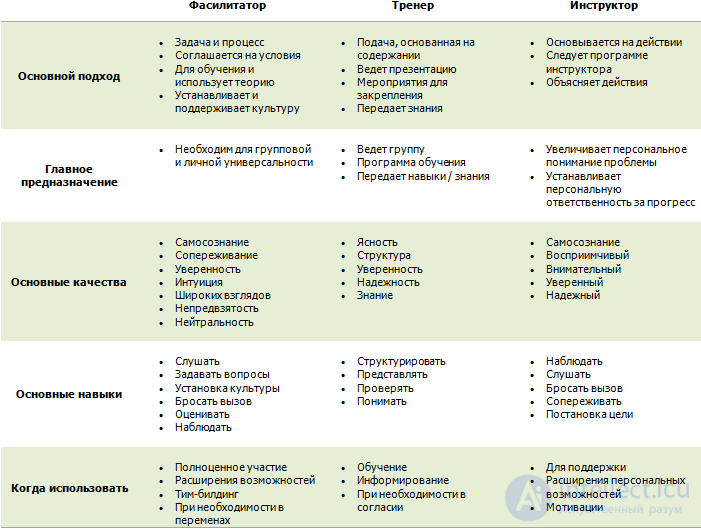
A facilitator - a person who organizes a group in such a way that it achieves the goals set before it.
Facilitation (translated from English) means to make easier, to help, to promote. Facilitation is a form of group work for developing solutions of increased complexity or increased importance.
A facilitator does not teach the participants but provides them with special group-work technologies for creating the required outcome
Facilitation is the process of easing and managing group activity or interaction in order to achieve specific goals, improve interaction among participants, and solve problems. A facilitator, performing the role of facilitation, helps the participants in a group reach effective and productive decisions, and also creates an atmosphere that promotes an open exchange of opinions and ideas.
The main aspects of facilitation include:
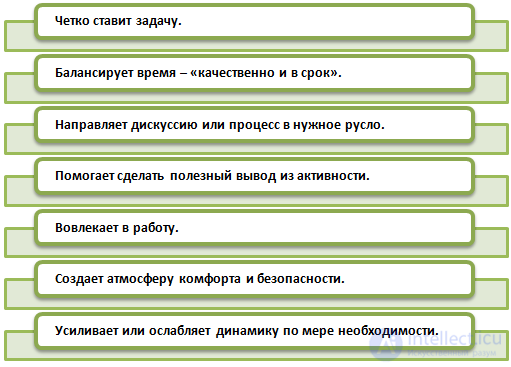
Planning and organization: The facilitator prepares the event plan in advance, defines the goals and objectives, develops the agenda, and determines the methods and tools that will be used during the event.
Managing the process: The facilitator manages the course of the event, ensuring that the schedule is followed, providing direction, and orienting the participants.
Creating a safe and supportive environment: The facilitator creates an atmosphere in which participants feel comfortable and free to express their opinions, even when they disagree.
Supporting communication: The facilitator stimulates open discussion and the exchange of ideas among participants. They may use various methods, such as brainstorming, round-robin discussions, role-playing games, and others, to structure the communication.
Resolving conflicts: The facilitator helps resolve conflicts that arise within the group and guides participants toward constructive solutions.
Decision-making: The facilitator may use special methods and techniques to support the decision-making process, ensuring that decisions are based on information and discussion rather than on subjective preferences.
Evaluation and reflection: At the end of the event, the facilitator evaluates the effectiveness of the process and the results obtained, and also gathers feedback from the participants in order to improve future events.
Facilitation is widely used in various contexts, such as meetings, training sessions, strategic planning, group discussions, conflict resolution, and other events where it is important to reach consensus and joint decisions. It helps increase the productivity and quality of a group's work, and also promotes more open and effective interaction among participants.
The term "facilitator" refers to a person or organization that performs the role of easing, promoting, managing, or organizing some process, event, or group activity. A facilitator helps participants achieve specific goals, improve interaction, solve problems, and make decisions. Facilitation can be applied in various fields, such as business, education, international politics, social groups, and many others.
Here are some key aspects of the facilitator's role:
Managing the process: The facilitator manages the process of a meeting, event, or group work, ensuring its planning, organization, and sequence of steps.
Facilitating interaction: The facilitator helps participants interact more effectively and productively. They promote an open exchange of opinions, discussion, and conflict resolution.
Creating a safe environment: The facilitator creates an atmosphere in which participants feel comfortable and free to express their ideas and opinions.
Support in the decision-making process: The facilitator may use various methods and tools to help the group make informed and well-considered decisions.
Developing participants' skills: The facilitator may help develop participants' skills and competencies, helping them improve their abilities in the areas of communication, problem-solving, and decision-making.
Maintaining neutrality: The facilitator should generally remain neutral and not interfere with the substance of the discussion or the decision, only easing the process.
Evaluation and process improvement: At the end of the event or the work, the facilitator may evaluate the effectiveness of the process and suggest improvements for the future.
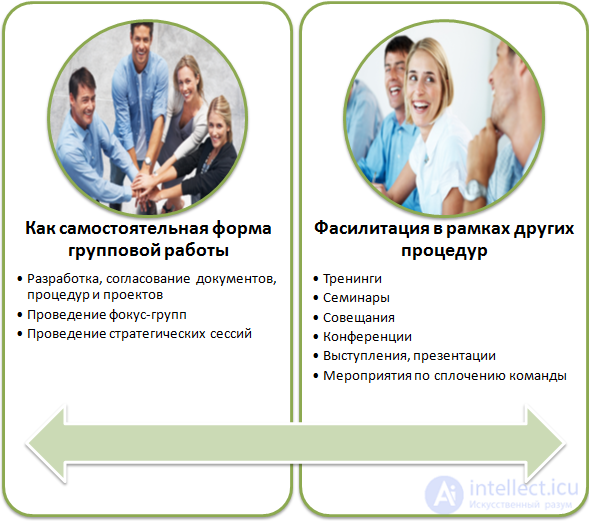
Facilitation can be applied in various contexts, including meetings, training sessions, conferences, group discussions, and other events. This role is especially useful in situations where it is necessary to reach agreement, coordination, or the resolution of complex tasks in a collective setting.
Possibilities of facilitation:
1. Increases the effectiveness of the group decision-making process:
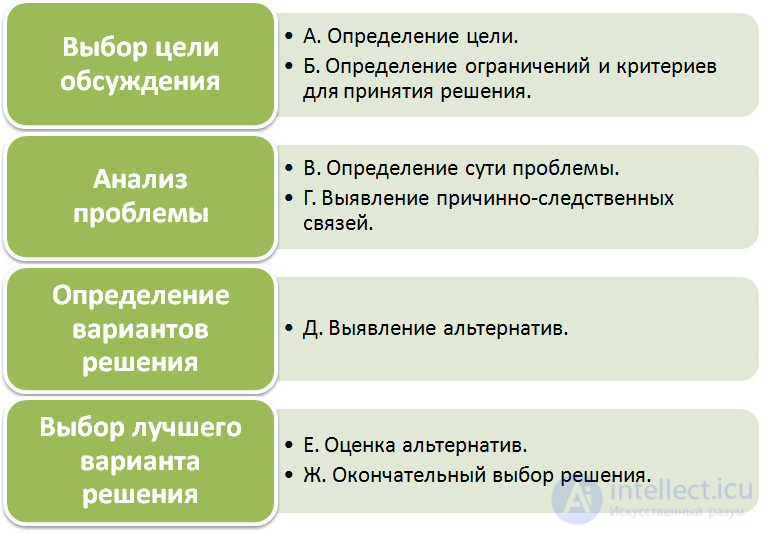
- analysis of the situation
- identification of options and alternative solutions to the problem
- selection of the best option
2. Creates and maintains the climate within the group:
- increases the level of engagement in the process
3. Ensures the exchange of experience among participants.
4. Promotes the personal development of participants.
Stages of facilitation in decision-making
Areas of application of facilitation
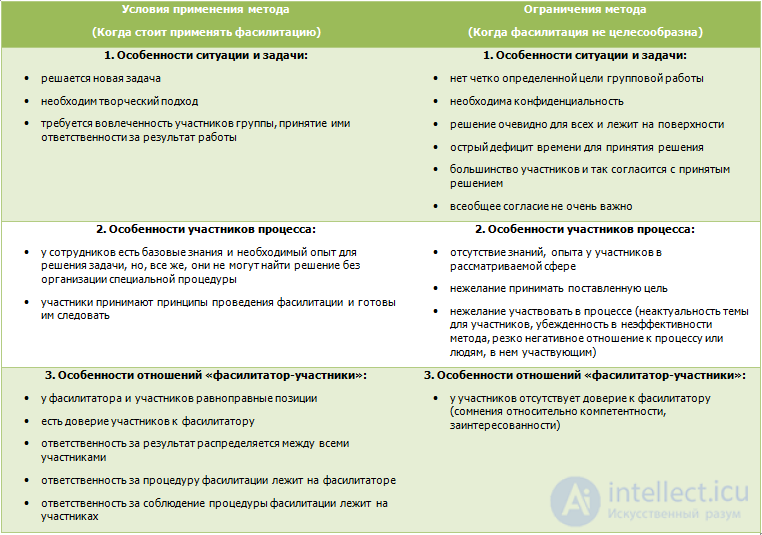
Conditions and limitations of applying the facilitation method
| Facilitation method | Description |
|
Open Space
(«Open Space») |
- The organization of a self-organizing process among a group of employees aimed at finding a solution to a specific task of a functional unit or the company.
- The method is used when a large group of employees needs to answer many specific questions or find solutions to problems within a single theme.
- The advantage of this technology lies in gathering a large number of opinions on a given topic in a short period of time. In addition, team members develop a sense of involvement in the process and cohesion.
|
|
World Café («World Café») |
- Gathering the opinions of a group (whether small or large) of employees over 1.5–2 hours regarding an important question or a strategic issue relevant to either a specific area of the company's work or the organization as a whole.
- The method does not necessarily entail subsequent structural or process changes within the company's system, so it can be regarded as one of the methods of change management.
- The merit of this technique is that employees generate a large number of ideas and solutions, which are immediately questioned and criticized, either rejected or accepted for further work. During the discussion, the experience and considerable body of knowledge of those present on the given topic is concentrated, creating conditions for intensive mutual learning.
|
|
Future Search («Future Search») |
- Holding a corporate conference in a specially designed «large group» format, which is the central part of the interactive process. The discussion covers a wide range of issues, and a direction is worked out in which the company's employees are to move.
- The technology is used when various interested departments of the company need a common basis for cooperation and for shaping the future of the whole organization.
- The method makes it possible to engage the entire company in effective work and to awaken the initiative of rank-and-file employees.
|
|
Appreciative Inquiry Summit («Summit of Positive Change») |
- The most widely applied and well-researched method, aimed at achieving a broad range of changes in the company, such as increasing the effectiveness of joint work, improving the corporate climate, developing leadership, strategic planning, correcting corporate culture, clarifying corporate values, improving business processes, and so on.
- The method involves acting on elements of a structural and process nature within the company's system and subsequently necessarily requires actions to achieve and consolidate the changes. The results of acting on structural elements may include: a vision of the future shared by all employees, the setting of clear goals and motivating tasks, suitable team members, transparently defined roles (including leadership), as well as the accountability of the teams carrying out the planning.
- Thanks to this technology, the group masters decision-making in self-organized teams and boundary management. In addition, after the summit employees continue to interact, drawing others into the work, and can independently organize and run similar events, turning into a continuously developing, self-learning structure.
|
|
Real Time Strategic Change ("Real-time strategic change") |
- The group's work process consists of developing the values and norms needed to achieve the tasks facing the company; learning to interact as an effective team; acquiring self-organization skills; working on real issues affecting their colleagues who are impacted by these issues.
- The method is used when it is necessary to engage employees in implementing a new development strategy, carry out restructuring, make changes in the organizational structure, changes in work processes or the company's corporate culture, and obtain a real result.
- The technology enables employees to explore and establish new ways of doing business. The method encourages employees to apply the skills they have gained in their everyday work in response to a variety of changes in the business environment, to communicate with one another in new ways, to make decisions effectively, and to interact productively.
|
|
Work Out ("Going beyond the limits") |
- Development of recommendations on topics important to the business by cross-functional and/or cross-level groups of managers and employees, followed by discussion in the form of an open dialogue and a decision on the proposed recommendations.
- The method is used to develop innovative ways of interacting, to overcome the company's bureaucratization, to improve business processes, and to enhance the ability to achieve the results the company needs.
- The technology is most in demand when a company needs to make a quick breakthrough and achieve a certain commercial result, to create a culture of a fast-changing, innovative organization that presupposes managers' ability to make quick decisions while conducting an active dialogue with employees.
|
|
Dynamic facilitation |
- One of the approaches to group and individual work, which is highly productive and makes it possible to achieve results on "unsolvable" problems. Through open discussion, in which employees talk about aspects that are truly important to them, it becomes possible to get to the heart of the matter at hand.
- In this method (unlike others) there is no division into subgroups. To take part in the discussion, employees are not required to follow any particular rules or to learn new ways of communicating. There is only one condition - to speak one at a time.
- The method is used when there is a generally known common topic that requires further development followed by the resolution of specific business tasks. Thanks to this method, employees gain a greater volume of information, increase their competence, their inclination toward cooperation, and their ability to independently solve complex problems.
|
| Brainstorming |
- The method is used when it is necessary to summarize the available information + find new, «fresh» ideas. Identifying solution options: 1. when there is a clearly formulated problem requiring a solution; 2. when there is the minimum information necessary for making a decision.
- Rules of conduct:
|
| Metaphorical method |
- The method is used when the group has reached a deadlock or is tired and a new form of activity is needed; new, «fresh» ideas or an unconventional view of the situation are needed; the emotional attitude toward the issue needs to be revealed. Identifying solution options: 1. when there is a clearly formulated problem requiring a solution; 2. when there is the minimum information necessary for making a decision.
- Rules of conduct: Participants in the facilitation session are invited to represent the problem (topic) in the form of some metaphor. Examples: Draw this problem the way you see it. The artistic quality of the drawing does not matter; what matters is the idea behind it. Draw a composite image of the ideal manager for our company. The drawing should reflect the main characteristics of a good leader. What does he do? Imagine our company as a tree. What would be its roots, branches, and trunk? Create a model… Describe…
|
| Creating conditions |
- The method is used when the group has reached a deadlock; «ready-made», obvious solutions have already been summarized, and it is necessary to find a new and/or unconventional solution. - The method is successfully used at the stages of: Identifying solution options: 1. when there is a clearly formulated problem requiring a solution; 2. when there is the minimum information necessary for making a decision.
- Rules of conduct: The facilitator suggests looking at the problem from a different angle by setting a broader frame for the situation. For example, the facilitator offers the group the following questions: How is this problem solved in other countries / in other companies / in other departments / by other employees? How was this problem solved in the past / in the previous century / how would this problem be solved by people of the future? How could we solve this problem if we had absolutely no constraints on resources (time, human, financial, technical…)? |
| Polarization of opinions |
- The method is used when it is necessary to reduce/"vent" a negative attitude toward a topic that will be discussed further; when it is necessary to determine a pessimistic and an optimistic forecast for how the situation will develop.
- The method is successfully used at the stages of:
Problem analysis: 1. when members of the group each hold separate "fragments" of the information needed to solve the task; 2. when there is a significant amount of unstructured and/or incomplete information; 3. when a shared vision/understanding of the problem/situation is needed.
- Rules for conducting it: The facilitator divides the participants into two groups – "skeptics" and "optimists," asks the "skeptics" to think about the negative aspects of the topic under discussion, and the "optimists" - about the positive aspects. For example: 1. Task for the "optimists": "Describe what possible benefits we gain from implementing this project / adopting this idea / etc. Why our company / our department can no longer function normally without it" 2. Task for the "pessimists": "Describe what we lose by implementing this project / adopting this idea / etc. What negative consequences might occur?"
|
| Sociometry |
- The method is used when it is necessary to determine the degree of "distribution" of ratings within the group and to see the "authorship" of the ratings. - The method is successfully used at the stages of:
Choosing the best solution option: when a list of possible solution options has been defined, the best one/ones must be selected.
- Rules for conducting it: Each member of the group places their right hand on the shoulder of the participant whose opinion they agree with most (in another version – disagree with most). It is noted which decisions received the most votes and which groupings formed. Each person takes a place on a scale defined by 2 poles (for example, a pole of agreement with the selected problem and a pole of disagreement).
|
| Voting |
- The method is used when it is necessary to tally up the number of votes; to vary the form in which opinions are expressed so that there is no fatigue from a monotonous format.
- The method is successfully used at the stages of:
Choosing the best solution option: when a list of possible solution options has been defined, the best one/ones must be selected.
- Rules for conducting it: Each participant expresses agreement or disagreement with a given opinion, statement, or assessment. Forms of voting 1. Voting by show of hands 2. Dot voting 3. Voting with stickers on a continuum or in an opinion matrix 4. Voting "by investment" 5. "Sealed envelope" voting 6. Card voting 7. Voting by the scheme "if not my decision, then whose"
|
| SWOT analysis |
- The method is used when it is necessary to comprehensively examine the strengths and weaknesses, opportunities and threats of the existing system.
- Rules for conducting it: 1. Do not limit yourself to the first ideas that come to mind; compile as full a description as possible of the strengths, weaknesses, opportunities, and threats. 2. After compiling the table, trace the internal connections: to what extent existing opportunities are used, and how threats are prevented.
|
| Description of Possible Consequences (Decision Tree) |
- The method is used when it is necessary to build an effective forecast of the near- and long-term consequences of problems and assess their probability.
- The method is successfully used at the stages of:
- Rules for conducting it: 1. Do not "skip over" significant links in the logical sequence of problems.
|
| Ishikawa Diagram |
- The method is used when it is necessary to think comprehensively about the near- and long-term causes of an emerging problem and find its root cause.
- The method is successfully used at the stages of:
|
| Moderation |
- The method is used when it is necessary to: let all participants confidentially voice their ideas; identify meaningful classes of problems/ideas; see the specific solutions proposed by different groups of participants; understand what groups of solutions exist; have participants initially work independently (to avoid "group effects") and accumulate a larger number of possible solutions.
- The method is successfully used at the stages of:
Problem analysis: 1. when members of the group each hold separate «fragments» of information needed to solve the problem; 2. when there is a significant amount of unstructured and/or incomplete information; 3. when a shared vision/understanding of the problem/situation is needed. Identifying solution options: 1. when there is a clearly formulated problem requiring a solution; 2. when there is the minimum information necessary for making a decision.
- Rules of conduct: 1. Each participant is given several sticky notes: Sticky notes in 2-3 colors – so that different aspects can be seen (for example, on yellow notes – the positive; on red notes – the negative; on yellow notes – what is common to everyone, red – what is specific, etc.). Single-color sticky notes – if you want to consider things of the same order. 2. Participants work individually; each participant writes different solutions on different notes 3. The sticky notes are grouped. Options: 1) Participants in subgroups collect the sticky notes, then determine a rating for each of the proposals 2) Participants stick their notes onto the flipchart according to a given solution area (for example, solutions relating to personnel work – into the «personnel» area; solutions relating to resources – into the «resources» area, etc.) 3) Participants stick their notes on in random order, and the facilitator then groups the notes according to the following principle: takes the first note and assigns it to group A; then takes the second note and asks the participants whether it can also be assigned to group A, or whether it is a different group. If the participants say it is dissimilar, the facilitator assigns it to group B;
|
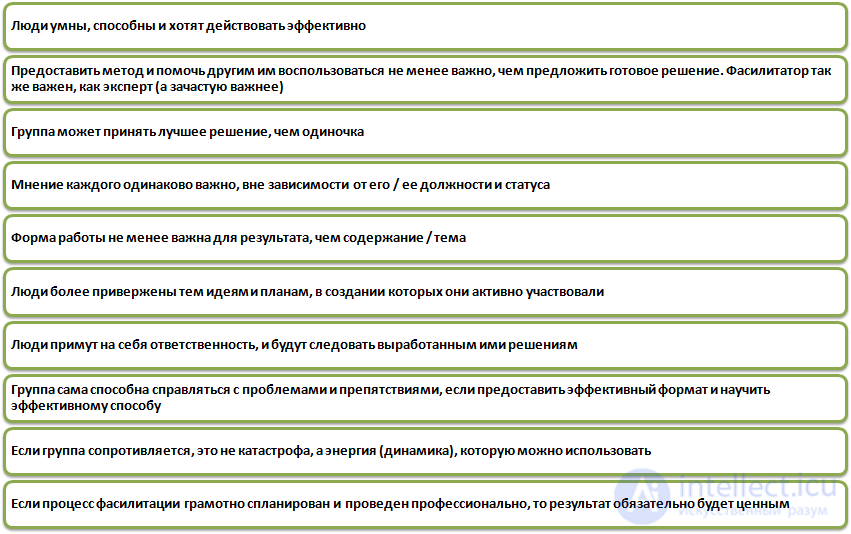
10 Beliefs of a Facilitator
6 Traits of a Facilitator:
A facilitator is not required to:
- Be an absolute expert in the matter being addressed (although knowledge of the subject is desirable)
- Do all the work themselves
Rules for group participants:
1. Don't spread yourself thin – focus on what matters most.
2. Don't sit on the sidelines – voice your thoughts, opinions, and reflections.
3. Speak openly and from the heart.
4. Listen to understand.
5. Link and connect ideas.
6. Enjoy the conversation!
Table host (facilitator)
Is not interested in the outcome of the discussion
Does not offer their own action plans or stereotypes
Tries to draw people out, observes the process from the sidelines, records the answers
Helps formulate conclusions and decisions, summarizes A facilitator is not required to:
Be an absolute expert in the matter being addressed (although knowledge of the subject is desirable)
Do all the work themselves

Comments