
Lecture
A counter-elite is the part of the bureaucracy that stands in opposition to the ruling political elite, a social group that fights for the right to enter the elite or to create a new one; a political actor that operates in a sufficiently organised manner (legally or otherwise) and seeks to seize power for itself or to transfer it to another political force.
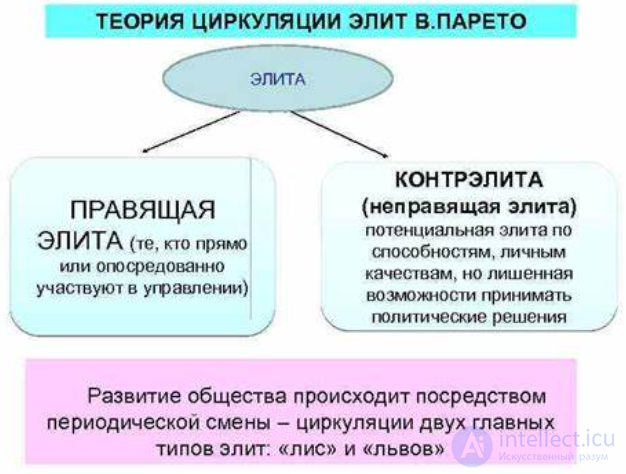
The experience of history shows that one and the same leading class is not simultaneously dominant in all spheres of social life: a historically progressive class rules, as a rule, in the economic and ideological spheres, while a historically obsolescent class rules in the sphere of state power. At the stage of the formation of capitalism, the class of feudal lords, which held state power, was confronted by the progressive class of the bourgeoisie, which dominated the economic and ideological spheres. Under contemporary conditions, when developed countries are undergoing a transition to the post-industrial stage of development, it may be supposed that the ruling elite, which directly holds and exercises power, may be opposed, for example, by a counter-elite political pressure group; or a confrontation may arise between factions of the political elite belonging to different political parties, whose members belong both to the ruling elite and to a political pressure group — in that case the faction constituting the majority may be called the elite, and the faction in opposition the counter-elite.
Counter-elite is a term denoting groups of people who oppose the dominant elite, proposing alternative paths of social development and criticising the current authorities and their values. While the elite concentrates on maintaining and consolidating the existing order, the counter-elite, on the contrary, strives for change, often speaking as the voice of the discontented, the dispossessed and those who hunger for change. The counter-elite has always played an important role in the development of social change, from the philosophers of antiquity to modern human rights movements.
A counter-elite is an oppositional force which, lacking access to official power, exerts influence through ideas, art, science or political activity. Unlike the elite, which strives to maintain the status quo, the counter-elite offers alternative values that may be radically opposed to the dominant ones. Thus the counter-elite often becomes the driving force of change, prompting society to reconsider old ideals.
The difference between the elite and the counter-elite is that the elite possesses power and resources and maintains and consolidates the existing order. The counter-elite, by contrast, acts as a critic, sometimes as an alternative "opinion leader" offering other models and approaches.
The political counter-elite consists of movements and groups that actively oppose the current political authorities. The political counter-elite includes opposition parties, pro-democracy movements, anti-corruption associations and any forces that call state policy into question.
The economic counter-elite comprises entrepreneurs, thinkers and researchers who propose new models of economic development. Among them are advocates of sustainable development, adherents of theories of new social entrepreneurship, and cryptocurrency ideologues who believe that the traditional financial system must be rethought.
The intellectual and cultural counter-elite consists of artists, writers, philosophers and scholars who challenge dominant cultural norms and values. Examples include the counterculture of the 1960s, contemporary ecological art, and works devoted to social justice.
Social and civic movements are activists and civic initiatives fighting for human rights, better working conditions, environmental protection, and the rights of women and minorities. They criticise not only the authorities but society as a whole, proposing concrete changes.
The counter-elite performs several important functions in society. First, it motivates change. The counter-elite openly points to problems that others may fail to notice and creates a demand for reform of the system. It also plays the role of the opposition, offering alternative solutions and creating pressure on the authorities and the elite. Under conditions of political and social stability the counter-elite may seem insignificant, but at moments of crisis or change its influence grows considerably.
In addition, the counter-elite shapes public opinion. Thanks to it, new ideas come to the surface, are taken up by society and discussed in the media. The counter-elite can also be a catalyst for democratic change, for example by organising mass protests or lobbying for particular laws.
History is full of examples in which the counter-elite exerted a strong influence on society. During the eighteenth-century Enlightenment, philosophers such as Voltaire and Rousseau criticised absolutist regimes, preparing the ground for the French Revolution. The nineteenth-century Russian intelligentsia was also a counter-elite: writers and thinkers such as Leo Tolstoy and Alexander Herzen criticised autocracy and contributed to the development of liberal and socialist ideas.
Modern examples of counter-elites include the civil rights movements in the United States in the 1960s, which changed society's attitude to questions of racial discrimination. Today the counter-elite manifests itself in environmental movements, activists for the rights of LGBTQ+ communities, and new political forces fighting inequality.
Today the counter-elite faces new challenges. One of them is radicalisation, when, owing to the absence of constructive dialogue with the elite, protest groups may turn to extreme forms of resistance. Another challenge is the spread of disinformation and manipulation on social media, where the boundary between truth and falsehood is blurred. Modern technologies give the counter-elite tools for mobilisation and for disseminating its ideas, but they also create a threat of the manipulation of mass consciousness.
In its relations with the elite, the counter-elite often faces attempts at discreditation or suppression; however, forms of cooperation are sometimes possible as well. For example, in some countries the power structures heed the demands of protesters, which leads to compromises and reforms. Nevertheless, the risk of suppression and control remains high.
The counter-elite plays an important role in the development of society. It acts not only as an opposition but also as an alternative, offering new ideas and approaches to solving social and political problems. Its existence confirms that society is not static but constantly changing and in need of criticism and reappraisal. In the future the counter-elite will most likely continue to play the role of an important social engine, especially amid global challenges such as climate change, technological transformation and social inequality.
The counter-elite is a necessary element in the mechanism of progress, creating a balance of forces and ideas that makes society more flexible and better able to adapt to new challenges.

Comments