In order to study political and economic objects and compare them with one another, absolute indicators are not sufficient, since there is a considerable number of phenomena that cannot be observed directly; preliminary procedures are required to identify and measure empirically observable attributes. For example, in order to study democracy, the stability of a political system, the level of political competition, political freedom, economic freedom or the standard of living, one must first carry out ope-rationalisation — determine how the attribute of the object will be measured and what variable will be created.
Theoretical operationalisation involves the search for indicators that reflect the concept under study, and these indicators must possess the property of validity, i.e. reflect and measure the object of research. Empirical operationalisation consists in calculating a specific value of the indicator — the variable. For example, to study "state failure"/"state fragility", the following groups of indicators are analysed: social (demographic pressure, migration, the presence of aggrieved groups), economic (uneven economic development, economic instability), and political (delegitimisation and criminalisation of the state, the quality of public services, human rights violations, the state security apparatus, the presence and influence of clan elites, interference by foreign states). Each of the listed indicators must be digitised in the form of corresponding variables drawn from statistics, expert assessments, sociological surveys and the media. On the basis of the aggregate of variables expressing particular indicators, an index is constructed, which represents a relative measure. Most often, in calculating indices the resulting variables are added or multiplied, with the empirical data first converted into a single unit of account — points. In cases where some indicators are considered weightier than others, a procedure of "weighting the components" is possible. Weightier components are multiplied by a larger weighting coefficient; for example, for three components the weighting coefficients may be 0.5, 0.3, 0.2 — the sum of all weights must equal one.
Thus, for example, the "fragile states index" is built on the basis of three research procedures: content analysis of English-language sources, analysis of the statistics of international organisations, and expert opinion. Each country is analysed according to 12 indicators:
- • security apparatus (SA): the threats of terrorism, separatism and civil war; the level of organised crime; the presence of private armed formations; the influence of the special services on state policy;
- • factionalised elites (FE): the fragmentation of state institutions along class, ethnic and confessional cleavages; conflicts among elites;
- • group grievance (GG): the presence of social groups that experience dissatisfaction with their access to resources and political participation; the presence of discrimination;
- • economic decline and poverty (EC): poverty, debt, inflation, unemployment, GDP per capita, devaluation, bankruptcies;
- • uneven economic development (UD): the structure of inequality on ethnic, confessional, regional and educational grounds; the perception of inequality; the availability of channels of social mobility;
- • migration and "brain drain" (HF): voluntary and forced emigration;
- • state legitimacy (SL): public trust in the authorities, political protests; free elections, government accountability, the level of corruption, the opportunities for the opposition to operate legally;
- • public services (PS): healthcare, education, utilities, transport, security;
- • human rights and rule of law (HR): the condition of individual, group and institutional freedoms, the situation of prisoners, the use of force against the population;
- • demographic pressure (DP): the sufficiency of food and water, protection against epidemics, disproportions in settlement patterns, uneven population growth among different ethnic groups;
- • refugees (RD): the influence of external and internal migrants on politics, the economy and the social sphere;
- • external intervention (EX): the economic, political and military impact of other states on domestic policy.
Each country receives points for each indicator, with a maximum of 10 for each indicator; the more points a country scores, the more "fragile" it is. Table 4.1 below presents the "fragility index" of the BRICS countries. The higher a country stands in the index, the worse its indicators (in compiling indices the reverse variant is also used, in which the highest number of points denotes the most favourable result).
The "fragility index" of the BRICS countries, 2020
|
Country (place in the index)/ indicator
|
Index
|
SA
|
FE
|
GG
|
EC
|
UD
|
HF
|
SL
|
PS
|
HR
|
DP
|
RD
|
EX
|
|
Russia (76th place)
|
72,6
|
8,0
|
8,1
|
8,3
|
4,9
|
5,3
|
3,5
|
8,3
|
3,3
|
8,8
|
4,1
|
4,9
|
5,1
|
|
India (68th place)
|
75,3
|
6,9
|
7,3
|
8,5
|
5,6
|
6,1
|
5,8
|
4,0
|
6,5
|
7,6
|
7,8
|
4,4
|
4,8
|
|
South Africa (85th place)
|
70,1
|
6,7
|
6,6
|
6,2
|
7,5
|
6,8
|
5,2
|
6,2
|
6,4
|
3,9
|
6,6
|
4,5
|
5,1
|
|
China (86th place)
|
69,9
|
5,8
|
7,2
|
7,4
|
3,9
|
6,4
|
4,3
|
8,8
|
4,8
|
9,3
|
5,6
|
4,0
|
2,4
|
|
Brazil (75th place)
|
73,0
|
7,1
|
6,2
|
7,3
|
5,2
|
7,1
|
4,2
|
6,7
|
6,9
|
7,0
|
7,8
|
3,6
|
3,9
|
Source'. Fragile States Index 2020. http://fundforpeace.org/fsi/data/
When using indices and rankings, it is necessary to analyse who compiles them and why, as well as the methodology applied; often, alongside objective information, indices employ a rather subjective expert assessment. For example, the compilers of the Fragile States Index 2020 gave Russia very high (poor) scores on the "Security apparatus" indicator, on which Russia ranked below Iran and Egypt; on the "Group grievance" indicator Russia ranked below Afghanistan and Eritrea; and on the "Human rights and rule of law" indicator Afghanistan and Turkmenistan came out better than Russia.
Thus indices and rankings can serve both as instruments of scholarly analysis and as technologies for manipulating mass consciousness. A number of indices built on the analysis of statistical data and reflecting reality fairly adequately may be regarded as goal-setting. Attaining respectable positions in such indices reflects progressive processes in particular spheres of social life. At the same time there exist highly partisan political indices built on expert surveys. Attempts to improve one's place in them are inevitably bound up with the demands of a "democratic transition", which is itself a product of the Western concept of the "end of history". Such indices serve rather the purposes of manipulating public opinion, and the methodology of their compilation must be given a scholarly assessment.
Presented below are the indices of democracy that are most frequently encountered or that have had the greatest influence on political research.
- 1. P. Cutright's index of political development (1963). The index makes it possible to compare the political systems of different countries according to the following criteria: the number of parties in parliament (the more there are, the more democratic), the percentage of minority parties in parliament (the higher, the more democratic), and the electivity of the head of the executive branch (the more competitive the elections, the more democratic).
- 2. D. Neubauer's index of democratic performance (1967). Two indicators are measured: electoral equality and electoral competition. The first indicator takes into account the percentage of the adult population that can vote; the correspondence between votes received and seats obtained in parliament; and the number of newspaper owners of various orientations and the circulation of publications (pluralism and the availability of alternative information). The second indicator measures the length of a party's tenure in power and the frequency with which ruling parties change (the shorter the period and the more frequent the change, the more democratic) and the percentage of votes won by the winning party (the higher the percentage, the less democracy).
- 3. The Freedom House freedom index (1978) was created by R. Gastil and is based on expert assessment on a ten-point scale of the following elements of democracy. The electoral process: the freedom and fairness of elections of the head of state and of parliament, and the fairness of the electoral system. Political pluralism and political participation: freedom to form organisations, freedom of activity for the opposition, the presence of pressure on voters from various groups in power, minority rights. The functioning of government: the ability of the head of government and of deputies to influence political decisions, the presence of corruption, the accountability of the authorities to the people. Civil liberties: the presence of independent media and independent courts, freedom of conscience, the neutrality of the educational system with respect to ideology, freedom of demonstration, movement and choice of employment, freedom of non-governmental organisations, the rule of law in judicial proceedings, protection from political terror, freedom of business and private property, equality of opportunity. The authors of the index themselves noted that freedom and democracy are not one and the same, and that not all democratic countries have the highest degree of freedom, although a correlation between freedom and democracy can be traced.
- 4. T. Vanhanen's index of democratisation (1979). Two measures are determined — the level of competition and the level of electoral participation. The level of competition is determined by the percentage of votes received by opposition parties or candidates. Electoral participation is calculated as the share of those who voted out of the whole population (for greater accuracy it may be recommended to count only those entitled to vote). The index is constructed as the product of the two measures.
- 5. K. Bollen's index of political democracy (1979). The index measures political liberty and popular sovereignty. To measure political liberty the following indicators are calculated: freedom of the press (state control over the media); freedom of group opposition (determined by the type of party system); government sanctions against the opposition (the number of sanctions). Popular sovereignty is measured by three indicators: the fairness of elections (the degree of corruption, falsification and coercion during elections, the presence of genuine alternatives); selection to the executive branch (the legitimacy of the selection); and selection to the legislative branch (the legitimacy of the selection, the reality of parliament's powers). Each indicator receives a numerical value, and the arithmetic mean of the six scores constitutes the index of a given political system.
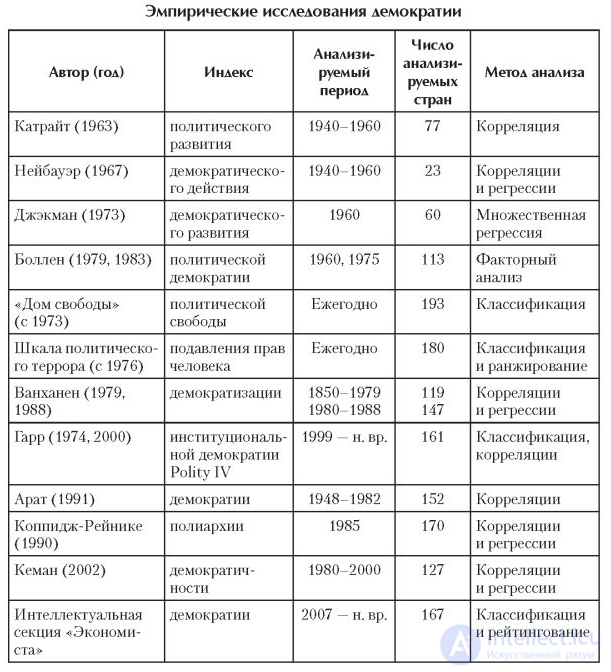
To date more than a dozen different indices of democracy have been developed (see table), covering various aspects of democratic organisation and the development of political systems. Let us turn our attention to the most significant of them.
Thus, if a country's political system scores the maximum number of "democratic" points — 10 — it is classified as a fully institutionalised democracy. If a country's political system scores the maximum number of "autocratic" points — 10 — it is classified as a fully institutionalised autocracy. Accordingly, one can distinguish strong autocracies (from —6 to —10 points), strong democracies (from 6 to 10 points) and a hybrid group of political regimes (from —5 to 5 points).
- 7. The Economist Democracy Index (2006). The index is calculated on the basis of expert assessments of 60 indicators grouped into five blocks: the electoral process and pluralism; civil liberties; the functioning of government; political participation; political culture. Experts assign each indicator a rating of "yes" or "no" (for a number of questions an intermediate option — "neutral" — is possible). On the basis of the final tally of points, political systems are divided into "full democracies", "flawed democracies", "hybrid regimes" and "authoritarian regimes".
- 8. The A. Hadenius and J. Teorell database of political regimes (2007). The database calculates indices of democracy on the basis of the already mentioned Freedom House index of freedom and the index of institutional democracy (Polity IV). As a result the authors obtained 18 types of political regime, configured according to the criteria of the form of government (monarchy — republic), party systems (absence of parties — multi-party system), the country's external sovereignty (independent — occupied state), internal sovereignty (stability — civil war), and the role of the military in governance (civilian — military regime).
- 9. P. Norris's Democracy Cross-National Data (2009). The database brings together more than 1,000 indicators from various indices of democracy: Freedom House, the World Bank, Polity IV, data on conflicts, political regimes, electoral systems, the organisation of executive power, ethnic pluralism, access to information, gender representation, observance of human rights and others.


Comments