A political ideology is a system of ideas, values, beliefs and principles that determines views on the organisation of society, the role of the state and the ways of achieving social order. It forms the basis for political programmes, parties and movements, setting the direction of political activity and public debate.
A political ideology is a particular ethical set of ideals, principles, doctrines, myths or symbols of a given social movement, institution, social class or large group, which explain how society ought to be organised and propose certain political and cultural projects for a particular social order.
Political ideology focuses to a large extent on questions of the distribution of political power and on the question of the purpose for which it should be used. Some parties follow a particular ideology very strictly, admitting no other offshoots, while others may hold a broad set of views drawn from different groups of ideologies without adhering to any specific one. The popularity of an ideology depends in part on moral authorities.
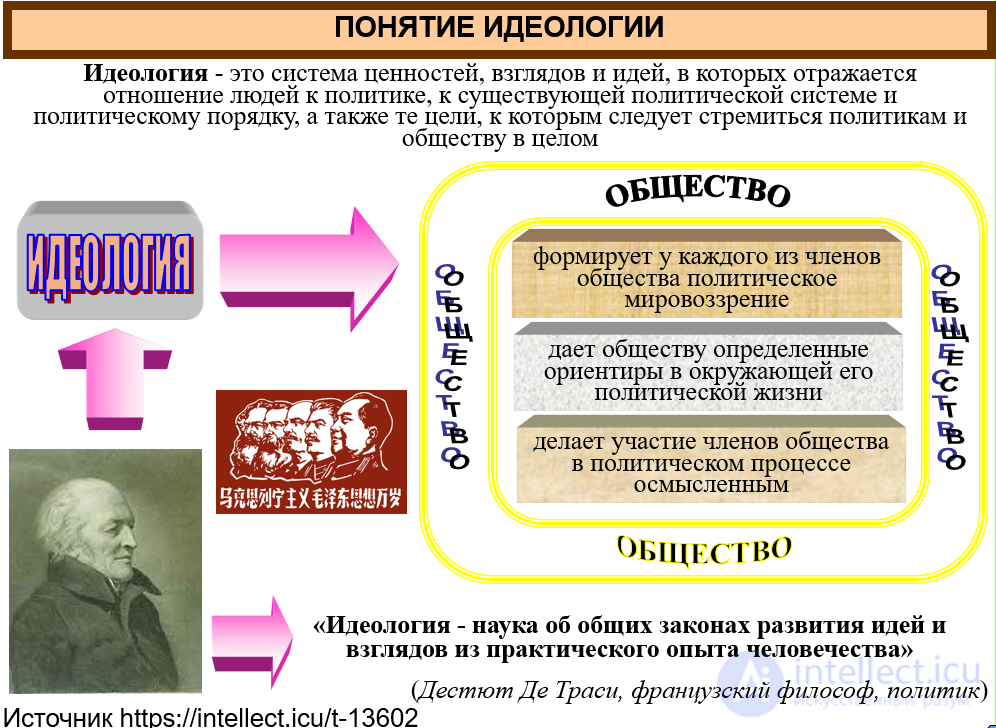
Political ideologies have two dimensions:
- Goals: how society should be organised.
- Methods: the most appropriate way of achieving that goal.
An ideology is a set of ideas. As a rule, every ideology consists of particular ideas about which form of government is best (for example, democracy, autocracy and so on) and which economic system is better (for example, capitalism, socialism and so on). Sometimes the same word is used to identify both an ideology and one of its core ideas. For example, "socialism" may refer to an economic system, or it may refer to the ideology that supports that economic system. Ideologies also identify themselves by their position on the political spectrum (as left, centrist or right), although very often such a division is contested. Finally, ideologies should be distinguished from political strategies (for example, populism) and from single positions on which a party may be built (for example, opposition to European integration or the legalisation of marijuana). It expresses the opinion of the people and of the political elite.
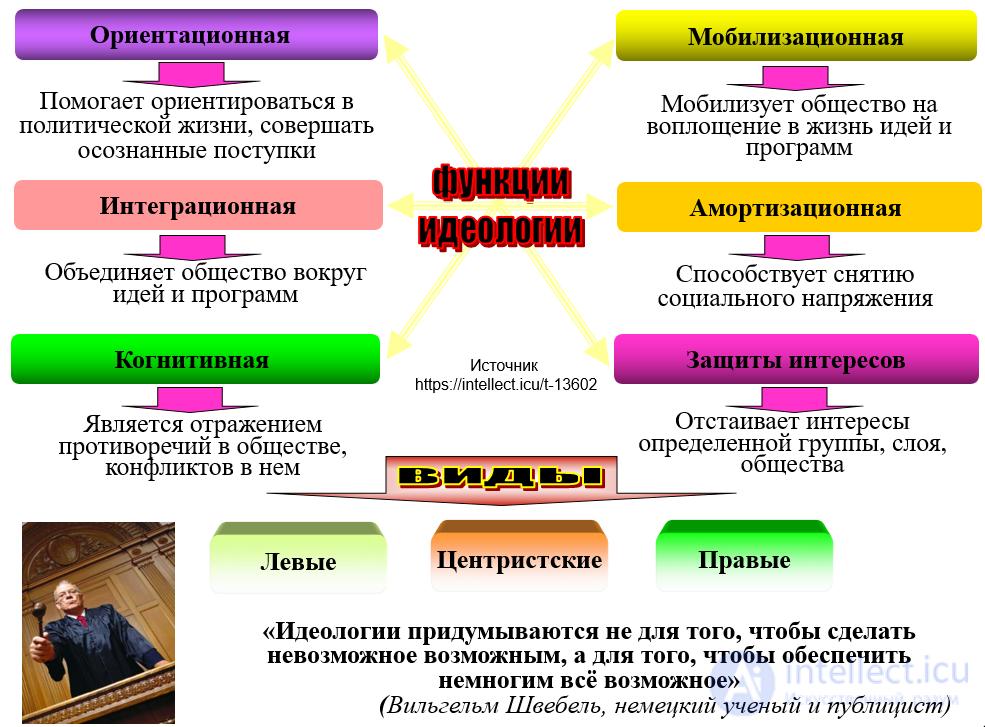
Functions of political ideology
-
A guide for action: it helps citizens and political leaders make decisions on the basis of a particular system of values.
-
Mobilisation: it unites people around common goals and beliefs.
-
Legitimation of power: it justifies existing political institutions or proposes alternative models.
-
Criticism and opposition: it serves as an instrument for analysing and criticising the existing order.
The structure of political ideology
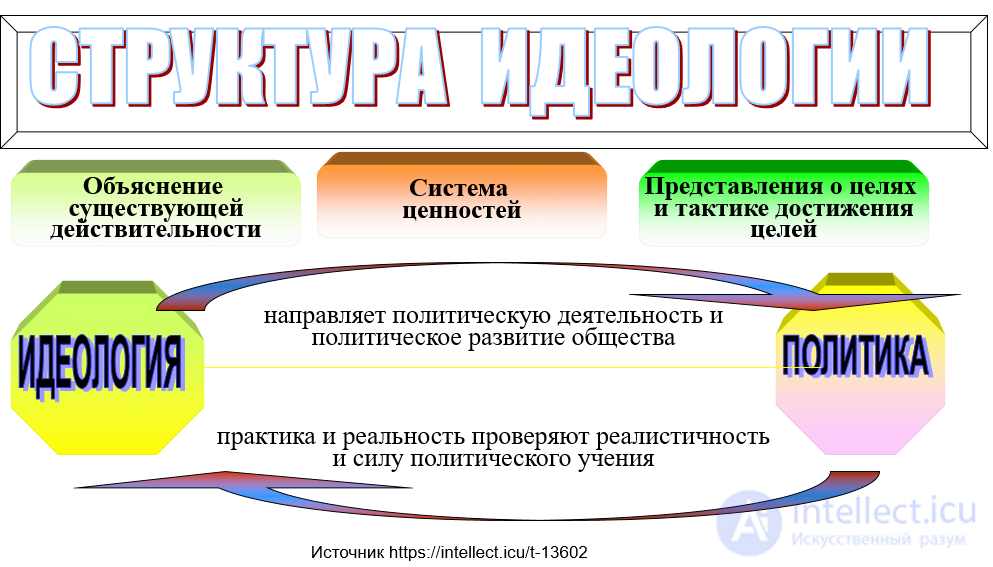
The structure of a political ideology includes key components that shape its content, orientation and impact on society. Here is a detailed breakdown:
The main elements of the structure of a political ideology
| Component |
Description |
| Values |
Basic ideas about the good, justice, freedom, equality, order. |
| Goals |
Desired states of society: for example, democracy, socialism, theocracy. |
| Means of achievement |
Methods and mechanisms: reforms, revolutions, elections, violence, propaganda. |
| Image of the enemy |
Ideologically opposed forces obstructing the achievement of the goals. |
| Model of society |
A conception of how the state and society ought to be organised. |
| Worldview |
A general picture of the world, including philosophical and cultural premises. |
| Historical mission |
The role of the ideology in history: salvation, renewal, liberation, etc. |
The interrelation of the components
These elements do not exist in isolation — they are interconnected:
-
Values determine goals.
-
Goals dictate means.
-
Means shape the image of the enemy.
-
The model of society reflects values and goals.
-
The worldview gives the ideology depth and stability.
-
The historical mission gives the ideology legitimacy and motivation.
Example: the structure of liberalism
-
Values: individual liberty, equality before the law.
-
Goals: the rule of law, protection of human rights.
-
Means: elections, laws, civil society institutions.
-
Image of the enemy: authoritarianism, the arbitrary exercise of power.
-
Model of society: democratic, with a market economy.
-
Worldview: rationalism, individualism.
-
Historical mission: the liberation of the individual from the pressure of the state.
Ideology and the political spectrum
Political ideologies are located on a political spectrum — from the far left to the far right. Left-wing ideologies (socialism, communism) emphasise equality and social protection, while right-wing ones (conservatism, economic liberalism) emphasise individual freedom and market mechanisms.
Ideology in the modern world
In modern society political ideologies are often mixed. Many parties and movements use elements of different ideologies, adapting them to current realities. This leads to the emergence of hybrid platforms in which, for example, economic liberalism is combined with social conservatism.
Features of IDEOLOGY as a form of political communication
This form presupposes a clash of many opposing worldviews. The birth of ideologies accompanied the emergence of politics as a relatively autonomous sphere in which systems of symbols and evaluations operate that differ from the prescriptions of religion and conventional morality. Ideologies perform the function of generating meaning about reality from the standpoint of a particular subject of social action. The mechanism by which ideologies work is bound up with simplifying the picture of reality and blocking alternative approaches and interpretations. Ideologies are "ideas striving for power": they pursue the goal of reordering the social system in accordance with the ideals they propose and serve the purposes of the struggle for
power.
At the dawn of parliamentary democracy, ideologies served as the basis for citizens' practical participation in politics, allowing them to engage with the goals of the state in an accessible form.
Ideologies have a discursive nature (they express socially accepted ways of interpreting the world, bound up with a particular behavioural and institutional practice).
Levels at which ideology functions
1. THEORETICAL-CONCEPTUAL:
political-philosophical conceptions that make sense of social reality. It performs a moral-theoretical function.
2. PROGRAMMATIC-POLITICAL:
the programmes of political parties, the rhetoric of political leaders seeking to attract the masses. It selects those ideas which can serve as weapons in the struggle for power. It performs a pragmatic function.
3. MASS CONSCIOUSNESS in its political dimension:
is the foundation of political ideology;
it is precisely its "assimilation" by mass consciousness that makes an ideology effective
CLASSIFICATION OF IDEOLOGIES BY THEIR POSITION ON THE POLITICAL SPECTRUM
CRITERION 1. The conception of change: the direction in which the promised changes will lead society (based on the conception of progress,
according to which humanity moves from traditional, authoritarian values to individualistic ones, and from these to greater social justice);
the depth and scale of the changes;
the pace of the changes;
the methods by which the changes are to be carried out (legal — illegal, peaceful — violent)
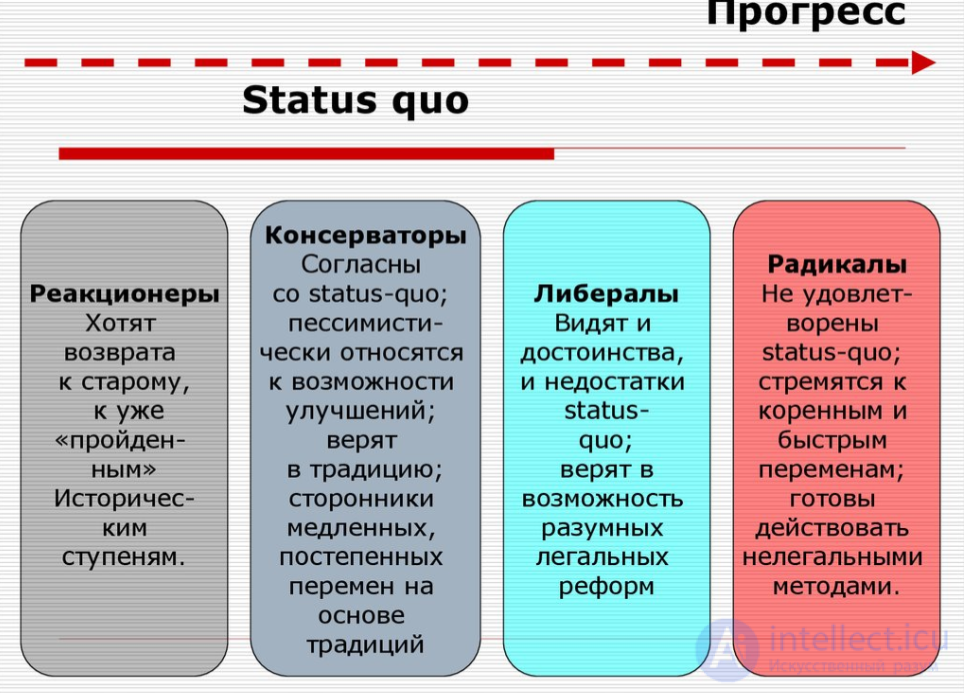
Criterion 2. The conception of values: it makes it possible to assess why particular changes appear desirable from the standpoint of the given ideology.
- Collectivist values: justice, equality, solidarity
- Individualist values: freedom, equality of rights, tolerance
- Traditional and authoritarian values: order, authority, fidelity to tradition
The main types of political ideologies
| Ideology |
Brief description |
| Liberalism |
Support for individual freedoms, a market economy, the rule of law. |
| Conservatism |
Preservation of traditional values and institutions, gradual reforms. |
| Socialism |
The priority of social justice, redistribution of resources, the role of the state. |
| Communism |
The idea of a classless society, common ownership, rejection of capitalism. |
| Anarchism |
Denial of state power, a striving for self-government and free associations. |
| Fascism |
Authoritarianism, nationalism, the cult of the leader, suppression of the opposition. |
Anarchism
Anarchism without adjectives
- Anarchism without adjectives
- Synthesis anarchism
Individualist anarchism
- Anarcho-naturism
- Egoist anarchism
- Freiwirtschaft
- Geoanarchism
- Participatory democracy
- Individualist anarchism
- Individualist anarchism in France
- Individualist anarchism in Europe
- Individualist anarchism in the United States
- Insurrectionary anarchism
- Illegalism
- Mutualism
Religious anarchism
- Pagan anarchism
- Buddhist anarchism
- Islamic anarchism
- Jewish anarchism
- Christian anarchism
Social anarchism
- Anarcha-feminism
- Anarcho-syndicalism
- Anarcho-collectivism
- Libertarian socialism
- Participatory economics
- Social ecology
- Participatory democracy
- Mutualism
Anarcho-communism
- Magonism (English)
- Platformism
- Insurrectionary anarchism
Others
- Autarchism
- Autonomism
- Crypto-anarchism
- Autochthonism
- Info-anarchism
- Insurrectionary anarchism
- The Makhnovshchina
- National-anarchism
- Panarchism
- Platformism
- Post-anarchism
- Post-left anarchism
- Queer anarchism
- Operaismo
- Anarcho-primitivism
Communism
- Stateless communism
- Revolutionary socialism
Marxism
- Classical Marxism
- Orthodox Marxism
- Neo-Marxism
- Revolutionary Marxism
Revisionism
Leninism
- Bolshevism
- World communism
- Scientific communism
- Bordigism (English)
Marxism-Leninism
- Anti-revisionism
- Stalinism
- Maoism
- Castroism
- Guevarism
- The political philosophy of Ho Chi Minh
- Hoxhaism
- Trotskyism
Others
- Religious communism
- Christian communism
- Posadism
- Juche
Conservatism
General
- Conservatism
- Fiscal conservatism
- Cultural conservatism
- Liberal conservatism
- Libertarian conservatism
- National conservatism
- Neoconservatism
- Paleoconservatism
- Social conservatism
Others
- Agrarianism
- Bioconservatism
- Carlism
- Christian democracy
- Communitarianism
- Fiscal conservatism
- Green conservatism
- Monarchism
- Toryism
- Traditionalism
- Reactionaries
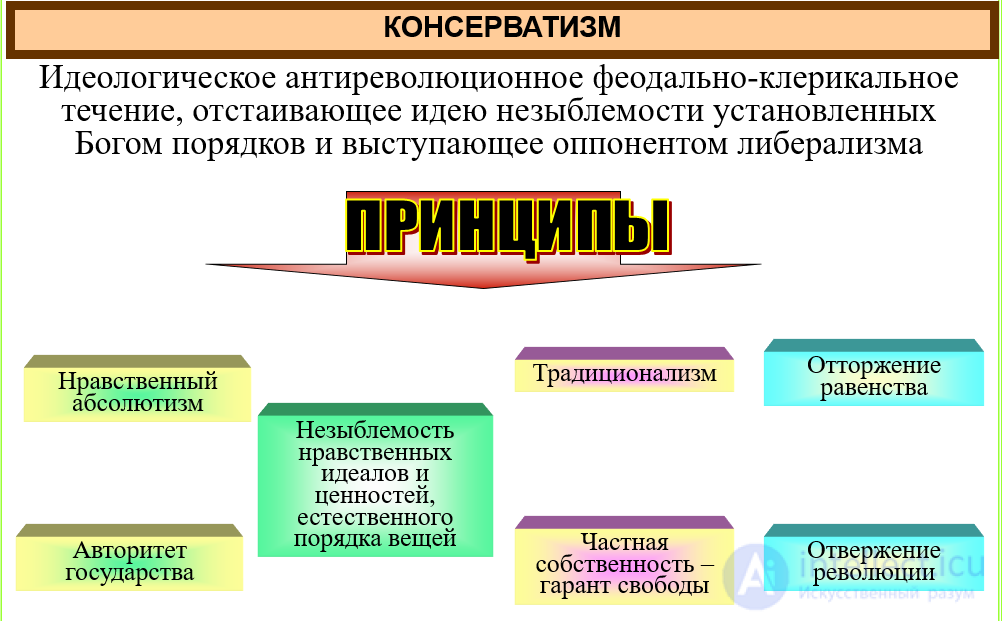
CONSERVATISM
S. Huntington:
conservatism has a situational
character: it has no "utopia" of its own; it
perceives the world as it is and strives
to preserve what already exists.
Conservatism is not universal: in different
countries it is bound up with the pursuit of different
political goals.
at the heart of conservatism lies a particular
attitude to the human being, to society,
to the past and the future, and it is this that is
definitive for this system of ideas.
Samuel
Huntington —
an American
political scientist in the field of
comparative
studies,
the theory of civilizations
and political
development
anti-rationalism: the notion of
reason's fundamental inability
to grasp human life
in all its fullness;
the notion, characteristic of the Christian
worldview, of
human imperfection; hence paternalism (the notion that
a person needs the tutelage
of authority);
the notion of the divine
origin of power and of its organic nature;
rejection of the idea of popular sovereignty;
the principle of authority (J. de Maistre:
authority precedes reason); very
few possess the capacity
to reason, and no one can judge
everything; authority is the beginning of all beginnings;
an organic conception of society as
a whole with a hierarchical
subordination of its parts (E. Burke:
society is a part of the created and
God-sanctified "moral
order", in which each has been assigned his own
place)
elitism: power should belong
to the elite, which expresses not the will but
the interests of the masses;
property as the foundation of social
stability;
A commitment to slow,
cautious change in
accordance with tradition (E. Burke:
the main question for a politician should
not be "how to change the status quo" but
"what and when can I improve"; however,
changes should be made only
when they will bring more
benefit than harm)
Edmund Burke
an English politician,
Member of Parliament for
the Whig party and for
the American
states, one of the
intellectual
inspirers of
classical
conservatism
Neoconservatism
In the twentieth century the social base of conservatism
in Western societies changes:
the "natural order" that conservatives seek
to preserve is no longer a feudal-hierarchical structure,
but "Western civilisation" with the values
inherent in it.
The goal becomes the defence of political
freedom and constitutional government
through the preservation of the market
economy
A rapprochement with liberalism is emerging
The Greens
- Environmentalism
- Anarcho-naturism
- Anarcho-primitivism
- Bioregionalism
- Bright green environmentalism
- Deep ecology
- Eco-capitalism
- Ecofascism
- Eco-socialism
- Free-market environmentalism
- Green anarchism
- Green conservatism
- Green liberalism
- Green libertarianism
- Green politics
- Green municipalism
- Green syndicalism
- Social ecology
Liberalism
General
- Classical liberalism
- Conservative liberalism
- Economic liberalism
- Individualism
- Liberal feminism
- Liberal socialism
- Liberalism
- Market liberalism
- National liberalism
- Neoliberalism
- Ordoliberalism
- Paleoliberalism
- Social liberalism
- Colonial liberalism
Others
- Cultural liberalism
- Green liberalism
- Individualist feminism
- Progressivism
- Radicalism
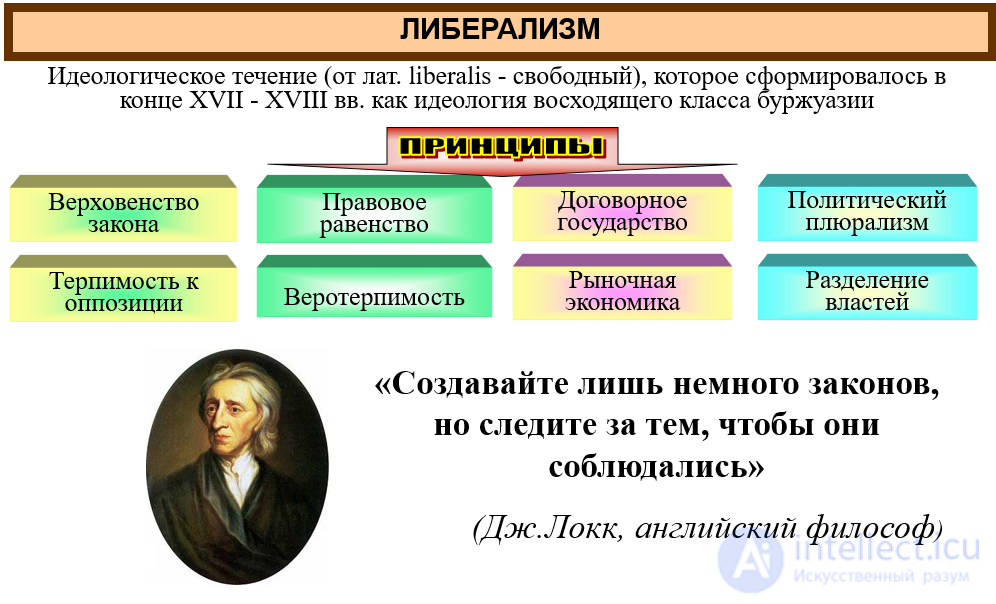
LIBERALISM - individualism; the priority of individual
interests and values over social ones;
commitment to the values of freedom,
equality of rights, tolerance, government by
the consent of the governed, anti-paternalism
(with differences in how these are interpreted);
rationalism, belief in the possibility of
rationally improving
society
CLASSICAL LIBERALISM
society = the sum of self-sufficient rational
individuals conscious of their own interests;
freedom = the absence of coercion;
the principle of laissez-faire: in the absence of
state intervention individuals
will themselves best look after their own
interest;
the task of the state is to ensure the observance
of reasonable "rules of the game";
means: reforms, first and foremost the extension of the franchise to
the "middle class".
Classical liberalism recognises the primacy of
the human individual in relation to society and
the state, which are created by individuals later.
The human rights to freedom of activity and to private
property are original "natural rights".
Classical liberalism not only binds
the individual, beginning with Thomas Hobbes, within the framework of
the "social contract" and a growing multitude of
legislative restrictions on his activism, but also
places emphasis on the demands of equality and
justice, which are too crudely trampled upon
by the early individualism of the modern era.
Classical liberalism, beginning with the ideologues of
the French Revolution (Jean-Jacques
Rousseau) with its ideas of liberty, equality and
fraternity, and continuing with Thomas Jefferson,
Immanuel Kant and others, introduces into its
normative framework the notions of the moral
(religious or secular) duty of the
individual-citizen towards society.
In classical liberalism an emphasis arises
on the religious commandments that appeal to
human equality and
non-acquisitiveness.
Classical liberalism reminds us that Adam Smith,
before his book "The Wealth of Nations" (on the "invisible
hand of the market", which creates the common good out of private strivings for
profit), wrote another book, which
was called "The Theory of Moral Sentiments".
In that book Smith formulated the moral and
behavioural requirements for the "society
of individuals" in which alone the "invisible hand of the market" can be
effective.
In "The Wealth of Nations" Smith not only wrote about
the "invisible hand", but also stressed the crucial
role of the state and society in supporting
the destitute and the disadvantaged.
Immanuel
Kant:
"My
freedom
ends
where
the freedom
of another
person
begins".
To protect the political and
economic freedoms and property of
individuals, a state is required that is
minimal in its capacity to interfere
in the affairs of individuals, and limited in that
capacity by the framework of the laws.
The state no longer merely protects
individuals and society from violations of the laws
and from external threats, but also confines
the activism of individual wills
to a certain "channel".
SOCIAL LIBERALISM
John Hobson, Walter Eucken, Benedetto Croce and others
the poverty of the lower social strata, the unbearable conditions of their labour
and life — are mounting → the liberals' declarations about
open opportunities for initiative and
self-directed activity sound like mockery
the basic liberal principle of the "free play
of individual interests" by no means guarantees
economic progress, but leads to wars,
revolutions and, ultimately, to "historical
rollbacks"
the conclusion that the state must be strengthened in order to
expand its regulatory functions and capacities,
and that the state has the right and the duty to intervene in
the life of society.
The concluding phase in the development of "social liberalism"
— the ideas of John Maynard Keynes, which became the basis of
the policies of the USA and England during the Great Depression.
Keynesianism supplemented (and limited) the liberal
principles of individualism, the free market and
free economic, social and political
competition — with the state's obligations to carry out
the necessary regulation of social life and
the economy in the interests of society.
It was precisely on the principles of Keynesianism that the
European "welfare
state" was subsequently built, the collapse of which we are witnessing
today.
SOCIAL DARWINISM
Extreme individualism in
human society is a necessary and inevitable
manifestation of the principle common to
all living nature,
"the survival of the fittest".
The main "engine" of social
progress and historical
development is the natural selection
of "the best" as a universal
law of nature: "…a creature
not energetic enough
to struggle for its own
existence must
perish".
Herbert Spencer
At the turn of the twentieth and twenty-first centuries, ideas of a return to
social Darwinism have once again become
respectable.
Social Darwinism is the best
mechanism for "spurring on"
personal, social and
historical progress.
John Locke
an English
philosopher, with
whose name
the beginning of
the age of
the Enlightenment in
England is associated, a theorist
of liberalism and
a politician.
NEOLIBERALISM
society exists thanks to the interconnection
of its members; its progress is bound up with
the transition from competition to
cooperation;
freedom is the real possibility of
self-realisation; society must
secure for its members the right to a decent
life;
the state must take on
additional functions to ensure
social justice
Libertarianism
- Voluntaryism
- Agorism
- Green libertarianism
Right-libertarianism
- Anarcho-capitalism
- Minarchism
- Libertarian conservatism
- Paleolibertarianism
Left-libertarianism
- Geolibertarianism
- Georgism
- Libertarianism
- Libertarian socialism
- Libertarian communism
- Libertarian Marxism (Eng.)
- Libertarian municipalism
Nationalism
- Nationalism
- National Bolshevism
- Fascism
- Nazism
- Strasserism
- Austrofascism
- Ecofascism
- National democracy
- Internationalism
- Neo-Nazism
Nationalism
Nationalism in the broad sense is
not merely an ideology but part of
an integral cultural subsystem,
thanks to and at the same time in spite of
which there forms a body of
national-patriotic
views, beliefs and sentiments.
N. A. Berdyaev (1874-1948): there are two types of nationalism
1. Creative, constructive –
Promotes the cohesion of the nation,
the formation of a national state
2. Destructive, ruinous,
accompanied by hatred of
the foreign.
Nationalism is a political principle
"which holds that the political and
the national unit should
be congruent" (Ernest Gellner)
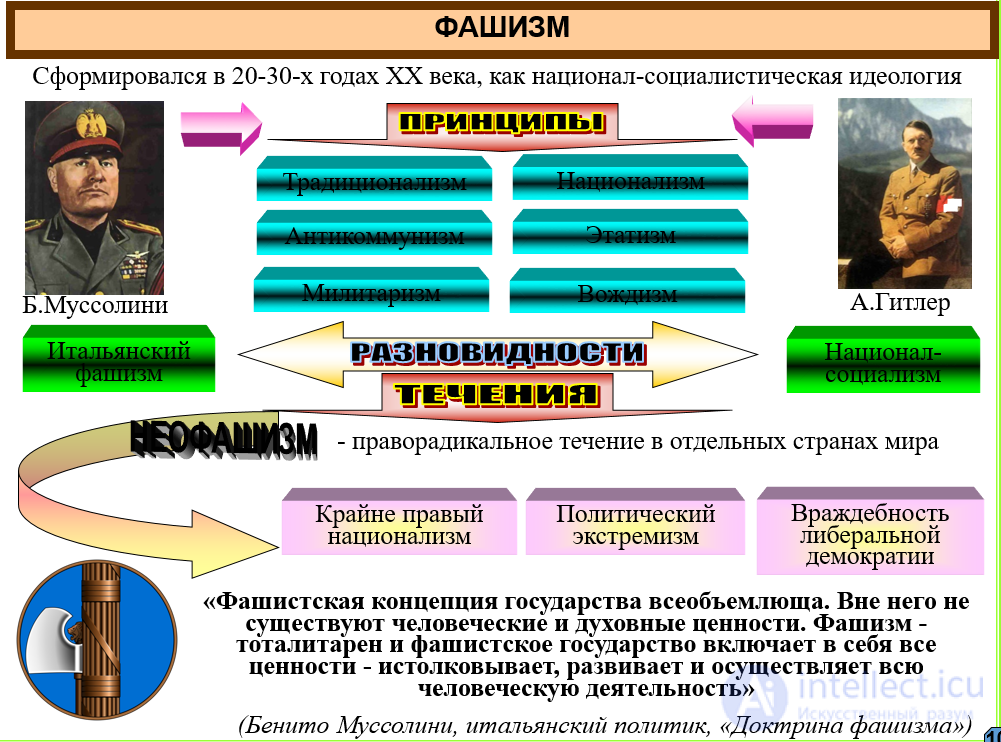
Fascism
A sharp distinction between the elite and the masses.
The elite status of those at the top was justified also by
biological arguments.
The ideology of the masses – based on the principles of national character,
social justice, the defence of
the interests of working people (elements of populism)
(Fascism as a "Marxist heresy")
Militant irrationalism, extreme
simplification of slogans
Built on the charismatic principle – on
the leader cult
A cult of brute force, a rejection of humanism
Benito Mussolini and Adolf Hitler
Fascism
Fascism declared that culture separates man
from nature, exerting a pernicious
influence upon him.
The main tasks of fascism:
To restore to man his deepest rootedness in
the natural principle.
To rid him of shame at his participation in that principle.
To make him not a sick but a healthy beast (a beast
he is by definition anyway).
To begin training the beast, turning it into a predator.
And by all this to save the world from degeneration.
Fascism
According to a survey
conducted by the University of
Leipzig:
10.6% of Germans
agreed with
the statement that they
"need a Führer
who rules Germany
with a firm hand for
the common good".
RIA Novosti, 15 June 2016
12%
of Germans
believe that
their nation is
from birth
superior to
others.
The idea of justice
Religious
National
Communist
May
be reborn
in Eastern
Europe
May come out ahead,
having stayed above
the fray of the first
two forces
Religious ideologies
Main
- Religious feminism
- Religious socialism
- Theocracy
Buddhism
- Buddhist anarchism
- Buddhist socialism
Christianity
- Christian anarchism
- Christian communism
- Christian democracy
- Christian socialism
- Liberal Protestant theology
- Liberation theology
- Pan-Christianity
- Dominionism
Islam
- Islamic socialism
- Islamic liberalism
- Islamism
- Pan-Islamism
Hinduism
Socialism
Libertarian socialism
- Fourierism
- Mutualism
- Guild socialism
- Revolutionary syndicalism
- Libertarian Marxism (Eng.)
- Left communism
- Council communism
- Gandhian economics
- Participism
- Participatory democracy
- Neozapatismo
- Communalism
Libertarian Marxism
- Libertarian Marxism (Eng.)
- Autonomism
- Situationism
- Luxemburgism
- Left communism
- Council communism
- Socialization
Social anarchism
- Mutualism
- Anarcho-collectivism
- Anarcho-communism
- Anarcho-syndicalism
- Platformism
- Social ecology
- Insurrectionary anarchism
Reformist socialism
Democratic socialism
- Austromarxism
- Bernsteinism
- Democratic socialism
- Fabianism
- Reformism
- Revisionism (Marxism)
Social democracy
- Social democracy
- Liberal socialism
- Market socialism
Other
- Social capitalism
- Socialist feminism
- State socialism
- Neosocialism
- Quotism
Regional variants
- African socialism
- Arab socialism
- Bolivarianism
- Socialist Zionism
- Melanesian socialism
- Socialism with Chinese characteristics
- Revolutionary democracy
Religious socialism
- Religious socialism
- Buddhist socialism
- Christian socialism
- Islamic socialism
- Liberation theology
Revolutionary socialism
General
- Revolutionary socialism
- Communism
Marxism
- Autonomism
- Castroism
- Council communism
- De Leonism
- Eurocommunism
- Guevarism
- Hoxhaism
- Kautskyism
- Left communism
- Leninism
- Luxemburgism
- Maoism
- Marxism
- Marxism-Leninism
- Marxist feminism
- Marxist humanism
- Neo-Marxism
- Orthodox Marxism
- Situationism
- Anti-revisionism (or Stalinism)
- Titoism
- Western Marxism
- Trotskyism
Anarcho-communism
- Anarcho-syndicalism
- Social ecology
Other
- Guild socialism
- Libertarian socialism
- Syndicalism
- Utopian socialism
- National Bolshevism
- Political realism
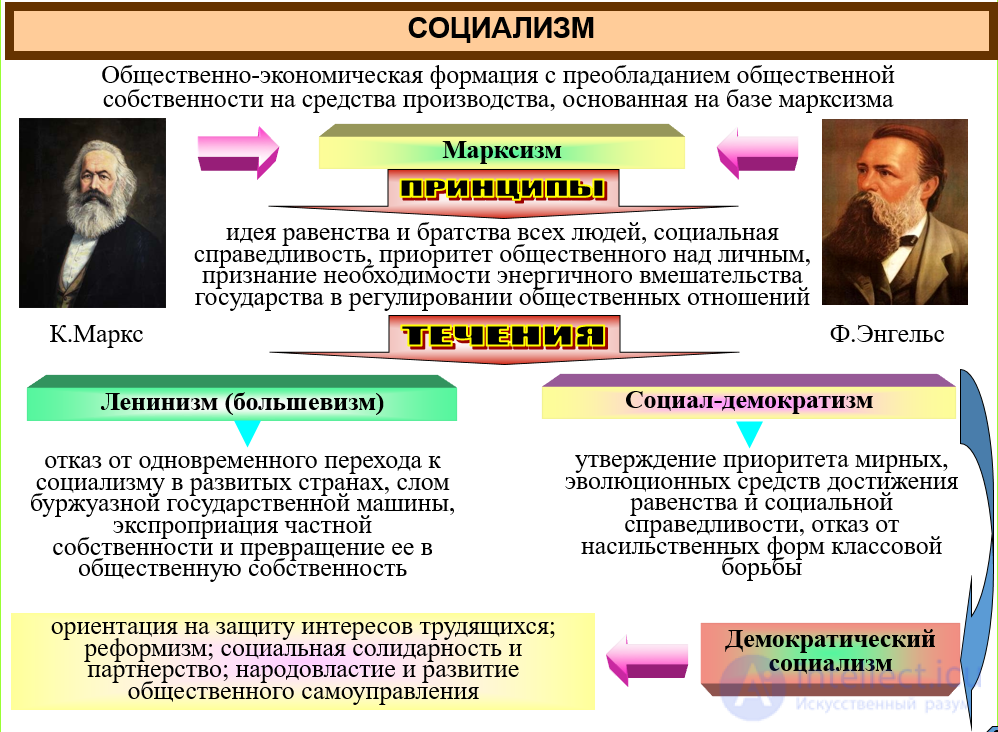
SOCIALISM
An ideal of social order,
placed at the foundation of many utopias
of early capitalism, a negative reaction
to private property and individualism
A political ideology that took shape in the 19th century,
with such tenets as
the ideal of public ownership,
the class approach, the ideal of equality and
the principle of egalitarianism,
an emphasis on society and
its needs
(collectivism)
The lower phase of the communist
formation (according to Marx)
Non-radical parties and movements based
on socialist ideology
The name of the social order in the USSR
and the countries of the socialist bloc
Present-day conceptions of socialism are the result of several "ideological forks".
The first fork (1860s-1870s). The dispute
between Marxists and anarchists: does the path to a free society lead
through the conquest of
state power, or through the development
of free communes and ultimately the abolition of the state?
With the creation of the Second International, all parties
wishing to join it had to
recognise the political path to the emancipation of the working
class. In 1880-1900 socialist ideology merged
with the mass workers'
movement, and Marxism was transformed into
the official party ideology.
The second fork (1880s-1890s).
The revisionism of E. Bernstein and others, as a theoretical
justification of the already established practice of reformism
(Millerand, Jaurès, Vandervelde and others): the need to
revise theory in accordance with reality:
refutation of the thesis of the inevitable collapse of capitalism,
against economic determinism; society can
move towards social justice not because this is
inevitable, but because it is better that way. Socialism does not follow
from the collapse of capitalism and is not reducible to replacing private
property with public property. The path to socialism is
a search for more perfect forms of organising production
that contribute to a fuller satisfaction of
people's needs;
"The goal is nothing, the movement is everything" (E. Bernstein)
The third fork (1917-1920s)
The question: Is the experience of the October Revolution in
Russia universal? Is a "dictatorship of the proletariat" in
the form of a dictatorship of Bolshevik parties, together with the curtailment of
"bourgeois democracy", necessary for the socialist
reconstruction of society?
March 1918 - the creation of the Third International,
which united the communist parties (its basis being recognition of the universality of the experience of the October
Revolution)
In 1923 - after a number of unsuccessful attempts at unification, the restoration of the Labour and Socialist
International:
denial of the inevitability of the collapse of capitalism;
a shift to a strategy of struggle for reforms
recognition of the importance of democracy and parliamentary
methods of struggle
Marxism is an intellectually constructed ("scientific") political ideology, based on the following:
Historical materialism;
The dialectical character of the world's development;
Rejection of capitalism owing to
the alienation of the worker from the product of labour;
Class struggle for the eradication of
private property
Proletarian revolution as the resolution of
the contradiction between labour and capital
The attainment of communism as
the ideal and goal of society's development
Stages in the development of Marxism
1. Adaptation to the national context (G. V. Plekhanov and others)
2. Marxism of the "revisionist" bent (rejection of class struggle, etc.)
3. Orthodox communism as an official ideology (Lenin, Trotsky, Stalin, Mao Zedong and others)
4. Neo-Marxism, with an emphasis on humanism and the theoretical problems of man (G. Lukács and others).
Representatives of the Frankfurt School of social philosophy (T. Adorno, H. Marcuse, E. Fromm and others, who combined Marxism with Hegel's philosophy and Freud's psychology – "critical theory"
. Marxism-Leninism as the official doctrine of the USSR
It comprised only the teachings (analyses, axioms and assessments) of Marx, Engels, Lenin (and later Stalin and the other leaders). It included Three Component Parts:
dialectical materialism, historical materialism, and from the early 1960s – the theory of scientific communism. It claimed the status of knowledge that "truly" explained
the laws of social development, including the inevitability of the replacement of capitalism by socialism, the increasing role of the popular masses in history,
the peaceful coexistence of states with different social orders, and the law-governed intensification of class struggle on an international scale.
Pacifism
- Anarcho-pacifism
- Tolstoyism
- Nonviolence
- Nonviolent resistance
- Gandhism
See also
- The left-right division in politics
- Form of government
- [[b8949]]
- [[b13602]]
- [[b2236]]
- [[b13671]]


Comments