
Lecture
Global politics , also known as world politics , names both the discipline that studies the political and economic patterns of the world and the field that is studied. At the centre of this field lie the various processes of political globalisation in relation to questions of social power.
The discipline studies the relationships between cities, nation states , shell states, transnational corporations , non-governmental organisations and international organisations . Current areas of discussion include the regulation of national and ethnic conflicts, democracy and the politics of national self-determination , globalisation and its relationship to democracy, conflict and peace studies, comparative politics , political economy and the international political economy of the environment. One important area of global politics is the struggle in the global political sphere for legitimacy.
Some say that global politics differs from the field of international politics (usually regarded as a branch of international relations ), since it does "not emphasise the primacy of intergovernmental relations and transactions". However, this distinction has not always been drawn among authors and political scientists, who often use the term "international politics" to refer to global politics.
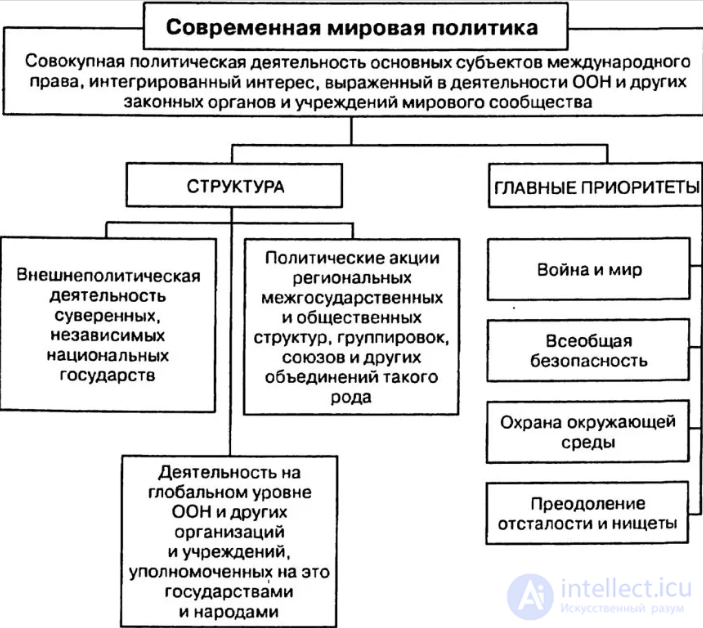
English-speaking researchers argue that the discipline of "global politics" should be distinguished from the discipline of "international politics" , whose representatives seek to understand the relations between nation states (national states) and therefore have a narrower scope for their object and subject of research.
Similarly, the discipline of "international relations" (its theory and history) seeks to understand, first and foremost, the economic and political (especially diplomatic) relations between "nation states" that arose after the European Peace of Westphalia (from 1648) and between the political entities that preceded them. Accordingly, these disciplines are narrower than the discipline of "global politics" (its theory and history), as is their subject matter.
Current topics of discussion within the discipline include the study of the problems of globalisation and the resolution of interstate and interethnic conflicts, global democracy, the influence of globalisation on national self-determination, democratisation and peace, and the analysis of comparative politics, political economy and the international political economy of the environment.
1. The purpose of global politics:
Studying and analysing world events: Global politics is aimed at studying and analysing events taking place on the world stage, such as international conflicts, diplomatic relations, economic ties, global environmental problems and other international issues.
Understanding and forecasting world trends: Global politics seeks to understand the trends that influence world politics and the economy, and to forecast future events and changes.
Developing and implementing international policy: One of the aims of global politics is the development and implementation of political strategies and decisions directed at regulating relations between states and actors on the world stage.
2. The methods of global politics:
Diplomacy: Diplomacy is the principal method of global politics; it comprises negotiations, treaties, international agreements and mediation aimed at resolving international conflicts and achieving world accord.
Military power: The use of military force may be part of global politics, especially in cases of conflict and war. However, this is usually a last resort and is applied when other methods do not produce the desired result.
Economic and financial instruments: Economic sanctions, trade agreements, financial aid and other instruments can be used to exert pressure on states or to encourage cooperation.
International organisations: Numerous international organisations, such as the UN, the World Trade Organization (WTO), the International Monetary Fund (IMF) and others, play an important role in global politics by providing mechanisms for cooperation and for solving world problems.
3. The tasks of global politics:
Maintaining peace and security: One of the main tasks of global politics is preventing wars and conflicts, as well as ensuring world security and stability.
Solving world problems: Global politics is aimed at solving world problems such as poverty, climate change, pandemics, migration and other global challenges.
Promoting economic growth and development: Global politics is also oriented towards promoting the economic growth and development of states, as well as promoting a fair distribution of resources.
Protecting human rights: Global politics seeks to protect and promote human rights on the world stage, including the struggle against discrimination and violations of rights.
Beginning at the end of the nineteenth century, several groups extended the definition of the political community beyond nation states to include much, if not all, of humanity. These internationalists include Marxists , human rights advocates, environmentalists, peace activists, feminists and minority groups. This was the general direction of views on global politics, although the term as such was not used. The way in which contemporary world politics is enacted is structured by a set of interpretations dating back to the rise of the European powers. They were able to overtake the rest of the world in economic and military power. The Europeans, who possessed global supremacy, imposed their own system and views on others, representing the world as a whole and defining regions of the world as "modern" or "backward". They regarded national statehood as the best and highest form of political organisation, and therefore viewed world politics as the outcome of competing states' striving for hegemony.
The perspective of contemporary world politics is often identified with certain works, in particular with their 1972 work Transnational Relations and World Politics . Here the authors argued that state-centred views of international relations are an inadequate framework for use in political science or international relations research because of growing globalisation. Today the practice of global politics is defined by values: norms of human rights , ideas of human development and such beliefs as internationalism or cosmopolitanism concerning how we should relate to one another. Over the past couple of decades cosmopolitanism has become one of the key contested ideologies of global politics:
Cosmopolitanism can be defined as a global politics that, first, projects a sociality of common political engagement among all human beings across the globe, and second, assumes that this sociality should have either an ethically or an organisationally privileged position over other forms of sociality.
Intensifying globalisation has prompted some authors to suggest that states are no longer relevant to global politics. This point of view has been the subject of debate:
On the other hand, other commentators argue that states still play an important role in global politics. They have facilitated the processes and projects of globalisation; it has not eclipsed them. They have been renewed because, among other things, they remain the principal providers of (military) security in the global arena; they remain the chief sites for the expression of the voices of (procedurally democratic) national communities and for ordering their interactions with similar polities; and, finally, they are essential to relations of (unequal) economic exchange, since they legitimise and reinforce the global legal frameworks that make globalisation possible in the first place.
Intensifying globalisation has led some thinkers to suppose that states are no longer relevant to global politics. This point of view has become the subject of debate: other commentators argue that states remain essential in global politics. They have facilitated globalisation; it does not eliminate them. They are rejuvenating because, among other things, they still remain the principal sources of (military) security in the planetary arena; they still have paramount importance as the site for the expression of the opinion of (procedurally democratic) national communities, as well as for ordering their interactions with similar polities; and, finally, they are essential to relations of (unequal) economic exchange, since they legitimise and enforce the global legal frameworks that permit globalisation in the first place
Among the philosophers who have attempted to provide a systematic methodology for the study of global politics, one may single out Karl Popper's student, the Israeli philosopher Joseph (Yosef) Agassi . From this philosopher's point of view, the requirements placed on the actors of global politics should be minimalist. In his opinion, global problems should be brought forward for public discussion in various forums in order to reach a compromise on their substance and on the means of solving them. In turn, the most important global problems should be resolved by a defined number of participants.
Also singled out among researchers is George (Jerzy) Modelski, an American political scientist who developed the concept of long cycles of global politics (cycles of hegemony ) and of the resulting evolution of the global political system. In this researcher's view, the development of global politics is conditioned by long cycles of economic development — Kondratiev cycles .
Global politics is the coordinated activity of states and influential interstate institutions aimed at solving the common, global problems of humanity — preventing the use and proliferation of weapons of mass destruction , especially nuclear weapons, combating dangerous pollution of the planet, global warming , combating poverty, organised drug trafficking , the spread of dangerous diseases, and so on.
The only acceptable course of global politics for the twenty-first century must be based on the principles of international law and international comity, peaceful coexistence and cooperation, and on the positive consequences of the processes of globalisation , which make the whole world a "single home" — a Cosmopolis .
On the whole, global politics has as its aim the management and regulation of world relations in the interests of global stability, peace and development.
The relationship between the concepts of "world politics", "foreign policy", "international relations" and "international politics". The nature of international relations. The classification of international relations. Types and levels of international relations. The degree of development of international relations. The subject matter of world politics and international relations. The plurality of actors in world politics and international relations. The plurality of factors determining the state of international relations. The global environment as a determining factor in the development of international relations. Levels of analysis in international relations. The individual level. The state (domestic) level. The international (interstate) level. The global level. Explicative methods. Predictive methods. The regularities of world politics and international relations. Political science and international relations. The concept and criteria of international relations. Participants in international relations. The state as the key element of the system of international relations. Methods of analysing international relations.
The formation and development of realist conceptions of international relations in the political thought of the Renaissance and the modern era. Marxism and international relations. Conceptions of foreign policy in the political thought of the ancient world. The genesis of the liberal conception of international politics.
Liberal and neoliberal conceptions of international relations. Neo-Marxist conceptions of international relations. Modernist and neo-modernist conceptions. Theoretical conceptions of international integration. The formation of the theory of international regimes. S. Huntington's conception of the "clash of civilizations". The geopolitical conceptions of Z. Brzezinski. Wallerstein's world-systems analysis. Political idealism in the theory and practice of international relations. Political realism and neorealism. Theoretical debates on the problems of world politics and international relations after the end of the "Cold War".
The balance of power as a static state and as a process. Ensuring the balance of power. The distribution of power. The emergence and development of the system of inter?national relations. The multipolar system. The unipolar system. The bipolar system. The "pyramid of power". Hegemony. Military-political alliances. The problem of anarchy in contemporary international relations. The basic principles and norms of international relations. Sovereignty. The territorial integrity of states. The security dilemma. The relationship between world order and international order. Historical types of international order. The Westphalian
system. The nation state. Political equilibrium. The Congress of Vienna of 1815. Legitimism. The First World War. The October Revolution. The "state of war" model. The "disrupted order" model. The Second World War. The post-war international order. The contemporary international order.
The balancer state and its role in maintaining the balance of power. The great powers and their criteria. International order. The concept of international order. The polarity of the contemporary system of international relations.
Theoretical debates on the issues of globalisation. World politics and the world economy under conditions of globalisation. Political movements and organisations under conditions of globalisation. Anti-globalism. The "Third World" under conditions of globalisation. The balancer state and its role in maintaining the balance of power. The great powers and their criteria. International order. The concept of international order. The polarity of the contemporary system of international relations.
The concept of national interest. The historical character of the concept of national interest. The internal and external aspects of national interest. Defining the concept of "foreign policy". The foreign policy conception. Foreign policy strategy. Making a foreign policy decision, implementing a foreign policy decision. The rational model. The "organisational process" model — the matrix model. The "bureaucratic politics" model. Subjectivism in the process of making a foreign policy decision. Factors impeding the making of a rational decision. Distortion of information. Emotional distortions. Cognitive distortions. The "mirror effect". The method of "historical analogies". roup psychology. Forms of foreign policy activity. The establishment and severance of diplomatic relations. Lowering the level of diplomatic relations. The suspension of diplomatic relations. Declaring war. Negotiations. Visits. Participation in the work of international organisations. The signing of international treaties and
agreements. Joint activity in environmental protection. Diplomacy as a science. Diplomacy as an art. The organs of a state's external relations. Ministries of foreign affairs. Overseas organs of external relations.
National security. Foreign policy state interests. Models of foreign policy decision-making. Crisis in international relations. Diplomacy.
lecture session (4 hour(s)):
The concept of "power" in international relations. The constituent elements of a state's power potential. Power resources. Power capabilities. The convertibility of power resources and power capabilities. Demonstration of force. Bargaining. The culture of political bargaining. Pressure. Threat. The use of force. The strategy of reciprocity. The strategy of deterrence. The strategy of coercion. The strategy of escalation.
practical session (6 hour(s)):
Power as influence. The power potential of the state. The armed forces. Strategy as a plan for using power potential.
lecture session (4 hour(s)):
The role of the military in implementing the foreign policy of the state. Command of the armed forces. Conventional armed forces. The arms race. The use of the armed forces in international relations.
practical session (6 hour(s)):
The place of the armed forces within the state. The armed forces as the guarantor of the state's security. Weapons of mass destruction. The threat of the use of weapons of mass destruction.
lecture session (4 hour(s)):
The place of conflict in international relations. Factor analysis. The liberal approach. The struggle for limited resources. The struggle for power. The struggle for influence. The division of the world. The redivision of the world. Territorial conflicts. Political conflicts. Economic conflicts. Ethnic conflicts. Religious conflicts. Ideological conflicts. The resolution of international conflicts. The negotiation process. Mediation services. Types of mediation services. Arbitration. People's diplomacy. Armed conflict. Theories of the origin of wars. War in international relations. War as the continuation of
state policy. Definition
practical session (6 hour(s)):
The definition of international conflict. The causes of international conflicts. Conflict of interests. The classification of international conflicts. The escalation of conflict into war.
lecture session (4 hour(s)):
The sovereign equality of states; the non-use of force and of the threat of force; the inviolability of borders; the territorial integrity of states; the peaceful settlement of disputes; non-interference in internal affairs; respect for human rights and fundamental freedoms; equal rights and the right of peoples to determine their own destiny; cooperation among states; the conscientious fulfilment of obligations under international law. The effectiveness of international law.
practical session (6 hour(s)):
The emergence of international law as a regulatory institution of international relations. Historical forms of international law. The basic principles of international law
lecture session (4 hour(s)):
The morality of international relations as a derivative of political morality. The problem of moral choice in the sphere of international relations. The idealist understanding of political morality. The realist interpretation of morality in international relations. The modernist interpretation of morality in international relations. The effectiveness of moral norms and principles in international relations.
practical session (6 hour(s)):
The historical evolution of ideas about international morality. The relationship between the principles of international relations and moral norms. War and violence from the standpoint of international morality.
lecture session (4 hour(s)):
Intergovernmental organisations in world politics: their main functions and new tasks under contemporary conditions. The UN in the contemporary world. Debates on ways of reforming the United Nations. Non-governmental international organisations and their classification.
practical session (6 hour(s)):
The essence and typology of international organisations. The origin, structure and operating principles
of the UN. The peacekeeping activity of the UN.
lecture session (4 hour(s)):
The influence of the domestic political situation in the country on my country's foreign policy.
The foreign policy views of various political forces in my country and the swamp. my country and Europe. my country and NATO. my country and the USA. my country and the "Third World". The Islamic factor and the foreign policy of my country .
practical session (8 hour(s)):
The evolution of my country's foreign policy doctrine. The place of my country and the swamp in the world community of the twenty-first century.

Comments