
Lecture
Ochlocracy (Ancient Greek ὀχλοκρατία, from ὄχλος "crowd" + κράτος "power" — the rule of the rabble or of the mob) is a degenerate form of democracy based on the shifting whims of the crowd (the ochlos), which constantly falls under the influence of demagogue-politicians, and in which demagoguery, the tyranny of the majority and the dominance of passion prevail over reason.
Ochlocracy, the despotic rule of the rabble, was contrasted in Greek theories with polity or democracy as its perverted form; it is characteristic of transitional and crisis periods and of upheavals (revolutions).
A crowd (a throng, gathering, assemblage, crush, ochlos) is a large accumulation, a multitude of people come together, and also the most fortuitous connection of people united within a given space by a purely temporary, transient interest.
Mob rule, or ochlocracy, or mobocracy, is a pejorative term describing a repressive form of majority rule controlled by ordinary people through the intimidation of more legitimate authorities. Ochlocracy differs from democracy or a comparable lawful and representative government in the absence or violation of procedural due process reflecting policy as a whole.
A crowd is chaotic, though not devoid of a certain organisation. The organising factor may be a shared object of attention, a tradition, or an event. Members of a crowd are often in a similar emotional state. A crowd is described by a whole range of parameters and characteristics, such as the number of people gathered, the direction and speed of movement, the psychological state and others. The crowd is an object of study in social psychology, which in particular introduces classifications of crowds according to a number of features. Gustave Le Bon, like other representatives of the criminological school — for example Cesare Lombroso, Scipio Sighele and Raffaele Garofalo — began to regard the crowd as an exclusively irrational, spontaneous and destructive force in society. In some cases a crowd may pose a danger to those around it (for example, rioters and insurgents) and to itself (in the event of panic). Crowds play a significant role in history. V. G. Belinsky wrote: "A crowd is a gathering of people who live by tradition and reason by authority."
The concept of ochlocracy originates in the ancient Greek theory of the state of the historian Polybius (Polybios, 200–118 BC), and it has not yet lost its analytical significance.
The term was introduced by Polybius. Aristotle describes Athens under Pericles and later as an ochlocracy, since the rabble then held sway; people of noble birth were systematically excluded from participation in the affairs of government, and the drawing of lots played a decisive role in appointment to office; the inevitable result of such a system was despotism towards the allies and disorder in administration. Other writers, meanwhile, see in Athens a model of pure democracy (in the later sense of the word).
Signs of ochlocracy may be found in the Roman Empire, where the army raised men to the throne and deposed them at its own discretion, although the institutions of the state were then monarchical.
With greater justification one may call ochlocracy the political order of France at certain moments of the French Revolution and in the first days after the revolution of 1848, when the crowd elected all the most important officials. Many point to the Paris Commune of 1871 as an ochlocracy; but the regular system of popular voting that prevailed there makes this designation largely arbitrary, though it is undoubtedly the case that individual events, such as the shooting of Generals Lecomte and Thomas, were acts of the will of the crowd.
At the end of the seventeenth and the beginning of the eighteenth centuries life in England was very disorderly. Although the Duke of Monmouth's rebellion in 1685 was the last uprising, there was scarcely a year in which London or the provincial towns did not see aggrieved people break out in disturbances. During the reign of Queen Anne (1702–14) the word "mob", first heard shortly before, came into general use. In the absence of a police force, public order was weak. Several decades later the anti-Catholic Gordon Riots swept London and cost hundreds of lives; at that time a proclamation painted on the wall of Newgate Prison declared that the prisoners had been freed by the authority of "His Majesty, King Mob".
The Salem witch trials in colonial Massachusetts in the 1690s, in the course of which the townspeople's unified belief prevailed over the logic of the law, have also been cited by one essayist as an example of mob rule.
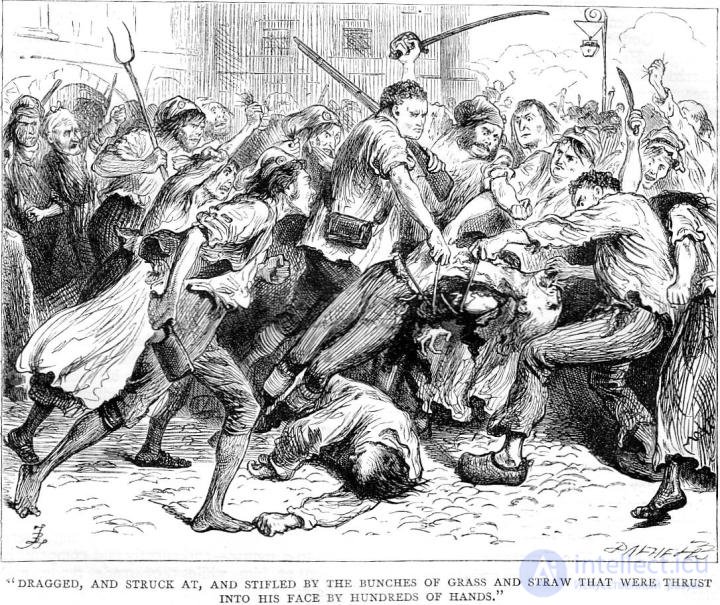
The crowd attacks Joseph Foullon de Doué.
The principal forms of political order (according to Polybius):
| Number of rulers | Common interests | Self-interest |
| one | Monarchy | Tyranny |
| some | Aristocracy | Oligarchy |
| all | Democracy | Ochlocracy |
According to Viacheslav Lypynsky, ochlocracy is the complete dominance of warriors with the suppression of all freedom. Lypynsky includes here the Asiatic despotisms, the European revolutionary dictatorships, modern fascism, Bolshevism and Muscovite tsarism.
In 1837 Abraham Lincoln wrote of lynching and of "the growing disregard for law which pervades the country — the growing disposition to substitute the wild and furious passions in lieu of the sober judgement of courts, and the worse than savage mobs for the executive ministers of justice".
Mob violence played a prominent role in the early history of the Latter Day Saint movement. Examples include the expulsions from Missouri, the Haun's Mill massacre, the death of Joseph Smith, the expulsion from Nauvoo, the murder of Joseph Standing and the Cane Creek massacre. In his 1857 speech Brigham Young delivered an address demanding military action against the "mobocrats".
In general, ochlocracy in the most precise sense of the word can exist only for a very short time, and most often it is an intermediate form in turbulent times, after the fall of the old order and before its replacement by a new, more or less organised one.
In the modern world ochlocracy is practically never regarded as an independent form of exercising political power, but it substantially supplements political regimes that are in a crisis or transitional period.

Comments