
Lecture
Demagogy (Ancient Greek δημαγωγία — leadership of the people) is a set of oratorical and polemical techniques and devices that make it possible to mislead an audience (the people) and win it over to one's side by means of false theoretical reasoning based on logical fallacies.
Demagogy is a method of argumentation or a rhetorical strategy that uses various tricks and ruses to persuade or manipulate an audience, not necessarily on the basis of logic or facts. Demagogic techniques may include emotional impact, the exploitation of fear, the creation of an illusion of support, personal attacks, the use of generalisations and exaggerations, as well as many other manipulative methods.
Demagogy is often used to achieve political or rhetorical goals, sometimes ignoring facts and engaging in the manipulation of the audience's opinions and emotions. It can be harmful to society, since it can undermine debate and lead to decisions being made on the basis of emotions rather than scientific or logical consideration.
Demagogy is most often employed to achieve political goals, in advertising and in propaganda.
Demagogue (Ancient Greek δημαγωγός, "leader of the people") — a democrat and dictator in Ancient Greece; also a populist, a "people's" politician. Originally the word had no negative connotation and denoted what Aristotle later (perhaps because the term "demagogue" had been discredited) conveyed through the expression "prostates (defender, representative of the interests) of the people".
The "prostatai of the people", that is, the democratic leaders, were for most of the fifth century BC men from noble families, such as Themistocles or Pericles. The situation changed towards the end of the century, when low-born "upstarts" came to the forefront of political life, such as the owner of a tannery, Cleon, or the owner of a lamp workshop, Hyperbolus, with radical political aspirations (in modern historiography they are called "leaders of radical democracy"). Their opponents accused them of populism, political irresponsibility, corruption and playing on the lowest and darkest instincts of the crowd. Thanks to them the concept of "demagogue" began to denote a populist politician and approached its modern meaning.
In the sense of the modern term "populist", the concept of "demagogue" was already being used in the nineteenth century, for example to designate revolutionary leaders: "…a politicker, a person who tries to create popularity for himself among the masses by unworthy means (distortion of facts, flattery, etc.)", that is, entirely in the ancient Greek sense of the word.
A striking satire on political demagogy, one that has not lost its relevance, is given in Aristophanes' comedy The Knights, directed personally against Cleon. Cleon is portrayed in it under the name of the Paphlagonian, the slave of the senile old man Demos ("the People"), whom he deceives and fleeces.
V. I. Dahl defines a demagogue — «an extreme democrat, who seeks power in the name of the people; a secret agitator; a champion of anarchy who wishes to overthrow the order of government", and demagogy as "the dominance of the power of the people, of the mob, in government".
The principal and most obvious demagogic ruses are the concealment of the true state of affairs, evasions and the refusal of rational argumentation. Demagogic techniques end in disillusionment and scepticism among the masses. Demagogy is in essence nothing other than a distortion of the truth. Therefore it can be exposed only by the truth conveyed to the people. A necessary condition for combating demagogy is the openness of those in power: the masses must possess the information required to make a decision.
— N. A. Baranov
Demagogy is practised by one who, given a favourable opportunity and with a political aim, publicly exerts influence by flattering the crowd, appealing to its emotions, instincts and prejudices, presents himself as far removed from lying and from stirring up malice, presents the truth in an exaggerated or crudely simplified form, passes off what he wishes to impose as the cause of all well-meaning people, and presents the manner in which he imposes it, or proposes to impose it, as the only one possible.
— Martin Morlock, 1977.
Demagogues seek not what is best for all, not truth, not peace and justice, but only a way to present their personal interests as public ones and their decisions as the only correct ones; their tactic in discussions is scandalous attacks and accusations against those who accuse them, rather than a substantive, evidence-based reply; their method is to interpret everything in their own favour and to the detriment of their opponents, up to and including outright, brazen lies, so long as they do not weaken their positions in the dispute or concede anything; their aim is not constructive dialogue, not peaceful coexistence, but hostility towards everything different, incessantly inflamed by provocations, and ostentatious discord, which they need as a platform for refusing to admit that they are wrong (so that they never have to correct it), and the propagandistic imposition and implanting of their will.
A compromise solution with demagogues can be reached only with a significant preponderance of their interests, which they will most likely proclaim as their victory.
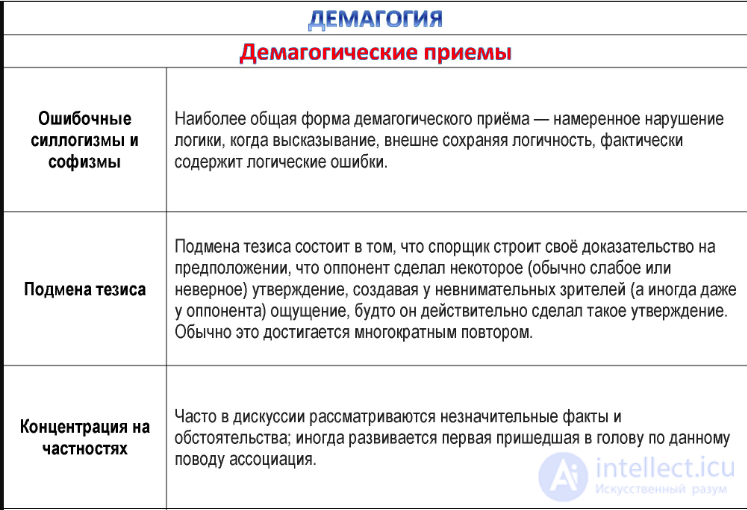
The most general form of demagogic technique is the deliberate violation of logic, when a statement, while outwardly preserving logical form, in fact contains logical fallacies. In its simplest form a fallacious syllogism can be characterised by the following example:
We are red-haired.
Lions are reddish.
Therefore, we are lions!
or
Our soldiers always bring peace.
They shot at our soldiers.
Therefore they are aggressors!
Substitution of the thesis consists in a disputant building his argument on the assumption that his opponent has made some (usually weak or incorrect) claim, creating in inattentive spectators (and sometimes even in the opponent) the impression that he really did make such a claim. This is usually achieved by repeating it many times.
For example:
A: "Sunny days are good."
B: "If all days were sunny, there would never be any rain, and without rain there would be drought and death by starvation."
In substitution of the thesis, having begun to prove one claim, the disputant gradually moves on to proving and substantiating a different claim . This technique has the everyday name "substitution of the concept".
Often insignificant facts and circumstances are examined in a discussion; sometimes the first association that comes to mind on the subject is developed.
An experienced demagogue tries to concentrate on an error or inaccuracy, even a completely insignificant one , or on his opponent's hesitation.
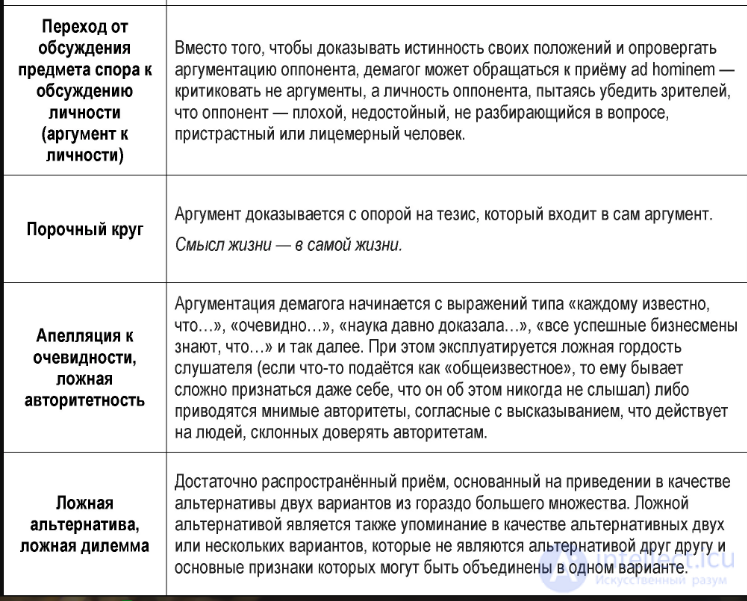
Instead of proving the truth of his own positions and refuting his opponent's argumentation, a demagogue may resort to the ad hominem technique — criticising not the arguments but the personality of the opponent, trying to convince the audience that the opponent is a bad, unworthy, ignorant, biased or hypocritical person.
What can a man without a residence permit say about architecture? (M. Zhvanetsky)
Such argumentation often makes an impression on poorly educated people who lack sufficient knowledge and skills of logical thinking to consciously analyse the objective weaknesses of an argument, and who prefer to place groundless trust in whoever appears more authoritative in their eyes.
One form of shifting to personalities is finding an easily criticised figure who holds views on the issue under discussion similar to those of the opponent.
— The state must combat smoking!
— Really? And do you know that a state programme to combat smoking was adopted in Nazi Germany, because Hitler was a committed opponent of tobacco?
An argument is proved by relying on a thesis that is itself part of the argument.
For example:
— What is the reason opium has a soporific effect?
— I answer: it lies in the fact that opium possesses the capacity to induce sleep.
or
— Why do you believe that the world was created by Someone?
— But surely it could not have appeared by itself, without the will of the One who created it!
The demagogue's argumentation begins with expressions such as "everyone knows that…", "obviously…", "science proved long ago…", "all successful businessmen know that…" and so on. In doing so, the listener's false pride is exploited (if something is presented as "common knowledge", it can be hard for him to admit even to himself that he has never heard of it), or imaginary authorities who agree with the statement are cited, which works on people inclined to trust authorities.
However, such phrases are not necessarily demagogy in themselves — for example, the phrase "Science proved long ago that the Earth is not flat" is quite acceptable, since it corresponds to reality.
Unsubstantiated assertions can be singled out as a separate technique.
The appeal to ignorance is an argument that counts on the lack of knowledge of the person being persuaded, when it is concluded that some statement is true because no one has proved it false, or, conversely, that a statement is false because no one has proved it true.
For example:
Ghosts exist, since no one has yet proved that they do not.
A fairly widespread device based on presenting two options as the alternatives when the set of possibilities is far larger. A false alternative also arises when two or more options are presented as alternatives although they are not alternatives to each other and their main features can be combined in a single option.
— Darling, could you please not yell at me?
— Should I crawl before you on my knees?
"After this, therefore because of this" (Latin post hoc ergo propter hoc) is a logical trick in which a cause-and-effect relationship is identified with a chronological, temporal one: "The serial killer was fond of postage stamps from childhood; therefore, philately turns people into ruthless murderers."
Demagoguery may pursue any aim except establishing the truth. In demagoguery an argument is deemed "correct" if it serves that aim; only "correct" (in this sense) arguments are admitted.
The demagogue… does not enlighten those he addresses but confuses them, distracts their gaze and leads them onto a false trail. He appeals not to the reason of the people, nor to their goodwill, but to dark feeling and self-serving passion. Devoid of any sense of responsibility, he does not ascertain the true state of affairs and does not explain it, but distorts it as he needs. He does not prove but allures or frightens; he strives to awaken a feeling of suspicion in men's souls, to sharpen mistrust, to arouse implacable greed and hatred.
— Ivan A. Ilyin "Demagoguery and Provocation", 1917.
To distinguish demagoguery from honest and rational discussion, it is important to develop skills of critical thinking and information analysis, and also to check facts and sources of information before drawing conclusions or succumbing to manipulative techniques.

Comments