
Lecture
The political process is the way in which the political system of a society functions; the aggregate activity of the subjects of politics, by virtue of which the functioning and development of the political system is ensured.
The concept of the political process is one of the central ones in the study of political science and the least well elaborated, which is due to its complexity. In considering the political process, Western political science falls into extremes and defines its essence either as the activity of some rational subject in pursuit of a particular goal, or as an aggregate of spontaneous actions and of the relations that arise as their result.
In Russian political science the most widespread definition of the political process is the following.
The political process is the aggregate activity of social subjects by means of which the formation, transformation and functioning of society's political system and of political-power relations takes place. This is the broad understanding of the political process. In the narrow sense the political process may be considered in one of the following meanings:
Of paramount importance is the understanding of the political process in the broad sense.

The essence and content of any particular political process is determined on the basis of the features of the political system and of the political regime under consideration. Thus a democratic system corresponds to a type of political process in which citizens have broad rights in governing the state and in which human and civil rights and freedoms are observed and guaranteed within the state itself. By contrast, in a totalitarian type of political system the political process wholly excludes any real possibility for citizens to participate in the political life of society, just as freedom of political and social choice is absent .
In its structure, "the political process consists of subjects, the bearers of political action, and an object — the goal that is to be achieved". The political process also includes means, methods, resources and executors .
Types of subject of the political process:
Besides the subjects of political activity there are also its participants. These may be social groups, individual persons, various organisations, and so on. What distinguishes participants from the subjects of political activity is that the former have no definite political goals and interests and may not even wish to become involved in political activity, but by force of particular circumstances may be "drawn" into the political process .
The political process consists both of the purposeful "conscious efforts of the subjects of political activity (individuals, social groups, political parties, state bodies and others)" and of interactions that arise spontaneously, independently of the will and consciousness of the participants in the process. G. T. Tavadov notes:
Such an aggregate of purposeful and spontaneous actions by the subjects and participants of the political process rules out any clear predetermination or inevitability in the political process's unfolding of events and phenomena. The result may accord with the well-known saying: "We wanted the best, but it turned out as it always does".
In carrying out their role-related tasks and positions, the participants and subjects of the political process must demonstrate their "significance, their capacity to reproduce, develop, change or destroy elements of the political system". Hence it is thanks to the political process that "both the surface and the deep-lying changes taking place in the political system" are revealed, and it "characterises the system's transition from one state to another".
Structurally, the political process is based on several stages, which are gradually put into practice while internally remaining connected with one another at all times and recurring cyclically
The stages of the political process are divided into:
G. T. Tavadov notes :
The main stages of the political process express the dynamics of the political system's development, as a result of which changes and transformations take place within it. Therefore in each new cycle the political system does not copy itself but, enriched by new aspects and properties (for example, the appearance of an electoral system or of new legislation, of political blocs, parties, and so on), political changes take place within it. But the main process is the repetition in a new way of what existed before — self-reproduction.
At the stage of reproduction of the political system, the historical type of the political system, its class nature and its links with other subsystems of society are repeated and consolidated, modified and renewed. Political relations and institutions, political norms and values, symbols and language are reproduced. The very participants in the political process are reproduced as the exponents of particular political positions, the bearers of corresponding views, the performers of one or another political role.
Historically and logically, the first stage of the political process is the constitution of the political system. It may be said that this is its main regulating principle, which makes it possible to bring separate (particular) political processes together into a single nationwide political process, which makes it consistent and relatively stable. The constitution of the political system proceeds continuously, is constantly renewed and represents the practical embodiment of the will of people who by their own efforts create this system. Various methods of carrying it out are possible: peaceful and violent.
The creation of a new political system as a result of victory in the course of political struggle requires legitimation, that is, securing the support and recognition of that political system on the part of the members of society. The process of recognising a political system may be active or passive, open or concealed, voluntary or forced, direct or indirect, conscious or unconscious. But whatever form recognition takes, it must necessarily be present. It should always be remembered, however, that the legitimation of a particular political system by society does not always mean that the system in question expresses the interests of the majority. The absence of recognition of a political system by society testifies to the loss of that political system's stability. Legitimation of a political system by methods of violence and terror does not justify itself and lasts for a very short span of time. Talleyrand in his day already stressed: "You can do anything with bayonets, but you cannot sit on them". [11, p.171]
The constitution of a political system takes place in accordance with certain historical regularities, taking into account the objective socio-economic needs of society, as well as socio-psychological factors and the established normative-value system.
Once the constitution of a political system is complete, it begins to reproduce itself, provided it receives recognition and support from society. The reproduction of a political system is a complex, internally contradictory phenomenon that passes through several stages of development. The principal characteristics of this stage are the continuity and renewal of the basic elements and mechanisms of the political system. Continuity means the development and improvement of previously established elements and relations while preserving theiressential characteristics, which reflect the nature of the given type of political system. Renewal is an essential complement to the preceding principle and presupposes the emergence of new features and properties. Traditionally, the reproduction of a political system is expressed in the recreation of political relations and institutions, political norms and values, signs, symbols and language, as well as of the subject of political relations with all his characteristics (positions, actions, views, etc.). The reproduction of a political system presupposes the obligatory renewal and improvement of the system of official normative prescriptions that regulate the behaviour of participants in the political process. This is accomplished through the revision and refinement of the current constitution, legislation and other normative legal acts. The reproduction of representative institutions and organs of power is accomplished through elections (re-elections), rotations, competitive selection procedures, etc. [10, с.247-248]
According to the significance for society of particular forms of political regulation of social relations, political processes can be subdivided into basic and peripheral. The former characterise the various ways in which broad social strata are drawn into relations with the state, the forms in which the interests and demands of the population are transformed into administrative decisions, the typical techniques for forming political elites, and so on. In this sense one may speak of the processes of political participation and state administration (decision-making, the legislative process, etc.). Peripheral political processes, by contrast, reveal the dynamics of the formation of particular political associations (parties, pressure groups, etc.), the development of local self-government, and other connections and relations within the political system that exert no fundamental influence on the dominant forms and methods of exercising power.
A distinction is also drawn between evolutionary and revolutionary, open and covert, local-regional and global processes, stable and crisis processes, and legal and "shadow" processes. [18, с.3111-312]
Control over the development and existence of "the political system is achieved by preventing and eliminating deviations in the behaviour of the parts of the political system and of the participants in the political process from the established benchmarks and standards of activity".
The outcome of "the political process depends on a set of independent variables (the availability of resources, favourable or unfavourable conditions, that is, the external environment, the intervention of unexpected, random factors, etc.) and dependent ones contained within the political process itself — the chosen means, methods, executors, etc., and the relations among them. Most of the independent variables can and should be taken into account in the design of the political process, as should the dependent ones; yet it is precisely this second group of factors that is most capable of disrupting the process".
At the same time, "the political process within individual countries is significantly affected by external factors, global political and global economic relations and ties, and the whole body of undertakings of an international character".
In the political science literature, political processes are classified according to various criteria.
Depending on the object in which the political will is manifested, they are subdivided into domestic and foreign political processes.
Depending on the time frame in which they unfold, political processes are distinguished as protracted — for example, the transition from a totalitarian to a democratic regime — and comparatively short-term, such as elections.
Depending on their significance for society, political processes can be divided into basic and peripheral.
From the standpoint of publicity in the way they unfold, a distinction is drawn between the overt (open) and the shadow (covert) political process.
In the political life of society there occur political processes possessing their own rhythm, or a recurrence of the basic stages of interaction among their subjects, institutions and participants. Examples include an election campaign, the government's report to parliament, the adoption of the budget, and so on.
In the political science literature it is customary to distinguish the following types of political action: revolution, counter-revolution, insurrection, riot, mutiny, putsch, political campaign, and direct action in politics.
Revolution is a fundamental transformation of the social order, the creation of a new political system founded on different principles of legitimacy. A revolution arises as a consequence of mounting contradictions within society.
Because not all members of society share the views of the new authorities, a counter-revolution may occur. Counter-revolution is a political process involving groups that seek to overthrow the new political elite and restore the previous order .
Reform is a gradual transformation of the economic and political order while preserving its foundations and the power of the ruling elite. In carrying out reforms, securing public support for them and reaching agreement on the content, types and methods of the transformations is of paramount importance. The success of reforms depends on their being carried out in good time.
Insurrection is a mass uprising against the given authorities and the existing order.
The aim of an insurrection is, as a rule, declarative and vague, finding its justification in a primitive programme and slogans. Every insurrection possesses a certain level of organisation. Purposefulness and organisation are what distinguish an insurrection from a riot.
A riot is a mass spontaneous action possessing a high degree of intensity. It is almost always a reaction to extraordinary actions by representatives of the dominant political groups or state bodies.
Close to a riot in its degree of intensity is a mutiny, which arises as the result of deliberate, purposeful preparation by a particular group of persons. It usually takes an armed form, relying on part of the army. As the range of participants widens, a mutiny loses its organisation and purposefulness, takes on the quality of a riot, and dies out. If a mutiny fails to obtain mass support, it becomes a putsch — that is, it degenerates into the armed actions of a narrow group of persons with no serious prospects.
A political campaign is a system of collective actions aimed at changing the structure of power, redistributing political authority, and forming organs of government. Its success depends to a considerable extent on the support of the population.
A number of political actions are covered by the term direct action. This is the immediate influence of citizens on the organs of political power through rallies, demonstrations and strikes.
A rally is a gathering of people devoted to the discussion of some particular problem. In holding rallies it is necessary to bear in mind that a rally may become an arena of confrontation between different political forces and a site of various excesses. This requires clear organisation from the rally's organisers and from the authorities, a carefully considered scenario, and readiness for various ways in which events may develop.
A demonstration is a mass march of supporters of a particular idea or demand, an expression of support for or protest against actions of the authorities. It requires advance planning and preparation: advertising in the newspapers, official permission from the authorities, the making of banners, the assignment of roles, the route of the march, and the speakers.
A strike is the stoppage of work for the purpose of exerting economic or political pressure on the authorities. Thanks to a strike, an enormous mass of people can be drawn into an active political stance in the shortest possible time.
The practice of political reality shows that, of all political actions, it is revolution and reform that lead to the most profound transformations.
The world political process is the totality of the actions and interrelations of political actors in those spheres of international relations that have global significance for all humankind.
The political life of any given state is significantly, and at times decisively, influenced by external factors, the international situation, and political processes in other countries.
Spheres of international relations that have global significance:
Let us single out the most popular approaches to defining "stability" accepted in Western political science (See: Makarychev A.S. Stability and instability under democracy // Politicheskie issledovaniya [Political Studies]. - 1998. - №1. - С.149-157.)
1. Stability is understood as the absence in society of any real threat of illegitimate violence, or the state's possession of capabilities enabling it to cope with such a threat in a crisis situation. Thus, the Scottish scholar F. Bealey defines stability as the capacity of a political organism for self-preservation under conditions that threaten the "identity" of the social system or its very existence.
2. The existence of a constitutional order may also be regarded as a determining factor of stability. S. Huntington defines stability by the formula "order plus continuity", whereby the model of the organisation of power retains its essential characteristics over a long period of time.
3. Stability is viewed as a consequence of the legitimacy of power. Different groups, however, interpret legitimacy differently and see different sources of the legitimacy of power. Today many political scientists prefer to speak no longer of legitimacy but of the population's support for the given political system (L. Green) and for its fundamental values (J. Zaller).
4. Stability as the absence of structural changes in the political system, or as the presence of an ability to manage them. That is, in a stable system either the political process does not lead to radical changes, or those changes are subordinated to a strategy worked out in advance by the ruling elite.
5. Stability is interpreted as a model of behaviour and a social attribute. In this case it is equated with that condition of society in which its members restrict themselves to socially acceptable behaviour (G. Goertz).
6. The American political scientists E. Duff and J. McCamant, analysing the problems of political stability and instability, hold that it is necessary to use the following data: first, the population's attitude towards the political process, and second, the internal reserves of the political system itself.
They point to the following criteria of stability: 1) the predominance of social assistance over social mobilisation; 2) high rates of economic development; 3) an even distribution of incomes; 4) the availability of reserves of political capacity; 5) the spread of institutionalised political parties with broad membership, ensuring the involvement of citizens in political life. It should be noted that stability does not always depend directly on the level of economic development. First, a social order based on a close link between the economy and the state may become "repressive and utterly unworthy". Second, in countries undergoing modernisation, economic growth not infrequently becomes precisely a destabilising factor (polarisation of society, differentiation).
Thus, stability is a multidimensional concept encompassing such characteristics as the preservation of the system of government, of civil order, of legitimacy, and of reliable governance.
Stability is achieved in two ways: either through dictatorship or through the broad development of democracy. The first path is based on fear, suppression and violence and, as a rule, stability achieved in this way has historically proved short-lived and fragile. It can secure only a temporary success for a particular political force, but not a stable condition of society. This form of stability is achieved "from above", without the participation of citizens and the opposition. In essence, the resolution of contradictions between, for example, the interests of the "party of power" and those of the opposition takes place through the imposition of one group's will upon another (possibly even the elimination of opponents). This type of stability, which may be called mobilisational, was realised in totalitarian regimes (for example, in the USSR under Stalin and in Germany under Hitler). The outward stability and "unity of party and people" during the period of the "Great Terror" in the USSR in the late 1930s, for instance, rested on a constant struggle against "objective class enemies" both inside and outside the country. Later, at the turn of the 1970s and 1980s, a different form of "stability" developed in our country — the so-called political and economic "stagnation", which prepared the catastrophic collapse of the USSR in the early 1990s.
The second path to achieving the stability of a social system proceeds on the basis of democracy, which has a broad social base and presupposes genuine pluralism in all spheres of society and the reconciliation of the interests of the main socio-political forces. Contradictions between the interests of social groups are resolved through consensus and the finding of compromise. This type of stability — the autonomous type — is characteristic of contemporary democratic regimes.
Let us note the following set of principal conditions and factors of political stability:
1. The effective functioning of the political system and all its subsystems, and society's successful resolution of the pressing tasks of development and of ensuring progress.
2. Agreement among the principal or leading social groups and the political organisations expressing their interests on the fundamental questions of social development.
3. The requisite level of society's trust in the activity of the institutions of power, and their ability to express the interests of the majority to a sufficient degree.
4. A high degree of effectiveness and legitimacy of the political regime, and the legality of the authorities.
5. The existence of a legal system that creates the conditions necessary for the rational and natural functioning of the given society.
6. The safeguarding of fundamental human rights and freedoms, and the finding of an optimum between those who participate in politics and those who abstain.
7. A sensible distribution of powers between central and local authorities, and optimisation of the number of political subsystems and of their degree of autonomy.
8. Governing the country in accordance with fundamental traditions and the norms of morality, ethics and religion, and finding their optimal interaction.
9. Preventing sharp social differentiation within society.
10. The prevention and effective resolution of acute social, national-ethnic and religious conflicts.
11. The ability of the leaders of power structures and social movements to use international experience and international and regional stabilising factors in the interests of national development, social progress and the political stability of society.
The principal factor in ensuring political stability is the adequate functioning of society's political system and, in particular, the overcoming and resolution of political conflicts.
The essence, types and principal factors of political development
Political development is one of the varieties (or modes of unfolding) of the political process.
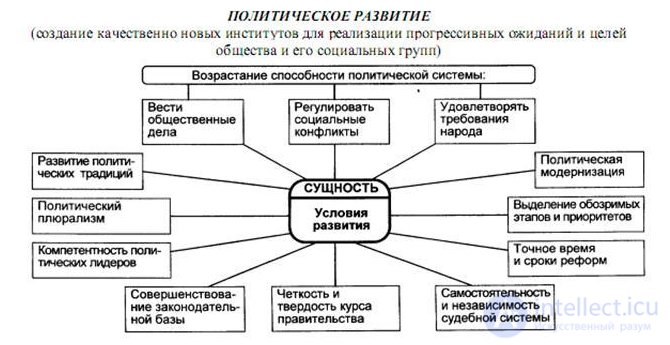
Among the principal conditions favouring political development, the following are usually singled out:
1. A constant increase in the number of organs of power (administration) and in the number of their functions — i.e. the emergence of new institutions and mechanisms;
2. Increased regulation of political processes and procedures (elections, decision-making, etc.) by state power and by society;
3. The expansion of political participation and the involvement of new social strata and groups in politics;
4. Society's increasing demands regarding the personal qualities and professional knowledge of the leaders of the state and of the political elite — as a result, new approaches to the selection of officials and administrators take hold and a more effective state bureaucracy is formed;
5. The elaboration of a programme of reforms and transformations answering the interests of society, which guide the process of political development itself;
6. In the spiritual sphere — secularisation and the establishment of a secular type of culture, and the universal spread of education and of the achievements of science and culture.
Among the principal causes of political development the following should be named:
1. Changes in the economic, political and spiritual-ideological needs of society;
2. Changes in culture and in public consciousness;
3. External contacts and the influence of the surrounding world (external threat, competition, or the borrowing of economic, cultural and everyday values and standards).
The two principal forms (varieties) of political development are revolution and reform.
A social revolution is a fundamental qualitative upheaval in the life of society which completes the gradually completes the process of the gradual maturation, within the womb of the old society, of the preconditions of a new socio-economic order. The fundamental question of every social revolution has traditionally been the question of political power — to which group (class) it will belong, whose interests it will express, how it will be structured, and so on. The character of revolutions is determined by which tasks they accomplish and which social forces take part in them.
In the world's most developed and socio-economically prosperous countries (the so-called "golden billion"), revolutions and radical socio-economic transformations are, as a rule, replaced by reforms.
A reform is an evolutionary and non-violent structural transformation within society (in social orders, relations and institutions — for example, political, economic, military, judicial, educational and other reforms) that is carried out by state power without a radical change in the foundations of the economic order and the political system, as a rule with the aim of increasing their effectiveness. Examples include the neoliberal economic course of M. Thatcher in Great Britain and R. Reagan in the USA, and the transformations of J. Chirac in France. The economic and political transformations in Russia and in most countries of the former "socialist bloc", which presuppose the creation of market and democratic institutions that are fundamentally new to them, are closer to revolutions of a new type than to reforms in the ordinary, "classical" sense. 
One of the most important stages of the political process is the making and execution of political decisions. Political decisions are in essence an expression of the political interests of a particular social group. In making a political decision, the goal and the means of attaining it are necessarily determined, bound up with the struggle for power and with the distribution, functioning and exercise of political power. At the same time, a situation is entirely possible in which the official institutions that at first glance bear responsibility for the decision-making process are in reality mere puppets subject to manipulation. In this sense it is always necessary to study carefully the relations among the bearers of political power. Therefore, behind the formal institutions of political power responsible for making decisions one must always look for the forces standing behind them, whose interests the decisions taken express.
The process of political decision-making is usually examined at the level of long-term goals and at the level of particular goals and their implementation.
The determination of long-term goals envisages large-scale socio-political transformations, which always require an assessment of the forces operating in the political arena, of their long-term interests, of the general course of historical development, and so on. The chief difficulty in implementing political decisions at this level is the time factor, since the results of the decision taken will become clear only after a long interval and may prove to be either positive or negative.
At the level of advancing particular goals, the tasks of a concrete stage of society's development are addressed. In this case decision-making passes through a series of successive actions, each of which expresses particular phases of the political system that constitute the mechanism for making and implementing political decisions.
1) Analysis of the problem situation. The starting point here is the receipt of a signal about unsatisfied social needs and about problems that have arisen and require resolution. The gathering of information is of enormous importance in this case. The analysis of the problem situation concludes with the formulation of the problem and its clarification in light of the other problems facing society.
2) Formulation of the decision. Here the decision is refined and evaluated and given a definite normative-legal form (a law, a decree, etc.). This usually takes place in the form of open debate and voting in representative organs of power. Nationwide discussion is also possible, however (a referendum, opinion polls, a plebiscite, and so on).
3) Adoption of the decision. In the practical activity of power structures this most often comes down to voting on the majority principle. In the case of nationwide discussion, the representative organs of power merely confirm its results. Should confirmation fail, it will be necessary to repeat the preceding stage.
4) Implementation of the decision. Under present-day conditions, the formation of approving public opinion acquires greater significance for this phase, without which any decision remains merely an element of discussion rather than a decision. For the successful implementation of decisions already taken, a number of conditions must be met: the political leadership must consistently press for the fulfilment of the decisions taken, must possess the ability to mobilise the necessary means and resources in implementing them, must secure the support of those groups in society capable of assisting in the execution of the decisions taken, and must
paralyse those actions which prevent the adopted decision from being carried through.
5) Monitoring the execution of a decision may be carried out both by the power structures and by society (state control and popular control). The exercise of control makes it possible to assess the correctness of the decision, to ascertain the results of its implementation, and to identify new problems as they arise. In examining the decision-making mechanism, one should always bear in mind that in a class-differentiated society there never have been (and never can be) class-neutral (so-called supra-class) political and administrative decisions, procedures for adopting them, forms of expressing them, or channels for implementing them. It is precisely for this reason that the making of political decisions functions as a form of realising the interests of the economically and politically dominant social group. [11, с.172]
There are various ways of making political decisions and putting them into practice. The most widespreadare:
1) Violence as the most effective means of ensuring that a decision is adopted in the shortest possible time. It may be exercised through coercion, pressure, the threat of punishment, oppression, repression, and so on. The use of violence has two essential aspects: it ignores the interests of a certain (usually substantial) part of the population, and it produces internal instability in the system owing to the failure to reconcile people's interests.
2) A system of multi-stage elections is the most widespread method of decision-making in contemporary democratic political systems. Here, however, there is scope for manipulation by particular social groups.
3) The consensual method of making political decisions is becoming ever more widespread. Without pressure or coercion, and with the full reconciliation of the interests of all or at least the majority of social groups, decisions are taken that satisfy the majority. This method best ensures the stability of the political system. [11, с173]
The stage of elaborating, adopting and executing political and administrative decisions is naturally succeeded by the stage of monitoring the condition and activity of the political system, with which the cycle of the political process concludes. It may be said that this is a kind of adjustment of the political system's movement in accordance with its own principles and with the interests of all participants in the political process. This adjustment is effected by minimising deviations of the given political process from the goals set. Control over the functioning of the political system is exercised in two ways: in the form of
so-called professional state control, and control from below, most often exercised with the help of the state's supervisory agencies and institutions but with the involvement of broad strata of the population. "Public control" performs the role of feedback in the overall movement of the entire political process.
The stage of monitoring the functioning of the political system completes a given cycle of the political process. But the political life of society represents a successive alternation of political processes. Therefore the completion of one cycle means the beginning of the next political process.

Comments