
Lecture
In most studies the political spectrum (political position, political orientation, political coordinates and so on) is a way of modelling the placement of various political views on the development and life of the world, a country, a state, a society and so on, by arranging them along one or more geometric axes representing independent political points of view.
L. F. Richardson, who published a work on the subject in 1919, is considered the founder of the methodology for modelling political processes. In 1928 this direction developed further after the publication of S. A. Rice's study "Quantitative Methods in Politics". Mathematical modelling in political science also developed in the 1950s–1960s (behaviouralism).
The most widely used spectrum comprises the "right wing" and the "left wing"; these concepts originally referred to the arrangement of seats in the French National Constituent Assembly of the 18th century.
On the simplest classic "right–left" axis, communism and anarchism are usually placed at the far left, social democracy to the left of centre, liberalism at the centre, conservatism and nationalism to the right of centre, and fundamentalism and fascism on the far right flank.
However, researchers often argue that a simple "left–right" axis is unsuccessful in describing the existing differences in political beliefs, and so other axes are often used. Ignoring the differences in the names given to the opposite poles of the axes in various studies, what one most often observes is a two-axis model in which one axis represents cultural aspects and the other political ones. Each of the axes has two poles: individualism and collectivism. Whereas the left are classed as individualists on social and cultural questions and as collectivists in relation to economic questions, the right are collectivists on questions of culture and social life and individualists on questions of economics.
Roderick Stackelberg wrote: "The more a person regards absolute equality among all people as a desirable condition, the further to the left he will be on the ideological spectrum. The more a person regards inequality as inevitable or even desirable, the further to the right he will be."
In 1950 Leonard Ferguson carried out an analysis of political values using scales measuring attitudes towards:
He gathered these variables into three factors, which he named religionism, humanitarianism and nationalism:
The last factor — nationalism — proved untenable.
Some time later Hans Eysenck began researching political preferences in Britain. In his book he states that he compiled a list of political statements that he found in newspapers and political documents and surveyed subjects as to whether they agreed or disagreed with each of them.
Applying a factor analysis similar to Ferguson's, Eysenck found two factors, which he named "Radicalism" (the R factor) and "Tender-mindedness" (the T factor). While the first factor is easy to relate to the "right–left" axis, the T factor was a novelty. People who scored highly on this factor supported pacifism, racial equality, religious education and restrictions on abortion, while those who scored lower supported militarism, harsh punishments and simplified divorce legislation.
Despite the differences in methodology, the factors discovered by Ferguson (religionism and humanitarianism) and by Eysenck correlate strongly The factors identified by Eysenck were later found by factor analysis of data in France and Japan , Germany and Sweden.
One of Eysenck's interesting findings was that in the Arab states only the T axis was present, with nothing resembling a radical–conservative continuum .
In subsequent research Eysenck discovered a split on the "left–right" axis between economic and social policy, which allowed him to introduce a new axis — "socialism–capitalism" (the S factor). The new factor showed a strong correlation with the original R factor, although there were certain differences: the new factor related to economic inequality and big business, whereas the R factor operated mainly with attitudes towards criminals, and towards military and sexual questions.
Milton Rokeach, dissatisfied with Eysenck's work, developed a two-axis model whose axes were "equality" and "freedom" . To test the model, Rokeach and his colleagues carried out a content analysis of works representing Nazism (A. Hitler), communism (V. I. Lenin), capitalism (B. Goldwater) and socialism (written by a number of authors).
By the frequency of use of the concepts singled out by Rokeach and of their synonyms, "freedom" and "equality" received the following ranks:
In further research Eysenck refined his methodology, including in it more questions on economic problems. This allowed him to identify a split on the "left–right" axis between social and economic policy, as well as a previously undiscovered socialism–capitalism dimension (the S factor).
Although the S factor differs factor by factor from Eysenck's earlier R factor, it correlates positively with the R factor, indicating that an underlying "left-to-right" or "right-to-left" tendency lies at the base of both social and economic values, although S is more concerned with items devoted to economic inequality and big business, while R is more connected with the treatment of criminals and with sexual and military questions.
Another replication was obtained from Ronald Inglehart's study of national opinions, based on the World Values Survey, although Inglehart's study described the values of countries rather than of individuals or of groups of individuals within countries. Inglehart's two-factor solution took the form of Ferguson's original dimensions of religiosity and humanism; Inglehart labelled them "secularism–traditionalism", which covered questions of tradition and religion such as patriotism, abortion, euthanasia and the importance of obedience to law and authority, and "survival–self-expression", which measured such questions as everyday behaviour and dress, acceptance of diversity (including foreigners) and of innovation, and attitudes towards people with certain controversial lifestyles such as homosexuality and vegetarianism, as well as willingness to take part in political activism.
Although not directly connected with Eysenck's research, the data suggest that in the USA there may be up to six dimensions of political views, and in the United Kingdom up to ten. This conclusion is based on two large data sets and uses a Bayesian approach instead of traditional factor analysis. [
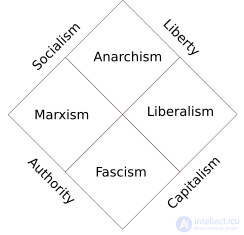
A multi-axis political scheme contrasting authoritarian and libertarian socialism.
The American Federalist Journal proposed only one axis — the "degree of state control" — placing "Communism/fascism" at one pole and "Anarchy" at the other.
In 1998 the political scientist Virginia Postrel proposed a different single axis, relating to views of the future. One pole is represented by those who fear the future and want to control it — the "stasists"; at the other pole are those who make no plans and do not wish to control the future — the "dynamists", which in essence reflects a utopian–dystopian spectrum.
Some other proposed axes:
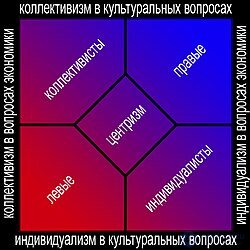
The Nolan chart |
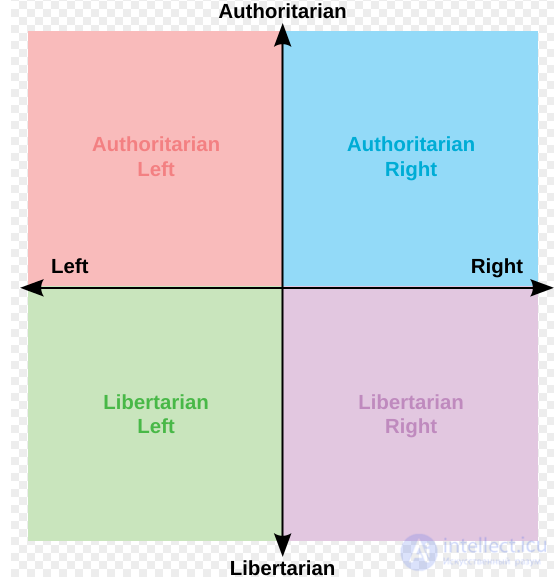
The chart proposed by the Political Compass Organization
The chart of the libertarian David Nolan represents "economic freedom" (taxes, trade, free enterprise, etc.) on the horizontal axis and "personal freedom" (drugs, abortion, etc.) on the vertical one. Nolan's model can be regarded as Eysenck's model rotated by 45 degrees, with the traditional "right–left" axis running along the diagonal.
There are also two three-axis versions of the Nolan chart. The Frisian Institute added an axis of "positive freedom". The Russian variant of the chart divides Nolan's economic axis into two axes — the corporate economy (the z axis) and the individual economy (the y axis).
In 2003 Jeff Greenberg and Eva Jonas proposed a model with two axes: "left–right" and an axis representing political rigidity. The latter, in the authors' view, relates to the concepts of dogmatism and authoritarianism and is characterised by "belief in strong leaders and submission, preference for one's own group, ethnocentrism and nationalism, aggression against dissidents, and police or military control".
In 2003 Chris Lightfoot proposed, on the basis of a survey of the British public, two eigenvectors: the standard "left–right" one and a second reflecting the degree of "political pragmatism". According to the results of the study, these two vectors best describe the British political spectrum .
Jerry Pournelle created his own two-axis model. One axis is "liberty" — those on the left seek freedom from control, while those on the right welcome state control. The radical "left" regard the state as evil, the far right exalt the state. The other axis is "rationality": the "left" believe in the rational resolution of social problems, while at the opposite pole are those sceptical in this respect.
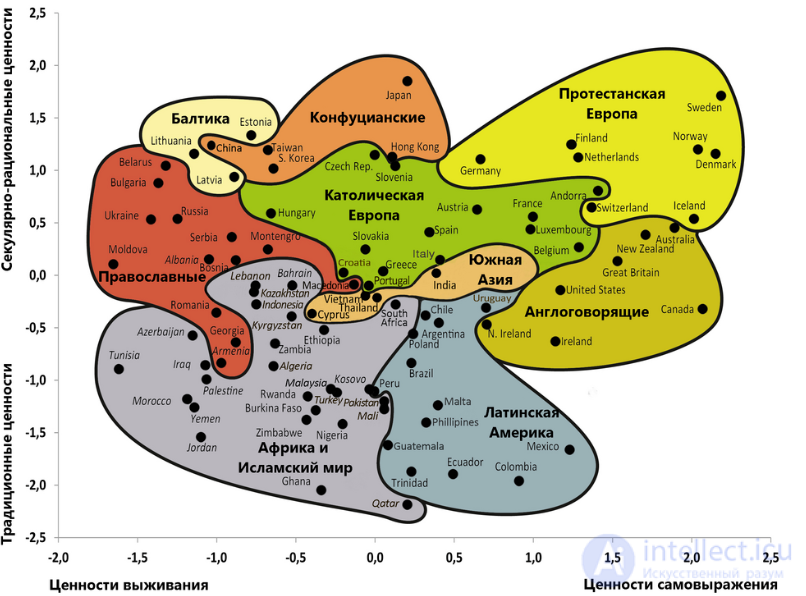
A reconstructed Inglehart–Welzel cultural map of the world based on the World Values Survey.
In 2003 the sociologist Ronald Inglehart proposed two axes — along one were plotted questions of religion and tradition: patriotism, abortion, euthanasia, the rule of law. Traditionalist positions are located at the bottom, secular ones at the top. The x axis relates to self-expression, to such questions as outward appearance, differences (including foreigners), innovation and political activism. On the right is the position of open self-expression, on the left the position that Inglehart called the survival position. This chart also makes it possible to compare countries: for example, the EU countries are located in the upper right, the English-speaking countries in the middle right, Latin America in the lower right, Africa, the Arab countries and South Asia in the lower left, and the former communist countries in the upper left.
In his book Brian Patrick Mitchell identifies four main political traditions in Anglo-American history[13]. Mitchell analyses contemporary American political society in terms of its attitude to "kratos" — force — and to "arche" — social differentiation — and identifies four traditions in Western political thought:
according to Mitchell, anarchy is not the absence of government but the absence of stratification in society.
Mitchell also characterises other political tendencies:

The Nolan scale
Political beliefs are a set or system of beliefs and views on politics, the economy, the structure of the state and of society, on what the laws should be and what public morality should be.
Political beliefs are often closely intertwined with a person's other personal convictions — with his faith or religion, his personal morality and his scale of values.
Political beliefs may or may not be reflected in specific actions aimed at defending or realising those beliefs — for example, in voting at elections for a particular political party or movement or for a particular candidate, or in taking part or not taking part in rallies and protest demonstrations, and so on and so forth.
At present political scientists, sociologists and social psychologists recognise that this scale and the very division into "left" and "right" are outdated and inadequately reflect the spectrum of opinion that actually exists in society. Thus it is entirely unclear where on this scale one might place, for example, libertarians. It is also possible for a person to hold beliefs that in one area (say, economics) are considered traditionally "left-wing", and in another (say, politics) are considered "right-wing". The situation is further complicated by the blurring of programmatic and ideological differences and the political convergence of the traditional parties in Western political systems over the past 100 years, and by the interpenetration and mutual enrichment of different systems of views. It is also significant that in post-communist countries, and especially post-Soviet ones, the notions of "rightness" and "leftness" are often used in a sense opposite to that accepted in the West — thus, during the perestroika era liberals and anti-communists were often called "the left", and traditional orthodox communists "the right" .
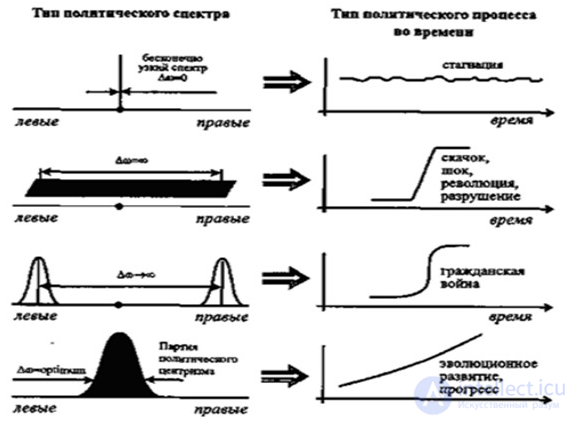
Types of political spectra and qualitative types of temporal processes.
Since the linear political scale ("right" and "left") does not make it possible to reflect with sufficient accuracy either views on the role of the state in controlling the life of society or views on the role of the state in ensuring social equality, use is also made of the "political compass" (which marks, alongside the "left"–"right" axis representing attitudes to economic questions, the distribution into libertarian and authoritarian socio-political beliefs) — a scale proposed by the American libertarian David Nolan in 1970.[15][16]:
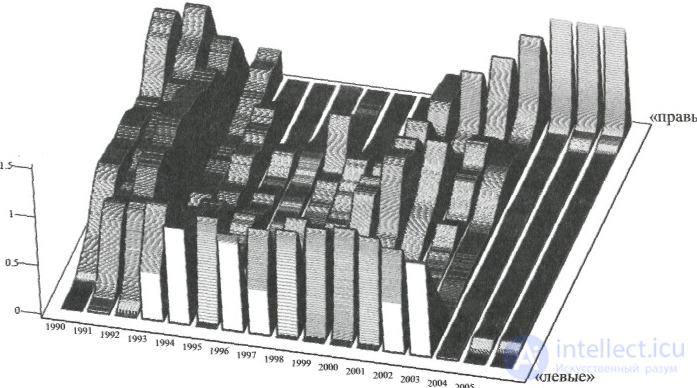
The dynamics of Russia's political spectrum in 1990–2006.
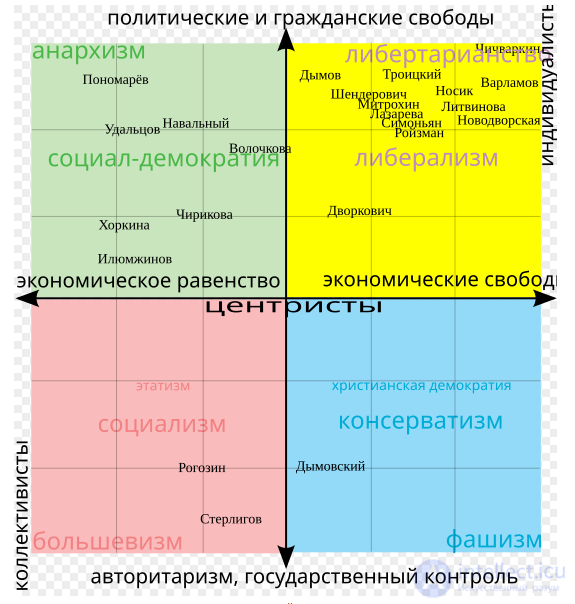
A political compass for Russian politicians and public figures according to data from Slon.ru and Dozhd.
The political spectrum can also be used as a forecasting tool. The works of S. S. Sulakshin are instructive in this respect
In their work the authors examine the political spectrum from the point of view of its quantitative representation. Quantitative assessment of the positions of political parties makes it possible to trace the dynamics of the political spectrum's variability and to identify the degree of the political spectrum's sensitivity to the political process, which in turn provides grounds for developing a methodology for monitoring and forecasting the political process in Russia. Political spectra were constructed on the basis of quantitative assessments of the results of roll-call votes by deputies of the Congress of People's Deputies of the RSFSR (1990–1993) and of the State Duma of the Russian Federation (1994–2006).
These works mathematically demonstrated that there exists a certain optimal width of the political spectrum, the presence of which guarantees the country's sustainable development (positive dynamics in a broad range of significant statistical indicators). At the same time, an infinitely narrow and an infinitely broad spectrum both lead to stagnation, revolution and so on. Thus changes in the political spectrum make it possible to forecast particular trends in the country's development.
It was also demonstrated that in the short term it is precisely the political spectrum that determines the dynamics of the indicators, and not the other way round.
As of 2012 the political spectrum of the main system political parties is represented by the following continuum: 1) the left (communists) — the CPRF; 2) the centre-left (socialists) — A Just Russia; 3) the centre — Yabloko (left liberals) and Right Cause (right liberals); 4) the centre-right (conservatives) — United Russia; 5) the right — the LDPR. The parties of the centre are not represented in the State Duma.
As the Russian political scientist Stepan S. Sulakshin has shown, political spectra can be used as a forecasting tool. Sulakshin mathematically demonstrated that sustainable development (positive dynamics in a vast number of statistical indicators) depends on the width of the political spectrum: if it is too narrow or too broad, stagnation or political catastrophes ensue. Sulakshin also showed that in the short term the political spectrum determines the dynamics of statistical indicators, and not the other way round.
A number of studies have found that biology may be linked to political orientation. Many studies connecting biology with politics remain controversial and unconfirmed, although the overall body of evidence is growing.
Studies have shown that people with conservative political views have larger amygdalae and are more prone to feelings of disgust. Liberals have a greater volume of grey matter in the anterior cingulate cortex and are better at detecting errors in repeating patterns. The anterior cingulate cortex is used when dealing with conflicting information. A study conducted by researchers from the University of California, Los Angeles (UCLA) and New York University (NYU) had participants go through a deck of cards. The letter M appeared in the deck four times more often than the letter W. Participants had to press a button every time the letter M appeared in the deck. Liberals were shown to make fewer errors confusing W with M. This behavioural study confirmed the view that liberals cope better with conflicting information. Conservatives' sympathetic nervous systems react more strongly to threatening images, and they are more likely to interpret ambiguous facial expressions as threatening. On the whole, conservatives more often report broader social ties, greater happiness and higher self-esteem than liberals. Liberals more often report greater emotional distress, dissatisfaction with relationships and difficulties connected with personal experience, and are also more open to experience and better able to tolerate uncertainty and disorder.
Genetic factors account for at least part of the differences in political views. From the standpoint of evolutionary psychology, conflicts connected with the redistribution of wealth may have been a common occurrence in the ancestral environment, and people may have evolved psychological mechanisms for assessing their chances of success in such conflicts. These mechanisms influence political views.

Comments