
Lecture
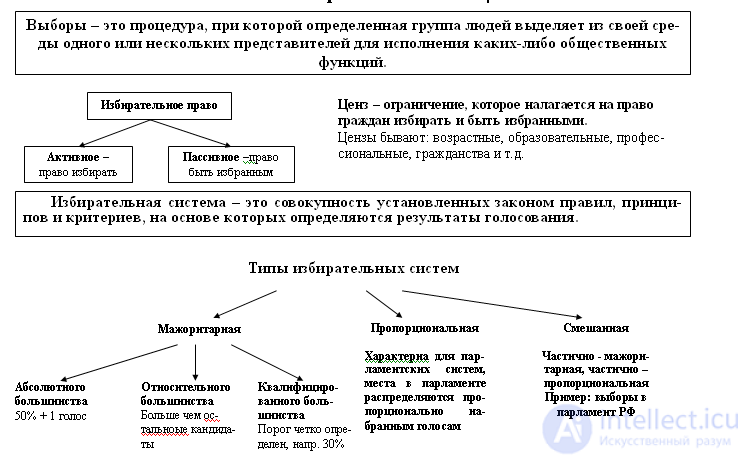
Elections - a means of forming bodies of power and administration through the expression, according to certain rules (in accordance with the electoral system), of the political will of citizens. As a result of elections, the elected candidates are vested with powers of authority. Elections are used in various democratic organizations: parties, trade unions, voluntary associations, cooperatives, joint-stock companies, and so on. This chapter deals chiefly with elections on the scale of the state, of the entire political system.
Elections are always bound up with voting. Yet for all the closeness of these concepts, they also have substantial differences. Elections are usually understood as a relatively regular, periodic process, enshrined in the constitution and other laws, of electing the membership of state bodies. Voting, however, is not always connected with elections. It is also used in various forms of direct democracy: in referendums, polls, the adoption of collective decisions at meetings, and so forth.
Under modern democracies, elections are their pivotal mechanism, the principal form in which the sovereignty of the people and its political role as the source of power are manifested. They also serve as the most important channel for representing the interests of various social groups in the organs of power. Universal elections presuppose the right of every citizen to take part in them. For many, and in some countries for the majority of citizens, they are the only form of their real participation in politics. They make it possible to exert the greatest influence on power: to retain or replace parliaments and governments, to ensure their accountability to the people, to change the political course, and so on.
Elections are a fairly frequent phenomenon in political and public life, since they extend to various institutions and levels of governance: parliament, the president, the representative and often the executive bodies of the constituent parts of a federation, and local authorities. Thus, in the United States, federal, nationwide presidential elections are held once every four years, and every two years there are elections to the House of Representatives, the lower chamber of Congress. Within the same intervals — once every two years, but for six-year rather than two-year terms — one third of the members of the upper chamber of Congress, the Senate, is elected. At the state level, governors, legislative assemblies, attorneys general and other officials are regularly elected; at the local level, mayors, councillors, treasurers, clerks, judges, sheriffs, constables, school superintendents, and so on. The overall picture is completed by elections in parties, trade unions and numerous voluntary associations. The diversity of electoral forms opens up fairly wide opportunities for citizens to display political activity and to influence state and public affairs.
Elections may be:
- Democratic and undemocratic.
- Regular and early – early elections are held if an official or the parliament as a whole resigns before the end of the term of office.
- Direct and indirect – indirect elections presuppose a two-stage system of election; first citizens elect their representatives, and then the latter vote for one candidate or another in accordance with the mandate of the voters.
- By-elections – held when it is necessary to fill a vacancy that has arisen as a result of a deputy's inability to perform his duties or of his premature death.
- Partial – this is how the upper chamber of the parliament in the USA is elected: every 2 years one third is re-elected, and over 6 years the membership is fully renewed.
The functions of elections:
- the articulation, aggregation and representation of the varied interests of the population. In candidates' election programmes, interests are articulated, i.e. they receive a clear formulation, and are aggregated, freed of extremes and averaged out, acquiring a consistent form suitable for implementation.
- control over the institutions of power.
- the integration of diverse opinions and the formation of a common political will.
- the legitimation and stabilization of the political system, as well as the legitimation of specific institutions of power: parliament, the government, the president, and so on.
- the expansion of communication and of relations of representation between the institutions of power and citizens. In the course of the electoral process candidates regularly meet with citizens, listen to their opinions and requests, and make adjustments to their electoral platforms. Elections are the most important channel of feedback between citizens and those in power.
- the channelling of political conflicts, their redirection into the course of institutionalized peaceful settlement. Elections make it possible to present conflicting interests, values and ideas openly and publicly to the judgement of popular opinion, to determine the real level of support for the positions of one or another side of the conflict, and, with the help of the authority of public opinion and state institutions, to persuade the conflicting parties to abandon the most radical demands and unlawful forms of struggle.
- the mobilization of the electoral body to address pressing social tasks.
- the political socialization of the population, the development of its political consciousness and political participation. In the course of the electoral process citizens assimilate political values and norms with particular intensity, and acquire political skills and experience.
- the recruitment of the political elite.
- the generation of society's renewal through competition among alternative political programmes. Elections are a kind of window opened to orderly, institutionalized influences on the state and society. They give various political forces the opportunity to present their own vision of social problems and to put forward programmes for solving them. This stimulates the search for optimal paths of development, ensures the competitive selection of political values and alternatives, and creates favourable opportunities for overcoming ineffective policy and for establishing new, viable ideas and political platforms;
- the constitution of an effective opposition and its preparation for performing the functions of political leadership. The effectiveness of the opposition presupposes that it performs the functions of criticizing and monitoring the government, as well as its capacity to work out an alternative policy. By prompting various political forces to compare their programmes openly, to make compromises and form coalitions, elections contribute to the consolidation of the opposition. [22, с.345-346; 10, с.212-214]
Elections perform the functions named above only if they are themselves organized democratically. Elections are from the outset meant to serve democracy and are inseparably linked with its general conception and values. Their main social purpose is, by adequately reflecting the opinion and will of citizens, to ensure the representation of the main social groups in the organs of power, and also to form an effective government.
The term «Electoral law» may be used in two principal senses:
1. The body of legal norms regulating the preparation and conduct of elections and the tallying of their results.
2. The right of citizens to elect (the active right to vote) and to be elected (the passive right to stand for election).
The active right to vote – is the right of a citizen to elect, to take part personally in elections to representative institutions and of officials. In our time all manner of estate-based, property, educational, racial-national and other restrictions – qualifications – have been abolished, and the circle of persons enjoying electoral rights is very wide. Nevertheless, some qualifications survive to this day. Thus, in some Muslim countries women are still deprived of the right to vote, and in a number of countries women obtained electoral rights not so long ago. For example, in Italy and Japan this happened in 1945, in Greece in 1956, and in Switzerland in 1971. [17, с.278; 18, с.236-237]
The exercise of the active right to vote may be direct or indirect. Direct elections mean that deputies are elected by citizens themselves. In indirect elections citizens elect electors, who then decide whom to elect to one post or another. Two-stage elections are used, for example, to elect the presidents of the USA, Brazil and Finland, and the upper chambers of the parliaments of India, Malaysia and other states. In France part of the Senate is formed by means of three-stage elections.
The passive right to stand for election – is the right to be elected, the legally established right of a citizen to be a candidate for representative bodies or for elective office. There are restrictions on the right to be elected as well. Thus, to run for the post of President of the USA one must have reached the age of 35 and be a citizen of the USA by birth. A senator of that country may be a person no younger than 30 who has been a citizen of the USA for 9 years. A citizen of the Republic of Belarus no younger than 35, possessing the right to vote and having lived in the country for at least 10 years, may be elected President of Belarus. [17, с.279]
The democratic principles of electoral law include:
1. Universality — all citizens, irrespective of sex, racial, national, class or occupational affiliation, language, level of income, wealth, education, confession or political convictions, have the active right (as voters) and the passive right (as candidates) to take part in elections.
2. Equality — each voter has only one vote, which is valued equally, regardless of which particular person it belongs to.
3. Secrecy of elections — the decision of a particular voter must not be known to anyone.
4. Direct (immediate) voting — the voter takes a decision directly about a specific candidate for elective office and votes for a real person. Between voters and candidates there are no intermediate bodies mediating their expression of will and directly determining the personal composition of the deputies. [22, с.347; 18, с.234-235]
On the basis of democratic electoral rights, principles have taken shape that characterize the organization of the electoral process. These principles include:
1. Freedom of elections, which presupposes above all the absence of political, administrative, socio-economic, psychological and informational pressure on voters, activists, candidates and the organizers of elections.
2. The availability of a choice, of alternative candidates.
3. The contested, competitive character of elections. Various political forces must have the opportunity to compete for the confidence of voters at elections, to acquaint them with and convince them of the soundness and advantages of their own electoral programme and of the shortcomings of their competitors' electoral platforms.
4. The periodicity and regularity of elections. Elections are able to perform constructive functions and to serve as an instrument of democracy on condition that the holders of mandates are elected for a definite and not overly long term. This is necessary so that voters can monitor their representatives, prevent abuses of power and correct the government's political course.
5. Equality of opportunity for political parties and candidates. This presupposes above all an approximate equality of their material and informational resources. Such equality can be ensured by establishing a maximum level of election expenditure for any party, limiting the size of contributions by organizations and individuals to the electoral funds of parties and candidates, granting them free airtime on state television and radio on the basis of equality, and so on.
An electoral system – is the body of legally established rules, principles and techniques by means of which the results of voting are determined and parliamentary mandates are distributed.
The functioning of any electoral system can be assessed only in connection with the form of government, the political culture of the country and the nature of its political parties. That is why electoral laws cease to correspond to their purposes as other institutions of society and the state change. It is no accident that under conditions of major social change the electoral system changes too. Thus the electoral system in Russia has changed, a reform of the electoral system is under way in Italy, and electoral laws have changed in Belarus and other post-Soviet republics.
The choice of one electoral system or another entails substantial changes in the alignment of political forces. Thus, in France the electoral law became the object of fierce political struggle and was substantially changed several times depending on the prevailing balance of political forces. The American system corresponds to the character of the dividing line that has taken shape there between the main tendencies and parties, and helps to preserve and even deepen it. The Italian (proportional) system takes account of the more diverse political world of that country, although it no longer fully corresponds to the present alignment of political forces, which is precisely what makes a reform of the electoral system necessary.
Thus, the electoral system in each country is created depending on how the interests of one's party and of society are understood and on what the political traditions and culture are. For this reason politicians are, as a rule, cautious in approaching changes to electoral legislation. Upsetting the balance of forces in a stable society always leads to unpredictable consequences and can destabilize political life.
The electoral procedure — is the state's measures for organizing and conducting elections, the electoral law in action.
The electoral procedure, as a body of organizational rules, may remain in a relatively unchanged form for quite a long time, in the course of which more than one election campaign will take place. The electoral procedure includes:
An election campaign — is the actions of the direct participants in the elections, of the sides competing in the elections — parties, various public organizations, and the candidates themselves.
An election campaign involves the nomination of candidates by the contending political forces, campaigning on their behalf, and so on. In states with established democracies the tone of the election campaign is set by parties and blocs of parties. So-called independent candidates in these states, as a rule, have no serious chance of victory; their solo is drowned in the powerful propaganda-and-agitation chorus of the political parties.
Electoral struggle is the main field of activity of a political party in a democratic society. One might even assert, in a certain sense, that democratic parties are born and exist for elections. Every party takes care to expand its electorate. The electorate (from the Latin elector — voter) is the contingent of voters who vote for a particular party at elections. For example, the electorate of social-democratic parties consists mainly of workers, the intelligentsia, white-collar employees and small proprietors. The electorate is not some strictly delineated social group, although it does possess a certain relative stability. From election to election the electorate of a given party changes both quantitatively and qualitatively. For instance, after Labour displaced the Liberals from Britain's effectively two-party system, the electorate of the former was substantially replenished at the expense of the electorate of the latter.
An election campaign— is a very costly undertaking. As a result the advantage often lies not with those who are right but with those who are rich. In order to soften somewhat this phenomenon, which does democracy no credit, in some countries (the USA, Great Britain, Japan, South Africa) the law establishes a permissible maximum sum of pre-election expenditure, but it is difficult to monitor compliance with it. In addition, with the aim of creating «equal conditions» for the groupings competing in the elections, state funding for them is practised in the form of subsidies or the reimbursement of election expenses, but the sums intended for this again end up in the hands of the stronger and less needy. In some countries, in order to receive state financial assistance a party must collect a certain minimum of votes (in Sweden—2%, in the FRG—0.5%), in others it must nominate candidates in a certain number of districts (Italy, Norway). The sum allocated is proportional to the number of votes collected by the party (the FRG, Norway) or to the number of candidates it has nominated (Sweden, Denmark, Finland).
The election campaign ends the day before the elections in order to give voters the opportunity to make up their minds.
The culmination of the electoral procedure is election day. In many modern states voting is not only a right but also a duty, failure to perform which carries a penalty: in Belgium, the Netherlands and Australia a fine, in Pakistan even imprisonment. Such severity is explained by the growth of absenteeism (from the Latin absentia — absence) — the avoidance by citizens of participation in elections
In some countries, in order to avoid an «electoral crush», the number of candidates standing in each electoral district is limited. Thus, in Great Britain this number must not exceed five candidates. In addition, each candidate pays a fairly large monetary deposit, which will be forfeited if the contender does not obtain a minimum of 5% of the total number of votes.
The electoral procedure concludes with the counting of votes and the determination and announcement of the election results. The counting of votes presents neither a technical nor a moral problem in civilized countries. In those that do not yet belong to their number, falsification of the voting results is also possible. This occurred at the 1986 presidential elections in the Philippines, at the 1988 parliamentary elections in Bangladesh and in other countries.
The 3 most widespread electoral systems are: majoritarian, proportional and mixed (majoritarian-proportional). Under the majoritarian system (from the French majorité – majority) only the votes cast for the candidate who received a majority of the votes are taken into account. The winner takes all. This system operates in Great Britain, the USA, France, Japan and Belarus. It is based on single-member districts, i.e. only one deputy is elected from a district. There are 3 types of majoritarian system: 1. The absolute majority system: the winner must collect more than half of the votes (50%+1 vote) in the given electoral district. Since it is very difficult to obtain so many votes, voting under this system usually takes place in 2 rounds. The candidates who received the most votes in the 1st round are admitted to the 2nd round. In the second round the winner is the one who received a simple majority of the votes. 2. The relative majority system: the winner is the candidate who collected more votes than each of his rivals individually. He may in doing so collect less than half of all the votes. In the event of a complete tie the question is decided by lot. 3. The qualified majority system: the winner must receive a majority established in advance and exceeding 50% — most often 2/3 or 3/4. The majoritarian system has both drawbacks and merits. Its drawbacks are that the principle of universal suffrage is not ensured, since the votes cast for the remaining candidates are not taken into account; small parties do not obtain representation; in deputies' politics the interests of their own district may prevail over nationwide interests; a head of state elected under this system may not represent the interests of the majority of voters; electoral districts may be drawn in such a way that the number of votes does not correspond to the seats obtained in parliament. Among the merits of the majoritarian system is that strong support for a deputy in his own district makes him more influential and independent in parliament, and also that a stable balance of forces is created in parliament, which makes it possible to form a stable government. The proportional system is usually used in elections to parliament. Under it seats in parliament are distributed among parties in accordance with the number of votes cast for each of them. There are 2 types of this system: - the proportional system at the national level. Under it no districts are designated and citizens vote for political parties on the scale of the entire country. On the basis of the results obtained, seats in parliament are distributed; - the multi-member district variant. Here seats are distributed depending on the influence of the various parties on the scale of the district. Under the proportional system candidates are nominated only by political parties (each draws up its own list), and the voter votes for the list of one party or bloc or another. In some countries strong parties have secured legislative safeguards against the penetration of small parties into parliament. These include the «percentage barrier». If a party does not collect the minimum of votes established by law, it is not admitted to the distribution of seats. Most often this is 5% (Russia, Germany), in Sweden it is 4%, in Israel 1%. The parties that have cleared the barrier also divide up the remaining percentage. Usually the parties of national minorities are exempted from this rule (in the countries of Eastern Europe).
After the voting, the distribution of mandates begins on the basis of the electoral quota – the number of votes needed to elect one deputy. each party receives in a district as many deputy mandates as fit into the quota depending on the votes obtained.
Among the merits of the proportional system are: a fuller representation of political parties in parliament and the possibility of adopting decisions that better meet the interests of various groups of the population. Among its drawbacks are the weakening of ties between voters and parliamentarians, since people voted not for specific individuals but for parties; the dependence of deputies on party structures; the representation in parliament of political forces that do not have serious support throughout the country, which leads to the formation of unstable coalition governments.
In the modern world various modifications of both the majoritarian and, especially, the proportional systems are applied. Many countries, seeking to make the fullest use of the merits of each of them and to soften their drawbacks, apply mixed systems that combine elements of the majoritarian and proportional electoral systems. Thus, in the FRG one half of the deputies of the Bundestag is elected under the majoritarian system of relative majority, and the second half under the proportional system.
In recent decades some organizations (the UN, the Green parties and others) have used a consensus system of elections. It has a positive orientation, i.e. it is aimed not at criticizing the opponent but at finding the candidate or electoral platform most acceptable to all. In practice this is expressed in the fact that the voter votes not for one but for all (necessarily more than two) candidates and ranks the list of them in the order of his own preferences. Thus, for example, if 5 candidates are contending for the post of president, the voter determines the place of each of them. First place is awarded 5 points, second — 4, third — 3, fourth — 2, fifth — 1 point. After the voting the points obtained are summed up and the winner is determined by their number.

Comments