
Lecture
Comparative political science is one of the branches of political science (politology). The principal method of comparative political science is the method of comparison. Hence another name for this branch — comparative studies, or comparativistics (from the English "compare"). Comparative political science studies politics by comparing and juxtaposing political phenomena of the same type across different political systems. Among such phenomena, the first to be studied are political processes, political relations, political institutions, political regimes, political culture, political parties, movements and so forth.
Comparative politics is the systematic study and comparison of the world's various political systems. Comparative politics analyses differences in political regimes, structures of governance, electoral systems, policy outcomes and public administration across different countries, regions or periods of time. It is comparative in that it seeks explanations for why different political systems have similarities or differences and how changes came about between them in the course of their development. It is systematic in that it looks for trends, patterns and regularities among these political systems. The field of study considers political systems throughout the world, paying particular attention to such topics as democratisation, globalisation and integration. New theories and approaches have been employed in political science over the past 40 years thanks to comparative politics. Some of them focus on political culture, dependency theory, developmentalism, corporatism, indigenous theories of change, comparative political economy, state–society relations and the new institutionalism. Some examples of comparative politics study the differences between presidential and parliamentary systems, democracies and dictatorships, parliamentary systems in different countries, and multi-party systems such as Canada and two-party systems such as the United States. Comparative politics must be conducted at a specific point in time, usually the present. A researcher cannot compare systems from different periods of time; it must be static.
While historically the discipline examined general questions of political science through cross-country comparisons, contemporary comparative political science mainly uses subnational comparisons. Recently there has been a considerable growth of interest in subnational comparisons and in the benefits they bring to comparative politics. We would know far less about major credible problems in political science were it not for subnational research. Subnational research contributes important methodological, theoretical and substantive insights to the study of politics. Important developments, often obscured by a focus on the national level, are easier to decipher with the help of subnational research. An example would be regions within countries where the presence of state institutions has been reduced in effect or in significance.
The name "comparative politics" refers to the discipline's historical connection with the comparative method, described in detail below. Arend Lijphart argues that comparative politics has no substantive focus of its own, but rather a methodological one: it focuses on "the how, but does not specify the what of analysis". [ 4 ] Peter Mair and Richard Rose offer a somewhat different definition, arguing that comparative politics is defined by a combination of a substantive focus on the study of countries' political systems and a method of identifying and explaining similarities and differences between those countries using common concepts.
Sometimes, particularly in the United States, the term "comparative politics" is used to mean "the politics of foreign countries". This use of the term is contested.
Comparative politics is essential for understanding the nature and functions of political systems throughout the world; political structures across the world vary considerably from country to country because of historical, social, ethical and racial differences. Even similar political organisations operate differently. For example, India and the United States are both countries with majority rule; nevertheless, the US has a liberal presidential system based on voting, unlike the parliamentary system used in India. Even the measure of political decision-making in the United States is more varied when considered in the light of India's popular government. In the United States the president is their leader, whereas India has a prime minister. The relative legislative issues prompt us to understand these central contracts and how the two countries are entirely different despite majority rule. This field of study is of decisive importance for the fields of international relations and conflict resolution. Close politics prompts international relations to clarify global legislative issues and current winning conditions around the world. Although both are subfields of political science, comparative politics studies the causes of international strategy and the influence of global approaches and structures on local political behaviour and functioning.
Comparative political science began to emerge as an independent field of research in the first half of the nineteenth century, and initially research in this field amounted to a simple description of differences in the course of one or another political process. Already in the middle of the nineteenth century, however, the American researcher F. Lieber worked not only with the political systems of his own day but also with historical facts, since he considered history the most important part of political science. Somewhat later, the English scholar E. Freeman, who taught at Oxford, pointed to three basic parameters on the basis of which similarities between political phenomena in different systems may be found. Their similarity may be due to the similarity of the environment in which the political systems find themselves, as well as to the similarity of their historical development and experience. Acts of direct borrowing of particular practices by one country from another are also not to be excluded. At the first stage in the development of comparative political science, it displayed a strong link with legal scholarship in matters of methodology. In addition, much attention was devoted to comparing legal systems directly from a political-science point of view. The similarity of methods was expressed in the fact that in both cases scholars mainly resorted to precise description of particular phenomena and the subsequent juxtaposition of common and differing features.
At the beginning of the twentieth century such outstanding sociologists as Max Weber and Émile Durkheim proposed new ways of comparatively studying social and, along with them, political phenomena. Weber introduced the concept of the "ideal type", a certain model of a given system or phenomenon that has never existed and cannot exist, but that serves as an ideal against which a phenomenon of political or social life can be compared and certain conclusions drawn on that basis. Durkheim, for his part, wrote about so-called "social species", which occur in contemporary societies and are neither historical models nor expressions of an abstract philosophical ideal. It is precisely such social species that can be subjected to productive comparative analysis. Nevertheless, in the first two decades of the twentieth century a purely descriptive approach, based solely on empirical facts, continued to dominate. This impeded the development of the methodology of comparative political science and led to biased, evaluative conclusions. Certain political systems were recognised as models for others to emulate; a preference for the European model of the political system was clearly discernible in this scholarly field. Thus, some scholars reduced comparative political science altogether to a simple generalisation of empirical information. As a result, the traditional school of comparative political science took shape at the beginning of the twentieth century. It was distinguished by its reliance on empirical facts and a poorly developed theoretical component. In addition, researchers often allowed purely evaluative judgements, and their sympathy for the political systems of the leading European countries was discernible. Comparative political science was reduced to a method of describing and simply juxtaposing mainly political systems, and these were only the countries of Europe, as well as America.
Changes in the paradigm of comparative political science began to manifest themselves increasingly in the second third of the twentieth century. At first these were short articles by a number of authors in which, among other things, they for the first time resorted to comparing individual political institutions rather than states as a whole. A. J. Toynbee also made a major contribution to the further development of comparative studies. He wrote that the juxtaposition of facts is only one part of this field of research. Alongside it, another important component is the elaboration of general regularities and the formulation of laws governing the operation of particular institutions in different environments. Historical events also pushed towards a revision of the established paradigm. Thus the strengthening of the United States after the Second World War, thanks to which it was able to influence the political systems of European countries, revealed the inapplicability of a number of the values and institutions of the American political model to other systems. This destroyed the previous assumptions about model countries and compelled researchers to turn to the analysis of the historical development of particular institutions.
The formation of the school of the new comparative political science is associated with a seminar held in Chicago in 1952 at the instigation of the Social Science Research Council. At this event the traditional paradigm of comparative studies was revised and new rules of research were put forward. The general outcomes of the seminar were a departure from the tradition of simple description and juxtaposition, a recognition of the need for more rigorous testing of hypotheses by means of the method of falsification, and an expansion of the range of countries studied to include those of Asia and Latin America.
The development of comparative political science was inevitably bound up with the development of political science as a whole. Thus, in the middle of the twentieth century two approaches to the analysis of political phenomena arose: the systems approach and the behaviouralist approach. Representatives of the first sought to identify systemic qualities in the functioning of particular institutions of political life and of political systems as a whole, studied the workings of their structural elements, and attempted to create universal variables that would characterise political processes. The behaviouralist approach, for its part, concentrated mainly on the behaviour of political actors, on their individual reactions to particular stimuli. In doing so, by identifying certain regularities, researchers were able to begin developing a certain theoretical basis that did not require empirical data. The emergence of these two approaches had a beneficial effect on political comparative studies, which, thanks to a number of scholars, absorbed the methodology of both approaches (this was vividly manifested, for example, in G. Almond's systems approach). In an attempt to integrate more mathematical instruments into political analysis, Gabriel Almond, together with B. Powell, developed a system consisting of nine sectors formed by three coordinate planes. Each of them reflected one or another characteristic of a political system depending on the degree of its manifestation. This system became a highly useful tool for political comparative studies.
In the second half of the twentieth century a new split emerged in approaches to comparative political science. On the one hand, the postmodernist philosophers who were gaining popularity at that time cast doubt on the very relevance of a science such as political comparative studies, since they postulated the largely random character of particular acts of cognition and the spontaneity of phenomena. Renewal was also brought into comparative studies by the feminist movement, which took an interest in the position of women in various countries. At the same time, the excessive rationalism of traditional political institutions and of comparative science itself was criticised. On the other hand, another group of scholars turned to the experience of the "founding fathers" — the teachings of K. Marx and M. Weber regained popularity. Researchers, on the one hand, attempted to apply the categories of Marxism to political comparison and, on the other, showed a heightened interest in Weber's "ideal types" and in historical factors in comparative political science. Another trend in the development of comparative studies was the striving to renew and expand its methodology while simultaneously rethinking its established approaches. The tradition of qualifying the nation-state as the principal institution of political analysis was called into question. In addition, greater importance was attached to establishing a theoretical paradigm that would allow empirical facts to be analysed more deeply.
Philippe C. Schmitter argues that the "genealogical tree" of comparative political science has two main traditions: one, invented by Aristotle, he calls "sociological constitutionalism"; the second, which he traces back to Plato, he calls "legal constitutionalism".
Schmitter places various scholars in each tradition:
Gerardo L. Munck proposes the following periodisation of the evolution of contemporary comparative political science as a field of political science, understood as an academic discipline, in the United States:
Since the turn of the century several trends can be identified in the field
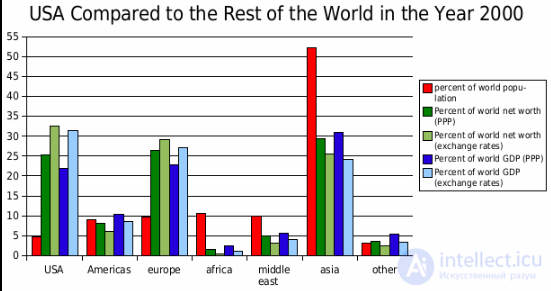
The wealth of the United States compared with other regions of the world.
By some definitions, comparative political science can be traced back to Greek philosophy, for example to Plato's Republic and Aristotle's Politics.
Comparative political science as a modern subdiscipline constitutes research across various substantive areas, including the study of
Although many researchers, research regimes and research institutes are identified according to the above categories or areas, it is not uncommon for geographical or country specialisation to be named as a differentiating category.
The division between comparative politics and international relations is artificial, since processes within countries shape international processes, and international processes shape processes within states. Some scholars call for the integration of these fields. Comparative political science does not have "isms" of the kind found in the discipline of international relations.
In comparative political science, as in other comparative disciplines, a crucial role is played by the definition of the methods and premises with which the scholar embarks on research. Most of the twentieth-century disputes concerning comparative studies were at bottom methodological disagreements.
Although the name of the subfield implies a single methodological approach ( the comparative method ), political scientists in comparative politics use the same variety of social science methods as scholars in other fields, including experiments, comparative historical analysis, case studies, survey methodology and ethnography. Researchers choose a methodological approach in comparative politics based on two considerations: their ontological orientation and the type of question or phenomenon of interest.
Comparative politics entails a number of assumptions and premises. First of all, empirical data must be collected before any hypotheses or theories are put forward. This is necessary in order to increase the objectivity of the final conclusions. Moreover, the conclusions drawn from comparing particular elements of political phenomena are not unconditionally true, since in any case they rest on empirical data. It should also be borne in mind that any comparison involves selecting particular features to be juxtaposed, which may distort the overall picture of a given political phenomenon. One should not forget that every system and phenomenon is in some sense unique. Finally, the variables on which the comparison will be based must be chosen in advance.
A comparative study of the phenomena of political life must be built on a set of specific chosen variables, which should reflect particular qualitative or quantitative changes and differences. In selecting them, scholars are guided by the propositions of political science, the aims of their research, and the need for particular variables in the investigation. Three types of variables are distinguished — dependent, independent and intervening. A relationship exists between the first two: since independent variables usually reflect the characteristics of the environment, they influence changes in the variables that depend on them. The interaction between them may itself be affected by intervening variables, which can alter the nature and degree of that interaction or destroy it altogether .
Comparativists inevitably encounter a number of difficulties in the course of their research. Thus, the most important problem of comparative politics is finding phenomena that can be compared at all while minimising distortions of the essence of each of them. A way out of this situation is to study countries with similar systems, similar historical experience, and geographical proximity. In addition, there arises the problem of finding principles governing the course of all the phenomena under study that are common to them, and of drawing conclusions about them. Researchers inevitably find themselves in a situation where, on the one hand, the uniqueness of every country and event must be kept in mind, but on the other, without identifying common regularities no further theory-building is possible. From the second half of the twentieth century onwards, researchers were also confronted with the question of the sovereignty of the countries they compared, as the process of globalisation gathered ever greater momentum. Since the nation state had previously served as the basic unit of comparative analysis, in the process of international integration their national distinctiveness began to be eroded in a whole range of respects, which called into question the very possibility of comparing them objectively. Furthermore, the larger problem of the objectivity of research also includes the problem of correctly interpreting the data. The difficulty lies not only in the correct reading of the empirical data obtained, but also in the interpretation of the concepts and categories the researcher employs (for example, the concept of "democracy" can have many readings, which may differ depending on the scholar's affiliation with one school or another or on his value commitments) .
Since the turn of the century, many researchers in comparative politics have compared units within a single country. In this connection, what Richard O. Snyder calls the "subnational comparative method" is increasingly discussed
Source:
To juxtapose particular phenomena of political life, scholars use various ways of comparing them. Thus, one of the principal types of comparative research is that in which two countries are selected and compared which, while being different, have achieved similar results, or have arrived at similar systems, and so on. Such studies are called binary. In this case one of the researcher's main tasks is to identify the most striking difference between them. Within this type of research it is precisely dissimilar countries that are often compared.
In addition, researchers also make comparisons between similar countries, which are similar by virtue of their close geographical location, level of economic development, or shared historical experience. Since whole regions are subjected to study, the studies themselves are called regional. At the same time, the countries themselves, according to new methodological premises, may have either very few differences (which, in A. Przeworski's view, is impossible) or nothing in common apart from their geographical location.
There are also studies in which the emphasis is placed on just one country, and in that case scholars examine one particular situation that has also occurred in other countries. Here their behaviour in similar "cases" is compared (this type of research is called a "case study"), given the initial difference in their political systems.
A special type of comparative research is that in which particular phenomena of political life are compared either in the course of their historical development, or in which particular phenomena in one political system are compared with the same phenomena in another, but at different historical moments. The first subtype is called dynamic research, the second — asynchronic.
Finally, yet another type of comparative research may be considered that in which one or a number of variables are taken and measured in all or many countries of the world. Following this strategy, such studies are called global. They can be useful for producing a detailed analysis of the dynamics of political regimes, for identifying regularities in the preconditions of particular political dimensions, and so on.
In recent years the field of comparative politics has developed in order to address new problems and developments in the global and domestic political landscapes. Scholars are increasingly focusing on the following trends:
The interconnectedness of nations has transformed political systems and structures of governance. Globalisation has led to the spread of democratic norms, the growth of international organisations and the increasing influence of transnational actors. At the same time, it has provoked debates about sovereignty and a backlash against global integration, exemplified by the rise of nationalist movements and populist leaders in various countries.
The rapid spread of digital technologies has revolutionised political communication, campaigning and governance. Social media platforms have become crucial instruments of political mobilisation and grassroots activism. However, they have also been used for disinformation campaigns and cyber interference in elections, raising concerns about the impact of technology on democratic processes.
While democracy has spread in many regions, others have simultaneously seen a surge of authoritarianism. Authoritarian regimes have employed sophisticated methods, such as surveillance technologies and media manipulation, to consolidate power. Comparative politics now studies how such regimes adapt to global pressures while maintaining domestic control.
Climate change and environmental crises have become central problems in comparative politics. Governments around the world are addressing these problems through a variety of policy approaches, from international agreements such as the Paris Agreement to local initiatives. Comparative studies analyse how political systems and cultures affect the effectiveness of environmental policy.
Questions of identity, including race, gender and ethnicity, have gained prominence in political discourse and policy debates. Comparative politics studies how social movements advocating equality and justice shape political outcomes, as well as how governments respond to these movements.
Institutions such as the United Nations, the World Trade Organization and regional bodies such as the European Union have gained importance in shaping domestic policy. Comparative politics studies how states interact with these organisations, and the consequences for national sovereignty and governance.

Comments