
Lecture
Metapolitics (sometimes written as meta-politics) describes political attempts to speak about politics in a metalinguistic sense; that is, to conduct a political dialogue about politics itself. Activists who use the term often regard metapolitics as a form of «inquiry» in which the discourse of politics and the political itself are rethought and reconceived. The term was coined by Marxists and is almost always used in the context of ideological discourse among the far left and the far right, in contrast to the broader academic field of political philosophy. Those who cite the term often do so in an attempt to occupy a «self-aware» role, describing their preferred form of political inquiry.
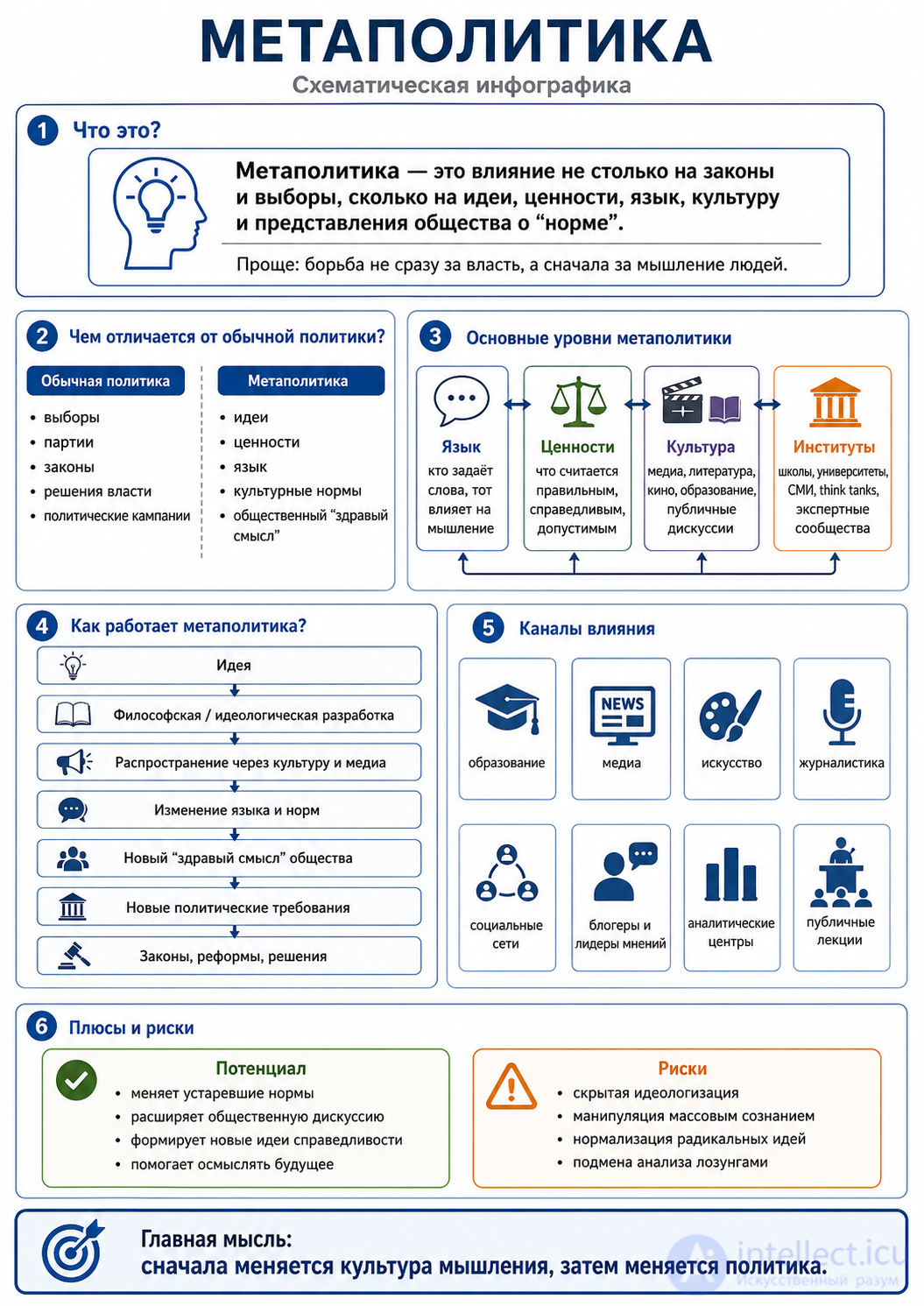
Metapolitics is not simply politics, nor is it the ordinary struggle of parties for power. It is a deeper level of political influence: the struggle for ideas, meanings, values, language, cultural norms and notions of what society considers «normal», «right», «just» or «natural». The prefix «meta-» means «above», «after», «beyond», «about a level higher».
If ordinary politics answers the question:
Who will govern and what laws will they pass?
then metapolitics answers a deeper question:
Which ideas, values and pictures of the world make some political decisions possible and others unthinkable?
In the academic sense the term is connected with reflection on the very nature of politics: on the relationship between politics, philosophy, ideology and culture. In reference works on political theory, metapolitics is described as a particular relationship between politics and thinking about politics.
Metapolitics is an activity or a theory aimed at changing the cultural, philosophical and ideological foundations of society, which then influence actual politics.
More simply:
Metapolitics is a struggle not immediately for laws, but first of all for people's thinking.
For example:
| Ordinary politics | Metapolitics |
|---|---|
| Elections | Shaping voters' values |
| Laws | Notions of justice |
| Parties | Ideological schools and cultural movements |
| State decisions | Changing public opinion |
| A political campaign | Long-term work with language, culture, education and the media |
By «metapolitics» I mean whatever conclusions philosophy is capable of drawing, both in and of itself and with regard to itself, from real instances of politics as thought. Metapolitics is opposed to political philosophy, which claims that, since no such politics exists, the task of philosophers consists in thinking «the political» as such.
The term «metapolitics» arose among left-wing French scholars, and it was first popularized by Alain Badiou and Jacques Rancière. Discussing Badiou's «Metapolitics», Bruno Bosteels argues that:
«Badiou opposes the tradition of political philosophy, which he associates with such thinkers as Hannah Arendt and Claude Lefort, proposing to consider not "the political" (le politique) but "politics" (la politique) as an active form of thought or as a thought-practice as such. He then assesses the affinity of this proposal of a "metapolitical" orientation with the work of his teacher Louis Althusser and of his contemporaries Jacques Rancière and Sylvain Lazarus, before offering examples from practice concerning the concepts of democracy, justice and Thermidoreanism».
GRECE promotes a project of gradually implanting its ideas and rhetoric in society in the hope of achieving cultural dominance, which would then make it possible to seize political power. Vial stated that «Politics is not GRECE's business. It should be placed on another, more fundamental level. GRECE intends to work on the metapolitical level [...] where collective thought and, consequently, popular consensus are elaborated». De Benoist called for the overthrow of liberal democracy by means of a long-term metapolitical strategy. Although the New Right rejects liberal democracy, it is not inherently anti-democratic, calling instead for a localized form of what it terms «organic democracy». De Benoist maintained that the New Right had never supported any particular political party, and that its aim had always been «to occupy the position of an observer rather than a participant. It produces analyses and reflections; it offers a theoretical corpus; it performs intellectual and cultural work. Nothing more».
The New Right criticizes both modernity and postmodernism. It opposes global capitalism and liberalism and praises regionalism, federalism, socialism and local forms of democracy. It rejects the principle of human equality, maintaining that people are not born free and equal and that society is hierarchical by its very nature. It emphasizes the need for elites, arguing that this would make possible a harmonious social hierarchy in which all people are aware of their particular duties and tasks.
One important source for understanding metapolitics is Antonio Gramsci's ideas about cultural hegemony.
Gramsci held that power rests not only on force, the police, the army or laws. It also rests on people's assent to a particular picture of the world. Cultural hegemony means a situation in which the worldview of the dominant group becomes «common sense» for society.
For example, a society may consider ideas such as these to be natural:
In themselves these assertions may be a matter of dispute. But when they become «self-evident» to the majority, they begin to determine political reality.
Metapolitics works precisely at this level — the level of “common sense”.
Inspired by the French example, Italian activists soon drew closely together. One quotation from that era reads:Another influential quotation on this subject:For this reason we chose a metapolitical strategy which, following Gramsci's teaching, allows us to obtain cultural power before political power, which does not preclude someone in the near future taking our cultural programmes to a more political level. Since I do not believe that the same people should engage in cultural and political work, and also because people have natural predispositions to one or the other, I have chosen the role of a cultural figure and do not intend to turn myself into a political figure.
Right before us the path of «metapolitics» became clear. In other words, it was something that did not ignore political needs but went beyond them, encompassing them in a vaster, more complex design that implied deep ideological revisions (without changing the worldview) and cultural roots [...] And, of course, talking about cinema and comics, about political science and the sciences, about etiology and energy, about sexuality and festivals, about community and sport, about literature and art was different from appealing to the past and imagining an apotheosis. The New Right is also a project for reclaiming everyday life, free time, the world of personal interests, and the recognition of what differs from us. Perhaps less than we think. The recognition of pluralism against monomaniacal goals. A proposal not to abandon the world, but to take it back for ourselves.
Metapolitics and propaganda may overlap, but they are not the same thing.
Propaganda usually acts directly and in the short term:
«Vote for us», «support this law», «this enemy is dangerous».
Metapolitics acts more deeply and over a longer term:
«What should society be like?», «what is to be considered the norm?», «which words should be used?», «which ideas should be considered outdated?»
Example:
That is, propaganda can be an instrument of metapolitics, but metapolitics is broader.
Political struggle often begins with a struggle over words.
For example, one and the same phenomenon can be named in different ways:
| Neutral phenomenon | Possible political framings |
|---|---|
| Raising taxes | «social justice» / «robbing business» |
| Migration | «humanitarian aid» / «a security threat» |
| Censorship | «protecting society» / «suppressing freedom of speech» |
| Reform | «modernization» / «destroying the system» |
| Protest | «civic engagement» / «destabilization» |
Whoever controls language partly controls thought.
Metapolitics influences which values society places higher:
Ordinary politics often offers concrete solutions. Metapolitics shapes in advance the system of values through which people will assess those solutions.
Culture is one of the main channels of metapolitics.
Public thinking is influenced by:
For example, if in mass culture the entrepreneur is constantly portrayed as a hero, this influences society's attitude towards business. If the official is always portrayed as corrupt, this influences trust in the state.
Metapolitics acts through institutions that shape the picture of the world:
Gramsci linked the durability of power to the fact that dominant ideas are disseminated through public institutions, and not only through direct coercion.
At first the environmental agenda might have been perceived as a narrow topic for activists. But through education, films, scientific reports, the media and international discussions, the idea of environmental responsibility became part of the political norm.
The metapolitical shift:
«Nature is not merely a resource, but a condition of society's survival».
After such a shift the following become possible:
The idea of human rights is also metapolitical in character. It changes the basic language of politics.
Instead of the question:
«What does the sovereign or the state permit?»
there appears the question:
«What rights belong to a human being independently of the state?»
This changes the legitimacy of laws, judicial systems, international relations and social movements.
Previously data collection might have been perceived as a technical question. Nowadays it is increasingly discussed as a question of freedom, control, security and power.
The metapolitical shift:
«Data is not merely information, but a resource of power».
After this, policy changes:
A political force may lose elections but win the struggle over the image of the future.
For example, if society begins to believe that «the future is automation, AI and technological modernization», then politicians are compelled to speak this language, even if their programme was previously different.
This is precisely metapolitical influence: changing the frame within which all participants are compelled to think.
Today metapolitics manifests itself especially actively on the internet.
The main channels:
Contemporary researchers often link metapolitics with the struggle for cultural hegemony in the digital environment, where ideas spread through memes, influencers, algorithms and network communities.
A distinctive feature of digital metapolitics:
Ideas may spread not as a party programme, but as a joke, a meme, an aesthetic, a lifestyle or a cultural trend.
For example, a meme may seem harmless, but through mass repetition it normalizes a particular view of politics, society, enemies, elites, the state or morality.
Ideology is a system of ideas about how society is arranged and what it should be like.
Metapolitics is the work of disseminating, entrenching or changing ideologies at a deep cultural level.
One might put it this way:
Ideology is the content.
Metapolitics is the strategy for disseminating and rooting that content.
For example:
| Ideology | Metapolitical work |
|---|---|
| Liberalism | Spreading the value of individual rights |
| Socialism | Shaping the idea of social justice |
| Conservatism | Strengthening the significance of traditions |
| Nationalism | Creating the image of the nation as the highest political community |
| Technocratism | The conviction that society should be governed by experts and data |
Metapolitics shows that power is not only control over the state.
Power may manifest itself as the ability:
For example, if in a society a particular idea is considered «dangerous», «ridiculous» or «indecent», it may be squeezed out even before the level of elections or laws.
Idea
  ↓
Philosophical / ideological elaboration
  ↓
Cultural dissemination
  ↓
Entry into media, education, art, memes
  ↓
Change in the language and norms of society
  ↓
Formation of a new "common sense"
  ↓
Change in political demands
  ↓
Emergence of parties, laws, reforms
The main idea:
Political victory often begins long before the elections — in culture, language and thought.
Metapolitics can:
But metapolitics can also be used manipulatively:
That is why it is important to distinguish critical thinking from covert ideological conditioning.
A few questions can be asked:
Metapolitics is politics at a deep level. It does not work directly with laws, but with what precedes laws: with thinking, language, values, culture and the image of the future.
Ordinary politics fights for power within the existing rules.
Metapolitics fights over what the very rules of thinking will be.
That is why metapolitics is especially important in the modern world, where public opinion is shaped not only by parliaments and newspapers, but also by algorithms, memes, games, TV series, bloggers and educational platforms.

Comments