
Lecture
Political calculation is the process of systematically analysing, forecasting and assessing the consequences of various political decisions, actions and strategies. It helps statesmen, parties, organisations and interest groups understand how particular steps will affect the balance of power, public sentiment, international relations and their own positions in power.
Political calculation is, in essence, the cold mathematics of power. It is the way politicians, parties and entire states calculate the consequences of their actions, choose advantageous moves and try to maximise influence, support or gains. It sounds dry, but in practice it is the very engine that drives almost all modern politics — from elections to international negotiations.
Political calculation may mean strategic planning in politics to achieve particular goals, or determining the political position of a person or group by means of tests and surveys.
Strategic planning: In this context, "political calculation" refers to the process of making decisions, assessing possible consequences and drawing up plans to achieve political goals — for example, winning an election or carrying out a reform.
Determining one's position: By means of a "political calculation" (or test) one can determine one's ideological orientation by placing oneself on a "political map" along such parameters as economics and the social sphere. One popular example is the "Political Compass" test
Politics is a game with a great many unknowns: public mood, economic conditions, the international situation, the influence of elites, competitors, the media… Everything is constantly changing. That is why simply "doing what seems right" is a luxury few can afford.
Political calculation is needed in order to:
understand which step will win the most support among the population or key groups;
assess risks — what may "take off" and what will damage one's reputation;
choose the moment — when it is better to announce a reform and when to keep silent;
forecast the reaction of competitors, allies and the media;
build a long-term strategy rather than merely one-off gestures.
In other words, this is not only about "how to win an election" but a whole logic of how players behave in the political field.
Political calculation is not a one-off act but a constant cycle of assessing reality, comprising:
analysis of the environment (domestic and external);
consideration of the interests of actors — voters, elites, allies, opponents;
forecasting the reaction of society and the structures of power;
assessment of risk and benefit;
choice of the optimal strategy.
In essence, this is the "mathematics of politics": every step must have a rationale, a weight, an expected effect and a clear forecast of consequences.
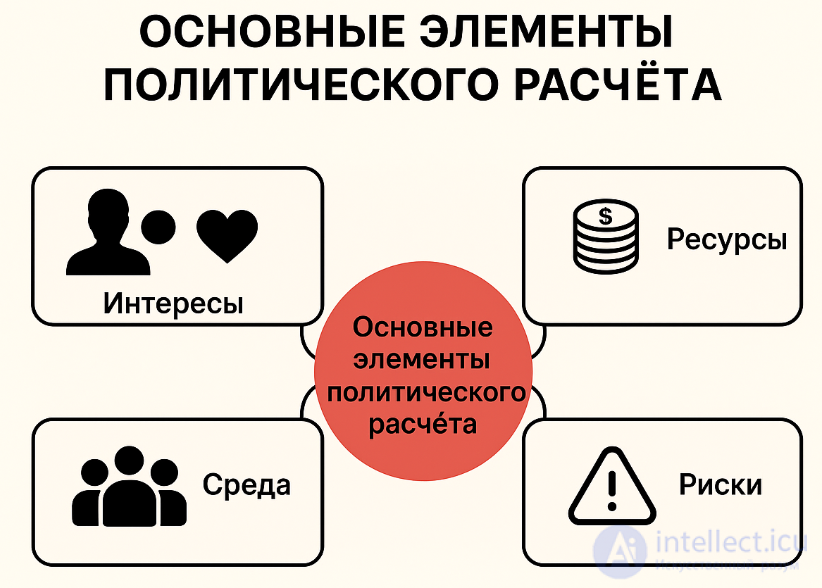
Every political force acts within the framework of its own interests — ideological, economic, electoral. Calculation takes into account what an actor gains or loses.
All politics is about interests. These may be:
the interest of a politician (ratings, influence, security of position),
the interest of a party,
the interest of a pressure group,
the interest of the state.
The first thing done is to determine who wants what.
A politician cannot act without resources:
institutional (power, authority),
financial,
informational,
human,
social (popular support).
Correct calculation shows what resources exist and how best to use them.
Any action in politics is read through the prism of the current background: economic, informational, social, international. One and the same decision may be brilliant in one set of conditions and suicidal in another.
This includes:
public opinion,
political stability,
media conditions,
the international situation,
legal constraints.
Political calculation matches actions to the real context.
Every decision carries consequences: reputational, legal, electoral, diplomatic.
Calculation helps to minimise risk or, conversely, to take it on deliberately if the benefit is greater.
Politicians model several variants of how events may unfold:
optimistic,
probable,
crisis.
Politicians rarely address everyone at once. There are:
electoral groups,
business elites,
international partners,
the bureaucracy,
local authorities, and so on.
Each group needs its own message, and calculation takes account of their reaction. This makes it possible to prepare for any outcome.
A choice between:
laws,
personnel decisions,
statements,
manipulation of the agenda,
diplomatic moves,
media strategies.
Political calculation helps to select the instrument suited to the task.
preparation of bills;
reforms;
coalition building;
choice of election strategy;
distribution of state resources.
negotiations and alliances;
participation in international organisations;
sanctions, trade agreements, military decisions;
positioning the country on the world stage.
defining the ideological line;
the structure of campaigns;
selection of candidates;
work with the electorate.
Introducing an unpopular reform
A politician may take an unpopular decision if:
the benefit is strategic,
the time remaining before the election makes it possible to "ride out" a drop in the ratings,
there is external support or pressure.
Forming a coalition
A party joins a bloc if calculation shows:
an increase in its chances of taking power,
minimisation of threats from rivals,
greater control over parliament.
International conflict
Before a decision is taken, the following are assessed:
economic consequences;
the reaction of allies;
the military potential of the parties;
the risk of sanctions.
Before elections, social benefits are increased or "visible" reforms are carried out, because this directly affects voters' sympathies.
In international politics a country may "suddenly" agree to a compromise — this is usually not a gesture of goodwill but a calculation: it is more advantageous to concede now in order to gain more later.
Intra-party reshuffles are not about sympathies but about the balance of forces, alliances and influence.
| Instrument | Description |
|---|---|
| Sociological surveys | Measuring the sentiments and preferences of the population |
| Expert analysis | The opinions of analysts, political scientists and economists |
| Scenario modelling | Forecasting the consequences of various decisions |
| Historical analogies | Analysis of the experience of other countries and of past situations |
| Information management | Working with the media, shaping the agenda |
Political calculation is the foundation of stable and rational politics. It makes it possible to:
avoid chaotic decisions;
ensure predictability;
reduce conflict;
use resources optimally;
build long-term development strategies.
Without political calculation, power becomes impulsive and the state unstable.
Politics is not a laboratory where everything is perfect. Mistakes occur when:
the public mood has been poorly assessed,
the data are out of date,
competitors have made an unexpected move,
the emotional factor has proved stronger than the rational one,
an external shock (a crisis, a war, a scandal) has changed everything.
Even the most perfect calculation can collapse because of a single sudden event.
Here is where it gets most interesting. Calculation is an instrument, not "good" or "evil".
It can be used:
to carry out sensible reforms and avoid chaos,
or to manipulate society for the personal benefit of the elites.
Politics often balances between rationality and morality, and this conflict almost never disappears.
Political calculation manifests itself in every era — from the ancient empires to modern democracies. Below are key historical cases that clearly demonstrate the strategic logic of power.
Amid constant wars and intrigues, the rulers of the Italian city-states (Florence, Milan, Venice) were compelled to take decisions on the principle of minimising risks and maximising influence. Observing these processes, Machiavelli formulated the classic understanding of political calculation: a ruler must foresee consequences and take decisions on the basis of real power rather than ideals.
After the Napoleonic Wars the great powers created the Vienna system, based on the principle of political calculation: no single country was to gain decisive superiority. Coalitions, diplomacy and the distribution of spheres of influence were built exclusively on the calculation of preventing the domination of any one side.
The USA and the USSR built their strategies on the logic of the "rational actor": each side took into account the possibility of a retaliatory strike and therefore took decisions in such a way as to avoid nuclear war. Here political calculation manifested itself through:
the counting of risks,
probabilistic models of the adversary's actions,
assessment of the consequences of escalation.
The doctrine of mutual assured destruction (MAD) is one of the most famous instances of political calculation in history.
The transition from the Maoist economy to "socialism with Chinese characteristics" was the result of a strategic calculation: to preserve political stability while modernising the economy. The Chinese Communist Party analysed the risks of liberalisation and chose a carefully dosed model of reform — a classic example of long-term political calculation.
In the late 1980s the political leadership took decisions balancing between reform, the preservation of party control and the prevention of violence. A failure to forecast the consequences (including economic and ethno-national processes) led to the collapse of the system — an indication that political calculation can be mistaken.
Political science and decision theory describe political calculation through several models. The main ones are set out below.
The state or leader is treated as a rational agent that:
chooses the optimal option,
assesses the consequences,
weighs costs against benefits.
Widely used in international relations and strategic studies.
Political decisions are treated as an interaction between several players.
Classic examples:
the "prisoner's dilemma" (trust and betrayal),
"zero-sum games",
coalition models.
Used for the analysis of:
— elections,
— international negotiations,
— legislative coalitions.
This means that calculation depends not only on the leader but also on the "rules of the game":
— constitutions,
— courts,
— parliaments,
— the bureaucracy.
Even a strong leader is constrained by institutions — and his calculations are obliged to take account of their reaction.
People are not always rational.
Decisions and political calculation are distorted by:
— emotions,
— stereotypes,
— cognitive biases,
— group pressure.
This model is important for understanding populism, mass protests and crisis decisions.
Most decisions are taken not by the people but by a narrow group of elites.
Calculation takes place within this group:
— the distribution of resources,
— competition between factions,
— the struggle for influence.
Example: the election of Politburo members in the USSR or intra-party primaries in the USA.
Political calculation is determined by the economic interests of classes.
The state is an instrument of the ruling class, and decisions are taken in its interests.
This model is used above all for the analysis of revolutions, economic reforms and social conflict.
Political calculation is the foundation of modern politics. One can pretend that everything rests on ideals, but the reality is this: whoever knows how to calculate is the one running the game.
Political calculation is an important instrument of political activity, allowing politicians and statesmen to take well-founded decisions that may affect the future of their countries and societies. Understanding this term and its application can help in analysing political events and actions. It is a mixture of psychology, strategic analysis, forecasting and experience. And it is precisely this that determines who becomes the winner and who is left on the sidelines of history.

Comments