
Lecture
Democracy (Ancient Greek δημοκρατία «rule of the people» from δῆμος «the people» + κράτος «power») is a political system based on a method of collective decision-making in which participants have an equal influence on the outcome of the process or on its essential stages . Although such a method is applicable to any social institution, its most important application today is the state, since the state possesses great power. In this case the definition of democracy is usually narrowed to one of the following features:

Popular rule requires that a number of rights be guaranteed to every member of society. A number of values are associated with modern democracy: legality, political and social equality, freedom, the right to self-determination, human rights and others.
Since the ideal of popular rule is difficult to attain and is open to various interpretations, many practical models have been proposed. Until the eighteenth century the best-known model was direct democracy, in which citizens exercise their right to take political decisions directly, by achieving consensus or by means of procedures in which the minority submits to the majority. In representative democracy citizens exercise the same right through deputies and other officials elected by them, by delegating to them part of their own rights; the elected leaders take decisions with regard to the preferences of those they govern and are answerable to them for their actions.
One of the main aims of modern democracy is to limit arbitrary rule and the abuse of power. This aim has often failed to be achieved where human rights and other democratic values were not universally recognised or lacked effective protection from the legal system. Today in many countries popular rule is identified with liberal democracy, which, alongside fair, periodic and universal elections of those vested with supreme power, in the course of which candidates compete freely for voters' votes, includes the rule of law, the separation of powers and constitutional limitations on the power of the majority through guarantees of certain individual or group freedoms. On the other hand, left-wing movements, prominent economists, and also such representatives of the Western political elite as former US president Barack Obama and IMF managing director Christine Lagarde argue that the exercise of the right to take political decisions and the influence of ordinary citizens on the country's policy are impossible without the provision of social rights, equality of opportunity and a low level of socio-economic inequality.
A number of authoritarian regimes had the outward features of democratic rule, but in them power was held by only one party and the policies pursued did not depend on voters' preferences. Over the last quarter of a century the world has been characterised by a trend towards the spread of democracy. Among the comparatively new problems facing it are separatism, terrorism, population migration and growing social inequality. International organisations such as the UN, the OSCE and the EU hold that control over a state's internal affairs, including questions of democracy and observance of human rights, should partly lie within the sphere of influence of the international community.
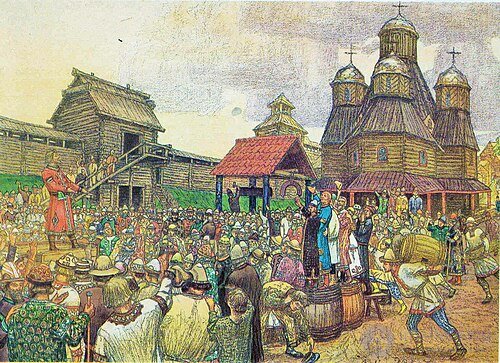
The Pskov veche. A. M. Vasnetsov, 1909
The first historically is said to be primitive communal democracy. Democracy has its beginnings in Ancient Greece and Ancient Rome, in the traditions of medieval city-states and in the development of representative bodies of power in Europe and some British colonies in the modern era. In the city-states of antiquity, supreme legislative, executive and judicial power was held by an assembly comprising all citizens. This was possible because the population of these cities rarely exceeded 10,000 people, while women, non-citizens and slaves had no political rights. Citizens had the right to hold various executive and judicial offices, some of which were elective while others were assigned by lot. With the fall of the Roman Republic the institutions of ancient democracy ceased to exist.
At the same time, popular rule was already a subject of philosophical reflection in antiquity (for more detail see the article Theory of democracy). It should be borne in mind that the term «democracy» could be invested with a meaning that differed greatly from the modern sense of the word. Thus, according to Plato, democracy is the rule of the envious poor. In the eighth book of the «Republic» he argued that excessive democracy inevitably entails tyranny. In a similar way Aristotle called democracy the rule of the majority of propertyless citizens in the interests exclusively of that majority. He considered such rule a distortion of the ideal form of popular rule, polity (the republic, according to Cicero's translation).
In medieval Europe a key role in the emergence of the principles of democratic rule was played by the concepts of religious, natural and customary law as constraints on the arbitrary exercise of power. Of great importance was the spread of the practice whereby monarchs sought to obtain the approval of their decrees from the various estates. The assemblies of representatives of these estates were the prototypes of modern legislative assemblies.
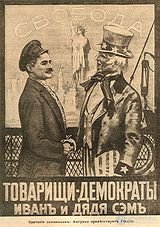
A 1917 poster depicting Russia after the February Revolution and the USA as allies
The Age of Enlightenment and the American and French revolutions stimulated intellectual and social development, in particular the development of ideas about civil rights and political equality. Beginning in the nineteenth century, assemblies of deputies elected in free elections became the central institutions of democratic rule. In many countries democracy also came to include competitiveness of the electoral process, freedom of speech and the rule of law. In countries with communist regimes the idea of popular rule was proclaimed, the structure of which included class unity and predominantly state ownership of the means of production. Until the twentieth century, democracy assumed that full citizenship was held by a minority of the population according to criteria of property qualification and racial, gender and ethnic characteristics, while the rest were in effect excluded from the process of taking political decisions. In Great Britain and the USA at the end of the eighteenth century only 2-5 % of inhabitants were granted the right to vote; in Great Britain, the birthplace of modern democracy, women were admitted to voting on an equal footing with men only in 1928, plural voting (when a single voter had several votes) was abolished in 1948, and in the USA the property qualification was finally abolished in 1964; universal suffrage has existed in the developed democracies for little more than 40 years. By the beginning of the twenty-first century the universality of elections had gained worldwide recognition as one of the most important criteria of democracy.
Today the number of functioning democratic regimes in the world is the largest in all of history. In the opinion of a number of political scientists, at the turn of the twenty-first century the democratic institutions of more than a third of the world's countries were comparable to the institutions of the oldest democracies.
Despite the trend towards the spread of democracy in the world, it remains a subject of debate. Discussions revolve around full citizenship, the procedures of democratic representation, the conditions necessary for democracy, the permissible limits of democratic politics, the protection of ethnic and cultural minorities, the extension of democratic principles to various public organisations and social groups, and the methodology of democratisation. Among the current challenges to democratic regimes are social inequality, terrorism, population migration and separatism. International organisations (such as the UN, the OSCE, the EU and others) presuppose a partial limitation of the sovereignty of member states so that the international community can exert influence on the policies pursued by individual states, chiefly in the sphere of the protection of human rights. At the same time, these organisations themselves have comparatively few democratic institutions.
The term «ideal democracy» has two meanings. According to the first, the ideal is understood as the best possible system. According to the second, the ideal system is a «purified» version of really existing systems. The second meaning is discussed in the section The basic institutions of liberal democracy. In order to formulate the ideal of popular rule in the first sense, it is necessary to answer a number of fundamental questions:
All these questions admit a wide range of answers. For example, a majority may be calculated on the basis of the total number of citizens, the number of those who took part in the vote, the number of representatives from smaller associations or territorial units, and so on. Over the course of history the standards of democracy have undergone considerable evolution.
According to Robert Dahl, the idea of democracy presupposes the existence of a certain society (a demos) in which every member is equally competent to take part in governing that society and possesses the necessary knowledge of which political choice allows him best to defend his interests. Taking political decisions in accordance with this principle requires that all members of society have equal and effective opportunities to
The criteria listed describe not only the political process, but also the rights of each member of society that are connected with this process. In particular, a democratic state must ensure the protection of personal freedoms at least to the degree necessary for the openness and competitiveness of the electoral process. The most important are the right to take part in voting, freedom of voting, the right to put oneself forward as a candidate in elections, freedom to express one's political views in the media, freedom to form political groups and the right to take part in their activities.
One of the fundamental questions of the democratic model consists in defining the circle of persons to whom political equality extends (that is, the demos). If a state is meant in which all full citizens have equal opportunities in governing the country, this is a question of citizenship. According to modern views, all or almost all adult inhabitants subject to the power of a democratic state should be full citizens.
According to Karl Popper, democracy is an open society in which its members are critically disposed towards taboos, relying on their own intellect and critical thinking, and also proceeding from agreements reached as a result of discussion
According to Daniel Bell, a significant criterion of a society's democratic character, an indicator of its openness, is the presence of social lifts allowing citizens, regardless of their social origin and solely thanks to their personal abilities and efforts, to rise to the top of the social ladder and enter the elite of society.
A comparison of approaches to the implementation of democracy in different countries shows that each of them is unique in its own way. At the same time, it is possible to draw various classifications: by the dominant branch of power, by the regional hierarchy of power, by the number of parties, and so on. Further generalisation makes it possible to identify the basic political institutions necessary (though perhaps not sufficient) for achieving ideal democracy.
The practical implementation of democracy depends on many circumstances, in particular on the size of the population and the extent of the territory. Compared with large administrative units, small units are more homogeneous in composition and offer better opportunities for direct participation in political life. In compact communities it is possible to organise effective discussions and to provide broad opportunities for citizens to influence the policies pursued. Smaller structures therefore find it easier to satisfy the criteria of democracy. At the same time, as size decreases, the real amount of power and the opportunities for solving problems diminish, especially on questions of defence and the economy. One way of resolving this contradiction lies in dividing spheres of influence between administrative and public units at various levels, in particular by granting autonomy to cities and regions. The most widespread method consists in the use of representative forms of government in large units.
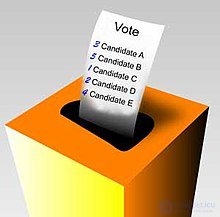
Preferential voting in a proportional electoral system
There are considerable differences between the political institutions of different democratic countries. The main types of democratic system are listed below.
The dominant branch of power
The regional hierarchy of power
The structure of the legislative power
The system of elections to representative bodies
The number of leading parties
Today many liberal democracies are characterised by the presence of the following procedural norms (institutions) and by adherence to the principle of the rule of law in observing them:
A political system that includes the seven institutions listed above is called a «polyarchy». The main features of polyarchy are the possibility of political competition, the guarantee of the right to take part in politics, and government on the basis of a coalition. Such government is the opposite of dictatorship, in which the preferences of a single group dominate the choice of political course. An important role is played by the need of competing elites to secure the support of broad sections of the population, which is not characteristic of oligarchy.
The institutions of polyarchy create the conditions for the emergence of independent and diverse organisations that play an important role in the country's political life, which entails political pluralism.
Throughout the twentieth century political scientists tended to the view that a considerable number of countries supported the institutions listed above to the proper degree and could therefore in practice be considered democratic. At the same time, a country may meet the standard of polyarchy even if it lacks proportional representation, referendums, party primaries, social equality or democracy at the level of local self-government. As Robert Dahl notes, the ideal of democracy makes extremely high demands, and in time polyarchy will probably come to be regarded as an insufficiently democratic system.
Jean Baudrillard holds that modern democratic society is a consumer society, a society of self-deception, in which neither genuine feelings, nor culture, nor any genuine values are possible, and in which the meaning of human life is reduced to ever-increasing consumption as a justification for the growth of the capitalist economy at any price. From Baudrillard's point of view, democracy and democratic values are, through globalisation, turned into a standardised impersonal product, a kind of commodity that is sold to other cultures in the packaging of absolute good as a universal means of solving all problems, which provokes in those on whom this commodity is forcibly imposed various forms of rejection. Some researchers argue that the promotion of democracy in the world is one of the consequences of the globalisation of the world economy, which also leads to increased international competition, migration flows and a reduction in the social rights of working people in developed countries.
From Noam Chomsky's point of view, control over the media in the interests of a narrow group of people in modern society makes possible the manipulation of mass consciousness, in which some notion or opinion is instilled in the mass, which perceives it as its own, and the illusion is created of the popular will being expressed on the basis of democratic procedures.
As Leonid Polyakov, head of the department of general political science at the Higher School of Economics and doctor of philosophical sciences, notes: «Today many of Lenin's ideas are very relevant. For example, the critique of bourgeois democracy as a hidden form of the dictatorship of capital. He wrote: whoever owns, also rules. In such a situation, holding forth about the power of the people is simply deception.» A number of authors of a socialist orientation believe that democratic principles should be developed not only in the political sphere, but also in the economic domain.
Economic democracy was elaborated in the works of Bernstein and his followers. It is defined as a set of measures necessary to eliminate the imbalances in the distribution of economic power that are harmful to democracy; as a question of a more even distribution of private property and the partial confiscation of economic power from private hands and its gradual transfer by one legitimate means or another (within the framework of the existing legal system) to democratically accountable collective control, since some researchers hold that if political democracy was achieved through the equalisation of political power, then economic democracy will likewise be achieved through a more even distribution of economic power.
Functionally, economic democracy at enterprises (workers' participation in management, industrial democracy) presupposes broader participation by ordinary employees in the company's share capital and the control of works councils (the grassroots levels of economic democracy) over a substantial sphere of productive activity: the humanisation of labour, social policy, employment policy; and it includes the demand for equal participation by works councils in the management of the enterprise on a par with owners and managers.
There is a point of view (Thomas Piketty, Capital in the Twenty-First Century), shared by part of the Western political elite (Barack Obama, IMF managing director Christine Lagarde), that the modern trend of growing economic inequality — the concentration of incomes and wealth in the hands of a few — is the greatest historical challenge to the institutions of democracy and leads to the concentration of the power of capital, to «patrimonial capitalism» (English patrimonial capitalism) and to oligarchy, rendering democratic procedures meaningless as they become a means of manipulating mass consciousness in the hands of financial oligarchs.
According to the Global Wealth Report of Credit Suisse bank (2016), wealth inequality in the world continues to grow: whereas in 2010 10 % of the population owned approximately 86 % of the world's assets, by 2015 they already owned 89 % of all the world's assets.
Some researchers (Anthony Giddens) see the way to solving the problem of growing social inequality and the growing power of capital in following the concept of the third way, a form of combining a free capitalist economy with certain social guarantees from the state, developing economic democracy, cultivating the social responsibility of business, introducing progressive taxation and a tax on inherited capital, and the slow evolutionary development of society by means of institutional reforms based on a critical rethinking of the legacy of Karl Marx and Ferdinand Lassalle in the direction of a non-Marxist form of socialism (the Fabian Society)[37]. Former British prime minister Tony Blair counts himself among the supporters of the concept of the third way and the building of Fabian socialism. Some researchers find elements of the concept of Fabian socialism in the policies of US president Barack Obama.
Transparency in the sphere of production and the movement of capital is regarded by researchers as one of the most important elements of modern democracy.
The concept of developing democracy in both its political and its economic aspect, by means of the gradual reform of capitalism on the basis of class peace in the direction of greater social justice, is criticised by Marxists. They hold that the power of the oligarchy cannot be seriously limited and placed under public control by means of progressive taxation and a tax on capital, or by the development of the cooperative movement as one of the ways of evenly distributing economic power (the International Co-operative Alliance). The nature of capitalism (Radical geography) consists in the constant creation of relations of inequality and domination—subordination between classes, nations and cultures as the basis for achieving maximum profit, which, from the Marxist point of view, makes a relatively even distribution of power among all members of society, in both the political and the economic spheres, impossible within the framework of the capitalist formation.
In modern democratic theory there are three main directions: the phenomenological, the explanatory and the normative. Phenomenological theory describes and classifies existing democratic systems. Explanatory theory attempts to establish whose preferences matter under democracy, what the decision-making procedures should be, and how undesirable consequences are to be avoided. The subject of normative theory is the ethical side of popular rule: when and why democracy is desirable from the moral point of view, what principles should be the foundation of democratic institutions, and what reasonable expectations there are of citizens in a democratic society.
An important contribution to the theory was made by Aristotle, John Locke, Charles-Louis de Montesquieu, David Hume, Jean-Jacques Rousseau, Alexis de Tocqueville, John Stuart Mill, John Dewey, Jürgen Habermas, John Rawls, Hannah Arendt, Isaiah Berlin and other thinkers.
According to the conclusions of the theory, democracy is not merely rule by the people, but also a system of citizens' rights. The violation of these rights calls into question the democratic character of the government. The question of equality and effective participation in the process of taking political decisions occupies a central place in democracy. Democratisation requires the existence of a stable state as the sole source of the legitimate use of force .
In the field of comparative political science there are projects that seek to measure the level of democracy in the world: «Freedom House», the «Cross-National Time-Series Data Archive», «Polity IV», the Democracy Index of «The Economist», and the «Democracy Barometer».
Democracy has been the subject of analysis from the point of view of its impact on other values and as a value in its own right. Common arguments in favour of democracy:
Some of the arguments listed are, from the point of view of democracy's opponents, its shortcomings. A number of arguments against democracy have also been widely discussed:
W. Riker criticised what he called the «populist theory of democracy», whose origins he traces back to J.-J. Rousseau. It is based on the idea that there exists a will of the people as a kind of abstract social phenomenon, and that democracy is the most reliable instrument for determining that will. In William Riker's view, all voting systems are manipulative in character and encourage people to be insincere. Since it is impossible to know which voters were insincere, and to what degree this insincerity manifested itself in the voting, it is impossible to create democratic institutions that would reflect the preferences of all citizens. Democratic procedures create the free-rider problem. This is a situation in which the activity of one social actor increases the benefits received by others, irrespective of their own real activity. The rationality of non-participation acts as a form of peculiar «blackmail». The advantage goes to the side whose orientations towards achieving other goals predominate. By virtue of its lesser interest in the democratic procedure, it can gain more from a market exchange of participation for alternative benefits.
Even if a decision taken gives equal consideration to the preferences of all citizens, for part of society it may have consequences that are unacceptable from the point of view of morality or law. In many theories such decisions are considered illegitimate. The implementation of universal suffrage and a proportional electoral system contribute to a more accurate representation of interests, but do not remove the problem. The way out lies in creating some additional system of checks and balances that protects the minority from the arbitrary action of the majority while not contradicting democracy. The following approaches have been proposed:
Some of the measures listed may also have negative consequences, such as political stagnation or the narrowing of the sphere of operation of democratic institutions.
For the stability of the state it is necessary that citizens carry out even those decisions of the authorities to which they object. In the case of democracy this means that the minority submits to the will of the majority, that the change of power proceeds peacefully, and that the opposition not only has the right to express public disagreement with state policy but also acts strictly within the framework of the law. Consequently, one of the most important conditions for the stability of democracy is its legitimacy in the eyes of citizens. The legitimacy of the implementation of democracy may be grounded in its value (see above) and in the equality of all participants in the process. An important role here is played by the presence of shared basic values, which makes it possible to reach agreement on the principles of political conduct . This helps to establish trust between citizens, encourages them to observe the existing rules and justifies the use of force to defend those rules.
A number of authors hold that society's recognition of democratic principles and constitutional rights as cultural values lends the state stability in times of crisis. At the same time, the absence of an effective legal system leaves the norms of a democratic society without protection and creates fertile ground for abuses on the part of the authorities, political elites and criminal groups.
The arguments given are confirmed by sociological research, according to which the stability of democracy correlates with interpersonal trust, tolerance towards unpopular groups, support for civil liberties and the political activity of the population.
In authoritarian states power is concentrated in the hands of a ruling group which, in its actions, experiences no constraints arising from accountability to those it governs. The majority of authoritarian regimes of the past differed from representative democracy in a number of respects:
At the same time, political scientists note that around the turn of the 1990s the number of hybrid regimes in the world grew (which have been given such names in the literature as «imitation democracy», «authoritarian democracy», «electoral authoritarianism» and others), having features of both authoritarianism and democracy[59]. In such regimes periodic elections are held and elements of political competition exist, so that the opposition is able to challenge, weaken and sometimes even defeat the ruling forces at elections, in legislative bodies, in the courts and in the media[58]. However, the conditions of competition for the ruling forces and for the opposition are unequal in character because of the systemic abuse of administrative resources and violations of the rights of the opposition's supporters.
Autocrats may use nominally democratic institutions for the purpose of their own legitimation and of mobilising society in their support. Persons who agree to cooperate with the regime receive rewards and concessions in exchange. The negotiations connected with this are often conducted in special forums with restricted access controlled by the authorities, in particular parliaments.
A significant indicator is the degree of development of the rule-of-law state. According to the political scientist Adam Przeworski, democracy is above all certainty of procedures amid uncertainty of results . In the opinion of political scientists and public figures , in a liberal-democratic country citizens, by means of democratic procedures, work out the rules of interaction between the various actors of society and form the mechanisms of state power, which acts in accordance with these rules.
Such a model differs fundamentally from a system in which the authorities themselves establish the order of interaction between the actors of society and form the mechanisms of governance necessary for this. In a state without the rule of law, individual bodies of power can annul or circumvent the laws that regulate the powers of those bodies. This in particular opens up opportunities for manipulating the justice system and the media in order to reward those loyal to the regime and to punish the opposition without regard for legal procedures.
In the opinion of political scientists at Freedom House and Radio Liberty , modern authoritarian regimes also deliberately distort the essence of democracy, interpreting it as the imposition by the West of alien values, obstruct the work of international organisations engaged in human rights activity (the UN, the OSCE, the ECHR) and cultivate in young people a hostile attitude towards democratic values.
Some political scientists single out as a separate category delegative democracy, in which the executive power partly subordinates the legislature to itself and takes little account of voters' preferences in the policies it pursues, but a change of power remains possible and civil rights are protected .
Historically, two basic models have dominated conceptions of democracy. Under direct democracy, citizens in full standing make political decisions themselves by voting, with the minority subsequently submitting to the will of the majority, or by reaching full agreement. In representative democracy, citizens delegate this function to representatives they elect, who are accountable to the voters for their actions. Practical implementations of democracy developed out of these conceptions, and the earlier models were discredited over time and are today regarded merely as stages on the way to modern forms of popular rule:
Oligarchic democracy allows only large property owners to take direct part in governing the state and guarantees them civil rights. Suffrage is subject to property qualifications. A related model is plutocracy, in which the ruling class pursues policies chiefly in the interests of big capital.
Egalitarian democracy has as its goal the achievement of political equality. Egalitarian policy presupposes equal participation in the political process, equal representation, equal protection of rights and freedoms, and equal access to politically significant resources. Advocates of this approach usually call for policies to be pursued in the interests of the entire nation and place these above the interests of a minority or of the individual citizen. Nationalist variants of this model interpret the nation in an ethnic rather than a civic sense and grant full rights only to persons of particular nationalities.
Socialist democracy is similar to the egalitarian model, but focuses on the will of the common people. It presupposes the gradual elimination of class society and predominantly state ownership of the means of production . The term "socialist democracy" was established by the Programme of the Russian Communist Party of 1919. In the late 1940s the communist parties introduced another term, "people's democracy", as a variety of socialist democracy.
Liberal (also bourgeois and constitutional) democracy rests on a number of principles:
Imitation democracy has a number of the outward attributes of popular rule, but in fact citizens' influence on decision-making is extremely slight. This may be because some citizens are deprived of the right to vote, or because elected representatives do not determine the whole of government policy, or because the executive branch subordinates the legislature and the judiciary, or because the justice system is unable to ensure compliance with the principles laid down in the constitution. A variety of this model is the dominant-party system.
Contemporary political science literature has also produced several theoretical conceptions of democracy:
The aggregative model views democracy as a set of legal mechanisms that ensure a stable equilibrium in society by achieving a compromise between the interests of different circles.
Deliberative theory focuses on the role of public discussion in decision-making and on the participants' striving for the common good. It maintains that a system's democratic character is proportional to its transparency.
Institutional theory sees the main role of a democratic state as the realisation and protection of society's conceptions of political and civil rights.
Consensus democracy strives to arrive at decisions that take into account as broad a range of preferences as possible, and not only the preferences of the majority.
The majoritarian conception combines the requirement of competitive elections with the thesis of the supremacy of the majority's will, for which purpose political institutions must promote the concentration of power rather than its decentralisation.
The minimalist conception sees democracy as a system of government in which citizens delegate their rights to exercise political power to elected officials, since they themselves lack sufficient time and knowledge. Within this theory, the leadership's responsiveness to the wishes of the led is ensured chiefly by competition for voters' ballots.
Participatory democracy proceeds from the need for broad and, as far as possible, direct participation by citizens in the drafting of legal norms. Its subject matter is political activism and citizens' willingness to bear responsibility for the consequences of their decisions.
The plebiscitary model reduces citizens' participation to the periodic granting of a "vote of confidence" to one candidate or another and is usually studied from the standpoint of the degradation of the institution of elections.
Economic democracy maintains that for the broad masses to participate in political decision-making, private and state property must be distributed among public shareholders, for example in the form of cooperative ownership.
The term "democracy" is sometimes used in the names of social movements:
Social democracy advocates a transition to a socially just society within a democratic framework
Christian democracy seeks to resolve socio-economic problems while observing Christian principles
Until the eighteenth century the term "democracy" meant direct democracy in small cities where the entire population was able to assemble together. It was in this same sense that one of the ideologists of the United States, James Madison, used the word; he called the system of representative government a "republic" . Other American leaders (James Wilson, John Marshall, Thomas Jefferson) began calling the American system a "democracy", since the source of power was ultimately the people, and they therefore used both terms interchangeably. Destutt de Tracy and James Mill spoke of representative government as a revolutionary invention that opened up the possibility of building a democracy over a large territory. After visiting the United States in 1831–1832, Alexis de Tocqueville likewise proclaimed it a democracy in which government rests on popular sovereignty.
Immanuel Kant called a "republic" a law-governed state with a separation of powers, a system of checks and balances, protection of personal rights and a certain level of representation in government. He contrasted the republic with democracy as a system with universal suffrage and unlimited majority power, which he considered prone to tyranny. Kant regarded the goal of human history as the attainment of a universal law-governed civil society, in which the greatest freedom of each would be compatible with the freedom of others and natural endowments, humanity's vocation, would receive their fullest development . According to modern dictionary definitions of a republic, this concept stands as the antithesis of monarchy and is incompatible with a head of state who is elected for life or not elected at all. By contrast, the concept of democracy does not contradict parliamentary monarchy.
Some contemporary political scientists hold that the concepts of "democracy" and "republic" do not differ in any way .
The list of principal religions in countries with representative democracy covers all the world religions and many national ones. In a number of countries it is Christianity; in Indonesia, Islam; in Mongolia, Buddhism. In the most populous democratic state today, India, Hinduism predominates. Many religions assert that every person is capable of moral choice, which historically fostered the spread of ideas about equality and, as a consequence, about democracy.
From its very inception, the Christian church was founded on important democratic principles: the election of the highest church hierarchs (bishops) by secret ballot; the supreme church body being a collegial one (the Local Council, the Ecumenical Councils); the highest offices in the church hierarchy being open to Christians irrespective of their national or social origin[69]. Islam, too, is based on significant democratic principles: the elective character of the imam, the head of the religious community, on the basis of authority and irrespective of his social origin; the absence of a strict hierarchy in the religious structure; according to Islamic law, sharia, the most correct means of transferring power is the election of the head of state directly by the population or by means of electors[70]. Any Muslim, regardless of his origin, may become the highest spiritual authority, a sheikh.
Some Christians express doubt that their religion is compatible with democracy, on the grounds that all authority comes from God, that the flock must obey their pastors, and that only the monarch is accountable to God as the anointed one . On the other hand, Protestantism teaches that all people are equal before God and therefore before authority as well; that God called people to be priests and kings, and thereby endowed them with the right to self-government; that God gave people life and faith, and therefore also inalienable rights and freedoms . Catholicism maintains that society and the state exist in order to create the conditions necessary for a person's self-realisation (personalism), and that authority should be as close to citizens as possible (the principle of subsidiarity). The Orthodox theologian Theophan (Prokopovich) held that power is originally divided among the people, who have the right to establish any form of government. The philosopher G. P. Fedotov saw Orthodox democracy as a continuation of the traditions of the Novgorod Republic. Orthodoxy also has a widespread concept of sobornost (conciliarity), which encourages everyone to take part in the search for truth, although it regards only unanimous agreement, founded on love and respect for others, as an acceptable method of decision-making.
Let us prove mathematically that democracy in its idealised form (the full and fair expression of the will of the people) is impossible, using Arrow's impossibility theorem and some logical reasoning.
By democracy we shall understand a system in which:
A collective decision (for example, the choice of a winner in an election) must reflect the preferences of all participants.
The decision-making process is fair (there is no dictator, everyone's opinion is taken into account).
The system must be consistent (if the majority prefers A > B and B > C, then A > C).
Kenneth Arrow proved that with three or more alternatives, no voting system based on individual preferences can simultaneously satisfy the following conditions:
Consistency (transitivity): If society prefers A > B and B > C, then A > C.
The Pareto criterion: If everyone prefers A > B, then the social preference must also be A > B.
Independence of irrelevant alternatives: If a new candidate is added, the order of preferences among the old candidates must not change.
Non-dictatorship: There is no single person whose opinion always determines the outcome.
These conditions seem natural for a fair democracy, but Arrow proved that it is impossible to create a voting system satisfying all of them at once.
Any democratic system either:
Leads to voting paradoxes (contradictory results).
Violates the will of the majority (because of technical limitations).
Contains a hidden dictator (whose opinion determines the outcome).
Suppose there are three candidates: A, B, C. The voters may distribute their preferences as follows:
1/3 of voters: A > B > C
1/3 of voters: B > C > A
1/3 of voters: C > A > B
If a system of pairwise votes is applied, we obtain:
A defeats B (2/3 against 1/3).
B defeats C (2/3 against 1/3).
C defeats A (2/3 against 1/3).
That is, the system goes round in circles: there is no absolute winner! This demonstrates the instability of democracy under honest voting.
The Gibbard–Satterthwaite theorem states that any voting system other than a dictatorship or random choice is susceptible to manipulation (strategic voting).
In practice this means that:
Voters do not always vote sincerely, but strategically.
Politicians can manipulate information, influencing elections.
The mass media create an illusion of choice by shaping public opinion.
Thus, even if a system is formally democratic, in practice it tends either towards oligarchy or towards populism.
From a theoretical point of view, democracy is criticised for internal logical contradictions:
Arrow's impossibility theorem shows that it is impossible to create a voting system satisfying the criteria of fairness and rationality.
The Condorcet paradox demonstrates that with three or more alternatives, democratic voting can produce cyclical and inconsistent results.
The problem of voter competence (Plato's argument) – the majority of voters do not possess sufficient knowledge to make complex state decisions, which makes democracy a form of rule by the incompetent over the competent.
The median voter effect – political decisions are made not on the basis of objective data but with the aim of satisfying the average electorate, which leads to populism.
From the standpoint of religious teachings, democracy
продолжение следует...
Часть 1 Democracy as a political system: its advantages and the proof of its impossibility
Часть 2 Criticism of the aim of democracy - Democracy as a

Comments