
Lecture 14 min.
| Name | Description | Noise level | Service life | Cost |
| Sleeve bearing |
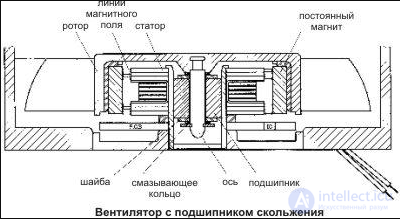
The simplest type of bearing; it consists of a bushing coated with an anti-friction material, inside which the shaft rotates. With upright mounting (the axis of rotation horizontal) the average period of stable operation of a sleeve bearing reaches up to thirty thousand hours. These bearings work excellently in conditions of both high humidity and dryness; the operating temperature of sleeve bearings ranges from +25°C to +40°C.
|
Low while in good condition, but as such bearings wear out the coolers as a whole start to make a lot of noise because of vibration. | Relatively short, and strongly dependent on the operating temperature and vibration loads. Modern versions are rated for up to 35 thousand hours, but that figure is attainable only under ideal conditions; in practice such bearings last two to three times less. | The cheapest type of bearing. |
| Sleeve bearing with a helical groove (rifle bearing, Z-Axis bearing) | A sleeve bearing with special grooves on the bushing and the shaft that recirculate the lubricating fluid. | Low. | Substantially longer than that of the simplest sleeve bearings and close to that of FDB bearings. | Slightly higher than that of ordinary sleeve bearings, but lower than that of FDB bearings. |
| Fluid dynamic bearing (FDB bearing) | An improved sleeve bearing in which the shaft rotates within a layer of fluid that is continuously retained inside the bushing by the pressure difference generated during operation. | Substantially longer than that of sleeve bearings; figures of up to 80 thousand hours are claimed, but under real operating conditions this figure should also be cut at least in half. | Higher than that of ordinary sleeve bearings, but lower than that of ball bearings. | |
|
HYDROSTATIC BEARING |
a sleeve bearing in which the oil film between the rubbing surfaces is created by feeding oil to them under pressure from a pump. The coefficient of friction of a hydrostatic bearing when starting from rest is low, and wear is practically absent . Hydrostatic bearings are used for critical, slowly rotating shafts and rotors. |
|||
| Ball bearing |
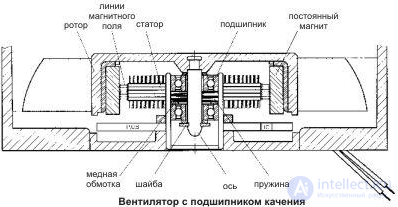
Of all types of rolling-element bearings, only radial ball bearings are used in coolers; they consist of two races, the rolling elements (the balls themselves) and a cage. The bearing works poorly in conditions of humidity and excessive dryness, but performs excellently at moderate temperatures (from +25°C to +40°C).
|
Formally higher than that of sleeve bearings; however, because of their longer service life, under equal conditions of prolonged operation fans on such bearings do not turn out to be noisier than sleeve-bearing counterparts, which are more susceptible to wear. Thus one of their main drawbacks is excessive noise during operation. But despite this downside, they work soundly in any position (vertical and horizontal) and run for up to 60-70 thousand hours. | The rated service life may be from 59 to 90 thousand hours; under real operating conditions such bearings are substantially more durable than sleeve bearings. | Higher than that of sleeve bearings. |
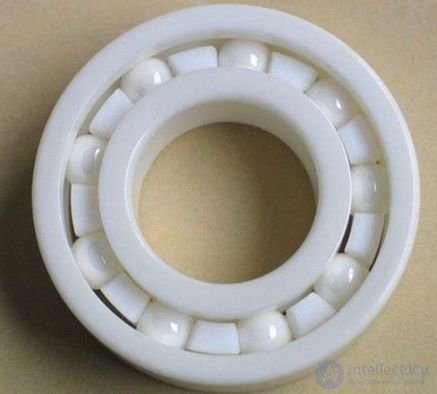
| Ceramic ball bearing (ceramic bearing) | A rolling-element bearing that uses ceramic materials. | Low. | The rated service life may be up to 160 thousand hours at fairly high operating temperatures; in fact, these are currently the most durable bearings used in coolers. | The highest. |
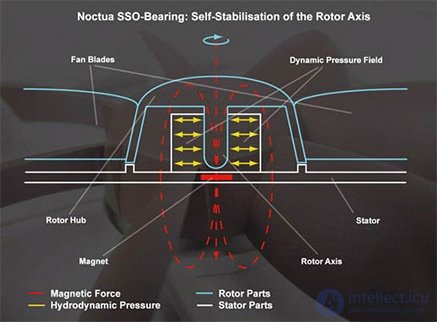
| Oil pressure bearing (SSO) | An improved fluid dynamic bearing. It is distinguished by a thicker layer of fluid (lubricant). To reduce wear, the shaft is centered by a permanent magnet installed in the base | The lowest. | The rated service life may be up to 160 thousand hours at fairly high operating temperatures; in fact, these are currently the most durable bearings used in coolers. | Higher than that of ball bearings, but lower than that of ceramic ball bearings |
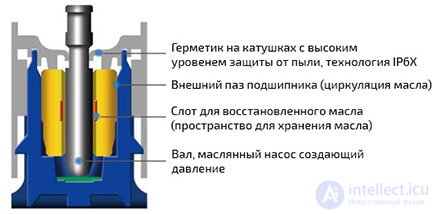
| Self-lubricating sleeve bearing (LDP) | An improved sleeve bearing. It has dust protection conforming to IP6X and a special slot for reclaimed oil, which increase the service life of the fan. | Low while in good condition. | The rated service life may be up to 160 thousand hours at fairly high operating temperatures; in fact, these are currently the most durable bearings used in coolers. | Higher than that of sleeve bearings, lower than that of fluid dynamic ones |
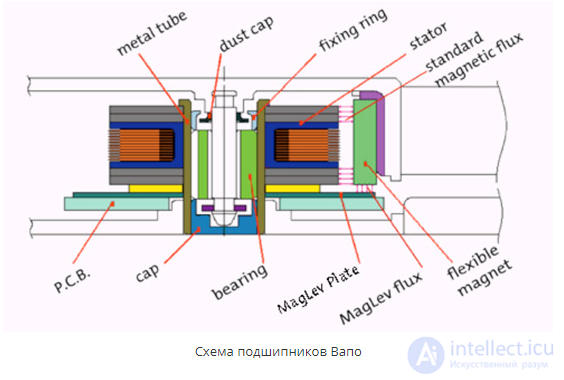
| Vapo bearings |
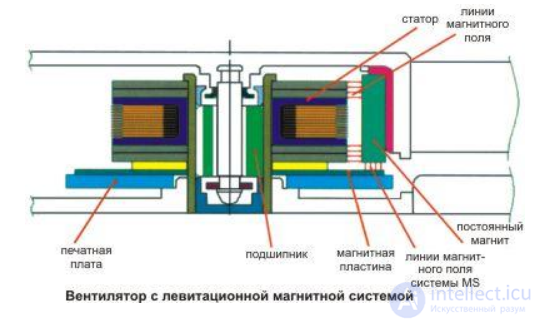
the manufacturer "Sunon" developed a unique technology called MagLev (from the words "magnetic levitation") that makes it possible to combine the advantages of both types of bearing and to minimize their drawbacks. This solution is better known under the name "Vapo bearing". How is it built? In essence, it is an upgraded sleeve bearing in which a special system of magnets creates a magnetic field that compensates for the rotor's own weight. As a result, during operation the rotor levitates in the magnetic field, almost without touching the walls of the bushing. Technologies of this kind reduce wear, damp vibration during operation and make the fan's rotation practically silent, which has a positive effect on how the fan's operation is perceived acoustically. For some models with a Vapo bearing the operating temperature can be above 70°C. The only downside is the higher cost compared with ball and sleeve bearings. But for high-quality, long-lasting operation this is exactly what is needed. The Vapo technology holds up excellently throughout the entire service period and works very efficiently both at moderate temperatures (from +25°C to +40°C) and in conditions of high humidity and dryness. |
Low noise level. |
Long service life (up to 60 thousand hours). Ability to operate in any position. |
|
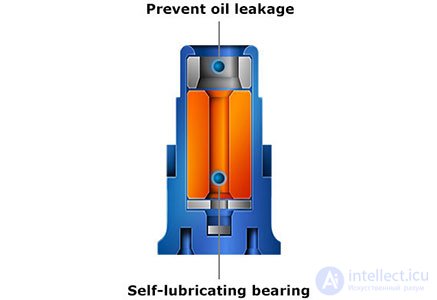
| Polyoxymethylene bearing (POM Bearing) | An improved sleeve bearing. To increase the service life, the shaft is coated with polyoxymethylene, which has a reduced coefficient of sliding friction. | Low while in good condition. | The rated service life may be up to 160 thousand hours | Higher than that of sleeve bearings, lower than that of fluid dynamic ones |
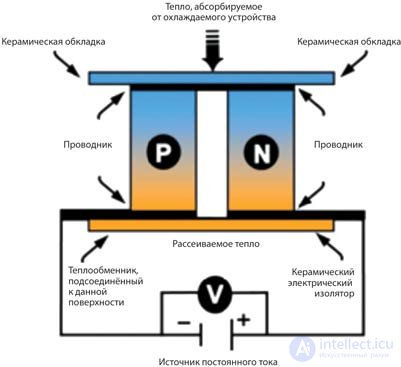
| Thermoelectric cooler |
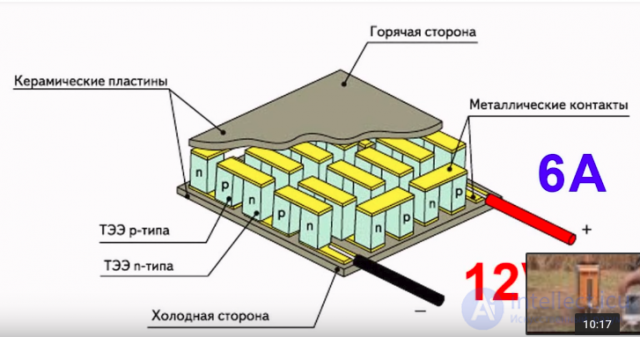
A thermoelectric cooler works on the basis of the Peltier effect. In a thermoelectric module the semiconductor component functions as a small heat pump. |
none at all | the higher the voltage, the higher the current and the temperature difference |
|
Name |
Diagram |
Sleeve bearing(Sleeve Bearing) |
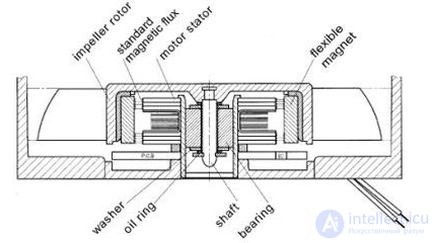 |
Sleeve bearing with a helical groove(Rifle Bearing, Z-Axis Bearing) |
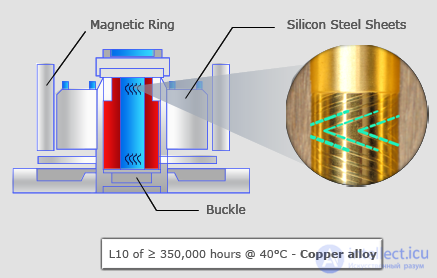 |
Fluid dynamic bearing(FDB Bearing) |
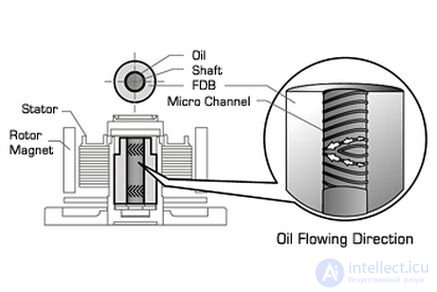 |
Ball bearing(Ball Bearing) |
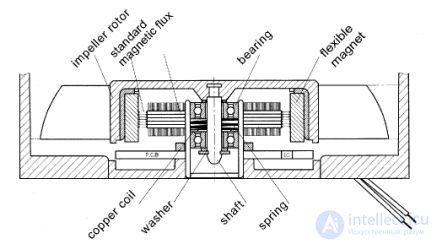 |
Ceramic ball bearing(Ceramic Bearing) |
 |
Oil pressure bearing(SSO) |
 |
Self-lubricating sleeve bearing(LDP) |
 |
Polyoxymethylene bearing(POM Bearing) |
 |
|
Vapo bearings manufacturer Sunon |
|
|
Thermoelectric cooler no mechanical parts |
3 volts - 1 amp 5 V - 1.5 A 12 volts - 4 amps - operating voltage, temperature difference 70 degrees surface 40×40 mm |
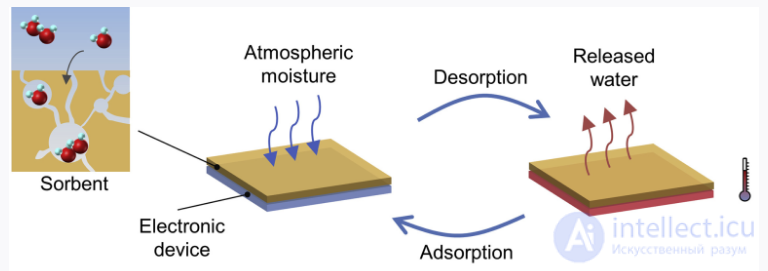
| metal-organic frameworks (MOFs), which are composites consisting of nanoscopic particles of polymers and metals. They contain a great many micropores, which makes this material a very effective sponge, able to absorb moisture from the surrounding environment on its own; heat-generating surfaces such as a CPU can be covered with a thin layer of MOF. When the load on the processor is low, the material, being cold, will take up water. On heating, the collected liquid begins to evaporate, keeping the temperature from rising further. The duration of the effect naturally depends directly on the amount of moisture stored. |
advantages of the solution: MOF takes up water fairly quickly under ordinary room conditions, "recharges" itself when the heating is switched off and is then ready to work again. Among the drawbacks of the development the researchers list the fact that the material's thermal conductivity is too low, so once its moisture reserve is exhausted it starts to act, conversely, like a blanket. In addition, the cost of MOF still remains too high to set up mass production of processors with such a coating. |
Note that fans with the same price and dimensions differ slightly: in the number of blades, their shape, and the thickness and width of each blade. Like the wings of an aircraft, fan blades obey the same laws of aerodynamics. The shape of the blades determines at which fan operating modes airflow stall, and hence an increase in noise, can occur.
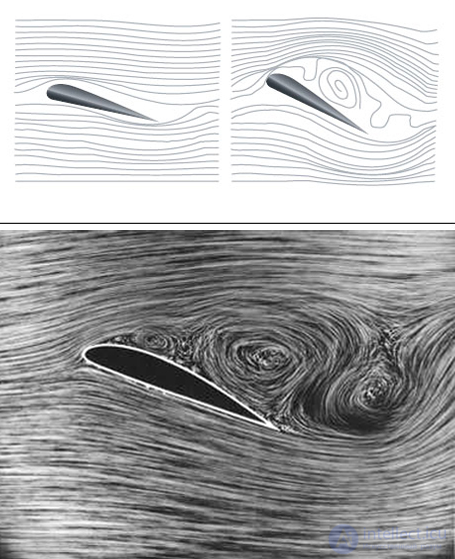
This effect can be seen clearly if you row an oar through water. Eddies with a large number of bubbles always form behind the oar. But if you set the oar at a slight angle, there are fewer bubbles and eddies. It is the same with airflow. If a fan blade is not quite the right shape, the airflow does not “slide” smoothly off the blade but separates, forming eddies. And at high fan rotation speeds this creates extra aerodynamic noise.
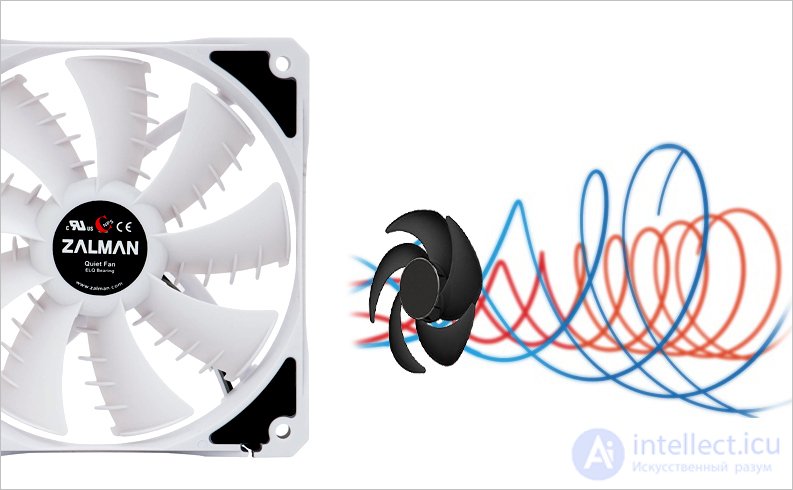
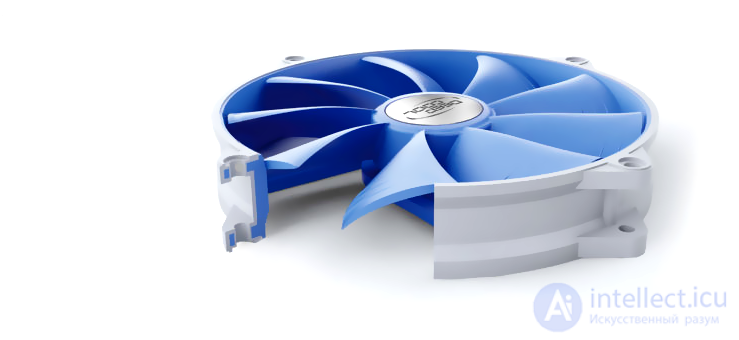
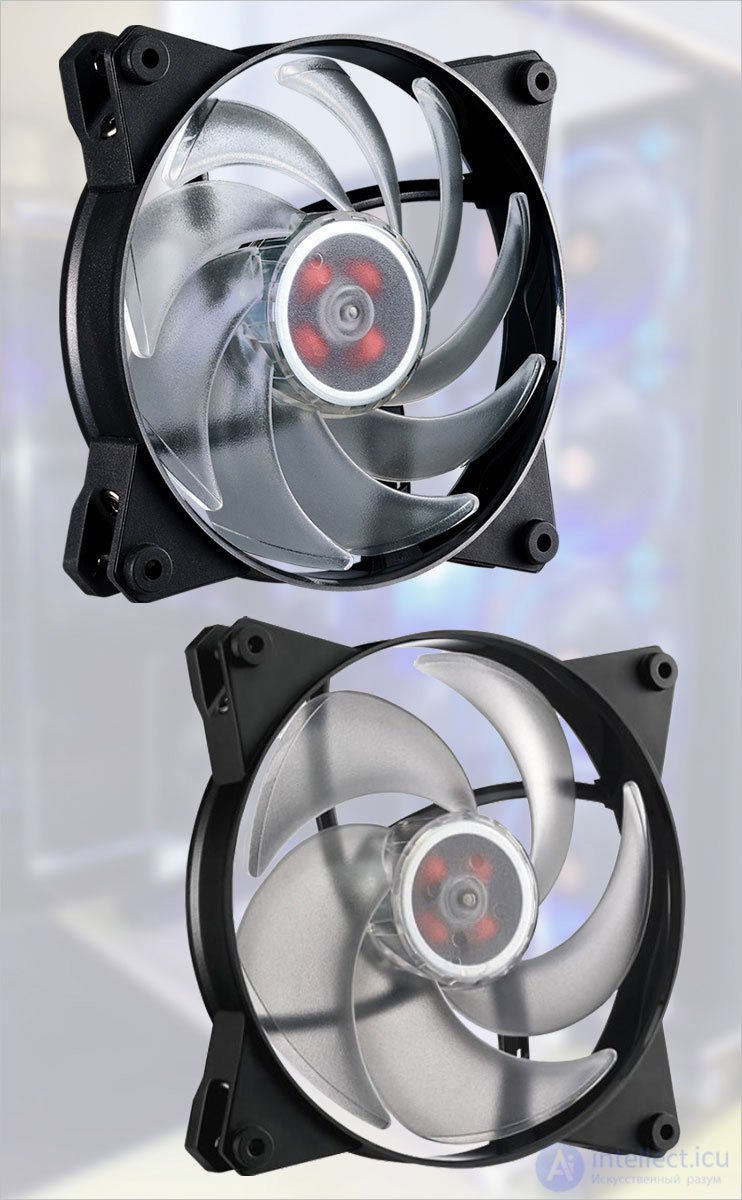
The air flow of a fan is the volume of air the fan can move per unit of time. It might seem that this is the only factor that matters in a fan's power. It is, but only where the air flow in front of and behind the fan is unobstructed (for example, in an ordinary desk fan). When there are obstructions, however (heat-sink fins, case grilles or dust filters, for instance), the air flow is deflected and efficiency drops. The static pressure of the air flow refers to the force with which air is expelled from the fan and, consequently, to its ability to overcome obstacles.
Fan static pressure is measured in pascals, Pa (1 Pa ~ 0.1 mm H2O). The visual difference of a fan with increased static pressure is the blade design. Such fans have wide blades, whereas fans optimized for air flow have narrow blades. Many manufacturers may market their fans as static-pressure fans, but in reality they are not always optimized for that purpose.
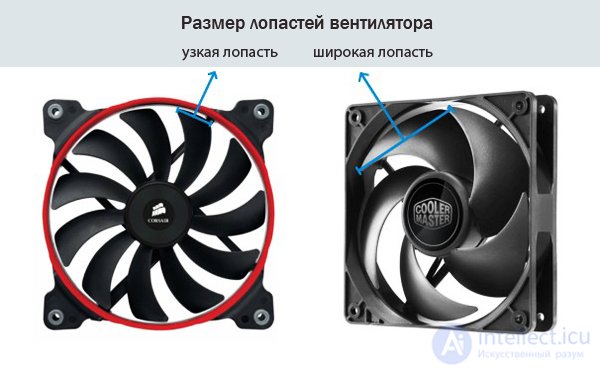
Left - Corsair Air Series AF140, static pressure 0.84 mm/H2O. Right - Silencio FP120 PWM 2400, static pressure 4.80 mm/H2O.
When installing fans with wide blades inside the system unit, make sure there are as few obstructions as possible in front of and behind the fan (fine case grilles, poorly routed cables).
Let us list the main factors that determine how noisy a fan is.
High rotation speed.
A fan with many blades (9 and up).
Wide, thick blades with a proper aerodynamic shape.
In the end, you should look for a fan with wide, thick blades of a proper aerodynamic shape (this is usually stated on the packaging). Reverse sweep of the blades has the best effect on reducing fan noise. A hydrodynamic sleeve bearing (the optimal price-to-quality ratio). A speed of about 1200 revolutions per minute.

Comments