
Lecture
Free cooling is a way of cooling an object without using compressors or other energy-intensive equipment, by making use of the surrounding environment. The basic idea behind this technology is to supply cool outdoor air directly into the room, or to use it via a coolant. For free cooling to work, the outdoor temperature must be lower than the temperature that needs to be maintained indoors.
Free cooling is an energy-saving method of cooling objects with high heat loads during winter and the transitional seasons. Instead of using a standard air conditioning system, which operates on a vapor-compression refrigeration cycle and requires an energy-intensive compressor, free cooling makes use of the outdoor environment and a supply of cool air to cool the premises.
A standard air conditioning system cools a room even when the outdoor temperature is higher than indoors. However, at some facilities, such as server and switching rooms, mobile network base stations and data centres, air cooling is required almost year-round. In such cases, the high heat loads exceed the need for heating, and free cooling becomes the preferred option.
Instead of running air conditioners in winter, which require a low-temperature kit and are inefficient, free cooling offers a simple solution - using the supply ventilation system to deliver cold air in winter. Free cooling technologies, such as indirect free cooling with adiabatic cooling, can also work successfully in summer.
Thus, free cooling is an energy-saving cooling method that is used at facilities with high heat loads during winter and the transitional season, and in some cases in summer as well.
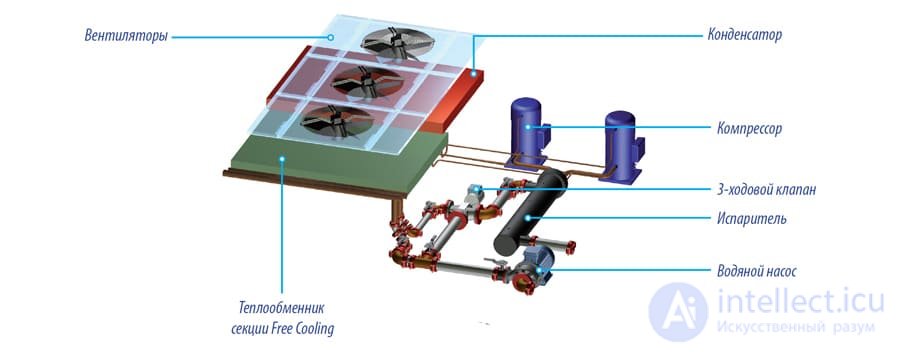
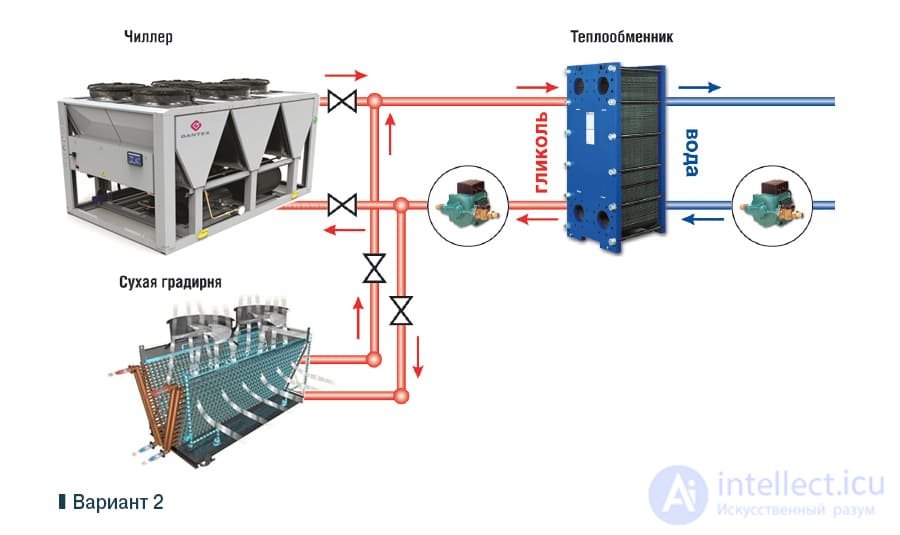
Chillers with a free cooling function are refrigeration units that have an additional heat exchanger for cooling the coolant using outdoor air.
The operation of such chillers is based on a specific algorithm. If the outdoor temperature is higher than the set coolant temperature, the chiller operates in standard mode, with the coolant cooled in the evaporator built into the chiller itself. However, if the outdoor air temperature is lower than the set coolant temperature, the coolant is directed not to the evaporator but to the additional heat exchanger, where it is cooled by the outdoor air.
The additional heat exchanger is located next to the condenser and is cooled by air from the same fans used to cool the condenser. Thus, chillers with a free cooling function differ from conventional chillers only in the presence of the additional heat exchanger, the piping arrangement and the controller's operating algorithm.
This same concept can also be implemented using conventional chillers and dry coolers. In this case, in summer the coolant is directed to the chiller for cooling, while in the transitional season and winter it is directed to the dry cooler. This system configuration offers increased reliability: if the chiller fails, cooling continues via the dry cooler. However, implementing such a system requires more complex engineering work: a piping arrangement must be created, the appropriate valves installed, and system automation algorithms developed.
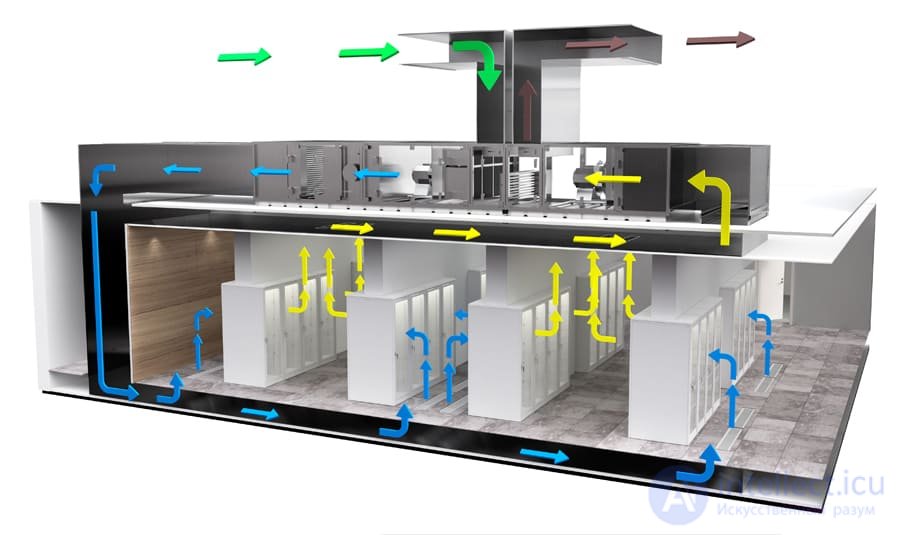
Direct free cooling is a supply-and-exhaust ventilation system with the ability to recirculate air. These systems are equipped with an efficient filtration system that ensures clean air inside the building.
With direct free cooling, the temperature of the supply air is kept constant regardless of outdoor conditions. This is achieved by changing the ratio of recirculated to fresh supply air. If the outdoor temperature matches the set supply air temperature, recirculation is not used. As the outdoor temperature drops, the share of recirculation gradually increases, reaching a maximum during severe frost. The ratio of recirculated to supply air is controlled using motorized dampers.
It is important to understand that direct free cooling cannot maintain an indoor temperature lower than the outdoor one. To keep the system running year-round, direct free cooling is supplemented with conventional coolers based on the vapor-compression refrigeration cycle. The main advantage of free cooling is that these coolers only operate for part of the year, resulting in substantial energy savings.
Thus, implementing a free cooling system always requires initial capital investment while reducing operating costs.
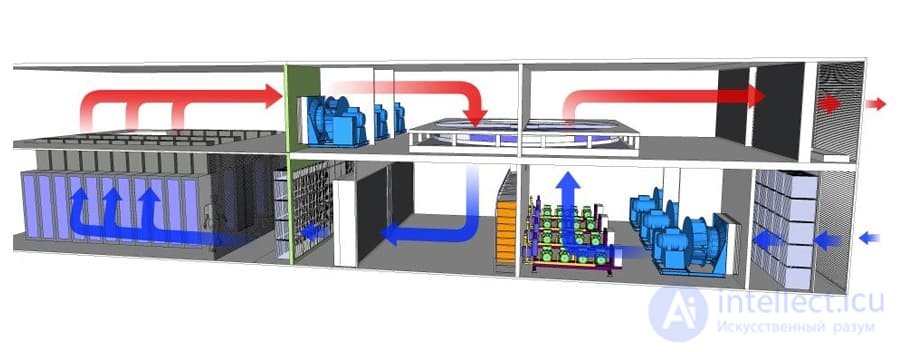
Indirect free cooling is based on cooling the indoor air by using outdoor air through special air-to-air heat exchangers.
For a heat exchanger to work, a difference in thermal potential - a temperature difference between the two media - must be maintained. Indirect free cooling can only operate when the outdoor air temperature is several degrees lower than the temperature of the cooled air supplied to the room. This means that this cooling mode must run for a shorter time than direct free cooling. However, there are exceptions.
Optimizing indirect free cooling installations includes adding a section for adiabatic (spray) humidification of the outdoor air. In this section, the air is humidified and cooled, producing the effect of a lower outdoor temperature than actually exists. Using adiabatic humidifiers significantly expands the capabilities of indirect free cooling, especially in hot, dry regions.
The air-to-air heat exchanger used in indirect free cooling installations is often a large-diameter, slowly rotating rotor. Similar to a rotary heat exchanger (heat recovery unit), it transfers cold from the outdoor air to the indoor air, keeping the whole system running.

Comments