
Lecture
A digital single-lens reflex camera, or DSLR, is a digital camera built on the single-lens reflex principle used in film photography. The term "digital reflex camera" implies a single-lens layout, since the twin-lens configuration never found wide use in digital photography.
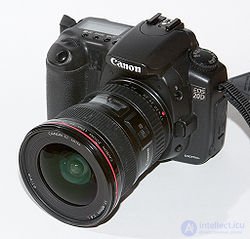
The Canon EOS 20D digital SLR with a Canon EF 17-40 mm lens.
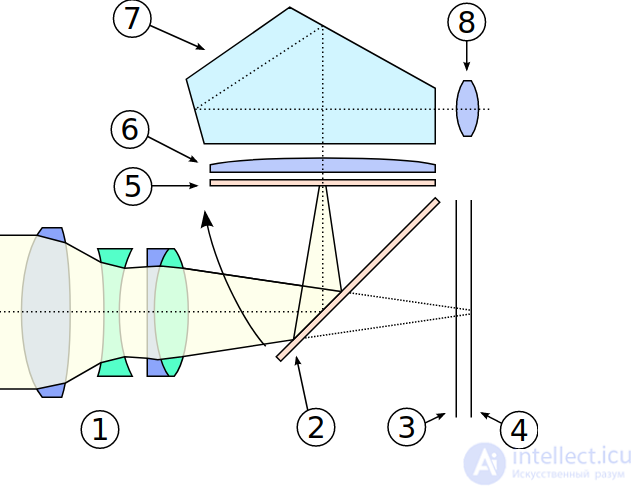
Construction of a single-lens reflex camera
The photographer can see the subject before taking the shot by way of the mirror. During exposure the mirror swings up, and the light reaches the sensor instead.
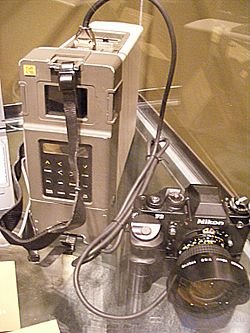 The first production digital reflex photographic system, the Kodak DCS 100, based on the Nikon F3 HP body. The camera with its digital back and the external unit housing the hard disk drive
Attempts to build portable electronic devices for recording still images began immediately after the invention of the charge-coupled device by Willard Boyle and George Smith in 1969 . However, the first reflex still video cameras, such as the "Sony Mavica" of 1981 and the "Canon RC-701" and "Nikon Still Video Camera 1" that appeared in 1986, were not digital, since they were based on analog image recording in one of the color television standards .
The first digital reflex camera can be considered the hybrid "Electro-Optic Camera", designed by Kodak's electronics division on a United States government contract using the professional Canon New F-1 camera . Its basis was the black-and-white "M1" CCD sensor developed by Kodak, whose resolution exceeded 1 megapixel for the first time . The sensor was housed in a unit attached to the camera's removable back; the single example was produced in 1988 and was used by the military. Two more similar "Tactic Camera" units were subsequently built for defense applications .
The resulting hybrids proved too bulky and awkward, and the next stage, a year later, was the development of the "IRIS" project for photojournalists and "Hawkeye II" for the military . Both prototypes were built around the "Nikon F3" reflex camera, but the black-and-white "IRIS" found no demand in the news photography market. Some of the military backs were fitted with the new "M3" sensor with a Bayer filter, which became the first color sensor with a resolution above 1 megapixel . That same sensor became the basis for the first commercially successful, series-produced digital hybrid, the "Kodak DCS 100", also assembled around the "Nikon F3 HP" camera. Released in 1991, the hybrid consisted of a digital back with a CCD sensor connected by cable to an external unit carried on the shoulder . The external Digital Storage Unit (DSU) contained a 3.5-inch hard disk drive with a capacity of 200 megabytes, onto which the images produced by the camera attachment were recorded. The back could be detached, and the camera once again became usable for shooting on film. The device was the first designed to work together with a computer rather than a videocassette recorder, as had been the case with most earlier designs from other manufacturers .
The hybrids listed above were created by Kodak's civilian (Professional Photography Division) and defense (Federal Systems Division) divisions independently of Nikon, which released, jointly with NASA, the digital "Nikon F4 ESC NASA" with a back equipped with a 1-megapixel black-and-white sensor . Further development was concentrated at Fujifilm, Sony and Kodak's civilian sector, which from 1994 to 1998 released more compact devices of the DCS series that mated with the "Nikon F801", "Nikon F90" and "Canon EOS-1N" cameras . All these developments were an intermediate stage before the creation of full-fledged digital SLR cameras of integral construction. By the early 2000s Canon and Nikon had created the professional "Canon EOS-1D" and "Nikon D1" lines, whose design drew on earlier experience with hybrid cameras. The option of replacing film with a digital sensor back survived only in medium-format reflex cameras intended for studio work.
The arrival of consumer-level digital SLR cameras can be dated to the end of 2003, when mass sales began of the "Canon EOS 300D", whose price fell for the first time below the symbolic threshold of 1000 dollars[10][11]. All earlier models, which initially cost between 5 and 20 thousand dollars, belonged only to the professional segment of the market. Once sales to the general public began, digital SLR cameras developed rapidly, increasing sensor resolution, sensor size and data processing speed. Gradually the quality of digital photography became comparable with that of classic film, while personal computers became affordable for the mass buyer. From the mid-2000s digital equipment almost completely displaced film analogs, above all in photojournalism, which had traditionally relied on the reflex viewfinder. In amateur photography, from the early 2010s the reflex viewfinder began to be displaced by mirrorless interchangeable-lens cameras and by camera phones[12][13]. Thus, while more than 16 million digital SLR cameras were sold worldwide in 2012, by 2017 that figure had fallen by more than half, to 7.5 million[14].
The main advantages of reflex cameras over other types of digital equipment are considered to be the ability to use interchangeable optics that deliver the same image as on film counterparts, and a relatively large sensor that ensures high digital image quality[15]. Advances in electronic viewing technologies are minimizing the chief advantage of the reflex layout: a parallax-free optical viewfinder that gives an image identical to the one formed in the focal plane.
The main advantage of reflex cameras over mirrorless ones is considered to be the ability to use phase-detection autofocus. This is the fastest and most accurate technology of all those in existence, but its operation requires an optical path directing light from the lens onto a separate sensor. Such an arrangement is easy to implement in single-lens reflex cameras by means of the main and auxiliary mirrors, but involves major difficulties in mirrorless designs, which focus directly on the image formed by the image sensor[16]. In that case a comparison of image contrast at different lens positions is used. To increase the focusing speed of mirrorless cameras, some manufacturers integrate phase-detection sensors directly into the light-sensitive image sensor, but the autofocus performance of reflex cameras remains unsurpassed to this day[17][18].
Using a variant of the reflex layout with a fixed semi-transparent mirror makes it possible to apply the phase-detection autofocus principle in "Live View" mode, including during video recording, but this calls for careful maintenance of the cleanliness of the additional optical surface, which, unlike the image sensor, is not protected from dust and contamination even by a shutter[19]. In addition, the presence of a semi-transparent mirror reduces the light-gathering power of the whole system and dims the image in the viewfinder. The Sony Alpha SLT line of cameras is built on this scheme.
In 2015 Sony introduced a number of technologies allowing fast hybrid autofocus to be implemented in mirrorless cameras, using a set of special microlenses and dedicated pixels on a principle similar to phase-detection autofocus[20][21].
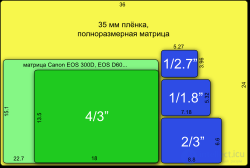 Comparative sensor sizes of digital cameras of various types. The sensors of compact cameras are shown in blue
The light-sensitive image sensors fitted in digital reflex cameras are considerably larger in physical size than the sensors of compact cameras[22][23]. A large frame makes it possible to use larger elementary photodiodes for the same pixel count, which determines resolution. As a result image quality improves: noise is reduced at the same sensitivity settings, and the dynamic range is wider[24]. The sensor of a typical consumer-class digital SLR is APS-C format (22×15 mm), but there is a trend toward increasing the sensor to full frame (Canon EOS 6D, Sony A99)[25].
The sensors of professional cameras are somewhat larger — APS-H format (the Canon EOS-1D series) — but can reach the size of the "classic" small format frame of 24×36 mm (Canon EOS 5D Mark III, Canon EOS-1D X Mark II, Nikon D5) and even exceed it (Leica S2, Mamiya 645D or the Hasselblad HxD series), which makes excellent color rendition and signal-to-noise ratio attainable. The sensor size of compact digital cameras as a rule does not exceed 7.2×5.3 mm (1/1.8″ format) and in most cases is 4.5×3.4 mm (1/3.2″ format), giving an area 56.5 times smaller than the small format "full" frame (864 and 15.3 square millimeters respectively)[26]. Such sensors can provide an acceptable noise level and image quality only at minimum ISO settings and in bright light.
At the same time, small sensors allow more compact and lightweight optics with high light-gathering power to be designed. Thus, the zoom ratio and speed of the zoom lenses of compact cameras are usually unattainable for optics designed for a small-format sensor or a film frame. Telephoto lenses intended for a small frame size are also far more compact and faster than large-format counterparts. This advantage of miniature sensors is exploited in bridge ("pseudo-reflex") digital cameras, which are usually fitted with a fixed compact high-ratio "superzoom" covering a substantial part of the range of focal lengths used in everyday shooting practice[27]. Such cameras, cheaper than reflex models, occupy a significant part of the market for amateur photography equipment, displacing DSLRs, which are more difficult to handle. In addition, the non-removable lens design prevents dust and contamination from reaching the sensor surface, which is unavoidable in reflex cameras with interchangeable optics.
Despite the importance of the physical characteristics of large sensors, an even more significant advantage of reflex equipment is considered to be the character of the image produced by lenses from small-format cameras. Photographic lenses have relatively long focal lengths compared with the optics of video cameras and compact cameras. As a result, at the same angles of view and relative apertures, the depth of field of the resulting image is considerably shallower than in miniature formats, which makes it possible to use techniques traditional in professional photography that emphasize the depth of the space and separate the main subject from the background.
Another important consideration is the fundamentally higher quality of the optical image, which depends directly on the physical size of the frame because of the diffraction limit of any optical system[24][28]. In other words, as in film photography, quality is directly related to frame size, regardless of the resolution of the light-sensitive element. For these reasons maximum detail in modern digital photography is attainable only with medium-format digital backs or reflex cameras with a full-frame sensor.
At the same time, the emergence of a new class of mirrorless cameras in the late 2000s broke the monopoly that DSLRs had held on large image sensors[29][30]. Some cameras of this type are equipped with Micro Four Thirds and APS-C sensors, and shortly afterwards the "Sony A7" appeared with a full-frame sensor[16].
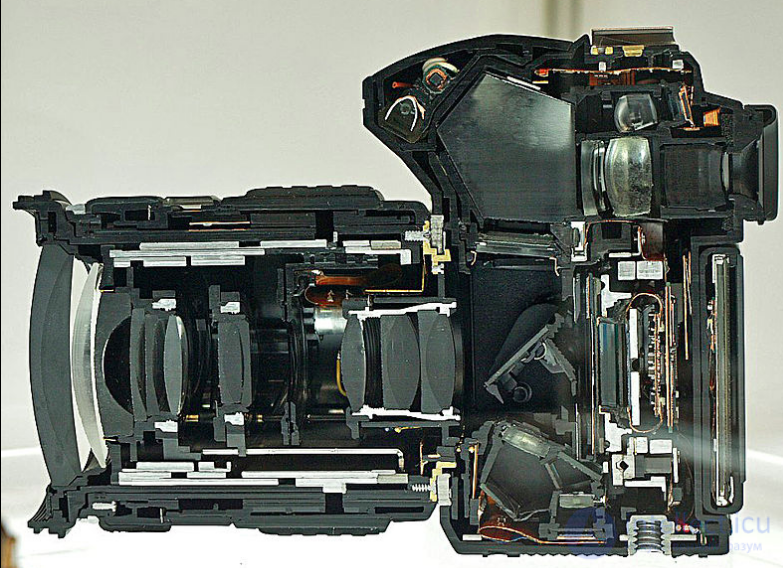 Cutaway of the Olympus E-30 digital SLR camera. The cutaway reveals the design of the reflex optical path: the main and secondary mirrors, the focusing screen, the pentaprism and the eyepiece
The fundamental difference between digital SLR cameras and all other types of digital camera is the reflex viewfinder, which is considered the most refined of all optical viewfinders and offers such advantages as the complete absence of parallax, the ability to assess depth of field visually, and an exact match between the frame boundaries and the field of view of any interchangeable lens, including zooms[31]. In addition, it is the only type of optical viewfinder suitable for shooting through optical instruments, for macro photography and for the use of specialized optics, including shift lenses[32]. Unlike rangefinder cameras, the accuracy of manual and automatic focusing with a reflex viewfinder does not depend on the focal length of the lens[33][34]. Compared with compact digital cameras, SLRs provide higher performance and more convenient control of an image that is seen without electronic conversion, with all its optical nuances.
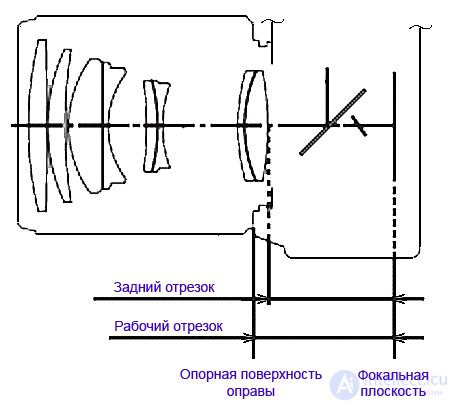
The drawbacks of the reflex viewfinder include its bulk and complexity, which are especially apparent in comparison with the latest mirrorless cameras[30]. In addition, the presence of a moving mirror complicates the design of short-focus optics because the back focal distance has to be lengthened. The retrofocus design of wide-angle lenses for SLR cameras is considered less refined than the symmetrical design used in all other types of equipment. The rapid movement of the mirror immediately before the shot causes vibration, which is unacceptable at the moment of exposure[34]. The complexity of the focusing path and the presence of additional high-precision optical elements such as the pentaprism and the focusing screen make the whole design more expensive[30]. The relative positioning of the viewfinder elements and the autofocus module requires precise alignment, on which the correctness of manual and automatic focusing depends. Another disadvantage of the reflex viewfinder is that it limits the maximum continuous shooting rate because of the inertia of the mirror and its drive mechanism[17].
At the same time, the electronic viewfinder of mirrorless digital cameras offers the same advantages as the reflex one, displaying the future image on a liquid crystal display. The traditional drawbacks of such a viewfinder — overheating of the image sensor (the photosensitive sensor) with a resulting loss of image quality, low display resolution and the possibility of it being washed out by bright light — had been overcome by the early 2010s thanks to vastly improved image sensor and TFT screen characteristics and to their falling cost. And the use of an eye-level electronic viewfinder prevents washout and brings the shooting technique closer to the traditional "reflex" one. The lag of the electronic image, noticeable on the first compact models, has been reduced to practically zero as processor performance has increased[14]. At the same time, the shutter lag of modern mirrorless cameras is comparable to that of SLRs, in which this parameter also exceeds the figures for rangefinder and scale-focus cameras because of the moving mirror. An advantage of the optical viewfinder such as not requiring power is of secondary importance in digital devices, but it does significantly reduce power consumption, especially in standby mode.
Using an electronic viewfinder in a digital SLR camera of the classic design is impossible because during framing the photosensitive sensor is covered by the shutter and by the mirror that makes the optical viewfinder work. In January 2006 Olympus introduced the E-330 SLR camera, the first to implement framing based on an image taken not from an auxiliary sensor placed in the viewfinder's optical path but from the main sensor[35]. To do this, the camera is switched into a mode given the trade name "Live View". In this mode, framing is done with the mirror raised and the shutter open, just as in all other types of digital equipment. The optical viewfinder does not work in this case, since it is blocked by the raised mirror[* 1]. Immediately before the shot the shutter closes and then makes one or several exposures, depending on the selected drive mode. The mirror remains raised until "Live View" mode is switched off.
The presence of such a mode makes framing more convenient, including by means of an articulated display, and makes the SLR camera suitable for video recording. In addition, one more advantage of the electronic viewfinder becomes available: remote framing on a computer screen[36]. The most modern models can output the image to the screen of an external smartphone connected over wireless protocols[37]. However, when the mode is enabled, power consumption and sensor heating rise sharply, and most of the advantages of the optical viewfinder over the electronic one are lost, above all phase-detection autofocus. In the first devices, for example the Canon EOS 5D Mark II, autofocus was impossible altogether when the mode was enabled, since with the mirror raised no light reaches the sensor. In later models this shortcoming was eliminated by using contrast-detection autofocus, but its speed is considerably lower than that of phase detection, which works in the standard shooting modes. In addition, the built-in TTL exposure meter becomes inoperative because its sensor is blocked by the raised mirror. In this case alternative metering directly off the image sensor is engaged. At present (2018) "Live View" technology is considered mandatory not only in consumer-grade SLR equipment but in professional equipment as well[38].
The ability to use interchangeable optics without restrictions, the availability of macro photography, and also of special kinds of photography through optical instruments such as a microscope, telescope or endoscope, are the main factors behind the popularity of digital single-lens reflex cameras, which are suitable for any applied task[34].
Since the design of most digital SLR cameras is based on film prototypes, the same lenses and the same lens mount standards are used, allowing for the crop factor due to the small sensor size. To compensate for the nominal "lengthening" of the focal length, the major manufacturers developed new standards compatible with the previous ones: Canon, for example, launched a new line of cameras and lenses to the EF-S standard, based on the film Canon EF. The new mount accepts old-standard optics without restriction, but backward compatibility is limited, especially for short-focus optics because of their shortened back focal distance[39]. The Nikon DX standard is arranged in a similar way, except that the back focal distance was left unchanged[40]. In addition, the new lenses may contain improved electronic circuitry (an electromagnetically driven automatic diaphragm, an optical stabilizer, and so on) that does not work with older cameras. Most such optics have a reduced image circle designed for a small sensor, and mounting them on a full-frame camera results in vignetting at the corners of the frame.
A mirrorless camera is a digital camera without an optical viewfinder, in place of which a high-quality electronic viewfinder is used. Mirrorless cameras differ from bridge (pseudo-reflex) cameras in that the lens can be changed and in being fully fledged system cameras, in no way inferior to digital SLR cameras.
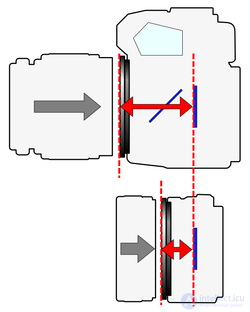 The design of an SLR camera (top) and a mirrorless camera (bottom)
The word "mirrorless" indicates the absence of an optical path with a mirror, even though in terms of functional capabilities cameras of this type fully match single-lens reflex cameras. The parallax-free electronic viewfinder makes it possible to frame and focus the image precisely at any lens focal length, and also when shooting through optical instruments: a microscope, telescope, endoscope and others. The world's first mirrorless camera, the "Panasonic Lumix DMC-G1", went on sale in October 2008. By the early 2020s mirrorless cameras remained the most rapidly developing segment of the photographic equipment market. In the first half of 2018 alone, sales of mirrorless cameras in Russia grew by 35%.
Mirrorless cameras are one of the newest phenomena in modern photography and have no settled, generally accepted designation. In different countries they may be called differently: in France, for example, the term "hybrid camera" is used (French: Appareil photographique hybride). More often, however, one encounters abbreviations that denote this concept on the international photographic equipment market.
The emergence of the mirrorless camera class became possible thanks to improvements in electronic components that replace expensive optical and mechanical structural elements. Using an electronic viewfinder instead of an optical path with a mirror and a pentaprism makes it possible to substantially reduce the size and weight of the camera without losing the functionality characteristic of reflex equipment[11]. Unlike compact cameras of similar size with miniature sensors, mirrorless cameras use large sensors in the Micro Four Thirds and APS-C formats, full-frame or even medium format, making it possible to obtain excellent image quality at high sensitivity settings[12].
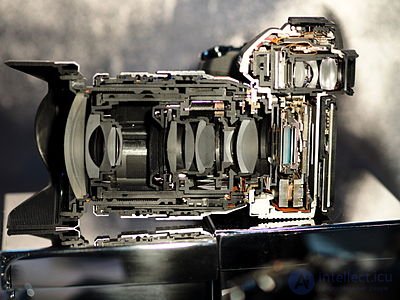 Cutaway of the "Olympus OM-D E-M1" mirrorless camera
The main gain achieved in the mirrorless design, however, lies in the absence of a moving mirror and its drive mechanism, which are the main source of vibration and noise. The electronic viewfinder principle even makes it possible to dispense with any mechanical moving parts at all, which sharply increases the reliability of the camera and makes it completely silent[13]. The latest mirrorless cameras are equipped with a shooting mode in which the exposure time is set not by the shutter but by the sensor readout time[14]. In some situations (at a music concert or in a theater, for example) such silent photographic equipment is indispensable[15].
Because an optical viewfinder is not needed, mirrorless cameras can implement the advanced principle of image stabilization by moving the sensor. With traditional optical stabilization by shifting the lens elements, a steady image is visible in the reflex viewfinder, whereas the result of stabilization by shifting the photosensor is not reflected in it at all, making it harder to assess the frame. For this reason a stabilized sensor is hardly ever used in SLR cameras[16]. In mirrorless cameras this method is implemented without any inconvenience, since the corrected, steady image is output to the LCD viewfinder. That is why most mirrorless cameras in the upper price segment are equipped with effective five-axis stabilization that works with any lens[17].
The absence of a mirror also removes the main limitation on continuous shooting rate, which in the best DSLRs does not exceed 14 frames per second ("Canon EOS-1D X Mark II", 2016)[18]. At the same time, mirrorless equipment delivers higher rates without making the design more expensive. For example, as early as 2011 the shutterless "Nikon 1 J1" reached a rate of up to 60 frames per second[19]. Among photography enthusiasts, an advantage of mirrorless equipment is considered to be the short flange focal distance, achieved because there is no bulky mirror box. This makes it possible to attach, through the simplest adapters and without any additional lenses, virtually any taking optics, including inexpensive lenses of obsolete types[15]. New lens mounts with a shortened flange focal distance were developed from scratch for all mirrorless systems — NX, E, Micro Four Thirds, Nikon Z, Pentax Q, Fujifilm X, Canon RF[* 2].
The main drawback inherent in mirrorless equipment is considered to be its greater dependence on battery power compared with reflex cameras[20]. An electronic viewfinder requires power throughout the entire process of framing and shooting. This is especially critical in standby, when the exact moment of the event is unknown and switching the finder off may lead to missing the desired frame. For these reasons mirrorless cameras require higher-capacity batteries able to keep the viewfinder running for a long time. In addition, an electronic finder cannot relay the light from the lens continuously, and instead displays only individual phases of movement at a finite refresh rate. For this reason some photographers consider the image quality of even the best LCD viewfinders inadequate, as they tire the eyes when shooting fast motion[20].
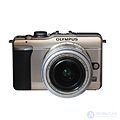
Mirrorless camera "Olympus PEN E-PL1" of the Micro Four Thirds standard
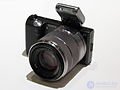
Mirrorless camera "Sony NEX-5" with an APS-C sensor
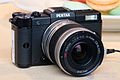
Mirrorless camera "Pentax Q" with a 1/2.3-inch sensor
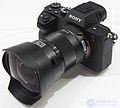
Full-frame mirrorless camera
"Sony ILCE-7M2"
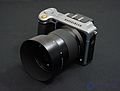
Medium-format mirrorless camera "Hasselblad X1D"
Another fundamental drawback of mirrorless cameras is considered to be the impossibility of fully implementing phase-detection autofocus the way it is done in reflex equipment[21]. A detector of this type requires a separate optical path for its placement, and such a path is absent from the mirrorless layout. The newest models of this type of equipment are fitted with so-called hybrid autofocus based on a special design of the sensor's pixels, for example Canon Dual Pixel AF[22]. However, such a solution is inferior to classic phase-detection sensors, which provide sufficient speed, especially in continuous tracking mode. Nevertheless, for most subjects, even in photojournalism, the autofocus of the newest mirrorless cameras provides the necessary responsiveness. The shortcomings show up mainly when shooting sports with long-focus lenses.
One more drawback of mirrorless cameras that is hard to eliminate is the longer and more complex shutter cycle compared with equipment that has an optical finder. For the electronic viewfinder to work, the shutter must be open, otherwise the sensor cannot send an image to the LCD display. When the release button is pressed, the shutter closes, is cocked, and only after that does it time the exposure. This increases shutter lag and halves the shutter's service life between repairs[23].
By the mid-2010s mirrorless cameras had begun to displace reflex equipment from amateur photography, trailing only cameraphones in sales growth[24]. Compactness and light weight at the same level of quality are especially evident in equipment with a smaller sensor of the Micro Four Thirds and APS-C formats, which quickly became popular in street photography[14]. From the mid-2010s onward, manufacturers of mirrorless equipment have followed the general trend of enlarging the frame to 35 mm size, and in 2014 the company "Phase One" began shipping three models of medium-format mirrorless "Alpa" cameras, the top one of which, the A280, has a resolution of 80 megapixels[25][26]. In 2016 medium-format mirrorless cameras were released by Hasselblad and Fujifilm[27][28]. However, a large sensor reduces the compactness advantage to practically nothing because of the size of the interchangeable optics, which often exceeds that of lenses for reflex cameras[29]. Nevertheless, in professional photography full-frame mirrorless cameras already pose serious competition to reflex cameras, especially in studio and wedding work. The success of the full-frame "Sony A7 III" prompted even the leading camera manufacturers to start producing mirrorless cameras of this class. In August 2018 two full-frame models of the "Nikon Z" series were presented to the public, and in September a similar camera, the "Canon EOS R", was announced.
The most important advantages of mirrorless cameras are inherited from the electronic viewfinder. These include image brightness that does not depend on the aperture setting, the ability to check exposure and color rendition directly at the moment of shooting, the display of any additional information on the screen, and much more[41]. Given sufficient quality, an electronic viewfinder is in no way inferior to a reflex one, and in some respects it even surpasses it, approaching direct-vision cameras[42]. Inconvenience arises when shooting sports, since the refresh rate of an electronic finder is finite, which inevitably leads to strobing of the image of fast-moving subjects. Watching them through the viewfinder for a long time therefore tires the eyes considerably.
Inexpensive mirrorless cameras are equipped with only one liquid-crystal display, located on the back of the body. A screen of this type serves both for framing during shooting and for reviewing the finished image. In some cases it is not informative enough because of stray light and its small size. More expensive models provide, in addition to the flat LCD display, a second finder of the eyepiece type. The second screen duplicates the image of the first, but thanks to the eyepiece it appears considerably larger and is comparable in angular size with the focusing screen of an ordinary reflex-type optical finder. In some cases the eyepiece finder is made as a detachable unit and may be sold as an optional accessory for a camera equipped only with a flat screen[43].
The concept of a mirrorless camera does not provide for any optical finder; however, cameras with a permanently built-in fixed lens are sometimes additionally fitted with a telescopic viewfinder. For example, the Fujifilm FinePix X100 uses an auxiliary optical finder that allows shooting with the screen switched off. Such a design considerably reduces power consumption, since the LCD display is the main consumer of battery charge. In cameras with interchangeable optics or zoom lenses, however, such a technical solution is difficult to implement and moves the camera into a different class.
Because there is no moving mirror and no possibility of installing a separate autofocus module, for a long time the only focusing method available in most mirrorless cameras was contrast-detection autofocus based on the image formed by the sensor. Most models implement automatic magnification of the central zone of the frame during manual focusing, or an indication of the contrast level at the focusing point. The most effective functions for these purposes are "Focus Peaking", based on edge-outlining technology. In reflex equipment these correspond to the microprism grid and the split-image rangefinder wedges, but they are considerably less effective and require good visual acuity.
Unlike reflex cameras, which have fixed focusing points, in mirrorless cameras the focusing zone can be chosen anywhere in the frame area. Most often this is done with a touchscreen. The Nikon and Sony NEX-5R[44] mirrorless cameras carry phase-detection autofocus sensors integrated into the image sensor, which are used in addition to contrast-detection focusing.[45] Hybrid autofocus makes it possible to approach the focusing speed of reflex cameras[19][46][47].
The brightness of the image on the electronic finder's display does not depend on the working aperture value, but reflects only how close the exposure is to correct. For this reason the use of an instant-return diaphragm in mirrorless cameras is not mandatory. However, most mounts developed for this type of camera provide for an electromagnetic instant-return diaphragm that opens fully during framing to make manual focusing easier. To check depth of field, such cameras, like reflex ones, are fitted with a depth-of-field preview control.
Even the very first models of mirrorless cameras supported video recording. Compared with reflex cameras, which require a special Live View mode and raising of the mirror, mirrorless equipment records video as easily as it performs its normal framing mode. Recording in the 4K standard became a common option on mirrorless cameras long before it appeared in consumer DSLRs[14]. A large sensor and the unrestricted ability to use interchangeable optics make mirrorless cameras serious competitors to video cameras[48]. Some manufacturers use the same lens mount both in mirrorless cameras with a video function and in dedicated video cameras. Panasonic and Sony have declared full compatibility of their entire lens lineups, suitable for both photography and video[49][50].
A lens mount (from French baïonnette — bayonet) is a variety of bayonet joint intended for attaching a lens barrel to still cameras, motion-picture cameras, video cameras and digital cinema cameras. Soviet sources also use the term "bayonet joint" (shtykovoye soyedineniye), which likewise denotes a lens mount. In modern equipment the mount is not only a mechanical but also an electronic interface, connecting the microprocessors of the lens and the camera via electrical contacts. Manufacturers may use either their own mount standards, incompatible with those of others, or universal ones used in many types of equipment. Today there are several dozen lens-mount standards, many of which are considered obsolete.
The flange focal distance, or working distance, of a lens or camera is the distance from the rear reference surface of the lens barrel to its principal focal plane (the plane of the film or image sensor). The flange focal distances of the camera and of the lens attached to it must be equal; otherwise normal focusing across the whole range of distances is impossible.
Crop factor (from English crop — to cut off, factor — multiplier) is a nominal coefficient reflecting the change in a lens's field of view when it is used with a reduced-size frame aperture. This quantity appeared together with digital photography and is most often interpreted as a virtual increase in the focal length of optics designed for the 35 mm film frame when a smaller image sensor is used. The physical meaning of the crop factor can be described as the ratio of the diagonal of the standard frame to the diagonal of the one actually used.
 = diagonal35mm / diagonalsensor (the diagonal of the small-format 24×36 mm frame ≈ 43.3 mm)
Thus the crop factor of a "full-frame" sensor matching the dimensions of the small-format frame equals one. In practical photography the crop factor cannot be less than one, since using a frame larger than the design size leads to vignetting. The crop factor serves only as a reference value and has no effect whatsoever on the actual focal length of lenses, which depends on their optical design. By the 2020s the importance of the term had declined with the widespread move to full-frame sensors, which require no recalculation.
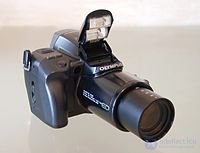 Olympus IS 1000 film bridge camera
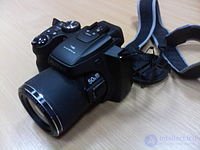 Fujifilm FinePix SL 1000 digital bridge camera, lens with a 50× focal length range
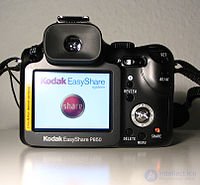 Electronic viewfinders of the Kodak P850 digital bridge camera: the eyepiece viewfinder (with eyecup) and the external LCD display.
A bridge camera (in Russian, literally a "pseudo-reflex camera") is a class of amateur photographic equipment filling the niche between compact cameras and consumer-segment single-lens reflex cameras . The Russian name comes from the Greek ψευδής — "false" — given for the resemblance to single-lens reflex cameras. Instead of a moving mirror, the first bridge cameras contained a beam-splitting prism that divided the light from the lens into two parts, one of which was directed into a simplified viewfinder. As electronic viewing technologies improved, the optical viewfinder was abandoned entirely . The main distinguishing feature of this type is a permanently built-in zoom lens with a very wide focal length range, which is why the names of many models carry the prefix Superzoom, reflecting yet another foreign term for this category of equipment.
Russian sources also used another term: "hybrid camera" . Despite serious competition from mirrorless cameras, bridge cameras remain popular to this day, and every major camera manufacturer keeps at least one model of this type in its product line . However, with the spread of camera phones, bridge cameras began to rapidly lose their market position.
Both film and digital bridge cameras are fitted with a non-interchangeable zoom lens. The reflex viewfinder of film cameras often has a simplified design with a fixed semi-transparent mirror and an inexpensive erecting system without a pentaprism . The bridge design became widespread with the appearance of the reduced Advanced Photo System film format (for example, the "Olympus Centurion"), but it was also used for the standard small-format frame.
Digital bridge cameras are generally not fitted with an optical viewfinder; instead they use an eyepiece viewfinder with a miniature liquid-crystal display (an electronic viewfinder) together with a separate liquid-crystal display. This makes classic viewing through the eyepiece possible, observing a parallax-free image shielded from stray light (though not on a focusing screen, but on an LCD display). The sensor size of bridge cameras and their operating principle differ hardly at all from those of compact digital cameras. In most cases a central (leaf) shutter located between the lens elements is used instead of a focal-plane shutter. In addition, no instant-return diaphragm is used, since the brightness of the viewfinder image does not depend on the aperture that has been set, but instead reflects whether the exposure is correct. The differences from the simplest cameras lie in the ability to view through the taking lens and in a sophisticated interface that allows most parameters to be adjusted. The small frame size makes it possible to use a built-in "superzoom" with a wide focal length range but a small maximum aperture . For most bridge cameras, wide-angle and telephoto converters are produced that extend the capabilities of the non-removable lens.
Unlike compacts, bridge cameras allow manual control of shutter speed and aperture, and they also support all automatic exposure modes. In addition, they allow manual setting of sensitivity and white balance, and various metering modes are available. Such an interface brings bridge cameras closer to SLRs. In the early 2000s, when digital SLR equipment was out of reach for photographers on a small budget, bridge cameras (for example, the "Konica Minolta DIMAGE A200" or the "Olympus C-730UZ") were the most common class in provincial Russian photojournalism
It should be noted that many mirrorless cameras (for example, the Samsung NX10) use a viewing method similar to that of bridge cameras: a miniature LCD display with an eyepiece and a large liquid-crystal display. The fundamental difference lies in the ability to make full use of interchangeable lenses, which bridge cameras lack.
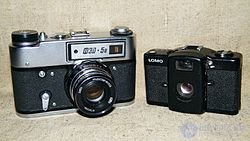 The "FED-5V" and "LOMO Compact-Automat" small-format cameras compared.
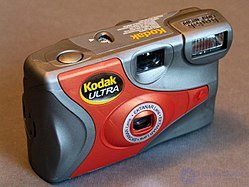 A Kodak single-use film point-and-shoot
A compact camera is a camera with a non-interchangeable, permanently built-in lens, generally of low weight and small dimensions. Versions in which every mechanism is automated so that there is no need to set shooting parameters, or which have only a limited, essential set of settings, are colloquially called "soap dishes" in Russian.
As a rule, this term refers to cameras using standard 35 mm film or film of the APS format. The dimensions, the rounded plastic body and the absence of a protruding lens give a compact camera a resemblance to a soap dish.
A distinction is also made for single-use film point-and-shoots (see Disposable camera (English)). Inexpensive examples are returned to a certified film processing center together with the body and can subsequently be reloaded with new film and sold again. Such cameras are often used for underwater photography.
| Specification | Value for
the cheapest models |
Value for mass-market models | Value for certain models with a zoom |
|---|---|---|---|
| Viewfinder | Frame type (parallax) | Optical (parallax) | Optical (parallax), coupled to the zoom lens. |
| Sensitivity, ISO | 100 — 400, the code is read from the cassette automatically. | 50 — 800, the code is read from the cassette automatically or set manually | |
| Optical zoom ratio | none | 1.7 — 2.2× | |
| Equivalent focal length | 28 — 43 mm | 35 — 70 mm | |
| Maximum relative aperture | 1:5.6 — 1:8 | 1:3.5 — 1:4 | 1:4 — 1:8 |
| lens material | plastic | plastic or glass | glass |
| Optical design of the lens | Achromat or triplet | Triplet | Achromat + afocal variator |
| Film advance time per frame | 2 — 3 seconds | about 1 second | |
| Autofocus | lens set at the hyperfocal distance | yes | |
| Automatic exposure | programd, directly linked to the shutter-aperture. |
The automation may offer exposure compensation of +/- 1.5 EV | |
| shutter and aperture | two-blade shutter-aperture | ||
| Flash | may be absent, or a low-power automatic unit. | up to a distance of ≈3 m, fires only automatically. | up to a distance of ≈5 m, can be switched off. |
| Macro photography | no | usually absent | |
| Ability to fit converters and filters | none, the lens is covered by a shutter or by an external cover. | usually available | |
| Tripod socket | none | yes | |
| Power | 2 AA batteries or a rechargeable battery | ||
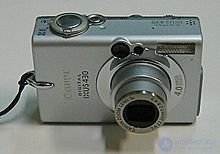 The Canon Digital IXUS 430 digital point-and-shoot
The technical level of digital camera manufacturing today, especially of their internals — image sensors and lenses — has risen so far that their physical size no longer entirely determines a camera's class.
Classification is made by intended use. For example, professional equipment has by now divided itself into reportage, studio, panoramic and other types, which are similar in size but differ greatly in technical specifications and in the range of accessories. The class of compact digital cameras is tied to the demands of the broad audience of amateur photographers, who are interested in minimum size and weight, the "aim, press, shoot" principle and a low price. Despite being aimed at a broad audience, compact digital cameras have a fairly wide range of settings and functions compared with film ones. The overwhelming majority of cameras have a zoom lens, ready-made setting presets for different shooting modes, and so on.
The reason the misconception "more megapixels means a better camera" spread is that in the first digital cameras image resolution was limited by sensors of up to 1 megapixel, and this did not allow a standard 10×15 cm print of a quality equal to that of shots taken on film. A large role in spreading this misconception is also played by marketing that advertises cameras with more megapixels. In reality, an extremely high pixel density on the sensor can sometimes worsen some characteristics of the resulting image
| Specification | Value for
most models |
Value for less
common models |
|---|---|---|
| Dimensions of the photosensitive sensor | 1/2.5" — 1/1.7" | 1/3.2" — 2/3" |
| Number of effective pixels | 6—8 million | 5—16 million |
| Sensitivity, ISO | 100—3200 | 50—6400 |
| Crop factor | 5—6 | 4—7 |
| Frame aspect ratio | 4:3 | 16:9, 16:10, 3:2, 5:4 |
| Viewfinder | Optical (parallax) or absent for cameras with a zoom of up to 5 — 6×. Electronic for models with a zoom of more than 6×. | |
| Optical zoom ratio | 3—6× | 7—20× |
| Equivalent focal length in wide-angle mode | 35—38 mm | 24—28 mm |
| Equivalent focal length in telephoto mode | 100—130 mm | 150—500 mm |
| Maximum relative aperture in wide-angle mode | 1:2.8 | 1:2—1:3.5 |
| Maximum relative aperture in telephoto mode | 1:4.5—1:5.6 | 1:2.8—1:6.3 |
| Liquid-crystal display for shooting and reviewing the material shot | 2" — 2.5" | 1.7" — 3" |
| Storage medium | Removable flash memory card in one of the common formats: SD, Memory Stick, CF, xD | |
The overwhelming majority of compact cameras have:
Compact cameras with the following capabilities are less common:
These include
The number of megapixels, once it exceeds 4, plays no noticeable role in the image quality of a point-and-shoot, since the other determining factors in resolving power are the quality of the lens and the technical characteristics of the image sensor itself.
For amateur film cameras, manufacturers often advertised more expensive high-sensitivity films (for example, Kodak Gold ULTRA, ISO 400), although the use of high-sensitivity film was far from always justified.
In practice, for 10×15 cm prints (the standard modern photo album), photo labs recommend 2-megapixel images. In other words, if you do not plan to print larger photographs, then in terms of megapixel count any modern camera will do. However, cameras with a greater number of pixels will let you crop the image.
The term "ultrazoom" generally means a point-and-shoot with a high-ratio zoom lens. Over time, though, the zoom ratio at which "ultra-" begins keeps changing. For instance, 8× zooms were once called that when compared with 6× ones.
The marketing policies pursued by manufacturers make it impossible for the mass buyer to judge the consumer qualities of a point-and-shoot objectively. Size, appearance, a large lens, an abundance of functions and buttons, and even price can all be misleading. The first thing one can recommend looking at is precisely the size of the image sensor, and of two cameras from the same company, choosing the one with the larger sensor. Unfortunately, in recent years this criterion has become of little use, since the sensors of the most varied compact-class cameras have become practically identical: a larger sensor is now found only in transitional-class and semi-professional cameras, which are substantially more expensive, larger and heavier. But the most advisable course, of course, is to study the results of objective testing carried out by independent specialist publications (including online ones), or by consumer protection societies using specialized laboratories.

Comments