
Lecture 10 min.
An image scanner (English scanner) is a device that converts an image placed on a flat medium (most often paper) into digital form. The process of obtaining such a digital copy is called scanning.
During scanning, an analog-to-digital converter (ADC) creates a digital description of the image of an object external to the computer, which is then passed to the computer through the input/output system.
A scanner is a specialized device used to convert images of a chosen surface into digital form. Such surfaces may be the pages of books, magazines or notebooks, photographs, slides and other documents containing graphics and text. Scanning devices can operate as a PC peripheral or as a stand-alone device, that is, they can send the scanned image over a wide-area network or Wi-Fi on their own.
Scanning technology first appeared in 1857, thanks to the Florentine abbot Giovanni Caselli. He created a device called the pantelegraph, which transmitted images over wires. At the receiving end the image was applied to a drum with conductive ink and then read off by a needle. Five years later the photoelectric scanning principle was patented. Later on, devices working on this technology came to be called telefax machines. Modern scanning devices have changed considerably; they have become an order of magnitude more efficient and productive.
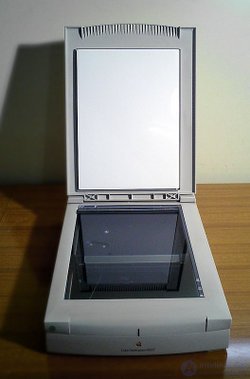

An image of fabric made with a scanner
In 1857 the Florentine abbot Giovanni Caselli (Italian Giovanni Caselli) invented a device for transmitting images over a distance, later named the pantelegraph. The transmitted picture was applied to a drum with conductive ink and read off by means of a needle.
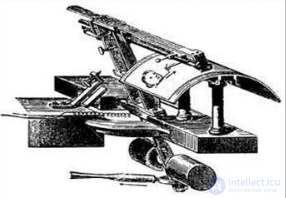
In 1902 the German physicist Arthur Korn (German Arthur Korn) patented a photoelectric scanning technology that later became known as the telefax. The image to be transmitted was fixed to a transparent rotating drum; a beam of light from a lamp moving along the drum's axis passed through the original and, by way of a prism and a lens mounted on the drum's axis, reached a selenium photodetector. This technology is still used in drum scanners.
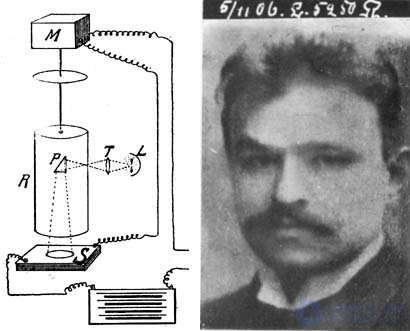
At the beginning of the 20th century the German physicist Korn invented the "phototelegraph". Mechanical scanning of the image was carried out along two coordinates, illuminating each point individually.
The phototelegraph, or Bildapparat, was an early facsimile technology developed to transmit halftone images over a distance. The phototelegraph was widely used in news photojournalism from the first half of the 20th century until digital technology and the Internet became widespread. The Associated Press began regular transmission of pictures from event locations to its head office in 1935 . The Soviet "Fotokhronika TASS" equipped its correspondent offices with phototelegraph equipment in 1957 . Photographs transmitted by phototelegraph were called "telefoto" in the USSR and "Wirephoto" in Western countries. Among professionals such a telephoto print was called a "Bild".
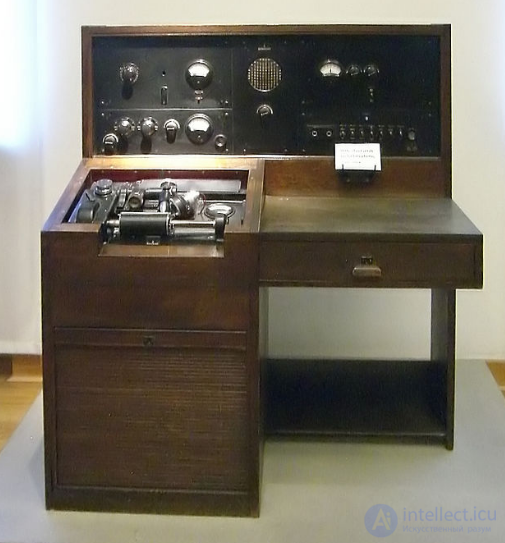
A German Bildapparat of 1940
Later, as semiconductors developed, the photodetector was improved and the flatbed scanning method was invented, but the principle of image digitization itself remains almost unchanged.
There are handheld, sheet-fed (English Sheet-Feed), flatbed and projection scanners. One variety of projection scanner is the slide scanner, intended for scanning photographic film. High-quality printing uses drum scanners, in which a photomultiplier tube (PMT) serves as the light-sensitive element.
A single-pass flatbed scanner works by moving a scanning carriage carrying a light source along the image being scanned, which lies on a stationary transparent glass. The reflected light passes through the scanner's optical system (consisting of a lens and mirrors or a prism) and reaches three CCD-based photosensitive semiconductor elements arranged parallel to one another, each of which receives information about one component of the image.
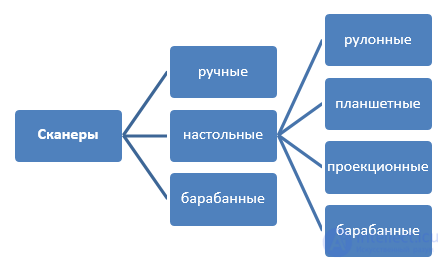
Industrial units are used in various kinds of production. They must meet high requirements for speed, scanning quality, reliability and other operating parameters, since they are designed for continuous operation. Home units are used rarely, and as a result they are cheaper and less productive. Nevertheless, devices for the home have lately been produced whose scanning speed is no worse than that of industrial models.
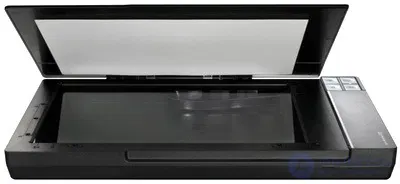
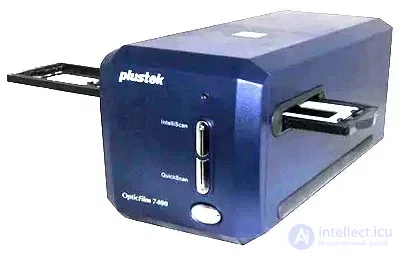
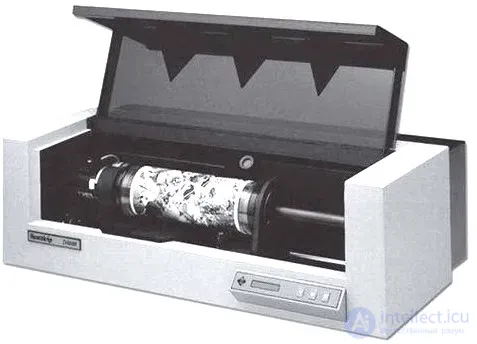
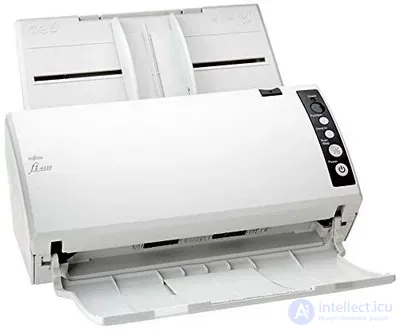
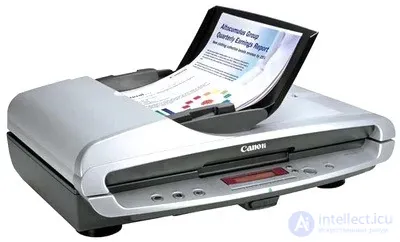
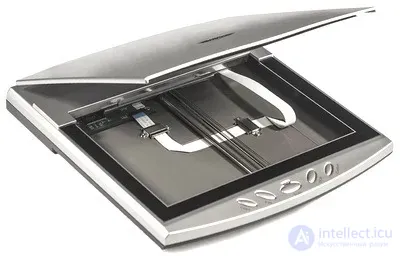
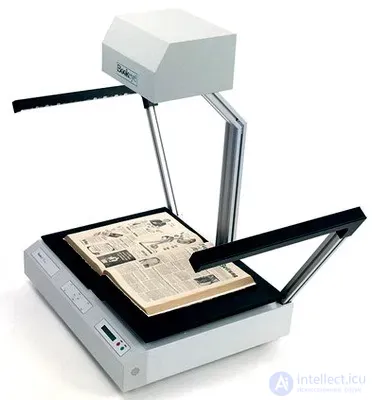
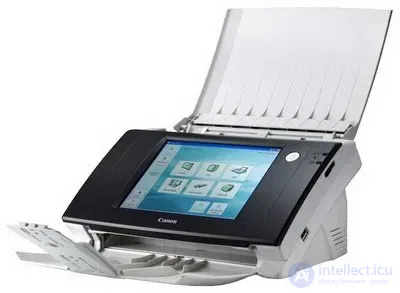
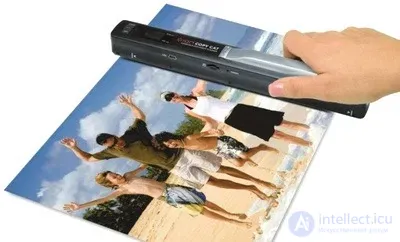

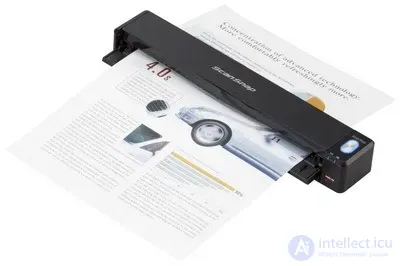
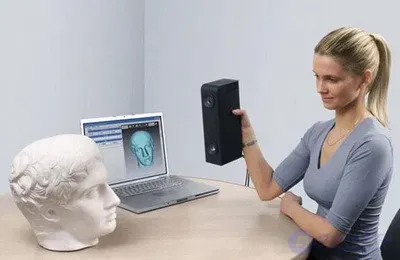
A scanner performs the scanning function in order to send a digital image to a PC or send it by mail. To this end the object is placed on the device's transparent glass. When the unit is started, the carriage is set in motion and begins to glow. The device's optical system, which includes a lens and mirrors, directs the light flux from the scanned surface of the object onto the receiving element. There the data is converted.
The analog signal is routed to a converter, where it is turned into a digital code. Next the controller comes into play, transmitting the code over a cable to the personal computer. On the PC the resulting image can be edited and used as intended.
Scanning technology

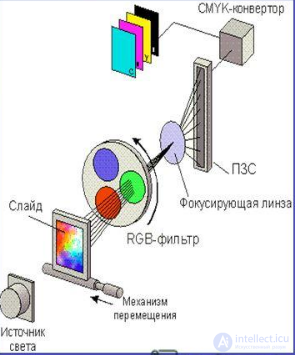
The general operating principle of scanners Light from a special lamp falls on the original being scanned at a particular point, is reflected and directed to the scanner's optical system. The optical system focuses the light on a charge-coupled device (CCD). The result is a signal containing information about the color at that point of the original image. An analog-to-digital converter (ADC) serves to bring the signal into a form "understandable" to the computer. From the ADC the digital signal goes to the computer, where it is analyzed by the scanner software.
Scanners are used to input pictures into a computer, where they can immediately be processed in a graphics editor. Scanners input a flat image into a computer better than digital cameras do

Comments