
Lecture 18 min.
There was a time when, for owners of floppy disks (those little square things that held a whole 1.2 MB of data), getting a CD writer was the height of ambition, and DVDs were the stuff of legend. Today nobody is impressed by a DVD, since data is now mostly stored and moved on USB media and external drives, while movies are recorded onto Blu-ray.
What, has someone still not heard of Blu-ray? Well then, we are simply obliged to run a crash course and share information that came to us, you might say, straight from the source. The company Verbatim, a manufacturer of data storage media (Blu-ray discs among them), has prepared an exhaustive answer to the questions "What IS this and what do you do with it?"
The little blue beam
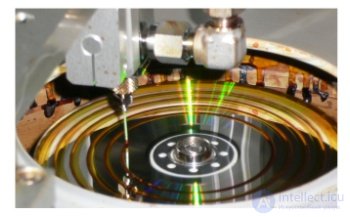
Blu-ray is an optical medium for storing data. Outwardly it is no different from ordinary "CDs" and "DVDs" - the same 12 cm diameter and 1.2 mm thickness - but its main distinction is the amount of space available for recording data. A single-layer medium holds 25 GB and a dual-layer one 50 GB of High Definition content (the very thing whose playback it is now fashionable to advertise on TVs, monitors and media players, and which "weighs" an insane amount).
But, as we all know, there is never enough space on a disc, and during 2011 we can already expect 100 GB and 128 GB Blu-ray discs to appear.
Everything strictly by the standards
Development of Blu-ray was begun by Sony and Philips, and the first set of specifications was drawn up in 2004, but a Blu-ray writer drive appeared only in 2006.
Blu-ray discs owe their name to the blue beam that is used to read and write BD discs.
The Blu-ray Disc Association strictly controls the Blu-ray standard. The body of technical requirements covers the physical specifications, the format specifications and the file system of the media. The Blu-ray Disc Association imposes strict standards on equipment, which helps ensure good compatibility between media, writer drives and players.
Specifications:
- blue-violet laser with a wavelength of 405 nm
- diameter of 12 cm
- protective coating and other factors
- outstanding error correction system
- use of the UDF 2.5 file system for recording
- video codecs
- digital rights management
- copy protection and so on
- spiral track recording
What do we have today?
By now, Blu-ray counterparts of all the familiar optical media formats are available: BD-ROM - read-only, BD-R - write-once, and BD-RE - rewritable. All variants are produced in 25 GB and 50 GB capacities.
Blu-ray ROM is the read-only version, used to distribute movies, video clips, games or software.
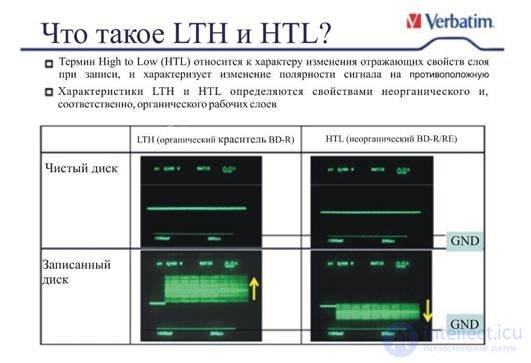
Blu-ray Recordable (BD-R) is WORM (Write Once Read Many), that is, it can be recorded only once. BD-R is the mainstay product for recordable and rewritable Blu-ray devices. Its main purpose is storing and distributing data of any kind. Initially the recording layer of BD-R used an inorganic material such as metal nitride, tellurium oxide or silicon-copper alloys. What such materials have in common is that their reflectivity and polarization change after recording from HIGH to LOW, which is why this type of disc is known as HTL BD-R. At present some manufacturers continue to use these materials both for single-layer 25 GB discs and for dual-layer 50 GB versions. BD-R HTL discs are manufactured in the same way as RW discs - by sputtering. This is an expensive and wasteful process, and the scope for using DVD manufacturing equipment is limited by the small number of sputtering units, which are used only to produce DVD-RW and CD-RW discs.
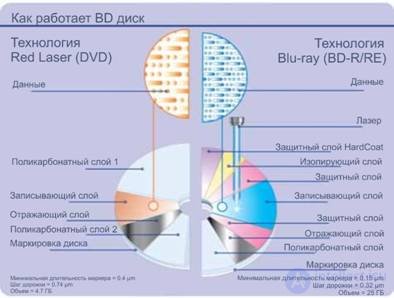
Blu-ray Re-Writable (BD-RE) is the standard for a disc that can be rewritten
up to 1000 times. These discs are likewise available in 25 GB and 50 GB versions, with a write speed of 2x.
BD-RE discs use phase-change recording layers. Such layers have been known for a long time and have proven themselves well in the manufacture of DVD-RW and CD-RW. In Blu-ray technology the existing phase-change materials were adapted to the new 405 nm laser wavelength. Mitsubishi/Verbatim uses the widely known SERL recording layers, based on eutectic semiconductor materials. SERL technology has already confirmed its longevity and the stability of its parameters after repeated rewriting. The use of SERL provides excellent readout of data and allows a disc to be rewritten up to 1000 times. BD-RE is used mainly for recording temporary data, for testing software under development, games, video and new hardware solutions. Blu-ray Re-Writable discs are very environmentally friendly and attractive in price thanks to repeated rewriting.
In Europe today, computer Blu-ray writer drives are more widespread than Blu-ray video recorders, which first reached the market in 2009. Practically all Blu-ray devices are also designed to read and write CDs and DVDs.
Verbatim Blu-ray discs with AZO technology.
In the manufacture of CD-R and DVD-R, AZO and phthalocyanine have proven themselves excellently as recording-layer materials. These organic materials combine all the advantages of an inorganic recording layer, including a cost-effective manufacturing process. Mitsubishi/Verbatim, a leader in the field of organic materials, joined forces with Pioneer, a well-known equipment manufacturer, and in 2007 introduced a BD-R based on an organic recording layer.
The layers take the form of solutions. The color of the solution depends on the peak absorption range required for the read/write laser diode of the corresponding generation of media - for example infrared 780 nm, red 660 nm and blue-violet 405 nm.
.jpg)
Blu-ray Disc Association approved a new standard, LTH Type, in which the organic recording layers of a BD change their reflectivity and transparency from LOW to HIGH after recording. At the end of 2007, writer drives and video recorders supporting LTH Type media appeared. Their compatibility with Sony's Playstation 3 was implemented in March 2008 through firmware version 2.20. At the end of 2008, support for LTH Type BD-R became a mandatory requirement for new Blu-ray equipment.
Mitsubishi/Verbatim together with other companies is promoting BD-R LTH Type on the market. Soon after their introduction, BD-R LTH media took a significant share of total sales in the BD-R market. Intensive testing has proved that for 20 years now this type of medium and this optical technology have delivered high recording quality, compatibility between the medium and various devices, and preservation of data over a period long enough for archival storage.
BD-R LTH media are available at a more attractive price than HTL media, because:
1. The manufacturing process for LTH Type media is simpler, and it is also more economical. The situation is the same as in DVD production, where DVD-RW discs always cost more than DVD-R.
2. A significant part of the "waste" from manufacturing LTH Type discs can be recycled - which is both profitable and more environmentally friendly.
The manufacture of LTH Type media uses spin-coating technology to apply the recording layer. Because of this, many existing CD-R / DVD-R production lines can be converted into Blu-ray lines, which makes it possible to upgrade production cheaply in response to growing market demand.
At present the new media have been shown to be highly compatible with writer drives, video recorders and players, and that compatibility improves with the launch of every new model of Blu-Ray equipment. Most 2009 models support the LTH Type media format, while older systems require a firmware update, which the device manufacturer supplies. This can usually be checked on the manufacturer's website and on various internet forums. The Mitsubishi/Verbatim website carries information about drive compatibility and the need for firmware updates.
What are we going to watch it on?
Sales of Blu-ray video recorders began in France and the United Kingdom in 2009, and in 2010 in Germany and other countries.
Blu-ray players became the sales leaders in most European countries, with some models priced at under €100; nevertheless the Playstation 3 consoles that are popular the world over, which can also work as a Blu-ray player, outsell them despite their price.
Blu-ray computer hardware is more popular today. Many PCs and laptops already come equipped with Blu-ray Combo drives for reading BD and writing CD/DVD, or with Blu-ray writer drives. Various companies also offer internal or external Blu-ray drives for upgrading older computers to the new standards. Prices for Blu-ray Combo drives are below €100, while BD writers currently cost more than €100.
All these systems ship with software for playing back and/or recording Blu-ray. The market for Blu-ray hardware is expected to grow in the near future.
Many vendors produce software with Blu-ray support. This applies not only to player programs or disc-burning programs, but also to a wide choice of packages for editing HD video content at HD resolution.
Who actually needs this?
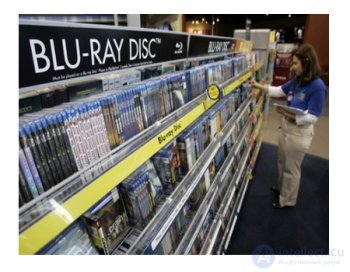
Blu-ray discs were originally developed for recording and distributing HD content, but in practice it became clear that there are other uses for Blu-Ray technologies as well - for example in computing fields, in medicine and in banking.
Professional archiving may cover the storage of medical records, industrial and design documentation, catalogs, and audio and video material.
Blu-ray media can serve as a portable system for storing the most important information; this is considered safer than using NAS network storage.
For private and semi-professional applications, Blu-ray offers large capacity combined with a low cost per gigabyte. A greater capacity than that of CD and DVD media means fewer discs are needed.
Another popular field of application is content distribution using duplication equipment. Blu-ray discs with an inkjet-printable or thermal-printable coating make it possible to duplicate copies in large quantities.
Development of Blu-ray was begun by Sony and Philips, and the first set of specifications was drawn up in 2004, but a Blu-ray writer drive appeared only in 2006. Blu-ray discs owe their name to the blue beam that is used to read and write BD discs. By now, Blu-ray counterparts of all the familiar optical media formats are available: BD-ROM - read-only, BD-R - write-once, and BD-RE - rewritable. All variants are available in 25 GB and 50 GB capacities.
In Europe today, computer Blu-ray writer drives are more widespread than Blu-ray video recorders, which first reached the market in 2009. Practically all Blu-ray devices are also designed to read and write CDs and DVDs.
Main applications of Blu-ray
Originally, Blu-ray discs were developed for recording and distributing HD content, but in the course of use it became clear that there are other ways to apply Blu-Ray technologies - for example, in computing. Blu-ray is an optical medium for storing and archiving data, both for professional and for private use. Blu-ray discs are used to store photographs, video films and other necessary data, such as financial reports.
Professional archiving may include the storage of medical records, industrial and design documentation, catalogs, and audio and video information. Blu-ray media can serve as a portable storage system for the most important information. Usually NAS network storage devices are used for these purposes. With Blu-ray discs, all the information can be kept in a secure place.
For private and semi-professional applications, Blu-ray offers a large capacity combined with a low cost per gigabyte. A greater capacity than that of CD and DVD media means fewer discs are needed. Another popular field of application is content distribution using duplication equipment. Blu-ray discs with an inkjet-printable or thermal-printable coating make it possible to duplicate copies in large quantities.
Hardware
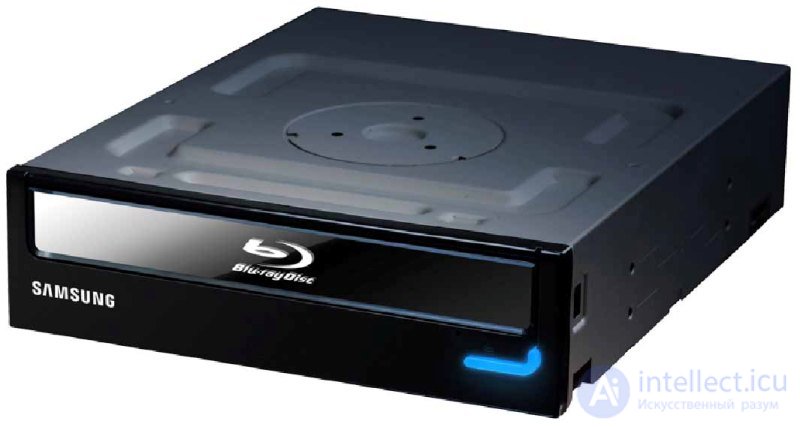
Sales of Blu-ray video recorders began in France and the United Kingdom in 2009, and in Germany and other countries in 2010. Blu-ray players became the sales leaders in most European countries, with some models costing less than 100 euros. But the Playstation 3 consoles, popular all over the world and able to work as a Blu-ray player as well, outsell them.
Today Blu-ray computer hardware is more popular. Many PCs and laptops are already equipped with Blu-ray Combo drives for reading BD and writing CD/DVD, or with Blu-ray writers. Various companies also offer internal or external Blu-ray drives for upgrading older computers to the new standards. Prices for Blu-ray Combo drives are below 100 euros, while BD writers currently cost more than 100 euros. All these systems ship with software for Blu-ray playback and/or recording. The market for Blu-ray equipment is expected to grow in the near future.
Playback and recording software
Software with Blu-ray support is made by many manufacturers. This applies not only to player programs or disc burning programs, but also to a wide choice of various packages for editing HD video content at HD resolution.
Blu-ray specifications
The Blu-ray Disc Association strictly controls the Blu-ray standard. The set of technical requirements includes the physical specifications and the format and file system specifications of the media. The Blu-ray Disc Association sets strict standards for equipment, which helps ensure good compatibility between media, writers and players. Specifications:
· blue-violet laser with a wavelength of 405 nm
· diameter of 12 cm
· protective coating and other factors
· excellent error correction system
· use of the UDF 2.5 file system for recording
· video codecs
· digital rights management
· copy protection and more
· spiral track recording
Types of Blu-ray media
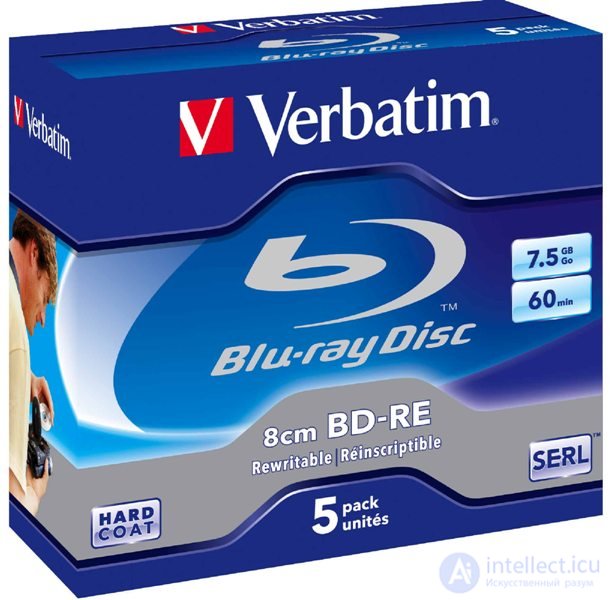
Blu-ray media are available in the three standard variants adopted for optical media:
· Blu-ray ROM - a read-only version, which is used to distribute films, video clips, games or programs
· Blu-ray Recordable (BD-R) - the write-once variant. It is available in versions with various write speeds, with capacities of 25 GB and 50 GB
· Blu-ray Re-Writable (BD-RE) is the disc standard that can be rewritten up to 1000 times. These discs are also available in 25 GB and 50 GB versions, with a write speed of 2x
Blu-ray Re-Writable
BD-RE discs use phase-change recording layers. These layers have been known for a long time and have proven themselves well in the production of DVD-RW and CD-RW. In Blu-ray technology, the existing phase-change materials were adapted to the new 405 nm laser wavelength. Mitsubishi/Verbatim uses the widely known SERL recording layers based on eutectic semiconductor materials. SERL technology has already confirmed its durability and the stability of its parameters after many rewrite cycles. The use of SERL provides excellent readout of information and allows the disc to be rewritten up to 1000 times. BD-RE is used mainly for recording temporary data and for testing software under development, games, video and new hardware solutions. Blu-ray Re-Writable discs are very environmentally friendly and advantageous in terms of price thanks to repeated rewriting.
Blu-ray Recordable BD-R
Blu-ray Recordable discs are the WORM (Write Once Read Many) format of Blu-ray. BD-R is the main product for Blu-ray devices with recording and rewriting capability. Their main purpose is the storage and distribution of any kind of data. Initially, an inorganic material such as metal nitride, tellurium oxide or silicon-copper alloys was used for the BD-R recording layer. A common property of such materials is that their reflectivity and polarization change from HIGH to LOW after recording, which is why this type of disc is known as HTL BD-R. At present, some manufacturers continue to use these materials both for single-layer 25 GB discs and for dual-layer 50 GB versions. BD-R HTL discs are manufactured in the same way as RW discs - by sputtering. This is an expensive and uneconomical process, and the possibilities for using DVD production equipment are limited because of the small number of sputtering installations, which are used only for producing DVD-RW and CD-RW disc
Blu-ray discs with AZO technology from Verbatim
In the production of CD-R and DVD-R, AZO and phthalocyanine materials have proven themselves excellently as recording layers. These organic materials combine all the advantages of an inorganic recording layer, including a cost-effective manufacturing process. Mitsubishi/Verbatim, a leader in the field of organic materials, joined forces with Pioneer, a well-known equipment manufacturer, and in 2007 introduced a BD-R based on an organic recording layer.

The Blu-ray Disc Association approved a new LTH Type standard, in which the organic recording layers of a BD change their reflectivity and transparency from LOW to HIGH after recording. At the end of 2007, writers and video recorders supporting LTH Type media appeared. Their compatibility with SONY's Playstation 3 was implemented in March 2008 by means of firmware version 2.20. At the end of 2008, support for LTH Type BD-R became a mandatory requirement for new Blu-ray equipment.
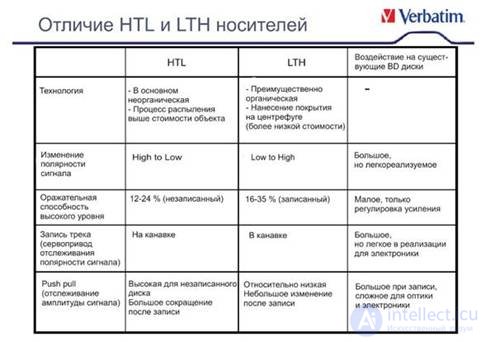
Mitsubishi/Verbatim, together with other companies, is promoting BD-R LTH Type on the market. Soon after their appearance, BD-R LTH media took a significant share of total sales in the BD-R market. Intensive tests have proved that for 20 years now this type of medium and the optical technology have provided high recording quality, compatibility between various devices and the medium, and preservation over a long period, sufficient for archival storage.
BD-R LTH media are available at a more favorable price than HTL media, because:
1. The production process for LTH Type media is simpler, and it is also more economical. The situation is similar to DVD production, where DVD-RW discs always cost more than DVD-R
2. A significant part of the "waste" in the production of LTH Type discs can be recycled - this is both profitable and more environmentally friendly.
 At present, a high level of compatibility of the new media with writers, video recorders and players has been established, and it improves with the launch of each new model of Blu-Ray equipment. Most 2009 models support the use of the LTH Type media format, while older systems require a firmware update, which the device manufacturer provides. This can usually be checked on the manufacturer's website and on various internet forums. The Mitsubishi/Verbatim website provides information about drive compatibility and the need for firmware updates.

Comments